
- Education
- Buying Knowledge & Custom Process
- Jewellery Insurance in Australia: How It Works, Step by Step
Buying Knowledge & Custom Process
Jewellery Insurance in Australia: How It Works, Step by Step
Jewellery insurance in Australia is easy to buy and easy to get wrong. A ring insured under the wrong kind of cover, or for an out-of-date value, can pay out a fraction of what it costs to replace.
 Reviewed by Raj Sood, Graduate Gemologist (GIA), AJP (GIA)Master jeweller and Graduate Gemologist (GIA) · reviewed 4 November 2026
Quick answer
Jewellery insurance in Australia comes three ways: as part of home contents cover, as specified portable valuables added to that policy, or as a standalone jewellery policy. Specified items are insured for a sum you set, usually backed by a valuation. If it is lost, stolen or damaged, the insurer repairs, replaces or pays out under the policy's terms.
How does jewellery insurance work in Australia?
Jewellery insurance pays to repair or replace a piece if it is lost, stolen or damaged, up to the amount you have insured it for. In Australia it is a form of general insurance, so every policy must come with a product disclosure statement (PDS): the legal document that sets out exactly what is covered, what is excluded and how claims are settled. Insurers also publish a target market determination (TMD), which says who the product is designed for. The PDS, not the advertising, decides your claim.
You choose a sum insured for each item: the most the insurer will pay for it. For anything of real value, the insurer will usually want evidence of that figure, normally a tax invoice or a written valuation. You pay a yearly premium for the cover and, when you claim, an excess, the fixed amount you contribute towards each claim.
Most policies give the insurer three ways to settle a claim: repair the piece, replace it with one of similar kind and quality, or pay you cash. Which option applies, and who chooses, varies from policy to policy. That one detail causes more disappointment at claim time than anything else, so it gets its own section below.
If you are still choosing a ring, think about insurance early, alongside setting an engagement ring budget, because the premium is an ongoing cost of owning it. Our full engagement ring buying guide covers the rest of the decision, and any term here you have not met is explained in our plain-English jewellery glossary.
Does home contents insurance cover jewellery?
Usually, but only up to a limit, and often only while the jewellery is inside your home. There are three common ways to insure jewellery in Australia, and the differences matter most for anything you wear out of the house, such as an engagement ring.
| Home contents (unspecified) | Specified portable valuables | Standalone jewellery policy | |
|---|---|---|---|
| Where you are covered | Usually only inside your home | At home and away; often overseas for a limited time | At home and away; often overseas |
| Limit per item | Capped, commonly about $1,000–$2,500 per item or a share of the contents sum | The sum insured you list for that item | The sum insured you list for that item |
| Valuation needed | Usually not until you claim | Usually, above a set value | Usually, for each item |
| Accidental loss | Often excluded or an optional extra | Usually included | Usually included |
| Cost | Included in the contents premium | Extra premium, based on each item's value | Separate premium, often about 1–2% of value a year |
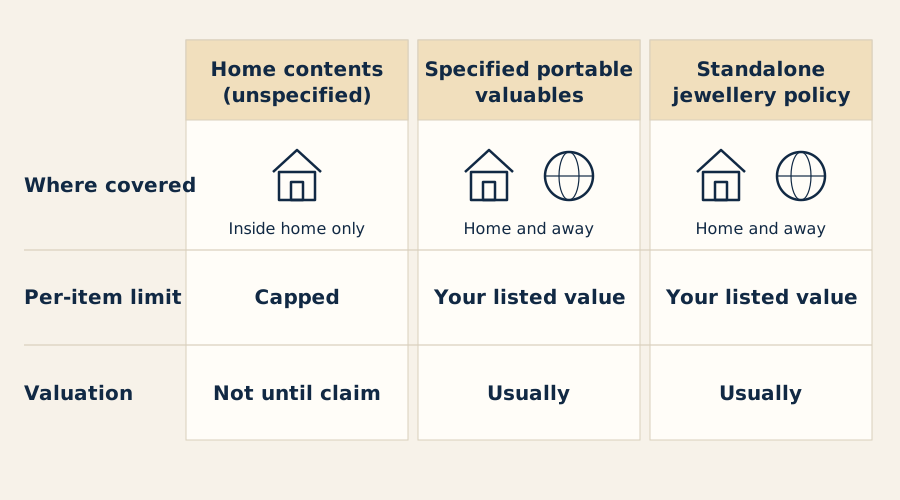
Unspecified contents cover is the trap. Suppose your contents policy caps any single piece of jewellery at $2,000 and your ring is worth $12,000 to replace. If it is stolen from home, the most you are likely to receive is $2,000, less the excess. Some policies also cap all jewellery combined, so a box of inherited pieces can be under-covered too.
Specified portable valuables (insurers use slightly different names, such as nominated or listed valuables) is an add-on to a home contents policy. You list each item with a description and a value, and it is covered at home and away, often including accidental loss like a ring slipping off at the beach. This is the usual route for engagement ring insurance in Australia.
A standalone jewellery policy covers jewellery only, with no home contents policy needed. Renters, people with a few high-value pieces and people who want specialist claim handling sometimes choose one. Read the PDS closely either way; the name of the product tells you very little.
What is the difference between agreed value and replacement value for jewellery?
This decides how much you actually receive. Policies describe the basis for settling a claim in different ways, and the wording in the PDS is what counts.
| Basis | What it means | What to watch for |
|---|---|---|
| Agreed value | You and the insurer agree a figure upfront; a total loss is settled at that figure | Keep it current; an old figure stays old |
| Replacement value (up to the sum insured) | The insurer pays what it costs to replace with an item of similar kind and quality, up to your sum insured | If they can replace it for less, you may get less than the sum insured |
| Market value | What a similar item would cost today, sometimes allowing for age and condition | Can be lower than your valuation for older pieces |
| Cash settlement | You take money instead of a replacement | Some policies pay only what replacement would have cost the insurer through its suppliers |
Some insurers replace jewellery through their own supplier network, where they buy at trade prices. If you would rather take cash, some policies pay you that lower trade figure, not the retail value on your valuation. If you want a replacement made by a jeweller you choose, check whether the policy allows it before you take out the cover. Ask the insurer directly: who chooses the jeweller, and what is the cash settlement basis?
An insured value is a retail replacement cost, not a sale price. Second-hand diamonds and jewellery sell well below retail, which is explained in why resale value sits well below the insured figure. Natural diamonds are not an investment, and an insurance valuation is not a price anyone will pay you for the piece.
Do you need a valuation to insure jewellery?
For specified items, usually yes, at least above a value threshold the insurer sets. A recent tax invoice is sometimes accepted for a new piece, but a proper jewellery insurance valuation describes the item in enough detail that an identical replacement could be made. A good valuation includes:
- Description: style, maker's marks and a photograph.
- Metal: type and fineness, such as 18 ct white gold or 950 platinum, and the weight in grams.
- Each stone: shape, measurements in millimetres, carat weight (measured or estimated), colour, clarity and cut.
- Origin: whether each diamond is natural or laboratory-grown, and any treatments in coloured gems.
- Reports: grading report numbers from labs such as GIA or IGI.
- Value and date: the replacement value in AUD, the date and the valuer's name and qualifications.
Look for a valuer with formal gemmology training, such as a Graduate Gemologist (GIA) or a Fellow of the Gemmological Association of Australia (FGAA). In Australia, valuers can also be registered with the National Council of Jewellery Valuers (NCJV). Our page on what an insurance valuation report includes goes through a sample report line by line.
Update the valuation every 2–3 years, or sooner if metal or diamond prices move sharply. Over-insuring wastes premium, because most policies will not pay more than the cost of replacement. Under-insuring means you may receive less than it costs to replace the piece.
Jewellery and diamond valuation service
Not sure which one is right?
Send us the stones you are looking at and our gemologist will tell you which to choose and why.
How much does jewellery insurance cost in Australia?
Premiums depend on the sum insured, your postcode, your home security (alarms, a safe), your claims history, the excess you choose and whether you want cover away from home and overseas. As a rough guide only, specified jewellery cover often works out at about 1–2% of the insured value a year. Real quotes vary widely, so treat this table as an illustration, not a price.
| Insured value (AUD) | Illustrative yearly premium at 1–2% |
|---|---|
| $5,000 | about $50–$100 |
| $10,000 | about $100–$200 |
| $20,000 | about $200–$400 |
| $50,000 | about $500–$1,000 |
Excesses commonly sit somewhere around $100–$500 per claim. Choosing a higher excess usually lowers the premium. Some policies charge a separate excess for portable valuables, so check the figure that applies to jewellery, not just the headline home excess.
The sum insured follows replacement cost, so it helps to know what the piece would cost today. Our guides to current diamond prices in Australia and how lab-grown diamond prices have moved give typical AUD ranges. If you are budgeting with the old three-month salary rule, remember it says nothing about the yearly cost of insuring what you choose.
What does jewellery insurance usually not cover?
Exclusions vary, but these come up again and again in Australian policies:
- Wear and tear: gradual thinning of a band, worn claws or scratched stones.
- Stones lost from worn settings: some policies exclude loss caused by claws that were not maintained, or require settings to be checked regularly.
- Unexplained disappearance: some policies cover only theft or accidental loss you can describe, not 'I don't know where it went'.
- Leaving it unattended: in a public place, a gym locker or an unlocked car.
- Damage while being worked on: cleaning, resizing or repair is usually the jeweller's responsibility, not your insurer's.
- Items over the unspecified limit: anything above the per-item cap that you did not list.
- Outside the cover period: overseas trips longer than the policy allows.
- Business use: stock or pieces held for sale.
A ring that is too loose is more likely to slip off, and a claim will be harder to explain if it was. Checking your ring size properly before it is made, and converting an overseas ring size if you bought abroad, reduces that risk. Some insurers also ask whether a ring was resized after the valuation, so tell them if it was.
How do you insure a lab-grown diamond ring?
The same way as a natural diamond ring. Lab-grown diamonds are real diamond, with the same hardness (10 on the Mohs scale) and the same refractive index (about 2.42); they are grown in a laboratory rather than mined. For lab-grown diamond insurance, the valuation must state clearly that the stone is lab-grown or laboratory-grown and quote its grading report number, so the insurer replaces like with like. Our page on how lab-grown diamonds must be described under ACCC guidance explains the wording.
The difference is price movement. Retail prices for lab-grown diamonds have fallen a long way over recent years, so a valuation from a few years ago can overstate what replacement costs now. You would pay premium on a figure you would never receive. Revalue lab-grown pieces more often, perhaps every 1–2 years, and lower the sum insured if the replacement cost has dropped.
Natural diamond replacement costs tend to move more slowly, but they still move, so the 2–3 year review still applies. For coloured gems, the valuation should note any treatments and say whether a stone is natural or lab-created; a lab-created sapphire and a natural sapphire cost very different amounts to replace.
How does a jewellery insurance claim work?
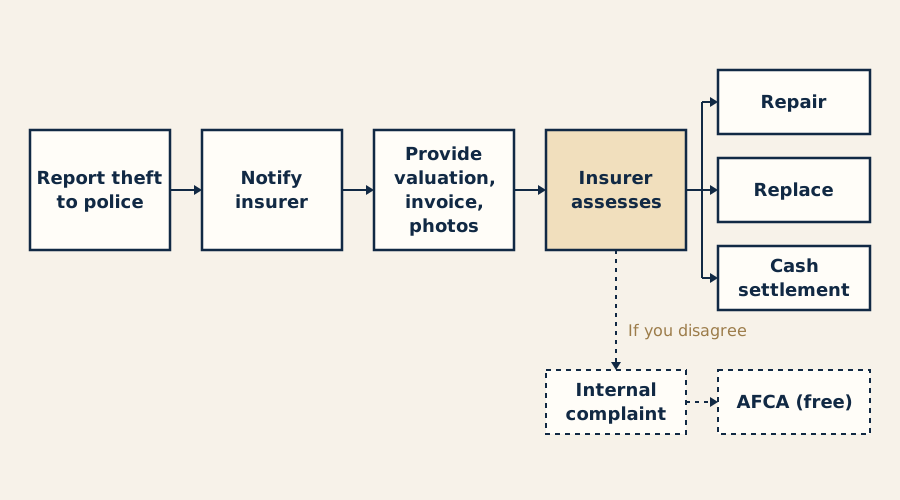
For theft, report it to the police straight away and note the event or report number. For any loss or damage, tell your insurer as soon as you can; most policies require prompt notice. You will usually be asked for the valuation or tax invoice, photographs, the date and place of the loss and what happened. The insurer then assesses the claim and decides on repair, replacement or cash under the PDS.
Custom pieces need more records than off-the-shelf rings. Keep the design sketches, CAD files, metal and stone details and the maker's notes, because a remake starts from those. Handmade and CAD-made rings are remade in different ways, and cast versus hand-fabricated construction affects both the time and the cost of a faithful replacement.
If you disagree with the outcome, ask the insurer for its internal dispute resolution process first. Insurers that subscribe to the General Insurance Code of Practice must follow set timeframes for handling claims and complaints. If it is still not resolved, you can take it to the Australian Financial Complaints Authority (AFCA), which is free for consumers.
Is your jewellery covered overseas or if you buy it abroad?
Check before you travel. Specified portable valuables cover often extends overseas, but usually only for a set number of days per trip. Travel insurance usually has low limits for valuables, often a few hundred to a couple of thousand dollars per item, and may exclude jewellery left in checked luggage. For a valuable ring, your home policy's specified cover is normally the one doing the work.
If you purchase jewellery overseas, you will need an Australian valuation in AUD to insure it properly, and foreign certificates or invoices may not be accepted on their own. Returning travellers also have a duty-free allowance for general goods, currently about $900 for adults, above which GST and possibly duty apply. Weighing up a diamond bought overseas covers these costs and the paperwork in more detail.
The Tourist Refund Scheme (TRS) lets travellers leaving Australia claim back the GST on goods bought here, generally where they spent $300 or more (including GST) with one business within 60 days of leaving and carry the goods with them. Australian residents who claim it and bring the piece home must declare it on return and may have to repay the GST. The tax invoice is also key evidence for your insurer, so keep the original. Our page on how the Tourist Refund Scheme works for jewellery sets out the rules.
How to insure an engagement ring in Australia: step by step
- Get the paperwork. Keep the tax invoice and any grading report, and arrange a written replacement valuation that states natural or lab-grown.
- Check your current policy. Find the per-item jewellery limit and whether it covers you away from home.
- Choose the cover type. Specified portable valuables on your contents policy or a standalone jewellery policy.
- Read the settlement terms. Agreed or replacement value, who chooses the replacing jeweller and how cash settlement is calculated.
- Compare excess and premium. Ask for quotes at two excess levels and note any separate valuables excess.
- Cover it from day one. Start cover on the day you collect the ring, not the day you propose.
- Maintain and review. Check claws every 6–12 months and revalue every 2–3 years, sooner for lab-grown.
Plan the timing alongside how long each step of making a ring takes, so cover is ready when you collect. For a surprise proposal, the ring is usually insured in the buyer's name first and updated once it changes hands; engagement ring etiquette around proposals touches on when to talk to your partner about these practical details.
Free consultation
Talk to a gemologist
Compare stones in person or online with Raj Sood, Graduate Gemologist (GIA), AJP (GIA).
Book a consultationShop this shape
FAQ
Common questions
Is my engagement ring covered by home contents insurance?
Usually only up to a per-item limit, and often only inside your home. To cover its full value away from home, list it as a specified portable valuable or take out a standalone jewellery policy.
How much is jewellery insurance in Australia?
It varies with value, postcode, security and excess, but specified jewellery cover often costs roughly 1–2% of the insured value a year. Get quotes, because the spread between insurers can be wide.
How often should I get my jewellery revalued?
Every 2–3 years is common guidance, or sooner if prices move sharply. Lab-grown diamond pieces are worth revaluing more often because their retail prices have fallen.
Will the insurer give me cash or a new ring?
It depends on the PDS. Many policies let the insurer choose to repair or replace, and some pay cash only at the insurer's own replacement cost, which can be lower than your valuation.
Can I insure a lab-grown diamond?
Yes. It is insured like any diamond, but the valuation must state it is lab-grown and quote the report number, and the sum insured should reflect current lab-grown replacement prices.
What if my insurer rejects my jewellery insurance claim?
Use the insurer's internal complaints process first. If that does not resolve it, you can lodge a free complaint with the Australian Financial Complaints Authority (AFCA).
Ask a gemologist
Not sure which diamond to choose?
Raj Sood is a Graduate Gemologist (GIA) and master jeweller. Bring the stones you are considering, or send the reports, and he will tell you honestly which one is better and why.
Keep learning
Related guides
 Certificates & ValuationsInsurance Jewellery Valuation Explained
 Buying Knowledge & Custom ProcessDiamond Resale Value Explained
 Buying Knowledge & Custom ProcessTourist Refund Scheme on Jewellery ExplainedBuying Knowledge & Custom ProcessEngagement Ring Buying Guide
 Buying Knowledge & Custom ProcessRing Size Guide AustraliaBuying Knowledge & Custom ProcessDiamond Price Guide AustraliaBuying Knowledge & Custom ProcessBuying a Diamond Overseas vs in AustraliaBuying Knowledge & Custom ProcessLab-Grown Diamond Price Guide Australia
Explore more
More guides on this topic
Education