
Pearls
Keshi Pearls: How They Form, Sizes, Colours, Quality and Care
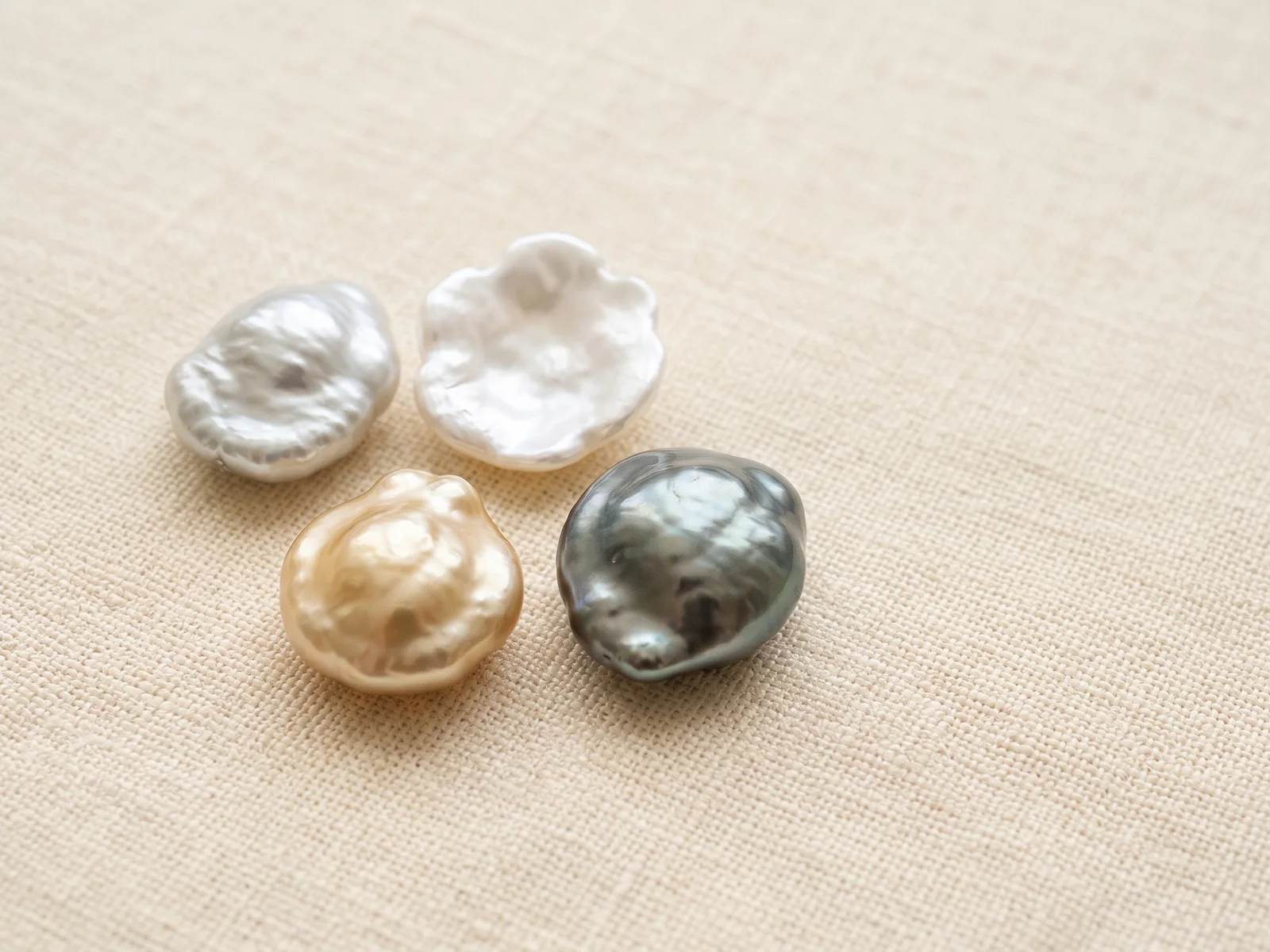
Keshi pearls are solid nacre from end to end, with no bead inside, which gives them some of the strongest lustre in the pearl world. Here is where they come from, how to judge one and how to look after it.
 Reviewed by Raj Sood, Graduate Gemologist (GIA), AJP (GIA)Master jeweller and Graduate Gemologist (GIA) · reviewed 4 November 2026
Quick answer
Keshi pearls are non-beaded cultured pearls that form by accident during pearl farming, when the oyster rejects its bead or a fragment of implanted tissue grows its own pearl. They are solid nacre, usually baroque in shape, range from about 1 mm to over 15 mm, and are valued for lustre, size, colour and surface.
What are keshi pearls?
Keshi pearls are small to medium cultured pearls that grow without a bead nucleus (the polished shell bead a farmer normally places inside an oyster). They form as a by-product of pearl farming, so no one sets out to grow them, and each one is made entirely of nacre: the layered mix of aragonite crystals and protein that gives every pearl its glow.
The word keshi means poppy seed in Japanese. It was first used for the tiny, seed-like pearls found in Japanese akoya oysters, many of them under 2 mm. Today the name covers non-beaded by-product pearls from South Sea, Tahitian and akoya farms, and some of them are far from seed-sized: a South Sea keshi can be 10 mm or more.
Keshi sit in an unusual place in the pearl family. They are cultured, because they only exist because someone operated on the oyster, but they grow freely without a bead, so their shape, lustre and colour are shaped by the oyster alone. If you are new to pearls, our overview of the main types of pearls and how to identify them sets the scene, and our page on pearl jewellery and strands shows how different pearls are used. Unfamiliar terms are explained in our glossary of jewellery terms.
How do keshi pearls form?
To understand how keshi pearls form, start with how a normal cultured saltwater pearl is made. A skilled technician opens the oyster slightly and inserts two things into its gonad: a round shell bead and a small square of mantle tissue (a graft) cut from a donor oyster. The tissue grows around the bead into a pearl sac, a pocket of cells that lays down nacre layer by layer over the bead.
A keshi forms when that process goes slightly wrong. There are two common routes:
- The bead is rejected. The oyster expels the bead, but the graft tissue stays behind and still forms a pearl sac. With nothing inside to coat, the sac builds a pearl of pure nacre around a small cavity or organic remnant.
- The tissue splits. A fragment of the graft breaks away and forms a second, separate pearl sac next to the beaded pearl. That sac grows its own small pearl, and both are found at harvest.
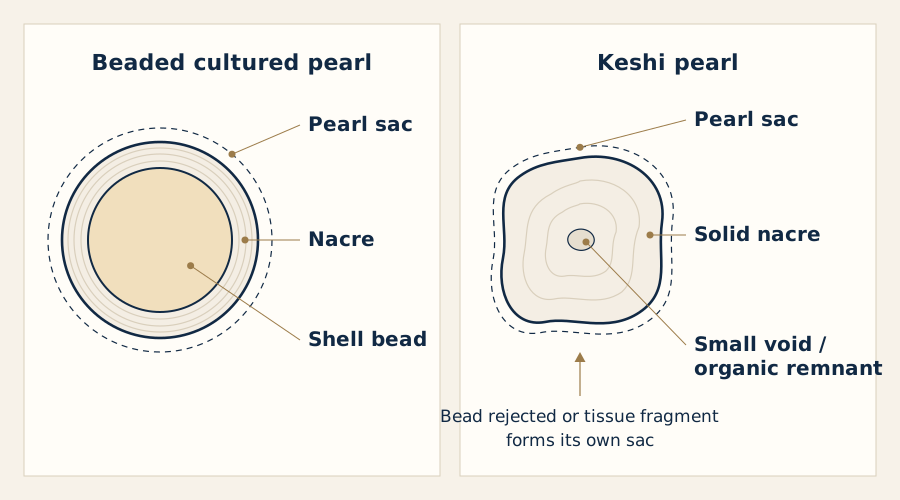
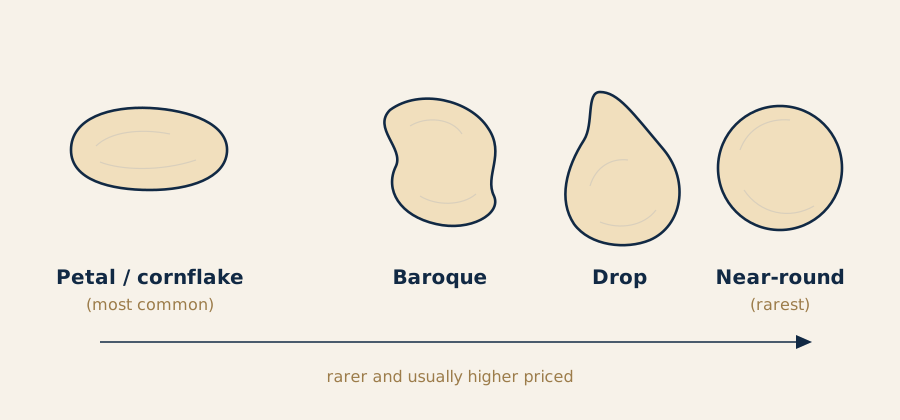
Because the sac has no bead to follow, it rarely grows a sphere. Most keshi are baroque (irregular), and many are flat and folded, a shape the trade calls petal or cornflake keshi. This is very different from mabe pearls, which grow as domes against the inside of the shell, and from beaded akoya pearls from Japan and China, which are usually round because they follow a round bead.
Keshi have become harder to find. Farms now often X-ray oysters to check whether the bead has been retained and re-operate on those that rejected it, and grafting techniques have improved, so fewer accidental keshi reach the market than a few decades ago. That scarcity is one reason good keshi command strong prices.
Are keshi pearls natural or cultured?
Keshi pearls are cultured, not natural. This trips up a lot of buyers, because keshi have no bead and look more like natural pearls than round cultured pearls do. In the past some were sold as natural, which is not accurate. A natural pearl forms with no human involvement at all; a keshi only exists because a person implanted tissue into the oyster.
Major laboratories such as GIA classify keshi as non-bead cultured pearls. Telling a keshi from a natural pearl needs X-radiography (an X-ray image of the inside) or, increasingly, X-ray computed microtomography. A natural saltwater pearl usually shows fine concentric growth rings around a tiny centre, while a keshi often shows an irregular or linear void where the tissue sat. Even then, some stones are hard to call, which is why a lab report matters for anything sold at a natural-pearl price. Our guide to the difference between natural and cultured pearls explains the testing in more detail.
Related guideBroome South Sea Pearls (Australian)Keshi are also real pearls in every sense. They are not imitations, not coated glass and not shell beads. They are simply a pearl the oyster grew on its own terms.
What sizes and colours do keshi pearls come in?
The size and colour of a keshi depend mostly on which oyster grew it. Larger oysters produce larger keshi, and each species has its own natural colour palette.
| Source oyster | Typical keshi size | Common colours |
|---|---|---|
| Akoya (Pinctada fucata), Japan and China | about 1–4 mm | White, silver, cream, with pink or green overtones |
| South Sea (Pinctada maxima), Australia, Indonesia, Philippines | about 3–12 mm, occasionally 15 mm+ | White, silver, cream, champagne, gold |
| Tahitian (Pinctada margaritifera), French Polynesia | about 3–12 mm | Grey, black, green, peacock, aubergine, silver |
| Freshwater mussels, China | about 2–10 mm | White, pink, lavender, plus dyed colours |
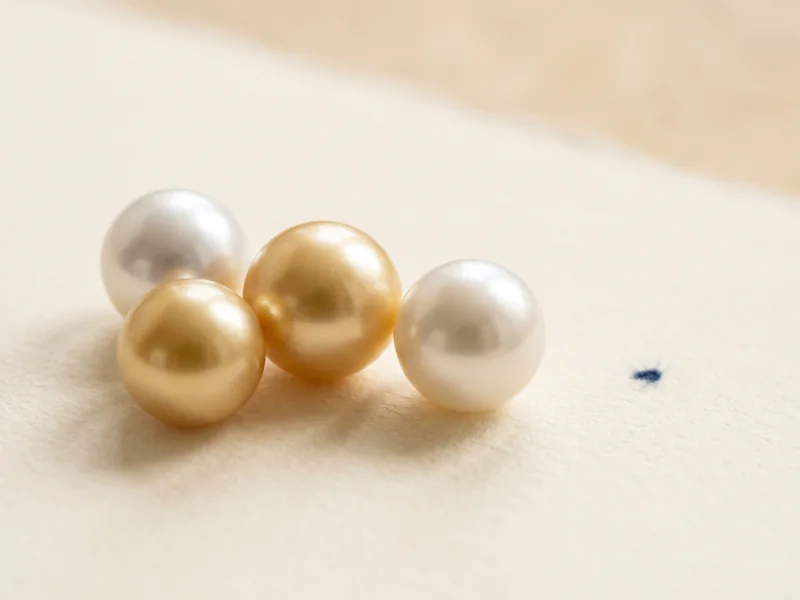
South Sea keshi pearls come from the silver-lipped or gold-lipped oyster, the same species that produces white and golden South Sea pearls. Western Australia is a major source of white and silver keshi, coming from Broome's Australian South Sea pearl farms and others along the north-west coast. Golden keshi come mostly from Indonesian and Philippine farms.
Tahitian keshi pearls come from the black-lipped oyster that grows Tahitian black pearls, and they show the same range of dark body colours and coloured overtones. Because keshi are pure nacre, their overtones (the secondary colour floating over the body colour, such as green or rose) can look especially vivid.
Freshwater "keshi" need a note. Most freshwater cultured pearls are grown without a bead in the first place, using tissue alone, so nearly all of them are solid nacre. In the trade, "freshwater keshi" usually means small, irregular by-product pearls, sometimes from bead-nucleated freshwater farming. They are attractive and affordable, but they are not the same as saltwater keshi, and the label should tell you which you are getting.
Not sure which one is right?
Send us the stones you are looking at and our gemologist will tell you which to choose and why.
How do keshi pearls compare with other pearl types?
Keshi are often grouped with baroque pearls, but the two words describe different things. Baroque is a shape: any pearl that is irregular. Keshi is a way of forming: a non-beaded by-product pearl. Most keshi are baroque, but many baroque pearls are beaded pearls that simply grew unevenly around their bead.
| Saltwater keshi | Beaded baroque | Round akoya | South Sea (beaded) | Freshwater | |
|---|---|---|---|---|---|
| Bead inside | No | Yes | Yes | Yes | Usually no |
| Nacre | Solid nacre | Layer over bead | Thin layer, often 0.3–0.5 mm | Thick layer, often 2 mm+ | Solid nacre |
| Typical shape | Baroque, petal, occasionally near-round | Baroque | Round | Round to baroque | All shapes |
| Typical size | 1–12 mm+ | 8–15 mm+ | 6–9 mm | 9–16 mm+ | 4–12 mm+ |
| Lustre | Often very high | Medium to high | High | Satiny to high | Medium to high |
| Supply | Small and shrinking | Steady | Large | Steady | Very large |
The key advantage of a keshi is its solid nacre. A beaded pearl's lustre depends on how thick its nacre coat is; a thin-nacre akoya can chip or wear through to the bead with years of use. A keshi has nothing to wear through to. The trade-off is shape: if you want a perfectly round, matched strand, keshi are not the place to look.
How are keshi pearls graded?
There is no single international grading standard for keshi, but jewellers and dealers judge them on the same factors used for other pearls, with some adjustments. Our page on how lustre, nacre, surface, shape and size are graded covers the general system; here is how it applies to keshi.
- Lustre: how sharply the surface reflects light. The best keshi show crisp, mirror-like reflections with strong contrast. Because there is no bead, lustre is the factor that most separates a good keshi from an average one.
- Orient: a soft iridescent shimmer that moves across the surface, caused by light interacting with the thin nacre layers. Keshi show orient more often than beaded pearls.
- Surface: some ridges and folds are part of the keshi character. What lowers value is pitting, chalky patches, cracks or dull spots.
- Shape: petal and flat keshi are the most common. Symmetrical drops and near-round keshi are rarer and priced higher.
- Size: larger keshi are much scarcer, so price climbs steeply above about 8 mm.
- Colour: even body colour with attractive overtones. Strong natural golds and peacock colours attract a premium.
- Matching: in a strand or pair of earrings, how well the pearls agree in colour, lustre and shape style.
Nacre thickness, the factor that matters so much for beaded pearls, is not a question with keshi: the whole pearl is nacre. Do still check the drill hole. A clean, straight hole with no flaking around the edge is a sign the pearl was handled well.
How much are keshi pearls worth in Australia?
The main drivers of keshi pearl value are the source oyster, size, lustre, shape and how well the pearls match. Australian South Sea and Tahitian keshi sit at the top, because those oysters produce the largest keshi. Small akoya keshi have become hard to find, which has lifted their price per strand. The ranges below are approximate and move with harvests and the market.
| Keshi type | Approximate price range (AUD) |
|---|---|
| Freshwater "keshi" strand, about 40–45 cm | about $80–$500 |
| Akoya keshi strand, 1–3 mm, about 40–45 cm | about $300–$1,500 |
| Tahitian keshi strand, about 4–8 mm | about $800–$4,000 |
| South Sea keshi strand, about 4–10 mm | about $1,000–$6,000 |
| Single South Sea or Tahitian keshi, 10 mm+ | about $150–$1,500 |
Within each row, lustre and matching make the biggest difference. A strand of well-matched, high-lustre keshi can cost several times as much as a mixed strand of the same size. Earrings need two pearls that agree in shape and colour, which takes sorting through many pearls, so a well-matched pair is often priced above two single keshi.
Keshi, like other pearls, are bought to wear and enjoy. Prices for any gem rise and fall, so it is sensible to choose a keshi because you like it rather than for what it might be worth later.
Browse natural gemstones
What jewellery suits keshi pearls?
Because keshi come in free-form shapes, they suit relaxed, modern designs as much as classic ones. Common uses:
- Keshi pearl necklace: a single strand of petal keshi has a light, textured look that layers well with fine chains. Graduated strands place the largest keshi at the centre.
- Multi-strand torsades: several fine strands of small akoya or freshwater keshi twisted together.
- Earrings: a single South Sea or Tahitian keshi drop on a hook, or a pair of small keshi studs.
- Pendants and charms: one larger keshi, cupped or pinned in gold so it hangs naturally.
- Rings: possible, but choose a design with metal around the base, because pearls are soft and pick up knocks on the hand.
Irregular pearls usually need a setting made around the individual pearl, since no two keshi are alike. That is where custom pearl designs come in: a cap, cage or peg can be shaped to fit the pearl's base. Keshi are also a popular way to mark pearl as the June birthstone without the formality of a round strand.
How do you care for keshi pearls?
Keshi need the same gentle care as any pearl. Nacre is soft, about 2.5–4.5 on the Mohs scale, and it reacts to acids, so a little routine goes a long way. For comparison, jade, which is far harder sits around 6–7, and moissanite, at about 9.25 on the Mohs scale, will scratch a pearl easily if they share a pouch.
| Do | Avoid |
|---|---|
| Put pearls on last, after perfume, hairspray and make-up | Spraying perfume or sunscreen directly onto pearls |
| Wipe with a soft, slightly damp cloth after wearing | Ultrasonic or steam cleaners, and household jewellery dips |
| Store flat in a soft pouch, away from harder gems | Hanging strands, which stretches the thread |
| Wear them often: a little skin oil keeps nacre looking good | Swimming, showering or the gym while wearing pearls |
| Have strands checked every year or two if worn often | Wearing a strand with loose or frayed knots |
Strands are threaded on silk or fine synthetic thread with a knot between each pearl, so if the thread breaks you lose one pearl at most. Keshi are often drilled with very small holes, sometimes through the thin edge of a petal, so restringing them takes fine thread and patience. GemTrove restrings pearls in-house, and our pearl care and restringing guide explains what is involved.
How to choose keshi pearls: step by step
- Confirm what they are. Ask whether the pearls are saltwater keshi (South Sea, Tahitian or akoya) or freshwater, and expect them to be described as cultured.
- Check the source oyster. It sets the likely size and colour range; South Sea keshi from Australia are usually white to silver, Tahitian keshi grey to black.
- Look at lustre first. Roll the pearls under one light and look for a sharp, bright reflection rather than a soft glow.
- Inspect the surface. Folds are normal; pits, cracks, chalky areas and flaking around drill holes are not.
- Judge the matching. In strands and pairs, the pearls should agree in colour, lustre and shape style.
- Ask for a lab report if natural is claimed. Anything sold as a natural pearl needs X-ray testing by an independent laboratory.
- Plan for upkeep. Budget for how often a strand needs restringing, usually every year or two with regular wear.
Free consultation
Talk to a gemologist
Compare stones in person or online with Raj Sood, Graduate Gemologist (GIA), AJP (GIA).
Book a consultationShop this shape
FAQ
Common questions
Are keshi pearls real pearls?
Yes. Keshi pearls are real pearls grown by an oyster and made entirely of nacre. They are cultured, because they form as a by-product of pearl farming, but they are not imitations.
Are keshi pearls natural?
No. Keshi are classified as non-bead cultured pearls, because they only form after an oyster has been implanted with tissue. Only X-ray testing by a laboratory can confirm whether a pearl is natural.
Why are keshi pearls valuable?
They are solid nacre, which gives them strong lustre, and supply has fallen as farms have improved their culturing methods. Large South Sea and Tahitian keshi with high lustre and good matching are the most sought after.
What is the difference between keshi and baroque pearls?
Baroque describes an irregular shape, while keshi describes how the pearl formed, without a bead. Most keshi are baroque, but many baroque pearls have a bead inside.
Do keshi pearls come from Australia?
Yes. Australian South Sea pearl farms in Western Australia, including around Broome, produce white and silver keshi from the Pinctada maxima oyster as a by-product of their pearl harvests.
How often should a keshi pearl necklace be restrung?
Every year or two if you wear it often, or sooner if the knots look loose or the thread is stretched or discoloured. Strands worn only occasionally can go longer between restringing.
Terms in this guide

Ask a gemologist
Not sure which diamond to choose?
Raj Sood is a Graduate Gemologist (GIA) and master jeweller. Bring the stones you are considering, or send the reports, and he will tell you honestly which one is better and why.
Keep learning
Related guides
 PearlsNatural vs Cultured Pearls
 PearlsSouth Sea Pearls (White and Golden)PearlsPearl Grading: Lustre, Nacre, Surface, Shape, SizePearlsPearl Care and Restringing
 PearlsPearl Jewellery, Pearl Strands and Custom Pearl DesignsPearlsTypes of Pearls and Pearl Identification GuidePearlsFreshwater PearlsPearlsAkoya Pearls
Explore more
More guides on this topic
Education