
- Education
- Wedding Bands & Eternity
- Eternity Ring Stone Sizes: A Pointer Guide to Points, mm and Carats
Wedding Bands & Eternity
Eternity Ring Stone Sizes: A Pointer Guide to Points, mm and Carats
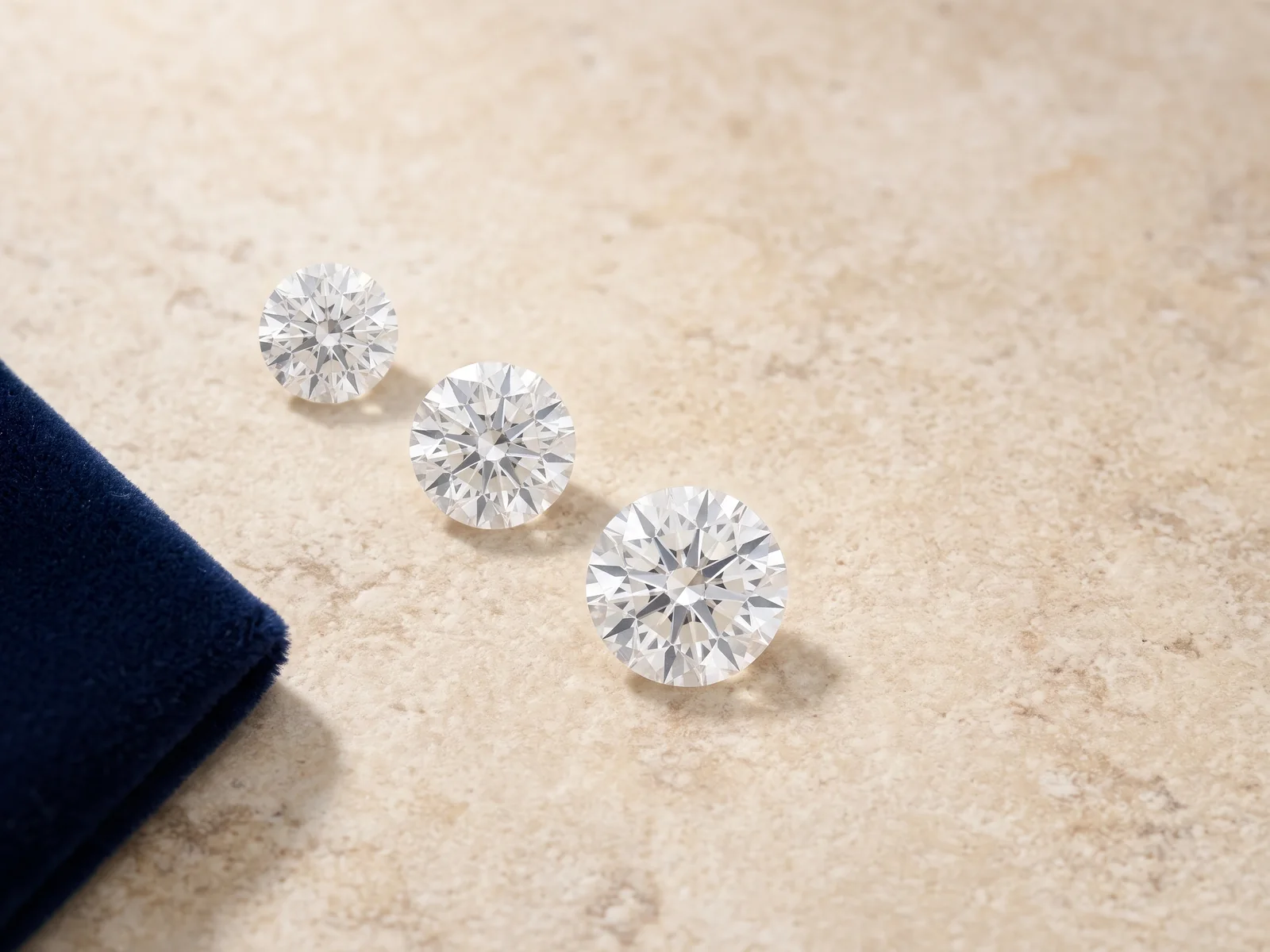
Eternity ring stone sizes are usually quoted in points, which means little until you see them in millimetres. Here is how points, millimetres, stone counts and total carat weight fit together, so you can compare bands properly.
 Reviewed by Raj Sood, Graduate Gemologist (GIA), AJP (GIA)Master jeweller and Graduate Gemologist (GIA) · reviewed 4 November 2026
Quick answer
Eternity ring stone sizes are measured in points, where one point is 0.01 carat. A 2 pointer is about 1.7 mm, a 5 pointer about 2.4 mm, a 10 pointer about 3.0 mm and a 25 pointer about 4.1 mm. Most eternity bands use 1.5–3 mm stones; a size N full eternity holds roughly 18–35 of them.
What does pointer mean in an eternity ring?
Jewellers divide a carat into 100 points. One point is 0.01 carat, and a carat is 0.2 grams. When someone calls a stone a 10 pointer, they mean it weighs 0.10 carat. A 5 pointer is 0.05 carat, a 25 pointer is a quarter carat, and a 50 pointer is half a carat. It is simply trade shorthand for small weights, and it is how most eternity ring stones are described.
Eternity rings are bands set with a continuous line of matching stones, either part of the way round (a half eternity) or all the way round (a full eternity). If you are new to the style, our overview of eternity and anniversary rings covers the history and the main designs, and our guide to how an anniversary ring differs from an eternity ring clears up two names that are often used loosely.
The catch with points is that they measure weight, not size. What you actually see on the hand is the stone's diameter in millimetres. Two stones of the same weight can look different sizes if one is cut deeper, and a sapphire and a diamond of the same millimetre size will weigh different amounts because the materials have different densities. That is why this guide always pairs points with millimetres.
Small diamonds under about 0.18–0.20 carat are often called melee (pronounced mel-ay). Almost every eternity band uses melee, which is why the stones are usually sold in matched parcels by size and quality range rather than each with its own grading report. Any other term here is defined in our jewellery terms glossary.
Eternity ring stone sizes chart: how do points convert to millimetres?
The chart below gives typical diameters for well-cut round brilliant diamonds. Real stones vary by a few hundredths of a millimetre depending on how deep they are cut, so treat these as close guides rather than exact measurements.
| Points | Carat | Approx. diameter (round) | Where you see it |
|---|---|---|---|
| 0.5 pt | 0.005 ct | about 1.0 mm | Micro-pavé, very fine bands |
| 1 pt | 0.01 ct | about 1.3 mm | Micro-pavé, halo stones |
| 1.5 pt | 0.015 ct | about 1.5 mm | Fine eternity bands under 2 mm wide |
| 2 pt | 0.02 ct | about 1.7 mm | Fine pavé and claw-set bands |
| 3 pt | 0.03 ct | about 2.0 mm | Classic everyday eternity band |
| 5 pt | 0.05 ct | about 2.4 mm | Medium eternity band |
| 6 pt | 0.06 ct | about 2.5 mm | Medium eternity band |
| 7 pt | 0.07 ct | about 2.7 mm | Bolder claw or channel band |
| 10 pt | 0.10 ct | about 3.0 mm | Statement eternity band |
| 15 pt | 0.15 ct | about 3.4 mm | Statement band, often worn alone |
| 20 pt | 0.20 ct | about 3.8 mm | Large eternity or cocktail band |
| 25 pt | 0.25 ct | about 4.1 mm | Large eternity, side stones |
| 50 pt | 0.50 ct | about 5.2 mm | Usually a centre or side stone |
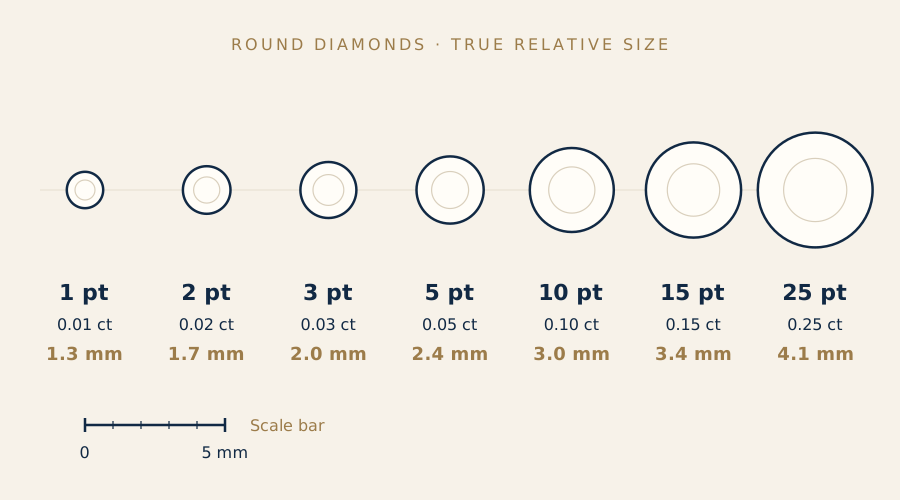
Notice how weight and size do not rise at the same pace. Weight grows with volume, so doubling the weight only adds about a quarter to the diameter. A 10 pointer (about 3.0 mm) is not twice as wide as a 5 pointer (about 2.4 mm); it is roughly 25% wider. When you compare bands, compare the millimetre figures first.
Other shapes weigh differently for the same width. A square princess cut carries more material than a round of the same width, so a 2 mm princess is roughly 0.04–0.05 carat against about 0.03 carat for a 2 mm round, and a 3 mm princess is about 0.14–0.17 carat. Baguettes (narrow rectangles) are quoted by length and width, such as 3 × 1.5 mm, which is roughly 0.04–0.05 carat.
Coloured gems also differ, because density (specific gravity) varies. Diamond has a specific gravity of about 3.52. Sapphire and ruby are about 4.00, so a 3 mm round sapphire weighs roughly 0.13–0.15 carat. Emerald is about 2.72, so the same size weighs less. Moissanite is about 3.21. If you are comparing a sapphire band with a diamond band, millimetres are the only fair comparison.
How many diamonds are in a full eternity ring?
The number of stones depends on three things: the stone diameter, your ring size and the setting. Stones sit around the outside of the band, so the circle they follow is larger than your finger. Each stone also needs a small gap for claws or channel walls, usually about 0.2–0.4 mm. Here is a guide for an Australian ring size N (inside diameter about 17.3 mm), a common size for women.
| Stone size (round) | Full eternity, size N | Approx. total carat weight | Half eternity, size N |
|---|---|---|---|
| 1.5 mm (about 1.5 pt) | about 32–36 stones | about 0.50 ct | about 15–18 stones, 0.25 ct |
| 2.0 mm (about 3 pt) | about 25–28 stones | about 0.75–0.85 ct | about 11–14 stones, 0.35–0.40 ct |
| 2.5 mm (about 6 pt) | about 21–23 stones | about 1.25–1.40 ct | about 9–11 stones, 0.55–0.65 ct |
| 3.0 mm (about 10 pt) | about 18–20 stones | about 1.80–2.00 ct | about 7–9 stones, 0.70–0.90 ct |
| 3.5 mm (about 15 pt) | about 15–17 stones | about 2.30–2.70 ct | about 6–8 stones, 0.90–1.20 ct |
| 4.0 mm (about 23 pt) | about 13–15 stones | about 3.00–3.50 ct | about 5–7 stones, 1.15–1.60 ct |
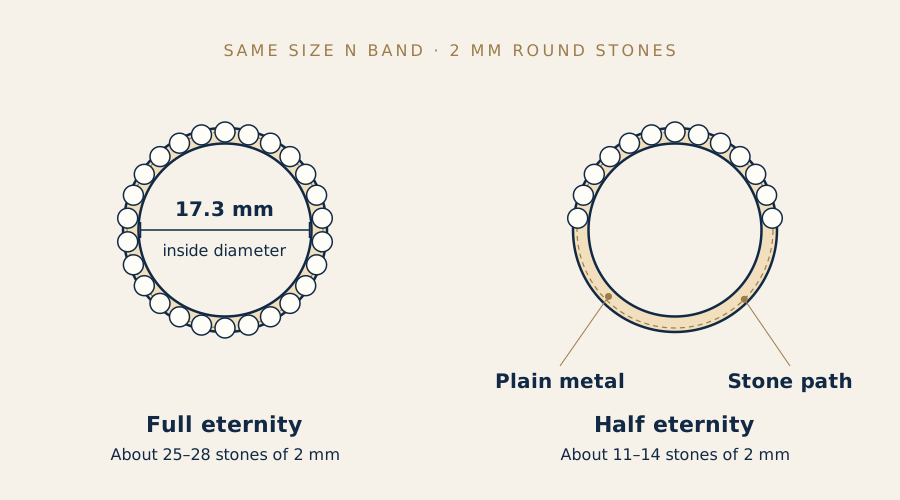
Go up one letter in ring size and the circumference grows by about 1.25–1.3 mm, which usually means room for half a stone to one more stone. That is why a full eternity ring has to be made to your exact size, and why our guide on whether a full-eternity ring can be resized matters before you order. A half eternity has plain metal underneath, so it can be sized up or down a little.
Half eternity is not a fixed measurement. Jewellers set stones across anything from about a third to just over half of the band. Ask how far round the stones go, not just how many there are. The pros and cons of each style, including comfort and price, are in our comparison of half eternity and full eternity bands.
Related guideHalf Eternity vs Full Eternity RingsHow is eternity ring total carat weight worked out?
Total carat weight (TCW, sometimes written ct tw) is the combined weight of every stone in the ring. It is the number usually printed in a listing, such as 1.00 ct TCW. To check it yourself, multiply the stone count by the weight of one stone: 20 stones of 0.05 carat gives 1.00 ct TCW.
TCW is useful for comparing price, but it tells you nothing about the look on its own. A 1 ct TCW band could be about 25 stones of 4 points (around 2.2 mm each) or 10 stones of 10 points (about 3 mm each). The first looks fine and sparkly; the second looks bold and chunky. Always ask for both the TCW and the size of each stone.
- Check the stone count: a higher count at the same TCW means smaller stones.
- Check the diameter: it tells you how wide the line of stones will look.
- Check whether the TCW is approximate: melee is weighed in parcels, so listings often round to the nearest 0.05 or 0.10 carat.
- Check what is included: some listings include side or accent stones on the shoulders in the total.
Not sure which one is right?
Send us the stones you are looking at and our gemologist will tell you which to choose and why.
What eternity band stone size suits your engagement ring?
If you will wear the eternity ring beside an engagement ring, the band's stone size should support the centre stone rather than compete with it. A common rule of thumb is that the band's stones should be roughly a third of the centre stone's diameter, give or take a little, and the band should be about the same width as the engagement ring's band.
| Centre stone (round) | Approx. diameter | Band stones that usually balance | Band width |
|---|---|---|---|
| 0.50 ct | about 5.2 mm | 1.5–2.0 mm (1.5–3 pt) | about 1.8–2.2 mm |
| 0.75 ct | about 5.8 mm | 1.7–2.2 mm (2–4 pt) | about 2.0–2.4 mm |
| 1.00 ct | about 6.5 mm | 2.0–2.5 mm (3–6 pt) | about 2.2–2.8 mm |
| 1.50 ct | about 7.4 mm | 2.2–2.8 mm (4–8 pt) | about 2.4–3.0 mm |
| 2.00 ct | about 8.1 mm | 2.5–3.2 mm (6–12 pt) | about 2.8–3.4 mm |
Engagement rings with stones down the shoulders need extra care. The eternity stones should match or sit just below the size of the shoulder stones, otherwise the two rows look mismatched. Our guide to engagement rings with side stones shows how shoulder sizes are chosen, and the same thinking applies to three-stone engagement ring designs, where the band should sit below the smaller side stones. For two-stone designs, the balance points in balancing the two stones of a toi et moi help you pick a band size that suits both.
Height matters too. Larger stones sit higher above the finger, and a 3 mm band can catch on the gallery (the underside) of a low-set engagement ring. If you plan to wear several bands together, our guide on stacking rings comfortably covers spacing, heights and contoured bands. For the broader picture of metals, widths and profiles, see our complete wedding ring buying guide.
Which setting suits each eternity stone size?
Stone size and setting style go together. Some settings need a minimum stone size to hold safely, and others only work with very small stones.
- Micro-pavé (about 0.8–1.5 mm): tiny stones held by tiny beads of metal raised from the band. Very sparkly and fine, but the beads are small and can wear down over years of daily wear.
- Shared claw (about 1.5–3.5 mm): each claw holds two neighbouring stones, so more of each diamond is visible and the band looks almost all stone. The most popular eternity style.
- Four-claw or basket (about 2.5–4.5 mm): each stone sits in its own little basket. Classic and lets light in, but the claws stand proud and catch more easily.
- Channel (about 2.0–3.5 mm, also baguettes and princess cuts): stones sit in a groove between two metal walls with no claws. Smooth and practical for active hands.
- Bezel or half-bezel (about 2.0–4.0 mm): a thin rim of metal surrounds each stone. The most protective option, though each stone looks slightly smaller.
- Grain or bead set in a vintage style: often paired with milgrain edges; see milgrain edges and engraved patterns for how the detailing is done.
Stones from about 1.5 mm upward can be cut and matched to tight tolerances, which is why most eternity bands use calibrated stones: stones cut to an exact diameter, usually within about 0.02–0.05 mm of each other. Even matching matters more than size, because a single stone that is a touch larger or smaller breaks the line of the band.
How do eternity ring stone sizes affect wear and maintenance?
Every stone is held by metal, and metal wears. The smaller the stones, the smaller the claws or beads holding them, and the sooner that metal thins. A micro-pavé band with 1 mm stones may need its beads checked every year or two, while a channel-set band with 3 mm stones can go much longer between checks. Full eternity bands also take knocks on the underside, against benches and steering wheels, where a half eternity has plain metal.
- Have it checked: a jeweller can inspect claws and beads under magnification about once a year.
- Watch for movement: a stone that rattles, turns or catches the light differently is often a claw starting to lift. Our guide to loose stones and how they are tightened explains what a repair involves.
- Clean gently: warm water, mild dish detergent and a soft toothbrush. Grease under small stones dulls them quickly.
- Take it off for heavy work: gardening, gym weights and lifting are where most claws get bent.
The plain metal on the sides and underside of the band also changes with time. A mirror-bright side picks up fine scratches within weeks; our page on the high polish finish and how it ages shows what to expect. Some people choose a softer side finish so scratches blend in, such as a brushed or satin side finish or a frosted sandblasted finish. Textured finishes such as a hand-hammered finish are rarely used right beside stones because the texture can interfere with the setting, but they suit plain bands worn alongside.
Refinishing an eternity band takes more care than a plain band. Polishing removes a little metal each time, so a jeweller works carefully around the claws and beads. With fine settings, heavy polishing can thin the metal holding the stones, which is another reason to choose a setting style suited to the stone size.
Natural vs lab-grown eternity ring stones: what quality and price?
Eternity bands can be set with natural diamonds or laboratory-grown diamonds. Lab-grown diamonds are real diamond, with the same hardness (10 on the Mohs scale) and refractive index (about 2.42), grown in a laboratory rather than mined. They cost much less than natural, and the saving grows with stone size. Because melee is so small, lab-grown and natural stones are screened with specialist equipment to make sure they are not mixed; a reputable jeweller tells you exactly which you are buying.
Melee is usually graded in ranges rather than individually. Common choices for eternity bands are F–G or G–H colour and VS or VS–SI clarity. Small stones hide inclusions well, but the stones in a band sit side by side, so even colour across the whole row matters more than a high grade on paper. Coloured gem options include natural or lab-created sapphire and ruby (Mohs 9), which are durable for daily wear; emerald (Mohs 7.5–8, often included) is better suited to bezel or channel settings.
| Band (18ct gold, round, claw-set) | Natural diamonds (approx. AUD) | Lab-grown diamonds (approx. AUD) |
|---|---|---|
| Half eternity, about 0.35 ct TCW, 2 mm stones | about $1,800–$3,500 | about $1,200–$2,200 |
| Half eternity, about 0.75 ct TCW, 3 mm stones | about $3,000–$5,500 | about $1,500–$2,800 |
| Full eternity, about 0.80 ct TCW, 2 mm stones | about $3,500–$6,500 | about $1,800–$3,200 |
| Full eternity, about 2.00 ct TCW, 3 mm stones | about $7,000–$14,000 | about $2,500–$5,000 |
These are broad ranges only. Prices move with the diamond market, the gold price, the metal (platinum usually costs more than 18ct gold), the colour and clarity range and the setting style. On smaller bands, the metal and the setting labour can make up a large share of the price, which is why lab-grown and natural small-stone bands sit closer together than you might expect.
Create your eternity ring or wedding band
How do you choose eternity ring stone sizes? Step by step
- Confirm your ring size. Have your finger sized properly, ideally at the end of the day, especially for a full eternity.
- Measure your engagement ring band. Note its width at the back and the size of any shoulder stones.
- Pick a stone diameter in millimetres. Use the points chart to translate any pointer sizes you are quoted.
- Choose half or full eternity. Decide how far round the stones should go, and whether you may need resizing later.
- Match the setting to the stone size. Micro-pavé for very fine stones, shared claw or channel for 1.5–3.5 mm, bezel for the most protection.
- Ask for the full specification. Stone count, diameter, TCW, colour and clarity range, and whether the stones are natural or lab-grown.
- Plan the upkeep. Book a yearly check of claws or beads and choose a side finish you are happy to see age.
Free consultation
Talk to a gemologist
Compare stones in person or online with Raj Sood, Graduate Gemologist (GIA), AJP (GIA).
Book a consultationShop this shape
FAQ
Common questions
What size is a 10 pointer diamond?
A well-cut round 10 pointer (0.10 carat) is about 3.0 mm across. It is a common size for bolder eternity bands.
What is the most popular stone size for an eternity ring?
Most eternity bands use stones between about 1.7 mm and 2.5 mm (roughly 2 to 6 points), which sit comfortably beside an engagement ring. Bands worn on their own often go up to 3 mm or more.
How many diamonds are in a half eternity ring?
It depends on the stone size and how far round the stones go. At size N, a half eternity with 2 mm stones usually has about 11–14 stones; with 3 mm stones, about 7–9.
Does total carat weight tell you how big the stones are?
No. Total carat weight is the combined weight of every stone, so the same 1 ct TCW could be many small stones or a few larger ones. Always ask for the diameter of each stone as well.
Are smaller stones in an eternity ring more likely to fall out?
Very small stones are held by smaller claws or beads, which wear down sooner, so they need checking more often. A yearly inspection and gentle wear keep them secure.
Can you get a lab-grown eternity ring?
Yes. Lab-grown diamond eternity bands are widely available, cost much less than natural ones and are still real diamond. The stones should be clearly described as lab-grown.

Ask a gemologist
Not sure which diamond to choose?
Raj Sood is a Graduate Gemologist (GIA) and master jeweller. Bring the stones you are considering, or send the reports, and he will tell you honestly which one is better and why.
Keep learning
Related guides
 Wedding Bands & EternityHalf Eternity vs Full Eternity Rings
 Wedding Bands & EternityCan a Full-Eternity Ring Be Resized?Wedding Bands & EternityEternity Rings & Anniversary Rings
 Wedding Bands & EternityHow to Stack RingsWedding Bands & EternityWedding Ring Buying GuideWedding Bands & EternityAnniversary Ring vs Eternity Ring
 Care, Repairs & RemodellingLoose Stones and Stone Tightening
 Engagement Rings & SettingsSide-Stone Engagement Rings
Explore more
More guides on this topic
Education