
- Education
- Wedding Bands & Eternity
- Best Wedding Band for Emerald Cut Engagement Rings: The Complete Guide
Wedding Bands & Eternity
Best Wedding Band for Emerald Cut Engagement Rings: The Complete Guide
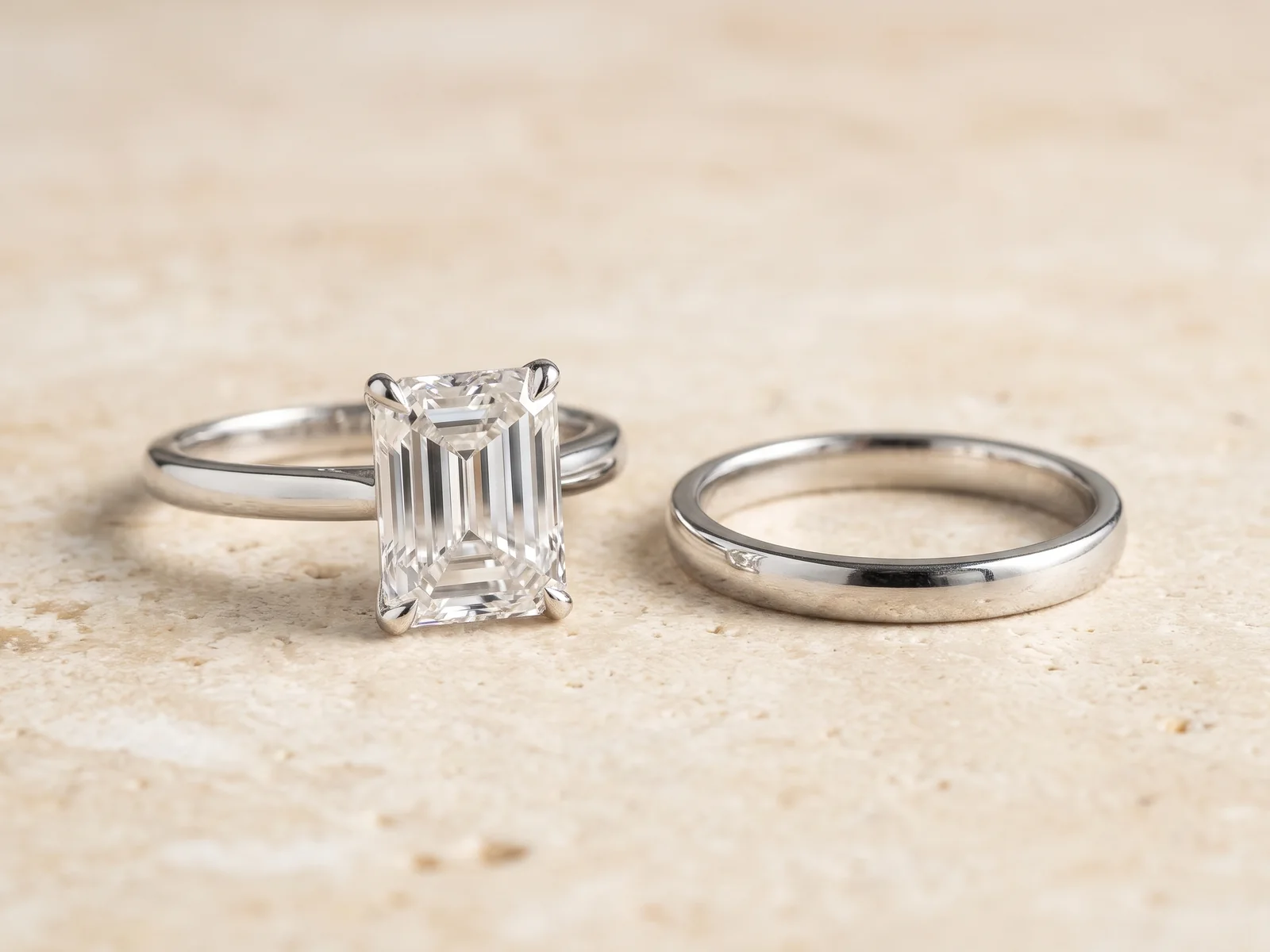
An emerald cut is all clean lines and open step facets, so the wedding band for emerald cut rings has to match that calm geometry. Here is how to choose the style, width and fit so the two rings sit well together for decades.
 Reviewed by Raj Sood, Graduate Gemologist (GIA), AJP (GIA)Master jeweller and Graduate Gemologist (GIA) · reviewed 4 November 2026
Quick answer
The best wedding band for emerald cut engagement rings usually echoes the stone's straight lines: a plain band, a channel of baguettes or small emerald cuts, or a claw-set band about the same width as the engagement ring shank (often 1.8–2.5 mm). Check whether the setting lets it sit flush; if not, choose a fitted or notched band.
What is the best wedding band for an emerald cut engagement ring?
An emerald cut is a step cut: instead of the many small triangular facets of a brilliant, it has long, flat facets running parallel to the edges, like a set of stairs. It is rectangular with its corners clipped off, and most have a length-to-width ratio between about 1.30 and 1.50. The look is calm, architectural and very clear, which is why the wedding band beside it matters so much.
The bands that work best follow the same logic. They keep straight lines, avoid fussy detail and sit neatly against the engagement ring. In practice that means one of four choices: a plain metal band, a channel of baguettes (small rectangular step-cut diamonds), a row of small emerald cuts set east-west, or a fine claw-set round diamond band for extra sparkle beside the step facets.
Before you pick a style, it helps to know the difference between a wedding ring and a wedding band, and the general rules for matching any band to any engagement ring. This guide applies those rules to the emerald cut specifically, including the one question that catches most people out: will the band sit flush?
Much of the answer depends on how the centre stone is held. A low four-claw basket, a bezel, a hidden halo and a three-stone setting all behave differently beside a band. Our guide to settings for emerald cut diamonds shows each one; here we look at what each means for the band next to it.
Which wedding band styles suit an emerald cut?
There is no single correct band. What you are choosing between is contrast and continuity: do you want the band to repeat the emerald cut's step facets, or to set them off with a different kind of sparkle?
| Band style | How it looks beside an emerald cut | Things to know |
|---|---|---|
| Plain metal band | Clean and quiet; lets the centre stone do the work | Easiest to resize and maintain; choose a profile that matches the shank |
| Baguette channel band | Repeats the step-cut flashes; very cohesive | Baguettes must be well matched in colour and size; harder to resize |
| East-west emerald cut band | Small emerald cuts turned sideways; echoes the centre directly | Usually made to order; check stone sizes line up |
| Claw-set round diamond band | Brighter, livelier sparkle against the broad step facets | Fine claws can catch; band height should match the shank |
| Pavé band | Lots of small sparkle, softer look | Tiny stones can work loose over many years; needs checking |
| Fitted or notched band | Curves or dips around the setting so both rings touch | Made to suit one engagement ring; less flexible later |
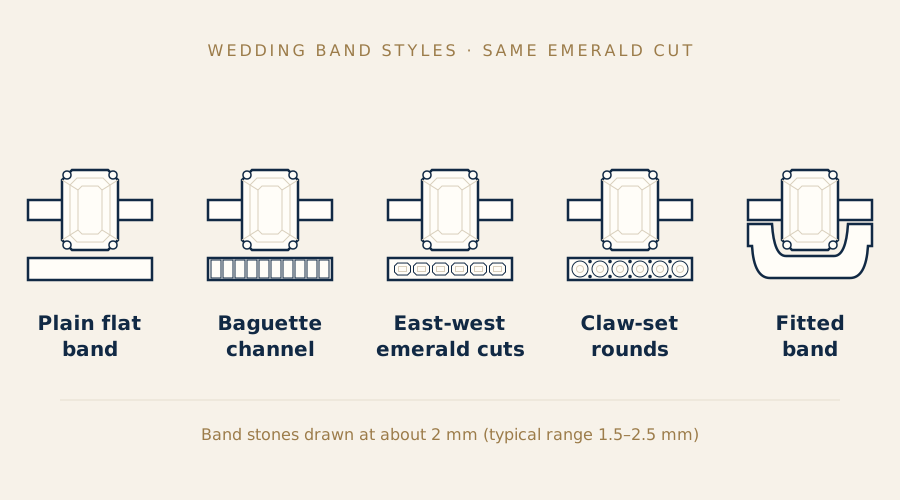
If you are deciding between metal and diamonds, our guide to plain versus diamond-set bands covers durability, cost and how each ages. For plain bands, the shape of the cross-section matters more than people expect: a flat or soft-court profile tends to suit the emerald cut's straight lines better than a domed one. See band profiles such as court, flat and knife-edge for how each feels on the hand.
With diamond bands, proportion is everything. Stones that are too large compete with the centre and push the band up above the engagement ring's shank. Most emerald cut bridal sets use stones of about 1.5–2.5 mm; our guide to how big the diamonds in a band should be explains how to judge it against your centre stone.
Will a straight wedding band sit flush against an emerald cut?
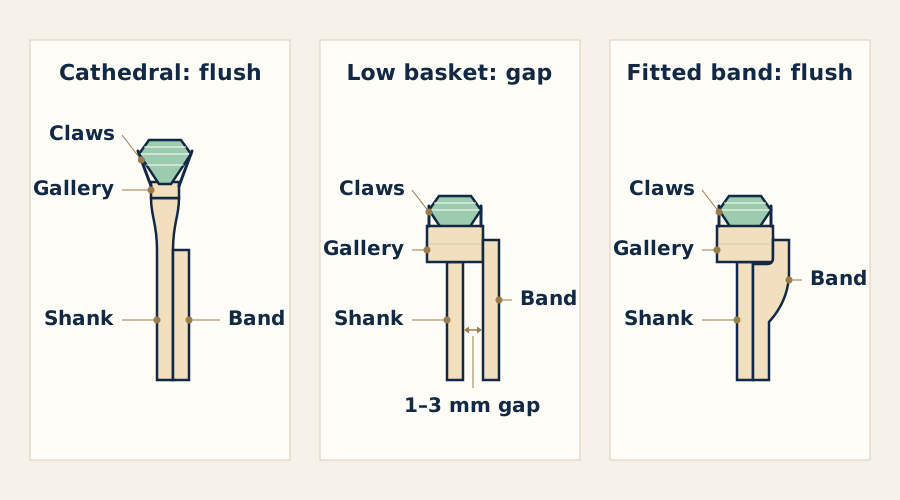
Often, but not always. A band sits flush when the two rings touch along their full length with no gap. Whether that happens is decided by the engagement ring, not the band: specifically by how low the centre stone sits and whether the claws, basket or halo extend down past the top of the shank.
An emerald cut has a deep, rectangular pavilion (the underside of the stone) and is often set with four corner claws or double claws. If the setting is low, the gallery (the metal structure under the stone) and the bottom of the claws can hang over the side of the shank. A straight band then hits the setting first and leaves a small gap, usually 1–3 mm, between the rings.
| Engagement ring setting | Straight band sits flush? | Usual solution |
|---|---|---|
| Cathedral claw setting (shoulders rise to the stone) | Usually yes | Straight band of matching width |
| High four-claw or double-claw solitaire | Often yes | Straight band; check claw tips do not touch |
| Low basket or bezel | Often no, small gap | Fitted, notched or curved band, or accept the gap |
| Hidden halo (diamond collar under the stone) | Often no | Fitted band, or a straight band set slightly lower |
| Three-stone with baguette or trapezoid sides | Usually no | Fitted or contoured band shaped around the side stones |
A gap is not a fault. Some people like the small space, because it stops metal on metal contact and keeps both rings looking separate. Others want the rings to read as one piece. If you want them flush and the setting will not allow it, how fitted and contour bands are made shows the options. Rings that do touch should be the same metal and finish, otherwise the harder one will slowly wear the softer one; our page on stopping rings rubbing and wearing goes through the fixes.
Related guideHow to Prevent Rings From Rubbing Each OtherWhat width wedding band works for an emerald cut?
The simplest rule is to match the band to the engagement ring's shank (the part of the ring that goes around the finger). If the shank is 2.0 mm wide, a band of 1.8–2.2 mm will look balanced. A band much wider than the shank makes the engagement ring look thin; much narrower and it can look like an afterthought.
Centre stone size also matters. An emerald cut faces up larger than its carat weight suggests in length, but its broad, open table makes it look bold on the hand, so it can carry a slightly wider band than a small round.
| Emerald cut weight | Typical size (length × width) | Band width that usually balances |
|---|---|---|
| 0.50 ct | about 6.0 × 4.0 mm | 1.5–2.0 mm |
| 1.00 ct | about 7.0 × 5.0 mm | 1.8–2.2 mm |
| 1.50 ct | about 8.0 × 5.5 mm | 2.0–2.5 mm |
| 2.00 ct | about 8.5 × 6.0 mm | 2.0–2.8 mm |
| 3.00 ct | about 9.5 × 7.0 mm | 2.3–3.0 mm |
These sizes are for an emerald cut at roughly a 1.40 ratio; a longer stone looks bigger from end to end at the same weight. Band height is the other dimension to watch. Diamond bands are usually taller than plain bands, and if the band stands higher than the engagement shank it can rub the gallery and look uneven from the side. Aim for both rings to be within about 0.3 mm in height.
Not sure which one is right?
Send us the stones you are looking at and our gemologist will tell you which to choose and why.
Should the wedding band match the engagement ring metal?
In almost every case, yes. Two rings worn side by side rub against each other constantly through daily wear. If one is platinum and the other 18 carat gold, they wear at different rates and the colours drift apart as plating wears or patina builds.
- Platinum (usually 950): naturally white and dense. It scratches into a soft grey patina rather than losing metal quickly, and suits emerald cuts in white metal.
- 18 carat white gold: usually rhodium-plated for a bright white finish. The plating wears with time and is renewed, so both rings should be re-plated together.
- 18 carat yellow gold: warms the look of the diamond and is very popular with vintage-style emerald cuts.
- 18 carat rose gold: softer pink tone; pair rose with rose so the colour matches.
Mixing metals can work deliberately, such as a yellow band beside a platinum engagement ring, but expect the softer metal to wear faster where they touch. If one partner's band is being made at the same time, choosing his band to match covers widths, profiles and finishes for heavier bands. For everything else, from budgets to sizing, see our full wedding ring buying guide.
Should the band use natural or lab-grown diamonds?
Both natural and laboratory-grown diamonds are used in wedding bands, and they look identical to the eye. Lab-grown diamonds cost much less than natural, which matters most in baguette and eternity bands where there may be 15 to 30 stones. Natural diamonds are rarer and are chosen by people who want the band to match a natural centre stone.
The most important thing is that the stones match the centre in colour. Step cuts show colour more than brilliants, so a band of slightly warmer baguettes next to a bright D–F emerald cut will be noticeable. Ask for the band's stones to be within one or two colour grades of the centre.
| Band type (18ct or platinum) | Approximate AUD range |
|---|---|
| Plain band, about 2 mm | about $800–$2,500 |
| Half eternity, lab-grown rounds | about $1,000–$2,800 |
| Half eternity, natural rounds | about $1,800–$4,500 |
| Baguette channel band, lab-grown | about $1,500–$4,000 |
| Baguette channel band, natural | about $3,000–$8,000+ |
These are wide ranges because metal weight, stone count and diamond quality all move the price. A full eternity band, with diamonds all the way around, looks complete from every angle but is difficult to resize; read whether a full eternity ring can be resized before you commit. Many people start with a half eternity and add rings later, which our guide to building an anniversary stack explains.
Browse emerald cut diamonds and create your band
How does pairing a band with an emerald cut compare with other shapes?
Each centre stone shape raises a slightly different problem for the band. The emerald cut's straight sides make it one of the easier shapes to pair with a straight band; the challenge is the setting height, not the outline.
| Centre shape | Straight band usually flush? | Bands that tend to suit | Main watch-out |
|---|---|---|---|
| Emerald | Often, depends on setting | Plain, baguette, east-west emerald cut | Low baskets and hidden halos |
| Radiant | Often | Claw-set rounds, baguettes | Brilliant sparkle can clash with plain baguettes |
| Princess | Often | Channel-set, plain flat | Sharp corners need protecting |
| Cushion | Sometimes | Pavé, claw-set, plain | Halos often push the band away |
| Round | Usually | Almost any | Very few |
| Oval | Sometimes | Claw-set, curved | Elongated sides overhang the band |
| Pear | Rarely | Curved or fitted | The point overhangs the band |
If you are still deciding on the centre stone, compare pairing a band with a radiant cut, which shares the emerald cut's outline but has brilliant faceting, and bands for princess-cut rings. Softer shapes behave differently: see cushion-cut band pairings, round engagement ring bands, oval engagement ring band options and bands that suit a pear.
When should you have a band made to fit?
A made-to-fit band makes sense when the engagement ring has a low setting, a hidden halo or side stones, and you want both rings to touch along their length. It also makes sense when you want a style that is rarely sold ready-made, such as a channel of small east-west emerald cuts matched to your centre stone.
The process starts with the engagement ring itself. The jeweller measures the shank width and height, the gallery depth and where the claws or halo sit, then designs the band in CAD (computer-aided design) so the curve or notch follows the setting exactly. A wax or resin model can be tried against the ring before anything is cast.
If any term here is new, such as gallery, shank or channel setting, our jewellery glossary explains each one in plain language.
How to choose a wedding band for an emerald cut: step by step
- Look at the engagement ring from the side. Note whether the setting rises above the shank (cathedral) or sits low and overhangs it.
- Measure the shank. Record its width and height in millimetres; the band should be within about 0.3 mm of both.
- Decide flush or gap. Try a straight band against the ring. If there is a gap and you want the rings to touch, plan a fitted or notched band.
- Choose the style. Plain for simplicity, baguettes or east-west emerald cuts for continuity, claw-set rounds for contrast.
- Match metal and colour. Same metal as the engagement ring, and band diamonds within one or two colour grades of the centre.
- Think about the future. Consider whether you may need to resize, and whether a half eternity leaves room for an anniversary ring later.
Free consultation
Talk to a gemologist
Compare stones in person or online with Raj Sood, Graduate Gemologist (GIA), AJP (GIA).
Book a consultationFAQ
Common questions
What type of wedding band goes best with an emerald cut engagement ring?
Bands with straight, clean lines suit it most: a plain flat or soft-court band, a baguette channel band, or a row of small east-west emerald cuts. A fine claw-set round diamond band works if you want more sparkle.
Will a straight band sit flush with an emerald cut?
It depends on the setting. Cathedral and higher claw settings usually allow a straight band to sit flush, while low baskets, bezels, hidden halos and three-stone rings often leave a small gap.
Is it okay to have a gap between my wedding band and engagement ring?
Yes. A gap is common and is not a fault; it also stops the rings rubbing. If you prefer them to touch, a fitted or notched band can close it.
How wide should a wedding band be for an emerald cut?
Match the engagement ring's shank, which for most emerald cut rings is about 1.8–2.5 mm. Larger centre stones of 2 carats or more can carry a slightly wider band.
Do baguette bands suit emerald cut engagement rings?
Very well, because baguettes are step cuts like the emerald cut and flash in the same broad way. Make sure the baguettes match the centre stone in colour.
Can I use lab-grown diamonds in my band if my emerald cut is natural?
Yes, and many people do, as lab-grown diamonds cost much less than natural. They look the same to the eye; just check the colour grades match the centre stone.
Terms in this guide

Ask a gemologist
Not sure which diamond to choose?
Raj Sood is a Graduate Gemologist (GIA) and master jeweller. Bring the stones you are considering, or send the reports, and he will tell you honestly which one is better and why.
Keep learning
Related guides
 Wedding Bands & EternityHow to Match a Wedding Band to an Engagement Ring
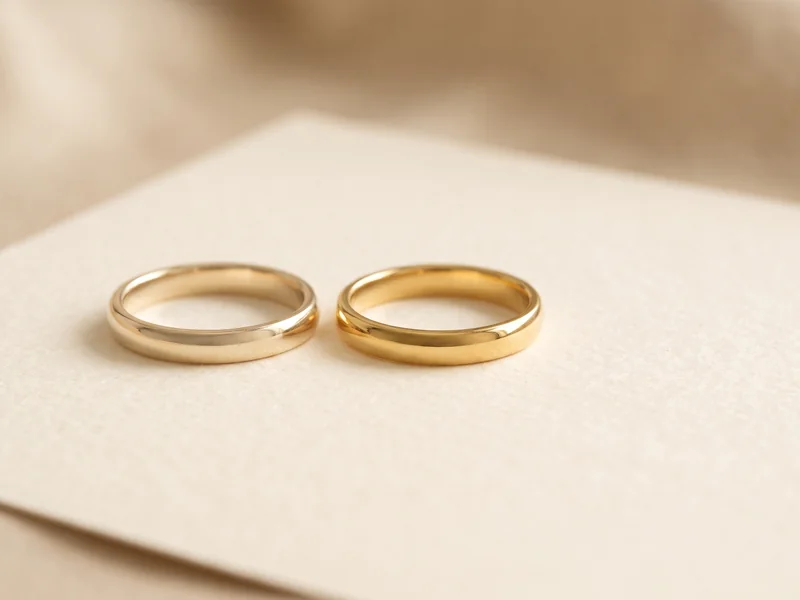 Wedding Bands & EternityFitted Wedding Bands Explained | Custom Curved Bands
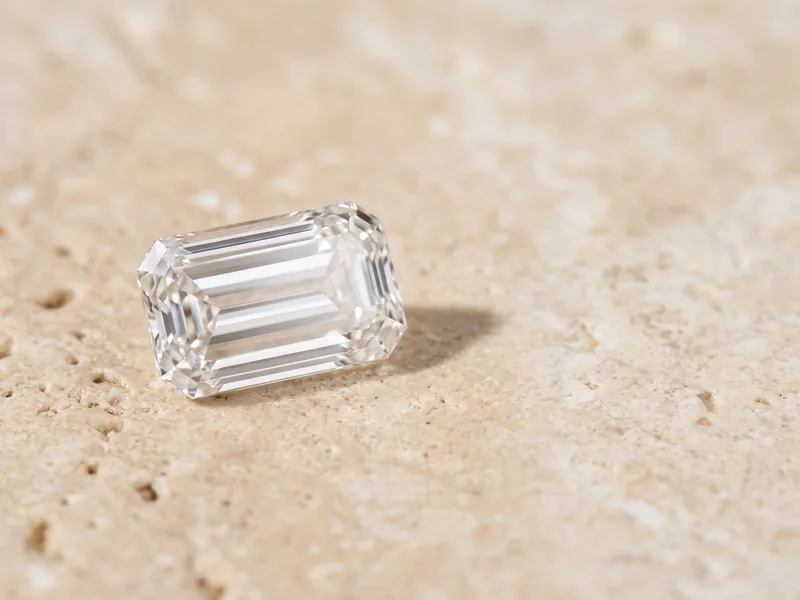 Engagement Rings & SettingsBest Settings for Emerald Cut Diamonds
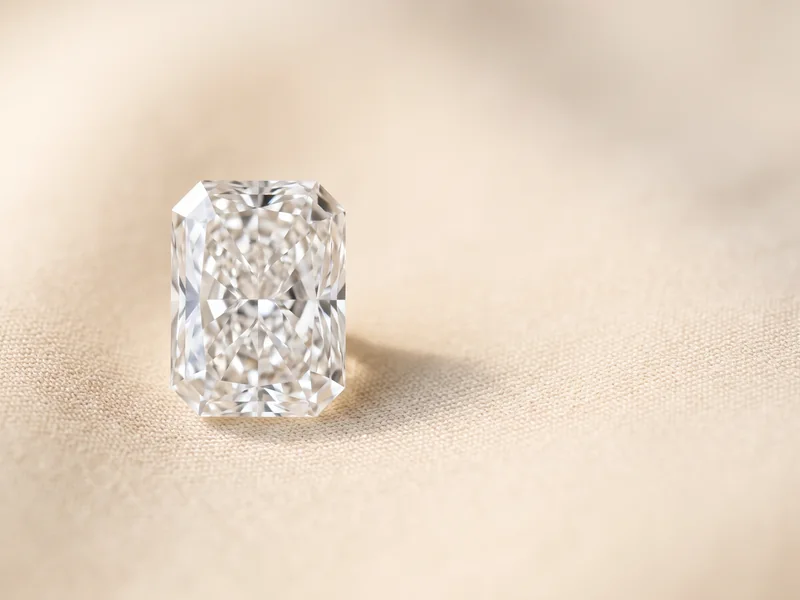 Wedding Bands & EternityBest Wedding Band for Radiant Cut Engagement RingsWedding Bands & EternityWedding Ring Buying Guide
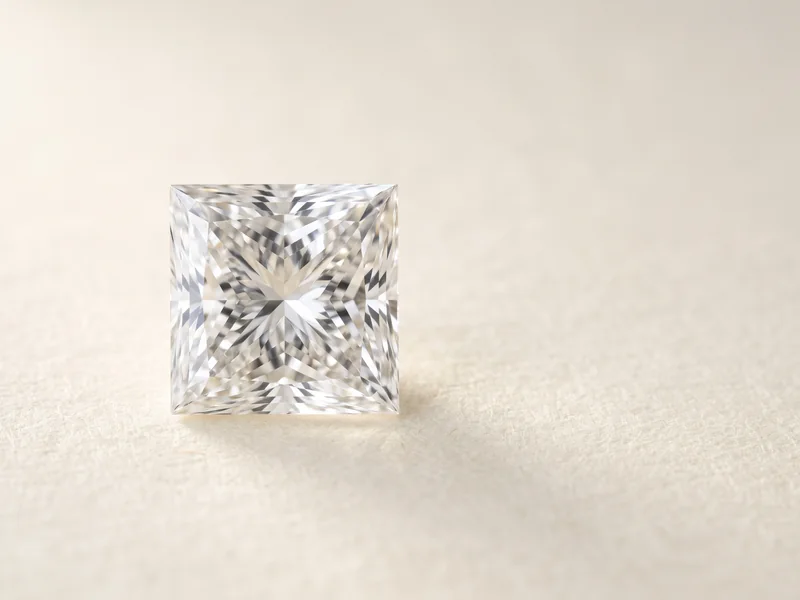 Wedding Bands & EternityBest Wedding Band for Princess Engagement Rings
 Wedding Bands & EternityWedding Ring vs Wedding Band
 Wedding Bands & EternityMen’s Wedding Band Guide
Explore more
More guides on this topic
Education