
Metals
Platinum Jewellery: The Complete Australian Guide
Platinum jewellery is heavier, whiter and purer than most people expect, and it ages differently from gold. Here is what the stamps mean, how it wears, what it costs and how to look after it.
 Reviewed by Raj Sood, Graduate Gemologist (GIA), AJP (GIA)Master jeweller and Graduate Gemologist (GIA) · reviewed 4 November 2026
Quick answer
Platinum jewellery is made from a dense, naturally white metal, usually 95% pure (stamped Pt950) in Australia. It never needs rhodium plating, suits most sensitive skin and holds claws securely. It scratches to a soft grey patina rather than wearing away, and costs more than white gold because rings use more metal and specialist work.
What is platinum jewellery?
Platinum is a naturally white, very dense precious metal. In jewellery it is used almost pure: most pieces sold in Australia are Pt950, meaning 950 parts per thousand (95%) platinum, with the remaining 5% a hardening metal such as ruthenium, cobalt or iridium. Compare that with 18K gold at 75% gold, and you can see why platinum is often described as the purest of the common jewellery metals.
It belongs to the platinum group metals, six related elements: platinum, palladium, rhodium, ruthenium, iridium and osmium. Most of the world's platinum is mined in South Africa, with Russia, Zimbabwe and North America supplying much of the rest. It is mined in far smaller quantities than gold each year, but its price is driven as much by industry (it is used heavily in vehicle catalytic converters) as by jewellery.
In the hand, three things set platinum apart from gold in its various colours: it is noticeably heavy, its colour is a cool grey-white all the way through, and it does not need plating to stay white. Those three facts explain nearly everything else in this guide, from what it costs to how it looks after twenty years of wear.
What do Pt950 and Pt900 mean on platinum?
Platinum purity is written in parts per thousand. Pt950 is 95% platinum, Pt900 is 90% and Pt850 is 85%. Pure platinum (Pt999) is too soft to hold a diamond securely, so a small amount of another metal is added to make an alloy, a blend of metals melted together. Which metal is added matters as much as the number.
| Alloy | Mix | Character | Typical use |
|---|---|---|---|
| Pt950 / ruthenium | 95% platinum, 5% ruthenium | Firm, holds a polish well, good for hand work | Wedding bands, hand-made settings |
| Pt950 / cobalt | 95% platinum, 5% cobalt | Casts with crisp detail; slightly magnetic | Cast engagement rings, detailed designs |
| Pt950 / iridium | 95% platinum, 5% iridium | Softer, very bright white, takes patina quickly | Some settings and older pieces |
| Pt900 / iridium | 90% platinum, 10% iridium | Harder than Pt950/iridium, very slightly greyer | Common in Japan and in older Australian pieces |
| Pt850 | 85% platinum, 15% other metals | Harder still, less common in fine jewellery | Some chains and imported pieces |
Hardness is measured on the Vickers scale (HV), which records how far a diamond point presses into a metal. As a rough guide, annealed (softened) Pt950 ruthenium and cobalt alloys sit around 130–140 HV, Pt950 iridium nearer 80 HV and Pt900 iridium around 110 HV. Work-hardening during making pushes these figures up. On the Mohs scratch scale, platinum sits around 4 to 4.5.
For colour, you will not see a difference between 950 and 900 on the hand. The real differences are hardness, how quickly patina forms and how the metal behaves at the bench. Our Pt950 vs Pt900 comparison goes through it in detail. As with high-carat 22K and 24K gold, higher purity does not automatically mean a harder metal; the alloy does that work.
How do you read platinum hallmarks in Australia?
Australia has no compulsory, government-run hallmarking system like the United Kingdom's assay offices. Instead, the maker or manufacturer stamps the fineness, usually inside the shank of a ring or on the clasp or tag of a chain, often next to a maker's mark (initials or a symbol identifying who made it). A fineness stamp that overstates the metal content is a false or misleading representation under Australian Consumer Law, so reputable makers take it seriously.
| Stamp you might see | What it means |
|---|---|
| Pt950, 950 Pt, 950 PLAT or PLAT | 95% platinum, the usual Australian standard |
| Pt900 or 900 Pt | 90% platinum, often iridium alloy |
| Pt850 | 85% platinum, less common in fine jewellery |
| 18K/Pt or 750/Pt950 | Mixed metals, for example an 18K gold shank with a platinum head |
| Pt plated, platinum plated | A thin platinum coating over silver or base metal, not solid platinum |
| Maker's mark | Identifies the workshop or brand that made the piece |
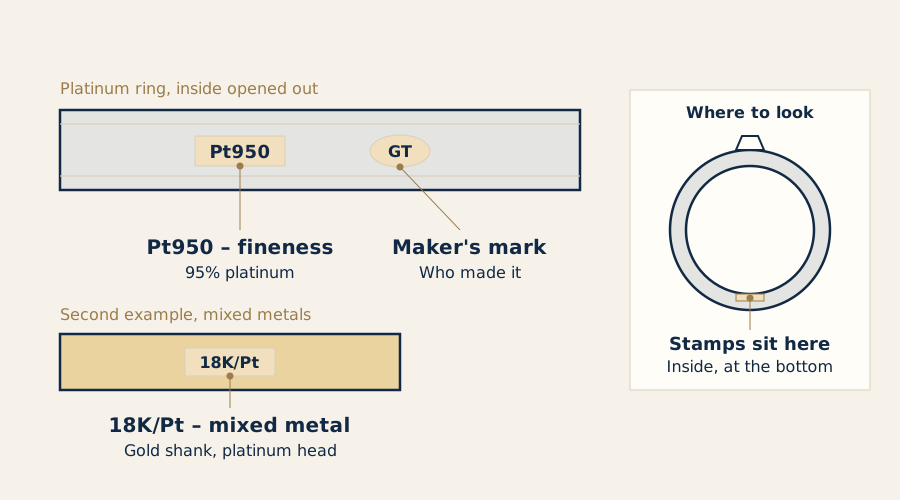
Imported and older pieces can carry other marks. British platinum may show an assay office mark and, traditionally, an orb symbol; Japanese jewellery is very often stamped Pt900; older American pieces sometimes read IRIDPLAT for a platinum-iridium mix. If a piece is unmarked, worn smooth or you simply want certainty, a jeweller can test it with XRF (X-ray fluorescence), a quick, non-destructive scan that reads the metal content.
Is platinum jewellery better than white gold?
Neither is better for everyone; they suit different priorities. Platinum stays white without maintenance and is very forgiving on sensitive skin. 18K white gold costs less, weighs less and looks brighter straight after plating. Here is how platinum compares with the other white metals people ask us about.
| Metal | Colour | Plating to stay white? | Density (g/cm³) | Skin-friendliness | Relative cost |
|---|---|---|---|---|---|
| Platinum Pt950 | Naturally grey-white | No | about 20–21 | Very rarely a problem | Highest of these |
| 18K white gold | Warm white under rhodium | Usually, every 12–24 months | about 14.5–16 | Depends on alloy (nickel or palladium) | High |
| 9K white gold | Greyer or slightly yellow under rhodium | Yes | about 11–12 | More base metal in the mix | Moderate |
| Palladium 950 | Grey-white, lighter in the hand | No | about 12 | Very rarely a problem | Varies with palladium price |
| Titanium | Darker grey | No | about 4.5 | Very good | Low; hard to resize |
| Sterling silver | Bright white, tarnishes | No, but needs polishing | about 10.4 | Contains copper | Lowest |
White gold is yellow gold alloyed with white metals, then usually coated in rhodium to give it that icy finish. When the coating wears, the warmer colour underneath shows, especially on the palm side of a ring. Our guide to rhodium plating and replating explains the process and how often it is needed, and 9K versus 18K gold covers why the carat matters for white gold too. For the full head-to-head, read our white gold vs platinum guide.
If budget or weight matters more than purity, the alternatives are worth a look: sterling silver for fashion pieces, lightweight titanium for bands, and scratch-resistant tungsten for men's rings, though neither titanium nor tungsten can be resized in the usual way.
Related guideWhite Gold vs PlatinumNot sure which one is right?
Send us the stones you are looking at and our gemologist will tell you which to choose and why.
Does platinum scratch, and what is platinum patina?
Yes, platinum scratches, and it scratches about as readily as gold. The difference is what happens to the metal. When platinum is scratched, most of it is pushed aside into tiny ridges rather than lost. Over months and years those fine marks blend into a soft, satin-grey finish called patina. With rhodium-plated white gold, everyday wear goes through the plating first, which is why white gold changes colour while platinum only changes texture.
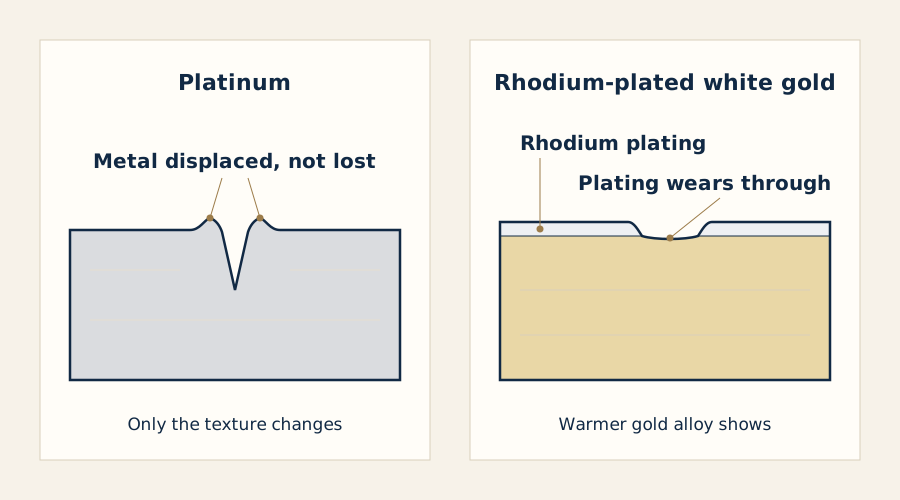
Some people love patina because it looks lived-in and makes a diamond stand out against a softer background. Others prefer a mirror finish. Either is fine: a jeweller can repolish platinum back to high shine in one visit, usually every few years for a daily-wear ring. Repolishing does remove a very small amount of surface, so there is no need to do it constantly.
Platinum is not indestructible. Claw tips still thin over decades, and a ring shank worn every day can slowly lose thickness on the palm side. The advantage is that platinum claws tend to bend rather than snap, and the metal is easy to build up again by re-tipping, which is why so many settings for valuable diamonds are made in it.
Is platinum jewellery good for sensitive skin?
For most people, yes. Pt950 is so pure that reactions are very rare, and it contains no nickel, the metal behind most jewellery allergies. That is a real difference from some white gold alloys, which use nickel to whiten the gold; others use palladium instead, so it is worth asking what is in a white gold piece if you react to cheap earrings or watch backs.
One detail people miss: platinum-cobalt alloys contain 5% cobalt, and a small number of people are sensitive to cobalt. If you know you react to it, ask for a ruthenium or iridium alloy instead. Rhodium plating on white gold protects skin while it lasts, but once it wears through, the alloy underneath touches the skin. If you have a diagnosed metal allergy, talk to your GP or dermatologist about patch testing before choosing.
Why does platinum jewellery cost more than gold?
For much of the last decade platinum has traded below gold per ounce on world markets, yet a platinum ring usually costs more than the same ring in 18K gold. The reasons are practical:
- More metal: platinum is about 1.3–1.4 times as dense as 18K white gold, so the same design simply weighs more.
- Higher purity: a Pt950 ring is 95% precious metal; an 18K ring is 75%.
- Harder to work: platinum melts at 1,768 °C against about 1,064 °C for gold, needing specialist casting equipment, torches or laser welders.
- Slower finishing: platinum takes more steps to polish to a high shine, adding bench time.
- Specialist skill: fewer jewellers work in platinum every day, and repairs need the same care.
| Piece (metal only, no centre stone) | Platinum Pt950, approx AUD | 18K white gold, approx AUD |
|---|---|---|
| Plain 2 mm wedding band | $1,200–$2,200 | $900–$1,600 |
| Plain 4 mm wedding band | $2,200–$4,000 | $1,500–$2,800 |
| Classic solitaire engagement setting | $1,800–$3,800 | $1,400–$3,000 |
These are broad ranges: weight, width, finish and the metal price on the day all move them. Metal prices change daily, which is why a quote for a platinum or gold ring is usually held for a limited time. Our guide to how metal prices flow through to jewellery prices explains the mechanics. Platinum jewellery holds its metal content, but like any jewellery it is something to wear and enjoy rather than a financial asset.
How are handcrafted platinum engagement rings made?
Most handcrafted platinum engagement rings start as a CAD (computer-aided design) model, so you can see the proportions, claw positions and band width before any metal is used. The design is printed in wax or resin and cast in platinum, or parts are hand-fabricated from platinum wire and sheet, which gives a denser metal for bands and claws.
Because of platinum's high melting point, joins are usually made with a laser welder or a specialist torch, and the claws are formed, set and polished in many more stages than gold. Fine details such as a hidden halo, a cathedral shoulder or thin micro-claws are where platinum's strength shows: it holds small diamonds firmly in very little metal.
Weighing platinum against gold, palladium and the rest for a ring you will wear every day? See our guides to the right metal for an engagement ring and the metals that suit wedding bands. If you like a patterned, mixed-metal look, mokume gane rings are usually made in combinations of gold, silver and palladium and can sit beside a platinum ring as a contrast band.
How to choose and care for platinum jewellery: step by step
Platinum jewellery in Australia covers everything from engagement settings and wedding bands to earring settings and chains. Whatever the piece, the same checks apply.
Browse ring settings by metal
- Check the stamp. Look for Pt950, 950 PLAT or Pt900 inside the shank or on the clasp, and be wary of pieces marked only as platinum plated.
- Ask which alloy. Ruthenium, cobalt and iridium alloys wear and polish slightly differently; if you are sensitive to cobalt, say so.
- Feel the weight and width. Try a platinum band against a gold one. Some people love the heft; others prefer a narrower band to keep the weight down.
- Choose a finish. High polish, satin or brushed. Satin and brushed finishes hide patina; high polish shows it sooner but can be restored.
- Match your bands. Plan the wedding band in the same metal so the two rings wear evenly and stay the same colour.
- Ask about resizing. Platinum rings can usually be sized up or down one to two sizes; full-eternity and some patterned bands cannot.
- Set a care routine. Clean at home in warm water with a drop of dishwashing liquid and a soft brush, have claws checked every 12 months, and repolish every few years if you want the shine back.
Store platinum pieces separately in soft pouches or lined compartments so diamonds and other jewellery do not scratch them; our guide on storing jewellery safely at home shows simple set-ups. Remove rings for gym work, gardening and anything involving chlorine or harsh chemicals, which can loosen settings or damage gemstones even though platinum itself will not tarnish.
Free consultation
Talk to a gemologist
Compare stones in person or online with Raj Sood, Graduate Gemologist (GIA), AJP (GIA).
Book a consultationShop this shape
FAQ
Common questions
Does platinum tarnish?
No. Platinum does not tarnish or rust in normal wear and stays the same colour all the way through. The grey look some older rings have is patina, a build-up of fine scratches, which can be polished away.
What does 950 mean on a platinum ring?
It means the ring is 950 parts per thousand platinum, or 95%. The other 5% is usually ruthenium, cobalt or iridium, added to make the metal hard enough to hold stones.
Is platinum hypoallergenic?
Pt950 is very rarely a problem for sensitive skin because it contains no nickel. People sensitive to cobalt should ask for a ruthenium or iridium alloy rather than a platinum-cobalt one.
Can platinum rings be resized?
Yes, most platinum rings can be sized up or down by one to two sizes. It needs a jeweller with platinum welding equipment, and full-eternity or some patterned bands cannot be resized easily.
Is platinum stronger than white gold?
Platinum is not necessarily harder, but it is denser and tougher: claws tend to bend rather than snap, and scratches displace metal rather than removing it. 18K white gold can resist surface scratches slightly better but relies on rhodium plating to stay white.
Is platinum jewellery worth the extra cost?
It is worth it if you want a white metal that never needs replating, suits sensitive skin and holds stones very securely. If weight or budget matter more, 18K white gold or palladium are sensible alternatives.

Ask a gemologist
Not sure which diamond to choose?
Raj Sood is a Graduate Gemologist (GIA) and master jeweller. Bring the stones you are considering, or send the reports, and he will tell you honestly which one is better and why.
Keep learning
Related guides
 MetalsPlatinum 950 vs 900
 MetalsWhite Gold vs PlatinumMetalsBest Metal for Engagement RingsMetalsRhodium Plating and ReplatingMetalsSterling Silver Jewellery
 Care, Repairs & RemodellingHow to Store Jewellery
 MetalsTungsten Jewellery: Modern Strength, Scratch Resistance & Contemporary Style
 Metals22K and 24K Gold Jewellery
Explore more
More guides on this topic
Education