
- Education
- Care, Repairs & Remodelling
- Ring Out of Round? Why Rings Lose Their Shape and How They Are Fixed
Care, Repairs & Remodelling
Ring Out of Round? Why Rings Lose Their Shape and How They Are Fixed
A ring out of round looks like a small cosmetic problem, but an oval or dented band loosens claws and can cost you a stone. Here is why it happens, how to spot it early and what a proper repair involves.
 Reviewed by Raj Sood, Graduate Gemologist (GIA), AJP (GIA)Master jeweller and Graduate Gemologist (GIA) · reviewed 4 November 2026
Quick answer
A ring goes out of round when pressure bends its band into an oval or flat-sided shape. The usual causes are thin or worn shanks, soft high-purity metals, gripping weights or tools, and old resizing joins. A jeweller reshapes it on a steel mandrel, checks every stone, and rebuilds the band if it has worn too thin.
What does it mean when a ring is out of round?
A ring is out of round when its band, called the shank (the part that circles your finger), is no longer a true circle. It may have become a slight oval, picked up a flat side, or developed a dent or kink where it took a knock. Seen from the side, the band can also twist, so the head (the part that holds the stone) no longer sits square on top of the finger.
Ovalling is one of the most common things a jeweller sees on the repair bench. Most owners never notice it happening, because the change is slow: a fraction of a millimetre at a time, over months or years. The problem is rarely the look of the band itself. It is what that movement does to the setting above it, and to the stones it holds. If any word here is new to you, our plain-English jewellery glossary explains it.
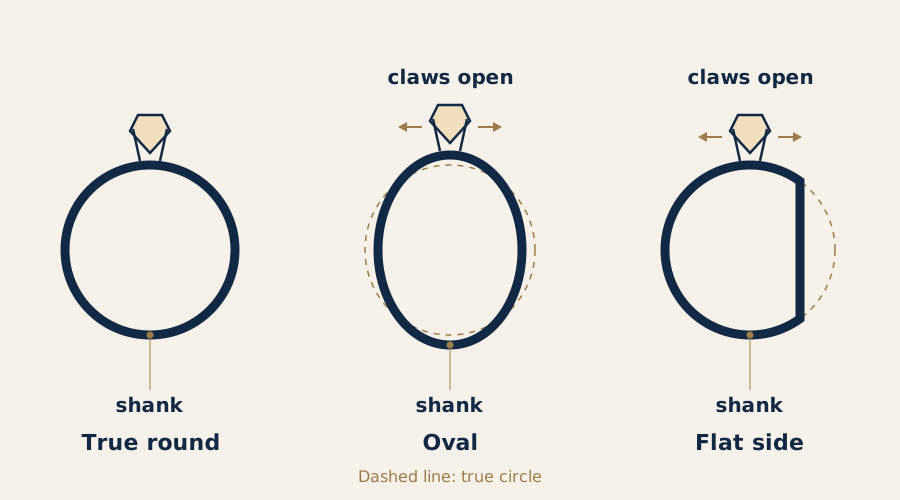
Rings bend because the precious metals they are made from are ductile, meaning they can be bent permanently without snapping. That is exactly what lets a jeweller form, size and repair a ring, and it is also why a ring can be squeezed out of shape on your hand. Each bend also work hardens the metal a little at that spot, making it stiffer but more brittle. A band that has been bent and straightened many times can eventually crack at the weakest point, often an old solder join.
Why does a ring go out of round?
There is almost never one single cause. Usually two or three things combine: a band that has become thin, a metal that is on the softer side, and a habit that puts regular pressure on it. The main culprits:
- Gripping pressure. Barbells, kettlebells, rowing machines, climbing holds, garden tools and heavy shopping bags press the band between your finger and a hard handle. Our guide on whether to sleep or train in your ring covers the activities that do the most damage.
- A thin or worn shank. Gold slowly wears away where it rubs against skin, other rings and surfaces. A band made 1.5 mm deep can be under 1 mm after many years of daily wear, and the underside of the shank usually goes first.
- Soft metal. High-purity gold (22 ct and 24 ct), sterling silver and some softer platinum alloys bend more easily than 9 ct, 14 ct or harder platinum alloys.
- Previous resizing. Resizing heats the metal, which softens it, and adds a solder join. Stretching a ring up instead of adding metal also thins the band. Our page on what decides whether a ring can be resized explains the trade-offs.
- Knocks. Car doors, handrails, benchtops and gym equipment can dent a band in a single moment, especially a thin one.
- Rings rubbing together. An engagement ring and wedding band worn side by side wear each other down where they touch. A band shaped to sit evenly reduces this; see our guide to choosing a wedding band to sit beside a round solitaire.
- Which hand you wear it on. Rings on the dominant hand take far more grip and impact. Our article on which finger and hand an engagement ring is worn on covers traditions and practical choices.
Design matters too. A very fine band, under about 1.5 mm wide, looks delicate but has very little metal to resist bending. A heavy head on a thin shank is a common combination in older and vintage rings: the weight of the setting rolls the ring towards the palm, the shank takes the knocks, and it gradually flattens.
Which ring metals hold their shape best?
Every precious metal can go out of round if the band is thin enough. Still, some alloys resist bending much better than others. This comparison is a practical guide, not a lab measurement, because the exact alloy, the band thickness and how the ring was made all change the result.
| Metal | Resistance to bending | How it wears | Notes |
|---|---|---|---|
| 9 ct gold | Good | Slowly | Lower gold content and more alloy metals make it relatively hard; common in Australian bands |
| 14 ct gold | Good | Slowly | A firm, practical choice for thin or fine bands |
| 18 ct yellow or rose gold | Moderate | Steadily over years | Holds shape well if the band is thick enough |
| 18 ct white gold | Moderate to good | Steadily; rhodium plating wears first | Alloy varies; some are noticeably harder than others |
| 22 ct and 24 ct gold | Low | Quickly | Bends and scratches easily; rarely used for engagement rings here |
| Platinum 950 | Moderate (varies by alloy) | Metal is pushed aside rather than lost | Cobalt and ruthenium alloys are usually harder than iridium alloys |
| Sterling silver | Low | Quickly | Thin silver bands bend easily |
| Titanium | High | Very slowly | Strong and light, but resizing is difficult or impossible |
| Tungsten carbide | Very high | Barely | Will not bend, but can crack or shatter under a hard knock; cannot be resized |
Platinum behaves differently from gold. When it is scratched or rubbed, the metal is mostly displaced rather than worn away, which is why platinum develops a soft, satin patina instead of thinning as quickly. That does not make it immune to bending: a thin platinum band can still be pushed oval, and some platinum alloys are softer than 18 ct gold.
In practice, thickness matters more than metal. As a rough guide, a shank about 1.6–2.0 mm deep and 2.0 mm or more wide holds its shape well under normal wear in gold or platinum. Fine bands below about 1.2 mm deep are where bending becomes likely. Hard metals that cannot bend, such as tungsten, solve one problem but create another: they cannot be resized or reshaped, as our guide to which rings can be resized explains.
How can you tell if your ring is out of round?
A ring that has gone out of round usually tells you in small ways before it becomes obvious. Look and feel for these signs:
- The ring feels tighter on two sides and looser on the others, or it suddenly sits differently on your finger.
- Seen end-on, against a plain background, the band looks slightly oval, or has a flat spot near the bottom.
- The head leans to one side, or the stone no longer sits square when your hand is flat.
- A stone clicks, rattles or turns when you gently press it with a fingernail.
- A gap appears between a claw and the stone, or claws catch on clothing and hair.
- Small stones in a band have fallen out, or a channel looks wider in one spot.
- The wedding band and engagement ring no longer sit flush together.
| What you notice | Likely cause | How urgent |
|---|---|---|
| Slight oval, nothing loose | Gradual pressure on a sound band | Reshape at your next check |
| Flat spot at the bottom | Wear or gripping on a thinning shank | Have the thickness measured soon |
| Head leaning or twisted | Band bent from a knock or grip | Soon; claws are under strain |
| Stone moves or rattles | Claws spread as the band changed shape | Stop wearing it until it is checked |
| Small stones missing from a band | Channel or pavé walls have opened | Stop wearing it until it is checked |
| Crack or dark line in the band | Metal fatigue, often at an old solder join | Stop wearing it; it may break |
A quick test at home: lay the ring on a flat table and look down through it from directly above, then roll it a quarter turn and look again. A true circle looks the same each time. An oval shows up clearly once you compare it with a round object of a similar size, such as a coin.
Not sure which one is right?
Send us the stones you are looking at and our gemologist will tell you which to choose and why.
Is a ring out of round a problem for the diamond?
Yes, and this is the real reason to fix it. A ring is a connected structure. When the shank bends, the metal at the top moves too, and the parts holding the stone are the thinnest metal on the whole ring.
- Claw settings. Claws (also called prongs) are small wires of metal that grip the edge of the stone. As the band flexes, they open by fractions of a millimetre and the stone starts to move. Our guide to round, eagle, tab, V and double claws explains how each style holds a stone.
- Channel settings. Stones sit in a track between two metal walls. If the band ovals, the walls spread in some places and pinch in others, and stones can drop out.
- Pavé and micro-pavé. Tiny diamonds are held by small beads of metal. Bending a band loosens these beads quickly, and lost pavé stones are among the most common repairs.
- Full eternity rings. With stones all the way around, there is no plain metal to absorb the bend, so they are both more likely to lose stones and harder to reshape safely.
- Tension settings. The stone is held only by the spring of the band. Any change in shape changes the grip.
The type of stone matters too. A round brilliant set in four or six claws is very secure when the band is true, which is part of why it remains the most common choice in settings designed around round diamonds. But when claws open and close against the stone, the girdle (the thin outer edge of the diamond) takes the pressure. Some cutting practices leave parts of the girdle very thin, as our article on how painting and digging out change girdle thickness explains, and a thin girdle is more prone to chipping when a loose stone knocks against metal.
Diamond is 10 on the Mohs hardness scale, but hardness is resistance to scratching, not toughness. Diamond can still chip along its cleavage planes when struck at the wrong angle. Softer stones such as emerald (7.5–8) or opal (5.5–6.5) are at greater risk again. Whether your centre stone is a classic round brilliant diamond or one of the star and Portuguese cuts in the round brilliant family, a bent band and a loose setting are the most common way stones are damaged or lost.
How do jewellers fix a ring that is out of round?
The repair depends on how far the ring has bent, how thick the band still is and what stones it holds. A careful jeweller works through it in this order.
- Inspect under magnification. Measure the band thickness with callipers, check every claw and setting, and look for cracks, thin spots and old solder joins.
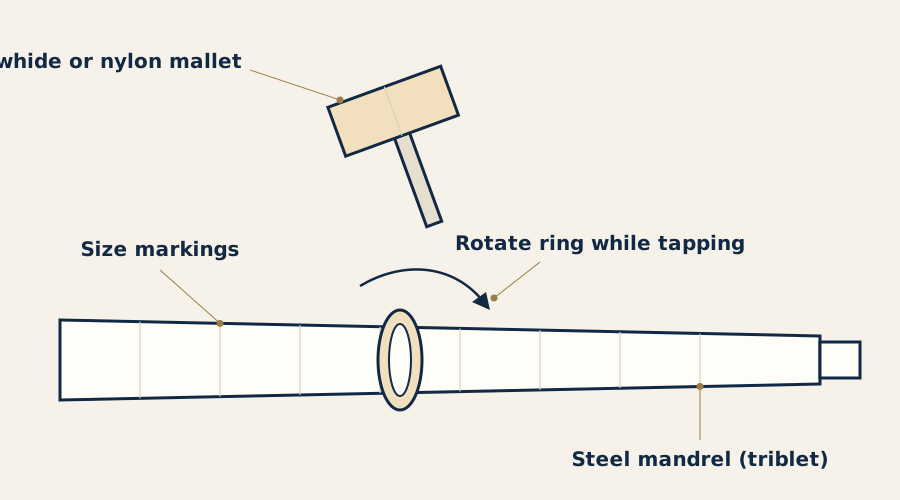
- Reshape on a mandrel. The ring slides onto a mandrel (also called a triblet), a tapered steel rod marked with ring sizes. The jeweller rotates the ring and taps it gently with a rawhide or nylon mallet, which reshapes the metal without marking it. Some workshops use a ring stretcher for plain bands.
- Protect the stones. Bands with channel, pavé or eternity settings need a lighter, slower approach, and some stones are better removed first. Heat-sensitive gems such as emerald, opal and pearl are always kept away from the torch.
- Anneal if needed. A badly bent or work-hardened band may be annealed, gently heated to soften the metal, so it can be reshaped without cracking.
- Tighten and re-tip. Once the band is round, claws are pushed back against the stone, and worn claw tips are rebuilt with new metal (re-tipping).
- Rebuild if thin. If the shank has worn too thin, simply rounding it will not last. The fix is re-shanking: replacing the lower part, or all, of the band with new metal.
- Finish and check. The ring is polished, re-plated with rhodium if it is white gold, and checked again for stone security.
Do not try to reshape a ring yourself by squeezing it or pushing it over a bottle neck. Without a hardened steel mandrel, the force goes into the weakest point, usually the claws or an old join. And never put a ring with a loose stone in a home ultrasonic cleaner; the vibration can shake it free. Our guide to which gemstones are safe in an ultrasonic cleaner lists the stones to keep out entirely.
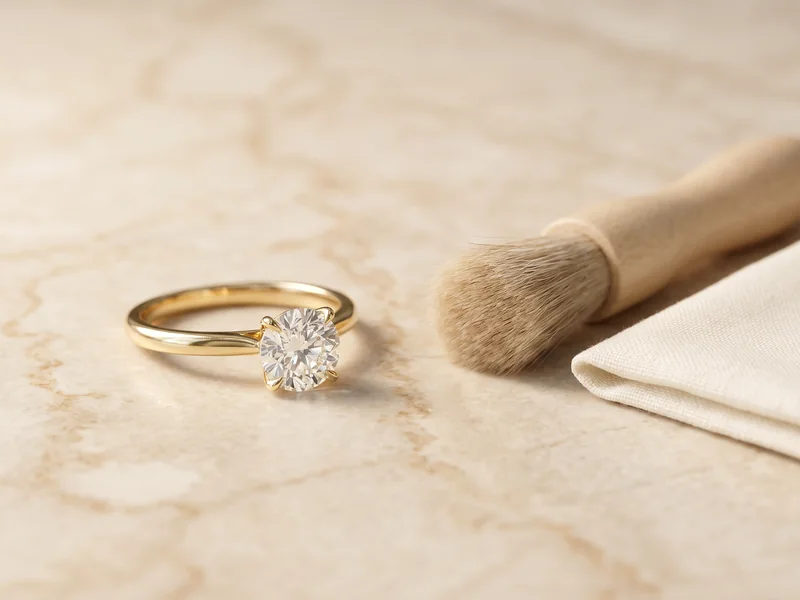
For everyday cleaning and storage between checks, our complete jewellery care and maintenance guide covers what to do at home and what to leave to a jeweller.
How much does it cost to fix an out of round ring in Australia?
Costs vary with the metal, the band width, the number of stones and whether claws or the shank need new metal. These are broad Australian ranges only; a jeweller can only quote properly after seeing the ring.
| Repair | What it involves | Approximate cost (AUD) |
|---|---|---|
| Reshape a plain band | Mandrel rounding and polish | about $30–$90 |
| Reshape and tighten stones | Rounding plus checking and tightening the setting | about $60–$200 |
| Re-tip a claw | Adding new metal to a worn claw tip | about $60–$150 per claw |
| Replace the head or claws | New setting for the centre stone | about $250–$700 |
| Half re-shank, gold | New lower half of the band | about $250–$800 |
| Half re-shank, platinum | New lower half of the band | about $400–$1,200 |
| Eternity ring reshape and reset | Rounding plus resetting loose or lost stones | quoted individually |
Replacing lost diamonds is extra: small melee stones may cost tens of dollars each, while a centre stone can cost thousands. That is why a reshape and tighten, done early, usually costs far less than the repair it prevents.
Jewellery repairs service
How do you stop a ring going out of round?
You cannot stop a ring from ever changing shape, but you can slow it down a great deal. The habits that matter most:
- Take it off for grip work. Weights, rowing, climbing, gardening and moving furniture are the main causes of bent bands. Our article on wearing rings to bed and to the gym suggests simple routines.
- Choose a sensible band thickness. For an engagement ring holding a centre stone, a shank around 1.6–2.0 mm deep is a practical minimum in gold or platinum.
- Pick a firmer alloy for fine bands. 14 ct gold or a harder platinum alloy holds its shape better than 22 ct gold or sterling silver.
- Get the size right. A ring that spins on your finger takes knocks on the head and the shank alike. A well-fitted ring, or a sizing insert for knuckles that are larger than the base of the finger, keeps it in position.
- Have it checked every 12 months. A jeweller can measure the shank and check the claws long before a stone is at risk. Ask for the condition of each claw to be checked at the same time.
- Store rings separately. A soft-lined box with individual slots stops rings pressing against each other and against heavier pieces.
What to do if your ring is out of round: step by step
- Check the stones first. Press gently on each stone with a fingernail. If anything moves, clicks or turns, stop wearing the ring.
- Store it safely. Put it in a small sealed bag or box, not loose in a pocket or bag, so no stone is lost on the way.
- Note what happened. A knock, a gym session or a slow change all help the jeweller understand the cause.
- Get it inspected. Ask for the band thickness to be measured and every setting checked under magnification.
- Ask about the options. Rounding alone, rounding plus claw work, or re-shanking if the band is too thin to hold its shape.
- Change the habit. Take the ring off for whatever caused the bend, and book a check every 12 months.
Free consultation
Talk to a gemologist
Compare stones in person or online with Raj Sood, Graduate Gemologist (GIA), AJP (GIA).
Book a consultationShop this shape
FAQ
Common questions
Can a ring that is out of round be fixed?
Yes, almost always. Most gold and platinum rings can be reshaped on a mandrel, and if the band is worn too thin it can be re-shanked with new metal. Tungsten carbide rings are the exception, because they cannot be bent back into shape.
Why is my wedding band out of round?
Usually from gripping pressure, such as weights or tools, combined with a thin band or a softer metal. Wedding bands worn beside an engagement ring also wear each other down where they touch.
Does platinum go out of round?
It can. Platinum is dense and tough, and it wears more slowly than gold, but a thin platinum band can still be pushed oval, and some platinum alloys are relatively soft.
Is it safe to wear a ring that is slightly oval?
A slight oval with every stone tight is not urgent, but have it reshaped at your next check. If any stone moves or a claw has lifted, stop wearing the ring until it is repaired.
How long does it take to reshape a ring?
A simple reshape on a plain band can take minutes. A ring that needs stones tightened, claws re-tipped or a new shank may take from several days to a couple of weeks, depending on the work involved.
Will resizing make my ring go out of round?
A careful resize should leave the ring round, but heating softens the metal and adds a join, and stretching thins the band. Rings resized several times, or stretched up a lot, tend to bend more easily.

Ask a gemologist
Not sure which diamond to choose?
Raj Sood is a Graduate Gemologist (GIA) and master jeweller. Bring the stones you are considering, or send the reports, and he will tell you honestly which one is better and why.
Keep learning
Related guides
 Care, Repairs & RemodellingRing Resizing: What Determines Whether a Ring Can Be Resized?Care, Repairs & RemodellingJewellery Care and Maintenance
 Engagement Rings & SettingsClaw Types: Round, Eagle, Tab, V-Prong, DoubleCare, Repairs & RemodellingCan You Sleep or Work Out in Your Ring?
 Engagement Rings & SettingsBest Settings for Round DiamondsWedding Bands & EternityBest Wedding Band for Round Engagement RingsEngagement Rings & SettingsWhich Finger Does an Engagement Ring Go On?
 Diamond Anatomy & LightPainting and Digging Out in Round Diamonds
Explore more
More guides on this topic
Education