
- Education
- Lab-Grown Diamonds
- Should a Lab-Grown Diamond Be Insured? A Guide to Lab-Grown Diamond Insurance in Australia
Lab-Grown Diamonds
Should a Lab-Grown Diamond Be Insured? A Guide to Lab-Grown Diamond Insurance in Australia
Lab-grown diamond insurance is not quite the same as insuring a natural stone: prices move faster, valuations date quickly and the paperwork has to be exact. Here is how to cover a lab-grown diamond properly in Australia without paying for value you would never get back.
 Reviewed by Raj Sood, Graduate Gemologist (GIA), AJP (GIA)Master jeweller and Graduate Gemologist (GIA) · reviewed 4 November 2026
Quick answer
Usually yes. A lab-grown diamond is real diamond and can be lost, stolen or damaged like a natural one. Insure it for a realistic replacement value rather than the purchase price, make sure the valuation says lab-grown, list it as a specified item if it exceeds your contents cap, and update the valuation every two to three years.
Do you need lab-grown diamond insurance?
A lab-grown diamond is real diamond. It is the same carbon crystal as a mined stone, 10 on the Mohs hardness scale, with a refractive index of about 2.42, and our page on why lab-grown diamonds are real diamond explains the science. What it does not carry is the price of a natural diamond, and that leads many people to ask whether insurance is worth it at all.
The risks, though, are identical. The diamond does not know where it was grown. The most common problems we see across the counter are loss (a stone working loose from worn claws, or a ring left at the gym or on a basin), theft (often of a whole jewellery box during a break-in) and damage. Diamond is very hard but not unbreakable: a sharp knock on a thin edge or a point can chip it, and our guide to how diamonds chip and what a cavity is shows what that looks like.
Insurance does not protect a diamond's value. It pays to repair or replace the piece if something goes wrong. So the real question is simple: if this ring or pair of earrings disappeared tomorrow, could you comfortably pay to replace it out of your own pocket? If not, it is worth insuring.
- Usually worth insuring: engagement rings, anything worth more than your contents policy's per-item limit, pieces worn every day, and jewellery you travel with.
- May already be covered: small studs or a pendant worth less than your contents cap, kept mostly at home.
- Easy to forget: the setting. On a lab-grown ring, the 18 carat gold or platinum mount and the jeweller's labour can make up a large share of the replacement cost, sometimes as much as the stone itself.
If you are still deciding between lab-grown and natural, or want the full background before you buy, start with our complete lab-grown diamonds guide.
How is a lab-grown diamond valued for insurance?
An insurance valuation is a written estimate of retail replacement cost: what it would cost today to buy an equivalent piece, new, from a retail jeweller in Australia. It is not a resale figure, and it is not what a dealer would pay you for the stone. In Australia, valuations are usually written by a qualified valuer; many are registered with the National Council of Jewellery Valuers (NCJV), which sets standards for how valuations are prepared.
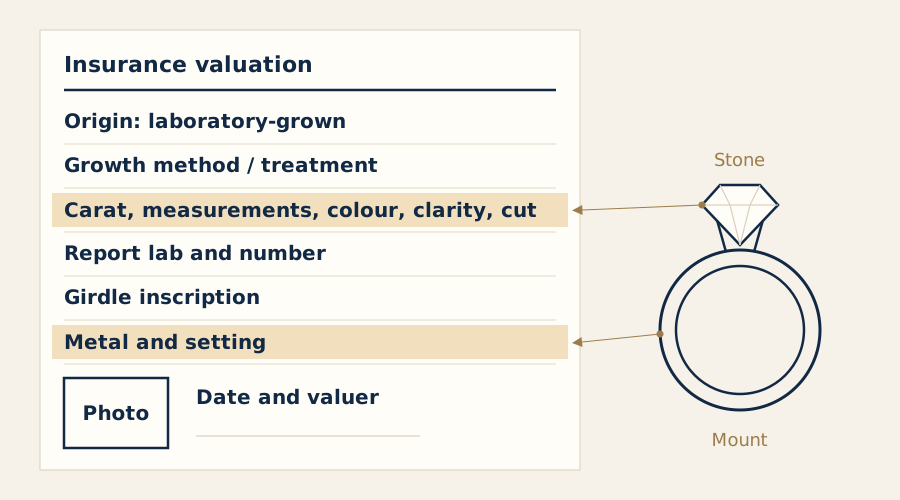
For a lab-grown diamond, a useful valuation should include:
- Origin: stated plainly as lab-grown or laboratory-grown, never just “diamond”.
- Growth method if the report states it: CVD (chemical vapour deposition) or HPHT (high pressure, high temperature). Our page on the CVD and HPHT growth methods explains the difference.
- Treatment: whether the stone has had post-growth treatment such as HPHT annealing, which many CVD diamonds receive to improve colour.
- The 4Cs and measurements: carat weight, millimetre dimensions, clarity, cut and colour, using the same scale as the report. See how colour is graded on lab-grown stones and cut grades for lab-grown diamonds.
- Report details: the grading lab, report number and any girdle inscription.
- The mount: metal and fineness (for example 18 carat yellow gold or 950 platinum), weight, setting style and any side stones.
- Photos, the date and the valuer's name and qualifications.
A purchase receipt is not the same thing. Some insurers accept a recent receipt for newly bought pieces, but a receipt rarely lists the grades and mount details an insurer needs to replace the piece accurately. A proper valuation does.
Is a lab-grown diamond covered by home contents insurance?
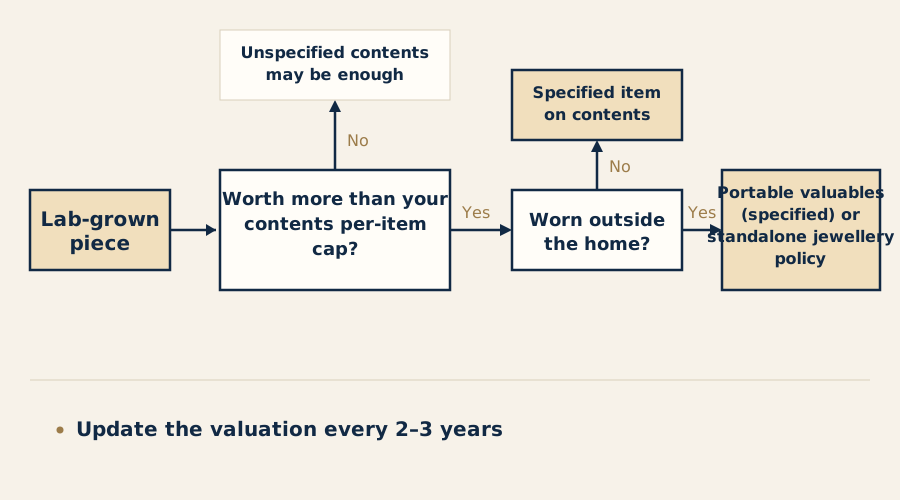
Often partly. Most Australian home contents policies cover jewellery inside your home, but with limits. There is usually a per-item cap for unspecified jewellery, commonly somewhere around AUD $1,000–$2,500, and sometimes an overall limit for all jewellery combined. Anything worth more than the cap is only paid up to the cap unless you list it separately.
Cover away from home is a separate question. A ring lost at the beach or stolen from a hotel room is generally not covered by basic contents cover. For that you need portable valuables cover (the name varies by insurer), either for unspecified items up to a small limit or for specified items you list by name.
| Type of cover | Where it applies | Typical limit | Suits |
|---|---|---|---|
| Unspecified contents | At home only | Per-item cap, often about $1,000–$2,500 | Small studs, pendants, everyday pieces under the cap |
| Specified item on contents | At home only | The value you list, backed by a valuation | Higher-value pieces kept mostly at home |
| Portable valuables (specified) | At home and away, sometimes overseas too | The value you list | Engagement rings and anything worn daily |
| Standalone jewellery policy | At home and away | The value you list | Several valuable pieces, or renters without contents cover |
Earrings and bracelets raise one more issue. Many policies have a pairs and sets clause: if you lose one stud, the insurer may only pay for that one, not the pair. That matters for lab-grown tennis bracelets and studs, where matching stones are part of the value. Check how your policy handles it before you need to claim.
What does lab-grown diamond insurance cost in Australia?
Jewellery premiums in Australia are commonly in the range of about 1–2% of the insured value per year, though they vary widely with your postcode, your chosen excess (the amount you pay towards each claim), home security, claims history and whether the cover applies away from home. Some insurers bundle specified jewellery into a contents policy for a modest extra cost; standalone jewellery insurers price each item separately.
| Example piece | Approximate replacement value (AUD) | Rough annual premium at 1–2% |
|---|---|---|
| Lab-grown 1 ct solitaire, 18 carat gold | about $2,000–$4,000 | about $20–$80 |
| Lab-grown 2 ct solitaire, platinum | about $3,500–$7,000 | about $35–$140 |
| Lab-grown studs, 1 ct total weight | about $1,000–$2,000 | often within a contents cap |
| Natural 1 ct solitaire, 18 carat gold | about $8,000–$16,000 | about $80–$320 |
These are illustrative ranges only, not quotes. Because lab-grown diamonds cost much less than natural diamonds of the same grades, the premium to cover them is small. That is an argument for insuring, not against: a modest yearly cost protects a ring that would still be expensive to replace, especially once you add the metal and the setting work.
Keep the excess in mind too. If your excess is $500 and the piece is worth $900, a claim would only return $400, and it may affect future premiums. For low-value pieces, self-insuring (simply accepting the risk) can be sensible.
Not sure which one is right?
Send us the stones you are looking at and our gemologist will tell you which to choose and why.
Agreed value or replacement: which policy suits a lab-grown diamond?
How your insurer settles a claim matters more than the headline sum insured. Australian policies generally work in one of the ways below, and the Product Disclosure Statement (PDS), the document that sets out exactly what the policy covers, tells you which applies.
| Basis | What you get | Watch out for |
|---|---|---|
| Agreed value | The amount you and the insurer agree at the start, usually from your valuation | You pay premiums on that figure, so set it realistically |
| Replacement (new for old) | An equivalent new piece, or the cost of one | Often capped at the lesser of the sum insured or the actual replacement cost |
| Market value | What the piece is worth at the time of loss | Can be well below what you paid, especially for lab-grown |
| Cash settlement | Money instead of a replacement | Some insurers pay what it would cost them to replace, which can be less than retail |
The most common mistake with lab-grown diamonds is over-insuring. Many replacement policies pay the lesser of the sum insured or the cost to replace. If you insure a lab-grown ring for $6,000 but an equivalent ring now costs $3,000 to replace, you will usually receive about $3,000, having paid premiums on $6,000 for years. Under-insuring is the opposite risk: insure for too little and you may not be able to replace like with like.
Related guideLab-Grown Diamonds vs Natural DiamondsWhy do lab-grown diamond valuations go out of date so fast?
Lab-grown diamond prices have fallen sharply over the past several years as production has expanded and growing techniques have improved. A lab-grown valuation written three or four years ago may be well above what it costs to replace the same stone today. Natural diamond prices move as well, in both directions, but generally more slowly; our page on how lab-grown and natural diamonds compare on price sets out the gap.
That is why we suggest updating a lab-grown valuation every two to three years, and whenever you change insurer or renew a specified-item policy. The aim is a sum insured that tracks the real replacement cost, so you are neither paying for value you cannot claim nor left short.
It also helps to be clear about what the number means. Neither lab-grown nor natural diamonds should be bought as an investment, and an insurance value is not a resale price. It is simply what it would cost to put an equivalent piece back on your hand.
Browse lab-grown diamonds
What should the grading report and valuation say about a lab-grown diamond?
Most lab-grown diamonds sold in Australia come with a grading report from an independent lab such as IGI or GIA. GIA offers more than one type of lab-grown assessment, and our guide to the difference between GIA's premium and standard lab-grown reports explains what each includes. Either way, keep the original report with your valuation; your insurer may ask for a copy at claim time.
Things on the report that matter for insurance:
- The origin statement: lab-grown reports state clearly that the stone is laboratory-grown, usually in the report title.
- Report number: IGI lab-grown report numbers usually begin with “LG”. Write the number on your valuation and policy schedule.
- Girdle inscription: most graded lab-grown diamonds have the report number, and often the words “lab-grown”, laser-inscribed on the girdle (the thin outer edge). It is visible with a 10× loupe and helps identify your stone if it is recovered.
- Measurements and grades: carat, millimetre dimensions, colour, clarity and, for rounds, a cut grade (GIA's newer lab-grown reports may give a premium or standard description instead).
- Growth method and treatment where the lab records them.
Exact wording matters. Under the Australian Consumer Law, a lab-grown diamond must not be described in a way that misleads someone into thinking it is natural. A valuation that calls a lab-grown stone simply a “diamond” at natural prices is inaccurate, and if the insurer later identifies the stone, the claim could be disputed. Standard diamond testers cannot tell lab-grown from natural, as our page on how lab-grown stones test on a diamond tester explains; identifying origin takes specialised lab equipment. For the same reason, a simulant is never a diamond at all: see why cubic zirconia is a different material.
If any term on the report or valuation is new to you, our glossary of jewellery terms explains each one.
What happens when you make a lab-grown diamond insurance claim?
A claim for a lab-grown diamond follows the same path as any jewellery claim. You report the loss promptly, get a police report number for a theft, and provide your valuation, the grading report, photos and proof of ownership. The insurer then decides whether to repair, replace or pay cash, according to the PDS.
Replacement means like for like. A lab-grown diamond is replaced with a lab-grown diamond of the same shape, carat, colour, clarity and cut, in the same metal and setting style. Some insurers replace through their own preferred suppliers; others let you choose your jeweller. If you have a strong preference, say a jeweller who made a custom ring, look for a policy that allows it.
Partial claims are common too: a stone lost from a worn claw, a chipped edge, or a bent band. These are usually handled as repairs, with the missing stone replaced to the same grades and the setting rebuilt.
Keep the description factual throughout. Marketing phrases do not belong on a valuation or claim, and our note on careful wording around conflict-free claims explains why loose terms cause trouble. If you disagree with how an insurer handles your claim, you can use its internal complaints process and then the Australian Financial Complaints Authority (AFCA), a free, independent service.
How do you insure a lab-grown diamond? Step by step
- Gather the paperwork. Keep the grading report, receipt and any certificate for the mount together, in a safe place and as scanned copies.
- Get an insurance valuation. Ask a qualified valuer for a written retail replacement valuation that states lab-grown or laboratory-grown, the report number and the full mount details.
- Check your contents policy. Find the per-item jewellery cap, the total jewellery limit and whether cover applies away from home.
- Decide how to cover it. Specify the piece on your contents policy, add portable valuables cover, or take out a standalone jewellery policy.
- Read the settlement basis. Confirm whether the policy pays agreed value, replacement or cash, and whether you can choose the jeweller.
- Set a realistic sum insured. Use the current replacement value, not the original price, so you are not paying premiums on value you cannot claim.
- Look after the setting. Have claws checked about once a year; many policies expect reasonable care, and a worn claw is the usual cause of a lost stone.
- Update every two to three years. Refresh the valuation and adjust the sum insured as lab-grown prices change.
Free consultation
Talk to a gemologist
Compare stones in person or online with Raj Sood, Graduate Gemologist (GIA), AJP (GIA).
Book a consultationShop this shape
FAQ
Common questions
Is it worth insuring a lab-grown diamond?
Usually, yes. A lab-grown diamond can be lost, stolen or chipped like any diamond, and the premium is small because lab-grown stones cost much less than natural ones. For very small pieces under your contents cap, existing cover may be enough.
How much should I insure my lab-grown diamond ring for?
Insure it for its current retail replacement cost, taken from a recent written valuation, not the price you paid years ago. Many policies only pay the lesser of the sum insured or the actual replacement cost, so over-insuring rarely helps.
Does home contents insurance cover a lab-grown engagement ring?
Often only up to a per-item limit, commonly around $1,000–$2,500, and usually only inside your home. To cover it in full and away from home, list it as a specified item or add portable valuables cover.
Do insurers treat lab-grown diamonds differently from natural diamonds?
The cover works the same way, but the valuation must state that the stone is lab-grown and the insurer will replace it with a lab-grown diamond of the same grades. Values also need updating more often because lab-grown prices have been falling.
How often should a lab-grown diamond be revalued?
Every two to three years, or whenever you change insurer. Lab-grown prices have moved faster than natural prices, so an old valuation can overstate the replacement cost.
What documents do I need to insure a lab-grown diamond?
A written insurance valuation, the grading report from a lab such as IGI or GIA, your receipt and clear photos. Make sure the report number on all of them matches the girdle inscription.
Ask a gemologist
Not sure which diamond to choose?
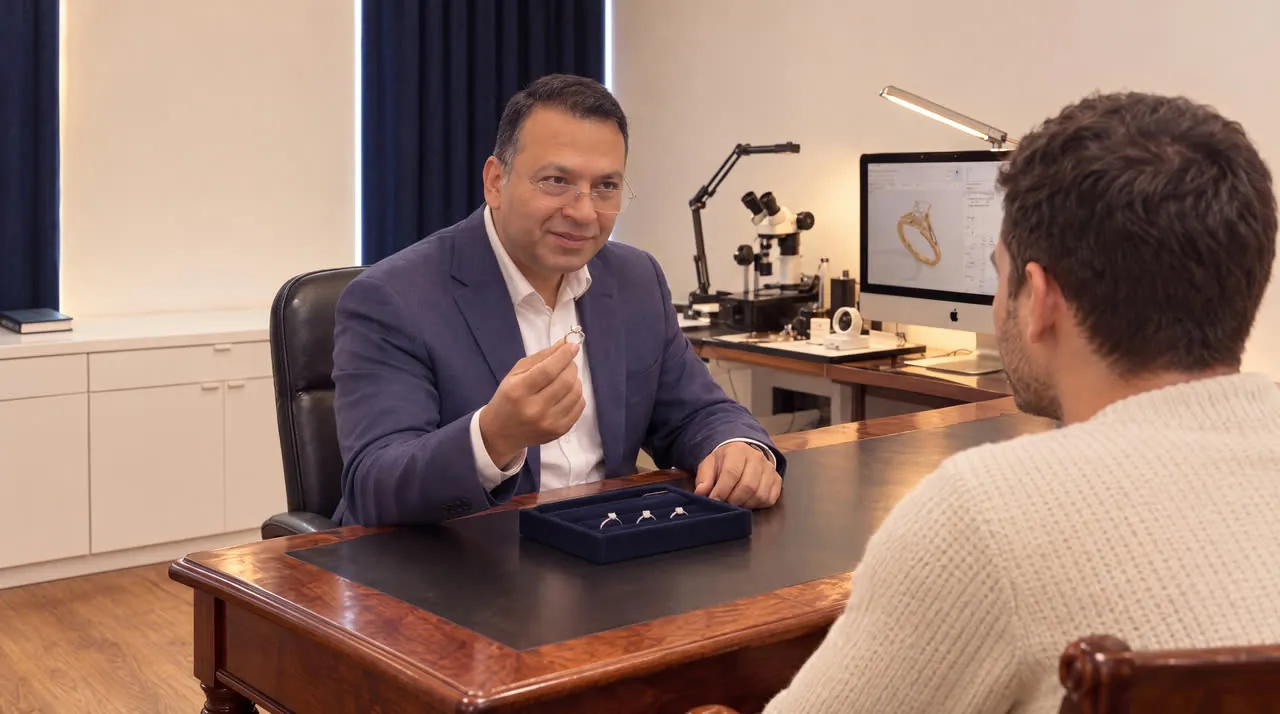
Raj Sood is a Graduate Gemologist (GIA) and master jeweller. Bring the stones you are considering, or send the reports, and he will tell you honestly which one is better and why.
Keep learning
Related guides
 Lab-Grown DiamondsLab-Grown Diamonds vs Natural Diamonds
 Lab-Grown DiamondsGIA Premium vs Standard Lab-Grown Diamond Assessments
 Lab-Grown DiamondsDo Lab-Grown Diamonds Test as Diamonds
 Lab-Grown DiamondsAre Lab-Grown Diamonds Real Diamonds
 Lab-Grown DiamondsHow Are Lab-Grown Diamonds Manufactured?Lab-Grown DiamondsLab-Grown Diamond Cut QualityLab-Grown DiamondsLab-Grown Diamond Colour Grades
Explore more
More guides on this topic
Education