
- Education
- Certificates & Valuations
- Certified vs Uncertified Diamonds: What Certified Diamonds Really Give You
Certificates & Valuations
Certified vs Uncertified Diamonds: What Certified Diamonds Really Give You
Certified diamonds come with an independent record of what you are paying for; uncertified diamonds come with the seller's word. Here is what a report proves, what it does not, and how it differs from an Australian insurance valuation.
 Reviewed by Raj Sood, Graduate Gemologist (GIA), AJP (GIA)Master jeweller and Graduate Gemologist (GIA) · reviewed 4 November 2026
Quick answer
A certified diamond comes with a grading report from an independent laboratory such as GIA, IGI or HRD that records its weight, colour, clarity, cut and whether it is natural or lab-grown. Uncertified diamonds rely on the seller's word. For any centre stone over 0.30 carat, certified diamonds are the safer choice and easier to value, insure and compare.
What are certified diamonds?
A certified diamond is one that has been examined by an independent gemmological laboratory and issued a grading report. The trade still says "certificate", but the labs themselves call the document a report, because it records the lab's opinion of the stone's characteristics on the day it was graded. It does not certify a price or a value. Our overview of diamond certificates and jewellery reports covers every document type, from full grading reports to short identification reports.
A full report records the 4Cs (carat, colour, clarity and cut), the measurements in millimetres, the proportions, polish, symmetry and fluorescence (a glow some diamonds show under ultraviolet light). Just as importantly, it states whether the diamond is natural or laboratory-grown and whether it has been treated. Diamonds are graded loose, out of any setting, so the lab can weigh the stone to a hundredth of a carat and examine it from every angle under 10× magnification.
Both natural and lab-grown diamonds can be certified. A lab-grown diamond is real diamond, with the same hardness (10 on the Mohs scale) and refractive index (about 2.42), grown in a laboratory rather than mined. Its report says so on the front, and the stone is usually laser-inscribed with a lab-grown mark on its girdle (the thin edge around the widest part). The two report types look similar but differ in important details, which we compare in how natural and lab-grown diamond reports differ. If any term on a report is unfamiliar, our plain-English jewellery glossary explains it.
What does an uncertified diamond mean?
An uncertified diamond has no independent report. That does not make it a poor or fake diamond. It simply means the only description of the stone comes from the person selling it. Diamonds end up uncertified for a few common reasons:
- Small stones: melee (small diamonds, roughly under 0.18–0.20 carat) used in pavé, halos and bands are almost never graded individually, because the lab fee would be out of proportion to the stone's value.
- Older jewellery: inherited and vintage pieces often predate routine grading, or the paperwork has been lost over the years.
- In-house grading: some sellers issue their own "certificate". That is an assessment by an interested party, not an independent report, however official it looks.
- Stones kept away from the lab: occasionally a seller skips grading because they expect a lower result than they plan to advertise.
The last two matter most. Grading is a fine judgement, and the step from G to I colour, or from VS2 to SI2 clarity, is very hard for an untrained eye to see. Yet on a 1 carat natural diamond those steps can move the price by thousands of dollars. A seller's description such as "G–H, VS–SI" gives you nothing firm to check against, and nothing to rely on if the stone is later valued lower.
Even a genuine report from a respected lab has limits. It describes the stone, not how it will look on your hand, and we set those limits out in full in the gaps a diamond report leaves.
Certified vs uncertified diamonds: what is the difference?
| Certified diamond | Uncertified diamond | |
|---|---|---|
| Who describes the stone | Independent laboratory | The seller |
| Natural or lab-grown | Stated on the report and usually inscribed | Seller's statement; needs testing to confirm |
| Treatments | Detected and disclosed by the lab | May not be known or disclosed |
| Colour and clarity | Graded under controlled lighting and magnification | Estimated, often as a range |
| Can you verify it? | Yes, report number checked on the lab's website | No independent record |
| Comparing prices | Like-for-like comparison across sellers | Hard to compare fairly |
| Insurance valuation | Valuer can confirm the stone against the report | Valuer must grade from scratch, often while set |
| Where it is normal | Centre stones, loose diamonds, studs from about 0.30 ct | Melee, accent stones, older jewellery |
The core difference is accountability. With certified diamonds, three parties can check the same facts: you, the seller and the lab. With an uncertified stone, you are relying on one person's skill and honesty. Many jewellers are both skilled and honest, but a report removes the need to take anyone's word for it.
A report also changes what happens years later. If you insure the ring, sell it, pass it on, or need it valued for an estate, the report travels with the stone and saves the next valuer from guessing, especially once the diamond is set and harder to examine.
Which diamond grading labs can you trust?
A report is only as useful as the lab behind it. Labs differ in how strictly they grade, so the same diamond might be called G colour by one lab and H by another. That one-grade gap is why two "G VS2" diamonds from different labs are not always the same thing. The labs you will meet most often in Australia:
| Lab | What it is known for | What to keep in mind |
|---|---|---|
| GIA (Gemological Institute of America) | Created the D–Z colour and modern clarity scales; consistent, strict grading | The reference standard for natural diamonds |
| IGI (International Gemological Institute) | Grades a very large share of lab-grown diamonds; also grades natural stones | Widely used in Australian retail |
| HRD Antwerp | Belgian lab with a strong European following | Uses its own report layout and terminology |
| AGS (American Gem Society) | Known for its 0 to 10 cut grading and light performance focus | Stopped issuing new reports in 2022; older reports still circulate |
| GSI (Gemological Science International) | Often used by large chain retailers, including for jewellery | Check how its grades compare before paying the same price |
| EGL (various labs) | Several independently run labs under one name | Historically linked with looser grading; compare carefully |
| GCAL | Light performance and optical symmetry imaging | Useful alongside a standard grading report |
For a side-by-side view of strictness and report features, see our GIA, IGI and HRD comparison and the wider comparison of every major grading lab. If you are looking at a particular document, we also walk through the IGI natural diamond report and the HRD report, section by section.
For older or less common reports, read up before you compare prices: what an AGS report and its 0 cut grade mean, and how GSI and EGL grading stacks up. As a working rule, compare diamonds graded by the same lab whenever you can.
Not sure which one is right?
Send us the stones you are looking at and our gemologist will tell you which to choose and why.
What does a diamond grading report show?
A full grading report for a round brilliant usually includes:
- Report number and date: the number links the paper to the stone and to the lab's online database.
- Shape, cutting style and measurements: for example, round brilliant, 6.42–6.45 × 3.96 mm.
- Carat weight: to two decimal places, such as 1.01 ct.
- Colour grade: D (colourless) to Z (light yellow or brown).
- Clarity grade: FL, IF, VVS1, VVS2, VS1, VS2, SI1, SI2, I1, I2, I3.
- Cut grade: Excellent to Poor, given for round brilliants on GIA reports; fancy shapes get polish and symmetry only.
- Polish, symmetry and fluorescence: finish quality and ultraviolet reaction, from None to Very Strong.
- Plotting diagram: a map of where the inclusions (internal features) sit.
- Proportions diagram: table size, crown and pavilion angles, depth and girdle thickness.
- Inscription and comments: any laser inscription on the girdle, plus notes on treatment or growth method.
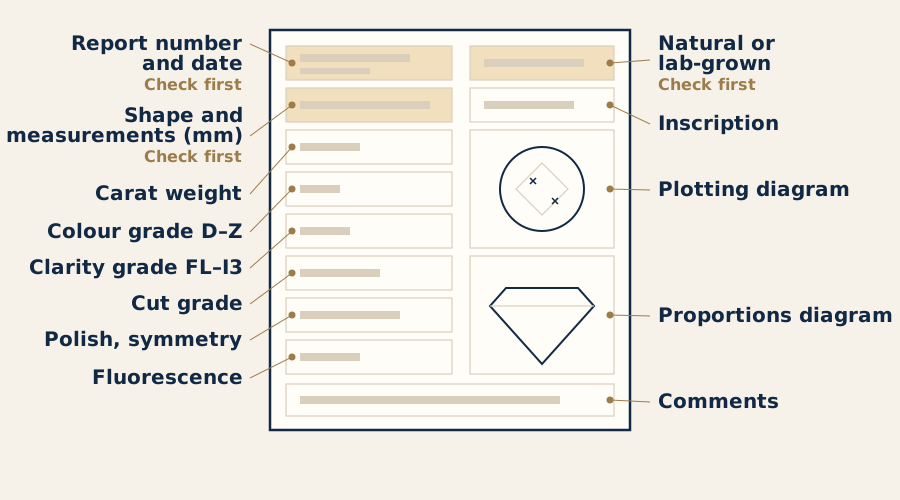
Our step-by-step guide on reading a GIA diamond report line by line goes through each box, with what good and weak results look like. Two details are easy to miss: the measurements, which help prove the paper belongs to the stone in front of you, and the comments, where treatments, extra clouds that do not appear on the plot, or growth methods are noted.
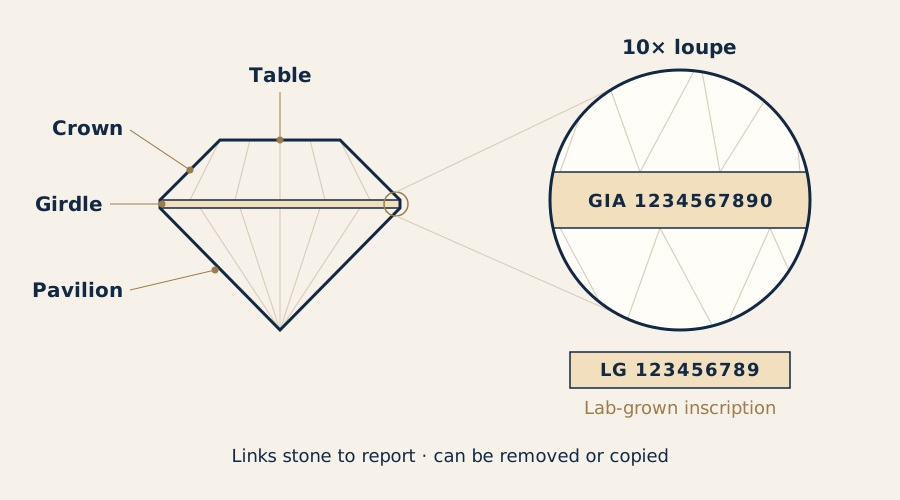
Most certified diamonds carry the report number laser-inscribed on the girdle, readable with a 10× loupe. It is a strong link between stone and paper, but not an unbreakable one: an inscription can be polished off or copied onto another stone. Our guide to what a laser inscription does and does not prove explains why the measurements and plot still matter.
Related guideHow to Read a GIA Diamond ReportWhat does a diamond certificate not tell you?
A grading report is a precise description, but it leaves out several things that affect how a diamond looks and what it is worth to you:
- Light performance: two diamonds with identical grades can differ in brightness and contrast. Fancy shapes usually have no overall cut grade at all. Specialist light performance reports such as GCAL measure this directly.
- Where an inclusion shows: an SI1 with a small crystal under a facet edge can be eye-clean; another SI1 with a dark crystal under the table may not be.
- Durability risks: the report notes girdle thickness but does not tell you whether a feather (a small internal crack) near the edge could be a weak point once set.
- Origin: a standard report does not say which country or mine a natural diamond came from. That needs a separate diamond origin report, available for a limited share of natural stones.
- Value: a report never states a price or replacement value.
That is why a report should start the conversation, not end it. Ask to see the stone or a 360° video under the same lighting as others you are comparing, and have someone with a loupe show you where the plotted inclusions actually sit.
Is a diamond certificate the same as a valuation?
No, and confusing the two is one of the most common mistakes Australian buyers make. A grading report describes the loose diamond's characteristics and is issued by a lab. A valuation (often called an appraisal overseas) is a written estimate of what the finished piece is worth for a stated purpose, prepared by a jewellery valuer. Our guide to how a valuation differs from a diamond certificate sets the two documents side by side.
In Australia, most jewellery valuations are prepared for insurance. They usually state a retail replacement value: what it would cost to replace the piece with one of like kind and quality. They describe the metal, the setting, every stone and, for certified diamonds, the report number and grades. The valuer can then confirm the set diamond matches the report rather than estimating its grades while it sits in claws. Look for a valuer registered with the National Council of Jewellery Valuers (NCJV).
Insurers generally want a recent valuation, and many valuers suggest updating it every two to three years as metal and diamond prices move. Our page on what an insurance jewellery valuation includes covers what insurers look for. Valuations for other purposes use different value bases: an estate, a divorce settlement or a sale needs a fair market value, not a replacement figure. See valuations for deceased estates and family law.
| Grading report | Insurance valuation | |
|---|---|---|
| Issued by | Independent gemmological lab | Jewellery valuer |
| Describes | The loose diamond only | The whole piece: metal, setting, all stones |
| States a value? | No | Yes, usually retail replacement value in AUD |
| How long it stays current | Grades do not change unless the stone is damaged or altered | Typically updated every 2–3 years |
| Main use | Buying, comparing, identifying | Insurance, estates, family law |
Are certified diamonds worth it?
For any diamond that carries most of the cost of a piece, yes. Lab fees depend on weight and report type, and for a 1 carat stone they typically sit somewhere around AUD $100–$300 including handling. That is a small fraction of the stone's price, and it buys an independent check of the grades that set that price.
Uncertified diamonds are sometimes advertised at what look like lower prices. Often the price simply reflects grades that would come back lower from a lab. Once you allow for a likely one- or two-grade difference, the saving often disappears. Treat any uncertified stone priced as if it were certified with caution.
There are sensible cases where an uncertified diamond is perfectly reasonable:
- Melee and accent stones in halos, pavé and eternity bands, where you judge the overall look rather than each stone.
- Small studs or pendants under about 0.30 carat, where the report fee is a large share of the stone's value.
- Inherited and vintage jewellery, where the piece's history matters more than paperwork. A valuer can still describe the stones, and a loose centre stone can be sent for grading if you want certainty.
- Remodelling family stones, where you already own the diamond and are not paying for its grades.
When comparing natural and lab-grown, certification matters for both. Lab-grown diamonds cost much less than natural diamonds of the same grades, and a report is what confirms which one you are buying.
Browse natural and lab-grown diamonds
What should you check in certified diamond rings?
Certified diamond rings usually have a report for the centre stone only. The side stones, halo and pavé are normally uncertified melee, described on the sales paperwork by total carat weight and approximate colour and clarity. That is standard practice, but check the wording: "1.50 ct total weight" might mean a 1.00 ct certified centre plus 0.50 ct of small diamonds.
- Match the centre stone: the report's measurements and inscription should match the stone in the ring.
- Natural or lab-grown: confirm on the report and on the receipt, including for the side stones.
- Metal: the ring should be stamped with its alloy, such as 18ct or 950 platinum.
- Setting: the report says nothing about how securely the stone is held; check the claws or bezel.
If you are setting a certified diamond into a new ring, keep the original report with your valuation. Once the stone is set, the report is what lets a valuer, insurer or future jeweller identify it quickly.
How do you check a diamond certificate is genuine?
- Check the lab. Confirm the report comes from an independent lab such as GIA, IGI or HRD, not the seller.
- Verify the number online. Enter the report number on the lab's website; the online record should match the paper exactly.
- Find the inscription. Use a 10× loupe to read the girdle inscription and match it to the report number.
- Match the measurements. Compare the millimetre measurements and carat weight with the stone, ideally measured loose.
- Confirm natural or lab-grown. Read the report heading and comments, and check for treatment notes.
- Compare the plot. Ask to see one or two plotted inclusions under magnification.
- Get it valued. Have the finished piece valued for insurance, with the report number recorded on the valuation.
Free consultation
Talk to a gemologist
Compare stones in person or online with Raj Sood, Graduate Gemologist (GIA), AJP (GIA).
Book a consultationShop this shape
FAQ
Common questions
What does certified diamond mean?
It means an independent gemmological laboratory has graded the diamond and issued a report recording its carat, colour, clarity, cut, measurements and whether it is natural or lab-grown. The report describes the stone; it does not state a value.
Is an uncertified diamond fake?
No. An uncertified diamond can be perfectly genuine; it simply has no independent report, so its grades and origin rest on the seller's description. A gemmologist can test and grade it if you want certainty.
Which diamond certificate is most trusted?
GIA is widely treated as the reference standard for natural diamonds, and IGI grades a large share of lab-grown diamonds. Grading strictness varies between labs, so compare stones graded by the same lab where possible.
Do lab-grown diamonds come with certificates?
Most lab-grown diamonds sold loose or as centre stones come with a report, usually from IGI or GIA. The report clearly states the diamond is laboratory-grown, and the girdle is usually inscribed to match.
Is a diamond certificate enough for insurance in Australia?
Usually not on its own. Insurers generally ask for a valuation of the finished piece stating a replacement value, and a valuer will record the report number and grades as part of it.
Can I get an old diamond certified?
Yes. The diamond normally needs to be removed from its setting and sent to a lab, which can take several weeks. For a smaller stone, a valuation describing it may be more practical than a full report.

Ask a gemologist
Not sure which diamond to choose?
Raj Sood is a Graduate Gemologist (GIA) and master jeweller. Bring the stones you are considering, or send the reports, and he will tell you honestly which one is better and why.
Keep learning
Related guides
 Certificates & ValuationsGIA vs IGI vs HRD Diamond Certificates
 Certificates & ValuationsJewellery and Diamond Valuation
 Certificates & ValuationsHow to Read a GIA Diamond Report
 Certificates & ValuationsWhat a Diamond Report Doesn't Tell YouCertificates & ValuationsDiamond Certificates & Jewellery ReportsCertificates & ValuationsInsurance Jewellery Valuation ExplainedCertificates & ValuationsIGI Natural Diamond Report Explained
 Certificates & ValuationsHRD Diamond Report Explained
Explore more
More guides on this topic
Education