
- Education
- Jewellery Types
- Diamond Stud Earring Sizes by Carat: mm Chart, On-Ear Look and Settings
Jewellery types
Diamond Stud Earring Sizes by Carat: mm Chart, On-Ear Look and Settings
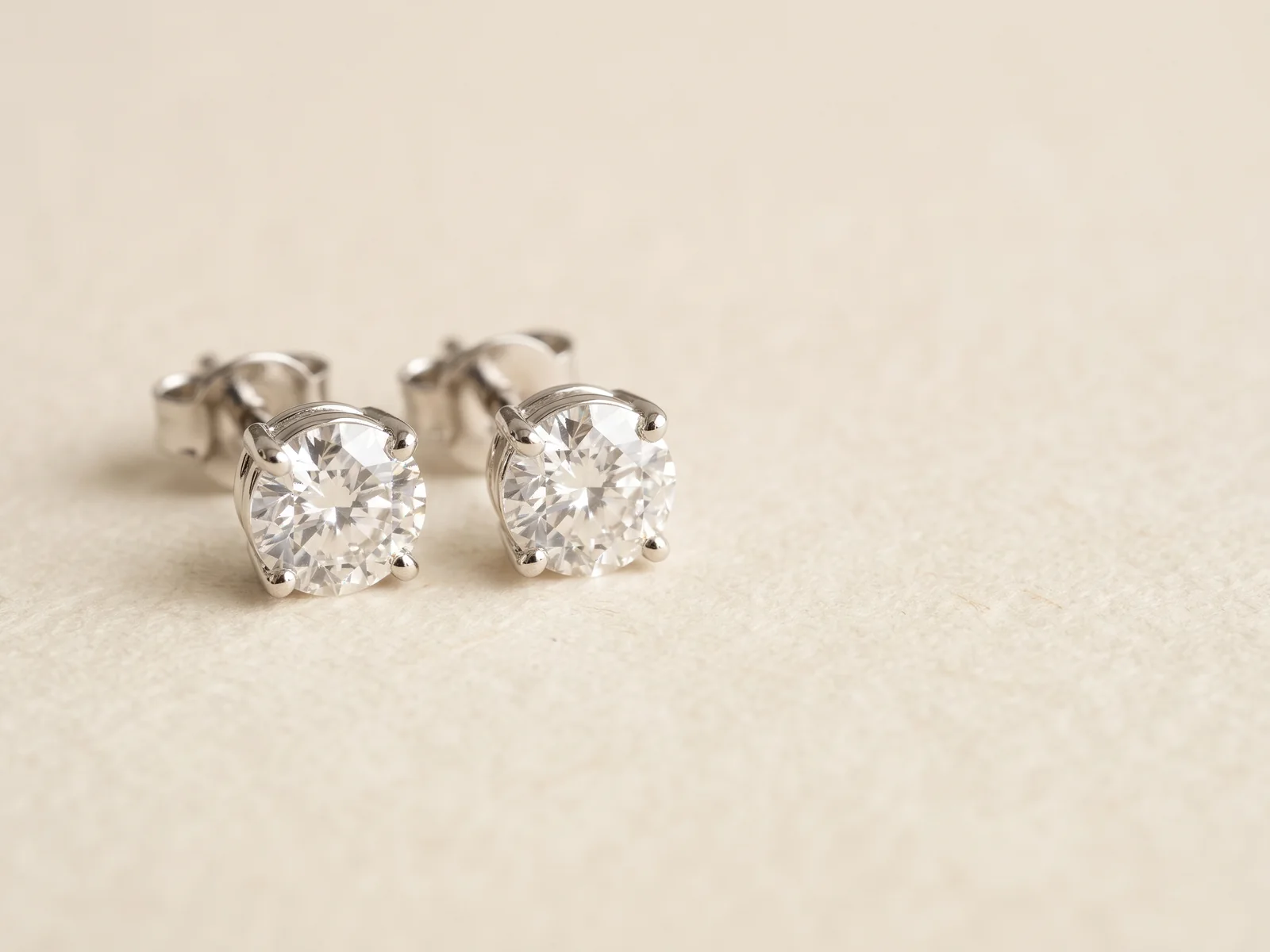
Carat weight on an earring tag is easy to misread, because most diamond stud earring sizes are quoted for the pair, not each ear. Here is what each size measures in millimetres, how it looks on the lobe, and which settings and backs keep it secure.
 Reviewed by Raj Sood, Graduate Gemologist (GIA), AJP (GIA)Master jeweller and Graduate Gemologist (GIA) · reviewed 4 November 2026
Quick answer
Diamond stud earring sizes are usually quoted in total carat weight (tw) for the pair, so 1 ct tw means two 0.50 ct stones. A round 0.25 ct stud measures about 4.1 mm, 0.50 ct about 5.1 mm, 1 ct about 6.5 mm and 2 ct about 8.1 mm. Most people choose 0.50–1.00 ct tw for everyday wear.
What do diamond stud earring sizes by carat mean?
A diamond stud is a single diamond on a straight post that sits flat on the earlobe. It is the simplest earring there is, and one of the pieces covered in our overview of jewellery types. Because there is nothing else to look at, the size of the diamond is the whole design, so it pays to understand exactly how that size is described.
Diamonds are sold by carat, a unit of weight, not size. One carat is 0.2 grams, and it is divided into 100 points, so a 0.25 ct diamond is a "25 pointer". Our page on how carat weight is measured explains why weight and visible size are not the same thing.
The catch with earrings is that the number on the tag is almost always the total carat weight of both diamonds added together. A pair sold as "1 carat diamond studs" usually holds two 0.50 ct stones, not two 1 ct stones. Look for these abbreviations:
- ct tw, TW or ctw: total weight of both studs. Halve it to get the weight in each ear.
- TDW: total diamond weight, used the same way. Both TDW and ct tw include any halo or accent diamonds, so check the centre stone weight separately.
- "each" or "per stone": the weight of one diamond. "1 ct each" is a 2 ct tw pair.
- Approximate weights: a pair labelled 1 ct tw might weigh 0.96–1.04 ct in total, and the two stones may differ by a few points.
Even per stone, weight only tells half the story. What you actually see on the ear is the diameter, the width across the top of the diamond in millimetres. Any unfamiliar word here is also defined in the GemTrove jewellery glossary.
Diamond stud earring sizes chart: how many millimetres is each carat?
This chart converts the total carat weight on a tag into the weight and diameter of each round brilliant stud, with a plain description of how it reads on the ear.
| Total weight (pair) | Each stud | Diameter each (round) | How it reads |
|---|---|---|---|
| 0.20 ct tw | 0.10 ct | about 3.0 mm | A fine point of light; suits second piercings |
| 0.33 ct tw | 0.17 ct | about 3.5 mm | Small and subtle |
| 0.50 ct tw | 0.25 ct | about 4.1 mm | The classic small stud |
| 0.75 ct tw | 0.37 ct | about 4.6 mm | Noticeable but understated |
| 1.00 ct tw | 0.50 ct | about 5.1 mm | The most popular everyday size |
| 1.50 ct tw | 0.75 ct | about 5.8 mm | Clearly visible at conversation distance |
| 2.00 ct tw | 1.00 ct | about 6.5 mm | A statement stud, 1 ct each |
| 3.00 ct tw | 1.50 ct | about 7.4 mm | Large; covers much of a small lobe |
| 4.00 ct tw | 2.00 ct | about 8.1 mm | Very large, 2 ct each |
| 6.00 ct tw | 3.00 ct | about 9.3 mm | Red-carpet size, 3 ct each |
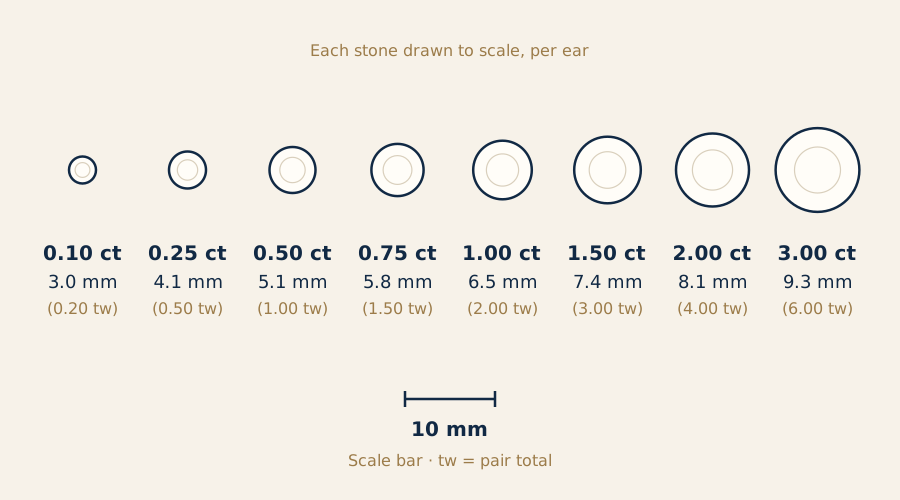
These figures are for a well-cut round brilliant with a depth percentage (the height of the stone divided by its width) of about 60–62%. A diamond cut deeper hides more weight underneath and faces up smaller; a shallower one spreads wider but can lose brightness. Two studs of the same weight can differ by 0.2–0.3 mm across because of this.
Notice how slowly diameter grows. Going from 0.50 ct to 1.00 ct per ear doubles the weight but only widens the stud from about 5.1 to 6.5 mm. The face-up area, the part you actually see, grows by roughly 60%, which is still a clear step up. For a close look at single-stone sizes, see what a 1 carat diamond looks like and our 2 carat diamond guide.
How big do diamond studs look on the ear?
A typical adult earlobe is roughly 15–20 mm from top to bottom, and a standard piercing sits around the middle of the soft part of the lobe. That gives you a useful frame for each size band:
- Under 3.5 mm (0.15 ct each or less): a delicate glint. Ideal for upper-lobe or second piercings, and for people who want something they forget they are wearing.
- 4–5 mm (0.25–0.50 ct each): the classic stud. Clearly a diamond from across a table, but never dominant.
- 5.5–6.5 mm (0.70–1.00 ct each): a confident size that is seen from a few metres away. On a small lobe it fills a good portion of the visible area.
- 7 mm and up (1.50 ct each or more): a statement. On smaller lobes the stud can reach close to the lobe edge, and weight starts to matter for comfort and droop.
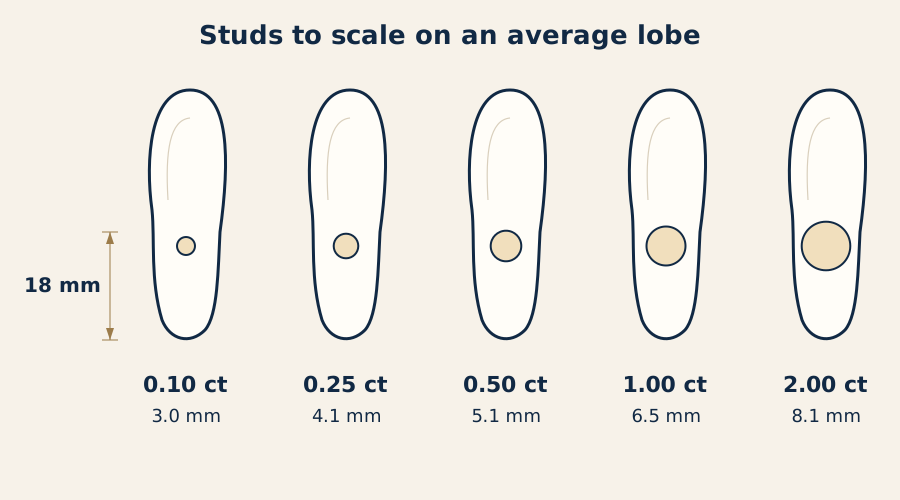
Your own features change the picture. Short hair and an open neckline show studs more; long hair worn down hides all but the largest. Smaller lobes make any stud look bigger. Yellow gold claws frame the stone and can make it read slightly warmer and larger, while white metal blends into the diamond. Cut quality matters too: a bright, well-proportioned stone looks larger than a dull one at the same weight, which is part of why two diamonds of the same carat can look different sizes.
The most reliable test is a printed or drawn circle of the right diameter held against your ear in a mirror at arm's length. That is roughly the distance at which other people see your earrings.
What size diamond studs should I get?
There is no correct size, only one that suits how you will wear them. As a starting point, by situation:
| Situation | Typical size each | Total weight |
|---|---|---|
| Second or third piercing | 0.05–0.15 ct (2.4–3.4 mm) | 0.10–0.30 ct tw |
| First diamond studs, everyday | 0.25–0.50 ct (4.1–5.1 mm) | 0.50–1.00 ct tw |
| Single stud worn in one ear | 0.25–0.50 ct | sold singly |
| Noticeable daily wear, special gift | 0.75–1.00 ct (5.8–6.5 mm) | 1.50–2.00 ct tw |
| Statement or evening studs | 1.50–2.00 ct (7.4–8.1 mm) | 3.00–4.00 ct tw |
| Very large studs | 2.50–3.00 ct (8.7–9.3 mm) | 5.00–6.00 ct tw |
Above about 1.5 ct per ear, most buyers choose lab-grown diamonds, simply because a matched natural pair at that size is a major purchase. If you are considering studs at the top of this range, our pages on 3 carat diamonds in detail, 4 carat diamond sizes and proportions and the 5 carat diamond guide cover what each single stone measures and weighs.
A sensible rule if you are unsure: go one step smaller than your first instinct for everyday wear. Studs are worn close to the face every day, and most people find 0.50–1.00 ct tw sits comfortably with everything from work clothes to evening wear.
Not sure which one is right?
Send us the stones you are looking at and our gemologist will tell you which to choose and why.
Do other diamond shapes look bigger than round studs?
Round brilliants dominate studs because they sparkle the most and look the same from every angle, but other shapes work well and some face up larger for their weight. Here is roughly how a 0.50 ct stone in each shape measures:
| Shape (0.50 ct each) | Approx. size | Face-up look vs round | Notes for studs |
|---|---|---|---|
| Round | about 5.1 mm | Baseline | Most sparkle; four or six claws |
| Princess (square) | about 4.4–4.6 mm | Slightly smaller | Corners need claws to protect them |
| Cushion | about 4.6–5.0 mm | Similar or slightly smaller | Soft, rounded square |
| Oval | about 6.0 × 4.1 mm | Looks larger, elongated | Wear vertically for a lengthening look |
| Pear | about 6.5 × 4.3 mm | Looks larger | Point usually worn down; V-claw protects it |
| Emerald | about 5.5 × 4.0 mm | Similar, less sparkle | Step cut shows clarity more |
| Asscher | about 4.4 mm | Smaller | Step cut, square, art deco look |
| Heart | about 5.4 × 5.0 mm | Similar | Shape reads best from 0.50 ct up |
These differences come from where the cutter keeps the weight. Elongated shapes spread more of it across the top; square and step cuts carry more in the depth. Lab-grown diamond has the same density as natural diamond (about 3.52), so the same weight gives the same size either way.
Coloured gemstones are a different story. Sapphire is denser than diamond, so a 0.50 ct sapphire stud is a little smaller, while emerald is lighter and looks larger at the same weight. Our page on how density changes size for coloured gemstones sets out the figures for each stone.
Which setting suits diamond stud earrings?
The setting decides how much diamond you see, how close it sits to the lobe and how safe it is. The main options:
- Four-claw: the most common setting. Shows the most diamond and gives a slightly square look from above.
- Six-claw: keeps the outline round and spreads the grip, so the stone stays secure if one claw wears.
- Three-claw martini: a cone-shaped setting with three claws that lets the diamond sit closer to the lobe, so it tips forward less.
- Basket: claws joined by a ring of metal underneath. Strong, but sits a little further from the ear.
- Bezel: a rim of metal around the whole edge. The most secure option for active lives, and it protects the girdle (outer edge) from knocks.
- Halo: a ring of small diamonds around the centre stone. A halo adds roughly 2–3 mm to the visible width, so a 0.25 ct centre can read closer to a 0.50 ct stud.
Metal is personal. Platinum and 18ct white gold suit bright white diamonds; 18ct yellow and rose gold add warmth and make lower colour grades look whiter. Studs are also the starting point for other styles: if you want the diamond to move, see how drop earring settings hang and swing, and for metal that hugs the lobe, our guide to hoop and huggie earring styles.
Related guideEarring Back TypesWhich earring backs are most secure for larger studs?
Most lost studs are lost because the back slipped off, not because the diamond fell out. The back matters more as the stone gets bigger and heavier.
- Push back (butterfly): two curled metal loops grip the post by friction. Easy to use, but they loosen over time and need squeezing back into shape.
- Screw back: the post is threaded and the back screws on. Very secure; a good choice from about 0.75 ct per ear and for anyone who sleeps in their earrings.
- Locking push back: pushes on like a butterfly, then a small lever or clasp locks it to the post.
- Large disc or support back: a wider back that spreads the load across the lobe, stopping heavier studs from tipping forward.
Larger studs droop because the diamond sits a few millimetres in front of the lobe on its setting, acting like a small lever. A 2 ct stud weighs only about 0.4 grams for the diamond, but the gold or platinum setting adds more. Our comparison of push, screw and lever earring backs covers fit, thread types and how to tell when a back is worn.
What colour, clarity and price should you expect for diamond studs, natural or lab-grown?
Earrings are seen from further away than rings, and the colour of a diamond face-up is hard to judge on the ear. That lets you be practical with grades. Most people are happy with G–I colour and SI1–SI2 clarity, as long as each stone is eye-clean (no inclusions visible without magnification). Cut quality is where to spend, because a bright stud reads larger and livelier.
Just as important is the match. A good pair should be within about 0.1 mm in diameter and one colour grade of each other, with similar brightness. Matched pairs cost more than two random stones of the same weight because the cutter or supplier has to find two stones that agree. From about 0.50 ct per ear, ask for an independent grading report (GIA or IGI) for each stone; smaller studs often come without reports.
Natural and lab-grown studs look identical on the ear. Lab-grown diamonds are real diamond, grown in a laboratory rather than mined; they cost much less, which is why larger sizes are far more common in lab-grown. Natural diamonds are rarer and priced accordingly. Approximate ranges for a pair of round studs, G–H colour, SI clarity, in 18ct gold four-claw settings:
| Total weight (pair) | Lab-grown (AUD, approx.) | Natural (AUD, approx.) |
|---|---|---|
| 0.50 ct tw | about $500–$1,200 | about $1,200–$2,500 |
| 1.00 ct tw | about $900–$2,000 | about $3,000–$6,000 |
| 2.00 ct tw | about $1,800–$4,000 | about $10,000–$20,000 |
| 3.00 ct tw | about $3,000–$6,000 | about $18,000–$40,000 |
These are broad ranges only; they move with the market, the exact grades and the metal. For the single-stone view, see lab-grown diamond sizes from 1 to 5 carats and our notes on choosing a 3 carat lab-grown diamond, which apply stone by stone to large studs.
Browse diamond earrings and jewellery
How do you choose diamond stud earring sizes? Step by step
- Convert the tag. Check whether the weight is total (ct tw) or per stone, and halve a total weight to get each ear.
- Find the diameter. Use the chart above, or the millimetre measurements on each report, rather than the carat number alone.
- Test it on your ear. Draw or print circles of two or three diameters and look in a mirror at arm's length.
- Check the match. Both stones within about 0.1 mm and one colour grade, with similar brightness.
- Choose the setting. Four or six claws for most studs, a martini to sit closer to the lobe, a bezel for active wear.
- Pick the back. Push backs for small studs; screw or locking backs and support discs from about 0.75 ct per ear.
- Confirm natural or lab-grown. The report or receipt should state which, along with the grades.
If the studs are part of a matching set, size the other pieces at the same time; our guide to measuring your wrist for a bracelet works the same careful way, in millimetres rather than guesses.
Free consultation
Talk to a gemologist
Compare stones in person or online with Raj Sood, Graduate Gemologist (GIA), AJP (GIA).
Book a consultationShop this shape
FAQ
Common questions
Is 1 carat diamond studs 1 carat each?
Usually not. Most studs are labelled by total carat weight, so a 1 ct tw pair holds two 0.50 ct diamonds of about 5.1 mm each. A pair with 1 ct in each ear is 2 ct tw.
What size is a 1 carat diamond stud in mm?
A well-cut round 1 ct diamond measures about 6.4–6.5 mm across. Deeper-cut stones can measure closer to 6.2 mm, and a halo makes the stud look wider again.
What is the most popular size for diamond stud earrings?
Most everyday diamond studs fall between 0.50 and 1.00 ct total weight, which is 0.25–0.50 ct per ear or about 4.1–5.1 mm across. That size is visible without dominating.
Are big diamond studs heavy?
The diamond itself is light: a 2 ct stone weighs about 0.4 grams. The setting adds more weight, and because the stone sits in front of the lobe, larger studs can tip forward; a support back or screw back helps.
Are lab-grown diamond stud earrings real diamonds?
Yes. Lab-grown diamonds have the same hardness, density and sparkle as natural diamonds and cost much less. They should always be sold and graded as lab-grown.
What clarity do diamond studs need?
Eye-clean is enough, which for studs usually means SI1 or SI2. Earrings are seen from further away than rings, so small inclusions are rarely noticed.

Ask a gemologist
Not sure which diamond to choose?
Raj Sood is a Graduate Gemologist (GIA) and master jeweller. Bring the stones you are considering, or send the reports, and he will tell you honestly which one is better and why.
Keep learning
Related guides
 Jewellery TypesEarring Back Types
 Diamond 4Cs & GradingDiamond Carat Weight
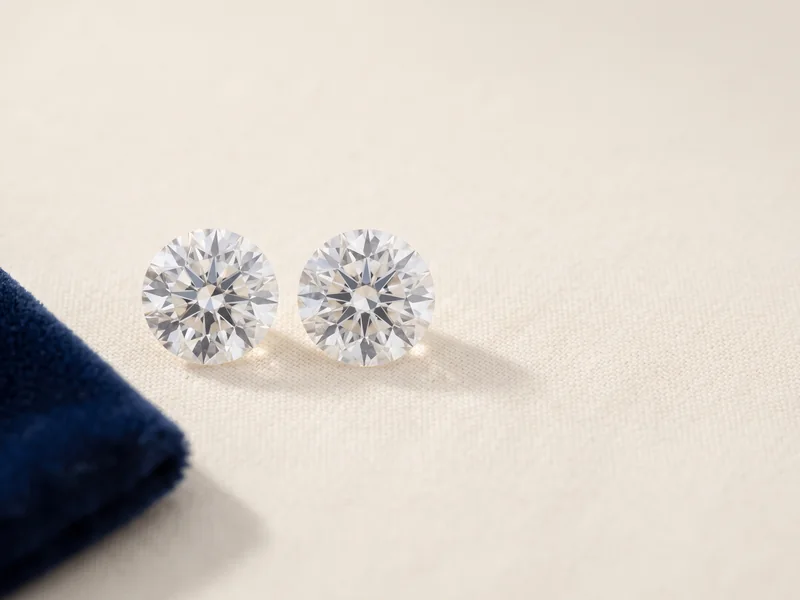 Diamond Anatomy & LightWhy Same-Carat Diamonds Can Look Different
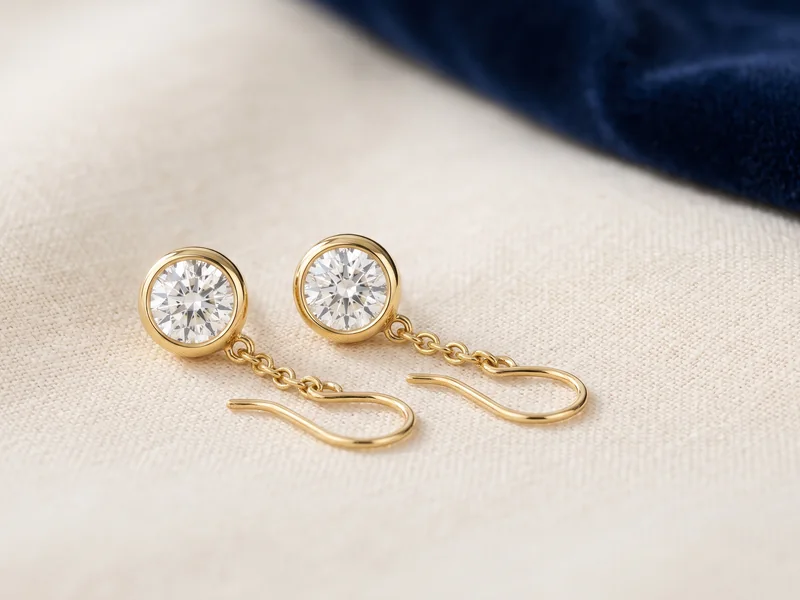 Jewellery TypesDrop Earring SettingsJewellery TypesJewellery Types Guide
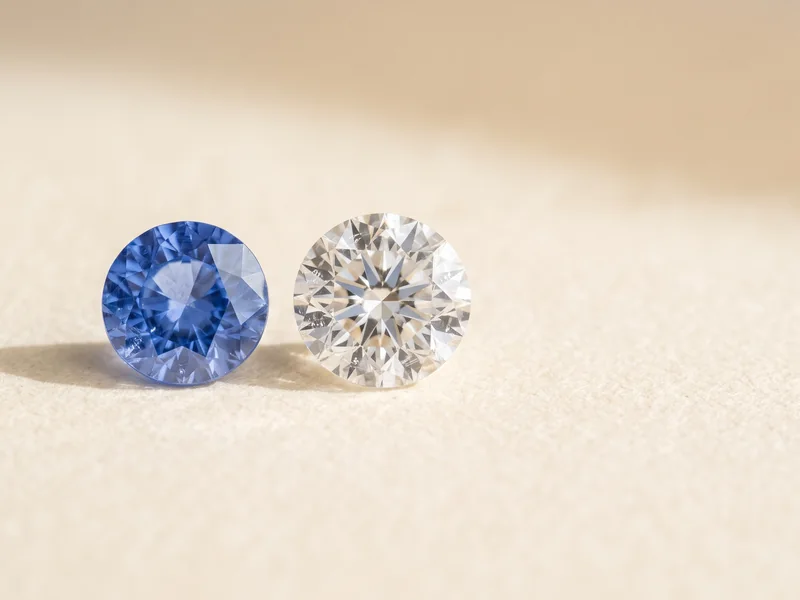 GemstonesGemstone Carat vs Size (Density)
 Jewellery TypesBracelet Size Guide
 Jewellery TypesHoop and Huggie Earring Styles
Explore more
More guides on this topic
Education