
- Education
- Care, Repairs & Remodelling
- Can You Wear Your Ring in the Shower, Pool or at the Beach?
Care, Repairs & Remodelling
Can You Wear Your Ring in the Shower, Pool or at the Beach?
Whether you can wear your ring in the shower, pool or surf depends less on the water than on what is in it: soap, chlorine, salt, sand and sunscreen. Here is what each one does to metal, stones and settings, based on what we see on the repair bench.
 Reviewed by Raj Sood, Graduate Gemologist (GIA), AJP (GIA)Master jeweller and Graduate Gemologist (GIA) · reviewed 4 November 2026
Quick answer
You can wear a solid gold or platinum ring in the shower without harming the metal, but soap film dulls diamonds and wet fingers let loose rings slip off. Take rings off for pools and spas (chlorine attacks gold alloys and solder), the beach (cold water, sand, sunscreen) and anything set with pearls, opals or emeralds.
What actually damages a ring in water?
Clean water on its own does very little to a well-made ring. Gold, platinum, diamond, sapphire and ruby are not harmed by a splash or a rinse. The trouble comes from three other things: what is dissolved in the water (chlorine, salt, minerals), what is on your skin (soap, shampoo, sunscreen) and what happens to your hand (cold water shrinks fingers, wet skin is slippery, sand gets everywhere).
| Hazard | What it does | Most at risk |
|---|---|---|
| Soap, shampoo, conditioner | Leaves a greasy film that dulls sparkle and packs under claws | Diamonds, all claw settings |
| Chlorine (pools, spas, bleach) | Attacks the copper, silver, zinc and nickel in gold alloys; can crack claws and solder joints | 9 ct and 14 ct gold, white gold, sterling silver |
| Salt water | Leaves salt crystals in the setting; tarnishes and dulls base metals | Sterling silver, plated jewellery, low-carat gold |
| Sand | Quartz (Mohs 7) scratches metal and wears claws; packs under the stone | Gold, platinum, silver, softer gems |
| Sunscreen and insect repellent | Builds a film and white residue; chemicals can attack soft and porous gems | Pearls, opals, turquoise; diamonds lose sparkle |
| Cold water | Fingers shrink, so rings slide off | Every ring, especially one that is slightly loose |
Two terms worth knowing: a claw (or prong) is one of the small metal tips gripping the stone, and an alloy is gold mixed with other metals to make it harder and change its colour. 18 ct gold is 75% gold; 9 ct gold is only 37.5% gold, so 62.5% of it is other metals, and that is the part chlorine and salt react with. Every other term here is explained in our plain-English jewellery glossary, and the wider picture sits in our complete jewellery care and maintenance guide.
Can you wear your ring in the shower every day?
For a solid gold, platinum or palladium ring set with diamonds, sapphires, rubies or moissanite, the honest answer is yes, you can, and plenty of people do. Hot water will not hurt the metal or a durable stone, and the occasional rinse does no harm. But showering in a ring every day slowly causes three problems.
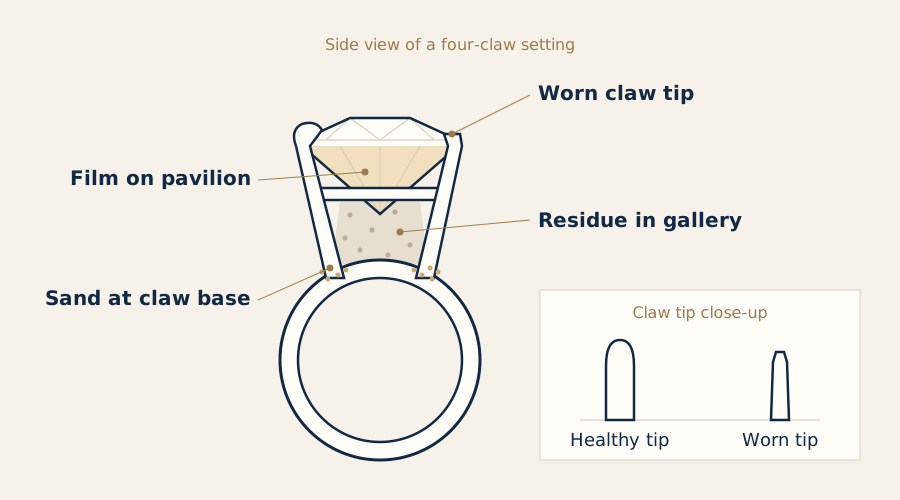
- Film on the stone. Diamond is lipophilic, meaning it attracts oil and grease. Soap, body wash and conditioner (especially those with silicones) leave a thin layer on the back of the stone, exactly where light is meant to bounce back out. A diamond that looks grey or glassy is usually dirty, not damaged.
- Build-up under the claws. Soap scum and hard-water minerals collect where the claws meet the stone and in the gallery (the open metalwork under it). The build-up hides cracks and can hold moisture against the skin, which some people notice as a rash under the band.
- Drops and drains. Wet, soapy fingers are slippery. Taking a ring off to wash your hair or hands over an open drain is an easy way to lose it.
Can you wear white gold in the shower? Yes, but most white gold is a slightly yellowish gold coated in rhodium, a hard, bright white metal from the platinum family. Shampoo, body scrubs and household cleaners speed up how fast that plating wears, so a white gold ring worn in the shower daily may need replating sooner. Our guide to how often white gold needs rhodium replating sets out typical intervals. Sterling silver is the exception to the yes: shower products, and especially sulphur-rich hot spring water, tarnish it quickly.
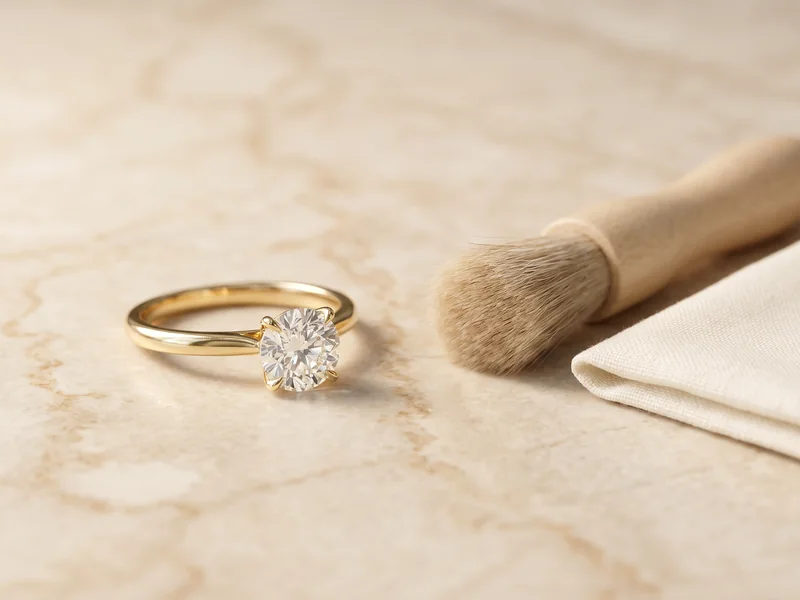
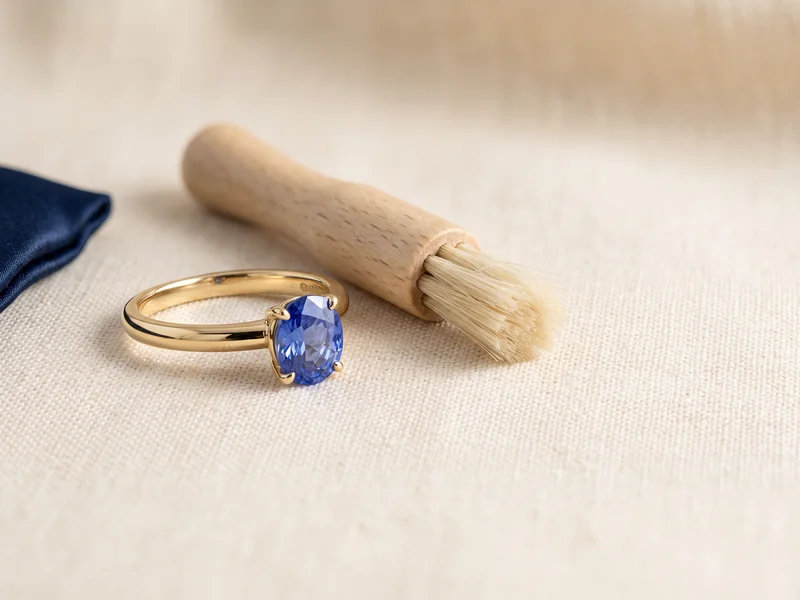
If you do shower in your ring, give it a quick clean every week or two rather than letting film build up for months; our step-by-step on cleaning a diamond ring at home with warm water and a soft brush takes about five minutes. And if your ring is a little loose and spins or slides when your hands are soapy, sizing beads and sizing bars that stop a ring slipping are a small fix worth knowing about.
Which rings and gemstones should never get wet?
How much care a ring needs around water depends on the metal, the stone and how the stone is held. Lab-grown diamonds behave exactly like natural diamonds here: the same carbon crystal, the same hardness (10 on the Mohs scale) and the same care. Lab-created sapphires and rubies are the same material as natural ones (corundum, Mohs 9) and are just as tolerant of water.
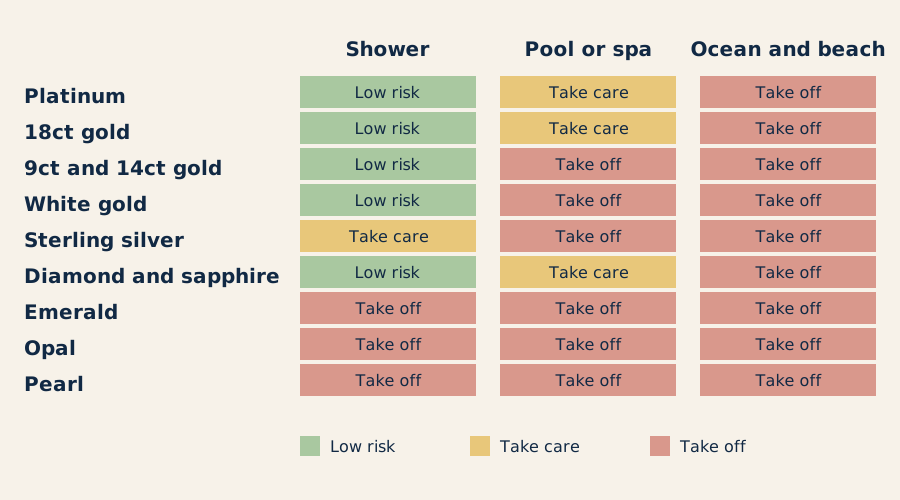
| Ring or stone | Shower | Pool or spa | Ocean and beach |
|---|---|---|---|
| Platinum with diamond (natural or lab-grown) | Fine; clean often | Better off; rinse if worn | Off for surf and sand |
| 18 ct yellow or rose gold | Fine | Better off; chlorine affects the alloy over time | Off for surf and sand |
| 9 ct or 14 ct gold | Fine | Take off | Take off |
| White gold (rhodium plated) | Fine; plating wears faster | Take off | Take off |
| Sterling silver | Off if you can; tarnishes | Take off | Take off |
| Gold-plated or vermeil | Off; plating wears | Take off | Take off |
| Sapphire, ruby, moissanite | Fine | The metal decides | Off; sand and knocks |
| Emerald | Off; filler can be drawn out | Take off | Take off |
| Solid opal | Off | Take off | Take off |
| Opal doublet or triplet | Never | Never | Never |
| Pearl | Never | Never | Never |
| Turquoise, lapis, malachite, amber | Off | Never | Never |
Why the soft and porous stones? Pearls are made of nacre (layers of calcium carbonate, Mohs about 2.5–4.5), which chlorine, acids and sunscreen chemicals etch and dull, and a pearl in a ring is usually glued onto a post that repeated wetting weakens. Opal, Australia's national gemstone, naturally holds a small amount of water inside it (typically about 3–10%) and is sensitive to sudden temperature changes and chemicals. Opal doublets and triplets are thin slices of opal glued to a backing, sometimes with a clear cap, and water can creep into the join and leave grey, cloudy patches. Emeralds are almost always treated with oil or resin to hide fine fractures; hot water and detergents can draw that filler out and make the fractures more visible.
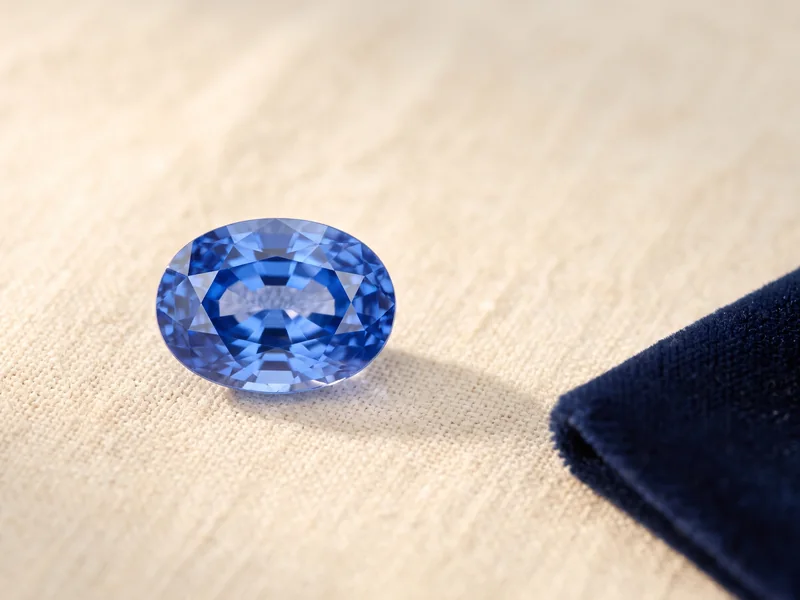
If you want a ring you can largely forget about, choose the stone with this in mind; our list of gemstones tough enough for daily wear compares the options by hardness and toughness. For the delicate ones, follow the safe cleaning method for each gemstone rather than general advice, and if silver has already darkened, see our guide to bringing tarnished sterling silver back.
Can you wear your ring in the pool or spa?
Can you swim with an engagement ring in a chlorinated pool? It is better not to. Australian home pools are usually kept at around 1–3 ppm (parts per million) of free chlorine, and spas run warmer and often stronger. Pure gold barely reacts at those levels, but no ring is pure gold: chlorine reacts with the copper, silver, zinc and nickel in the alloy.
Over many swims, chlorine can cause stress corrosion cracking: fine cracks that start where the metal is already under tension, such as the base of a claw that was bent over to grip a stone, a solder joint, or a band that has been resized. It rarely shows as a dramatic colour change. Often the first sign is a claw that snaps or a stone that suddenly moves. Low-carat gold and white gold are most at risk; 18 ct gold is more resistant, and platinum is highly resistant to chlorine, though it still picks up scratches from rough pool edges.
- Saltwater pools: these still sanitise with chlorine (the salt is converted into it), so treat them the same way as any chlorinated pool.
- Spas and hot tubs: heat, higher sanitiser levels and sometimes bromine make them harsher than a pool. Take every ring off.
- Natural hot springs: sulphur compounds blacken silver and can darken low-carat gold very quickly.
- Pool chemicals and household bleach: never handle them with a ring on; concentrated chlorine is far stronger than pool water.
One quick dip will not crack a ring. The damage is cumulative, which is why it tends to show up in people who swim laps several times a week, often on rings that have also been resized or repaired. Our detailed guide to what sunscreen and chlorine do to jewellery goes further into the chemistry. If a band has already cracked, read about deciding whether to repair or replace a damaged band before choosing what to do.
Not sure which one is right?
Send us the stones you are looking at and our gemologist will tell you which to choose and why.
Should you take your ring off at the beach?
For most rings, yes. The beach combines nearly every hazard on this page at once: salt water, sand, cold, sunscreen and a very large area to lose something small in. Does salt water damage gold? Not quickly. Seawater is about 3.5% salt, and solid 18 ct gold or platinum copes with a swim. But salt crystals dry inside the setting, sterling silver and plated pieces tarnish, and low-carat gold can take on a dull film. The bigger risks are physical.
- Cold water: fingers shrink in cold water, and much of the Australian coastline, especially in the south, is cool enough for a ring that fits on land to slide off in the surf. You usually will not feel it go.
- Sand: beach sand is mostly quartz, 7 on the Mohs scale. Gold is about 2.5–3 and platinum about 4–4.5, so sand scratches both, and grit rubbed between your fingers and a towel slowly wears down claws and the band. Packed under a stone, it acts like sandpaper between the claw and the diamond.
- Softer stones: quartz scratches anything softer than 7, including opal (about 5.5–6.5), tanzanite (about 6–6.5), pearls and many vintage pieces.
- Waves and boards: a dumping wave, a bodyboard or a surfboard rail can knock a stone hard enough to chip it or bend a claw.
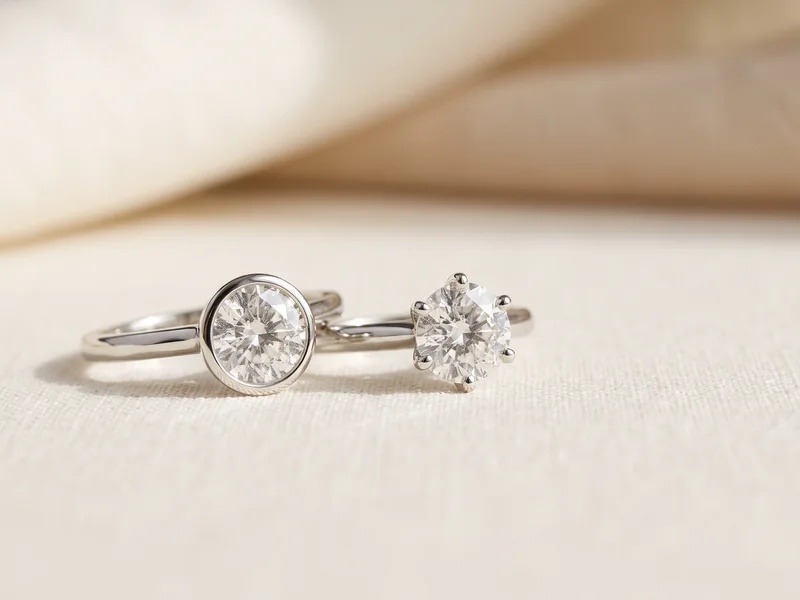
The setting matters too. A bezel (a rim of metal around the stone) protects the edge and has fewer gaps for sand to pack into; claws show more of the stone but leave more exposed tips. Our comparison of how bezel and claw settings cope with everyday wear covers the trade-off. The same thinking applies to the rest of an active Australian summer, from beach cricket to the gym; see our guide to wearing your ring to sleep, the gym or a workout.
Does sunscreen damage rings and diamonds?
Sunscreen will not damage a diamond, a sapphire or solid gold, but it does make them look much worse. Lotion forms the same greasy film as soap, only thicker, and a diamond coated in it loses much of its brightness. Mineral sunscreens based on zinc oxide and titanium dioxide leave a white paste that sets hard in claws, galleries and engraved patterns. Because many Australians wear sunscreen for much of the year, it is one of the most common cleaning jobs we see.
| Product | Effect on a ring | What to do |
|---|---|---|
| Mineral sunscreen (zinc oxide, titanium dioxide) | White residue packed into claws and the gallery | Soak in warm soapy water and brush gently |
| Chemical sunscreen (organic UV filters) | Oily film on the stone; a dull, glassy look | Clean weekly through summer |
| Spray-on sunscreen | Fine mist over the whole ring, hard to notice | Put the ring on after it dries |
| Insect repellent | Some ingredients, such as DEET, can attack plastics, lacquers and surface treatments | Keep off pearls, opals, coated and plated pieces |
Soft and porous materials are the real concern. Pearls, opal, turquoise and coral can absorb oils and some sunscreen ingredients, which may stain or dull them permanently. Apply sunscreen with your ring off and put it back on once your hands are dry. That habit of putting jewellery on last is at the heart of our day-to-day care for an engagement ring.
Related guideSunscreen, Chlorine and Your JewelleryWhat damage do jewellers see from water, sand and chlorine?
On the repair bench, problems from water and the beach tend to fall into a handful of patterns. None of them happens on the first swim. They build up over months or years of small exposures, which is why a regular check matters more than any single rule.
- Worn or cracked claws. Thin claw tips from sand and daily wear, or fine cracks at the base from chlorine. The stone often looks secure right up until it moves.
- Lost stones. A small diamond missing from a halo or band after a beach holiday, usually where a claw was already weak.
- Yellowing white gold. Rhodium worn through after a summer of swimming and sunscreen, showing the warmer gold underneath.
- Cloudy opal doublets. Water in the glued join, leaving grey patches that cannot simply be dried out.
- Loose pearls. A pearl detached from its post after repeated wetting softened the glue.
- Blackened silver. Sterling silver darkened after a hot spring or spa.
- Thin bands. A shank (the band part of the ring) worn thin underneath, sped up by sand and abrasive scrubs.
Many of these can be fixed. Claws can be re-tipped or rebuilt, and our page on signs of a loose stone and how tightening works explains the warning signs, such as a faint rattle when you tap the ring near your ear or a stone you can see shift. A band worn too thin can be rebuilt with new metal; see replacing a worn-thin shank. If a stone has chipped and you are rethinking the ring anyway, our guide to options for upgrading your diamond covers what is involved.
What should you do if your ring gets wet, sandy or lost?
If your ring has been in the sea, a pool or a spa, rinse it in fresh, lukewarm water as soon as you can. Then soak it for 10–20 minutes in warm water with a drop of mild dishwashing liquid, brush gently around the claws with a soft toothbrush and dry it with a lint-free cloth. Do not use toothpaste, bleach or abrasive cleaners, and skip the soak for pearls, opals and emeralds, which only need a soft, damp cloth.
Then check it. Look at the claws under good light, run a fingertip over them for anything sharp or bent, and look for any gap between claw and stone. If anything has moved, stop wearing the ring until a jeweller has looked at it. If a ring is lost in the water, note where and when, check your home contents or travel insurance, and ask locally: beach metal-detecting groups sometimes help people search.
As a rough guide only, re-tipping a claw costs about AUD $40–$120 per claw, rhodium replating about $60–$150, and a full set of new claws on a solitaire about $150–$400, depending on the metal and design. A claw check is quick, and fixing a worn claw early costs far less than replacing a lost stone.
Jewellery repairs and claw checks
How to wear your ring in the shower, pool and beach without damage: step by step
- Know your ring. Check the metal stamp inside the band (for example 375 for 9 ct, 750 for 18 ct, PT950 for platinum) and the stone type before deciding where it can go.
- Shower: fine for solid gold or platinum with durable stones. Take it off if it catches in your hair, and never remove it over an open drain.
- Pool or spa: take it off, especially 9 ct, 14 ct, white gold or silver. If you forget, rinse it in fresh water straight away.
- Beach: leave it at home or locked away. Cold water, sand and surf cause most of the wear and losses.
- Sunscreen: apply it with the ring off and put the ring back on once your hands are dry.
- Store it safely: use one ring dish at home and a zipped pouch when travelling, never a pocket, shoe or towel.
- Clean regularly: a warm soapy soak every week or two, more often in summer.
- Get it checked: have the claws and setting inspected every 6–12 months, and straight away after any knock.
Free consultation
Talk to a gemologist
Compare stones in person or online with Raj Sood, Graduate Gemologist (GIA), AJP (GIA).
Book a consultationShop this shape
FAQ
Common questions
Can you shower with your engagement ring on?
Yes, if it is solid gold or platinum set with a durable stone such as diamond or sapphire. The water will not hurt it, but soap film dulls the stone, so clean it often and keep it well away from the drain.
Does chlorine damage diamond rings?
Chlorine does not harm the diamond itself, natural or lab-grown. It can weaken the gold alloy in the claws and band over time, which can lead to cracked claws and lost stones.
Can you wear gold in the ocean?
Solid 18 ct gold will not be damaged by salt water, but cold water shrinks fingers so rings slip off in the surf, and sand scratches the metal. Leaving the ring at home is the safer habit.
Can lab-grown diamonds get wet?
Yes. A lab-grown diamond is real diamond with the same hardness and chemistry as a natural one, so water, chlorine and salt do not harm it. The metal setting needs the same care as any ring.
Can you wear white gold in the shower?
Yes, but shower products and scrubs wear the rhodium plating faster, so a white gold ring worn in the shower every day may need replating more often.
Will sunscreen ruin my ring?
Not a diamond or solid gold ring, but it leaves a film and white residue that dull the sparkle. It can stain or damage pearls, opals and other porous stones, so put jewellery on after sunscreen dries.

Ask a gemologist
Not sure which diamond to choose?
Raj Sood is a Graduate Gemologist (GIA) and master jeweller. Bring the stones you are considering, or send the reports, and he will tell you honestly which one is better and why.
Keep learning
Related guides
 Care, Repairs & RemodellingSunscreen, Chlorine and Your JewelleryCare, Repairs & RemodellingCan You Sleep or Work Out in Your Ring?Care, Repairs & RemodellingEngagement Ring Care Guide
 Care, Repairs & RemodellingCleaning Gemstones by TypeCare, Repairs & RemodellingJewellery Care and Maintenance
 GemstonesBest Gemstones for Daily Wear Rings
 Engagement Rings & SettingsBezel vs Claw Settings for Everyday Wear
 Care, Repairs & RemodellingRhodium Replating Schedule
Explore more
More guides on this topic
Education