
- Education
- Buying Knowledge & Custom Process
- Planning a Proposal: When to Order the Engagement Ring
Buying Knowledge & Custom Process
Planning a Proposal: When to Order the Engagement Ring
Knowing when to order the engagement ring is what turns a proposal plan into a calm one. Here is how long each kind of ring really takes in Australia, plus the sizing, insurance and Tourist Refund Scheme details most guides leave out.
 Reviewed by Raj Sood, Graduate Gemologist (GIA), AJP (GIA)Master jeweller and Graduate Gemologist (GIA) · reviewed 4 November 2026
Quick answer
Order the engagement ring about three to four months before you plan to propose. A custom ring usually takes three to six weeks to make, a ready-made ring one to two weeks with sizing, and you need spare time for resizing, engraving, insurance and any travel plans, including the Tourist Refund Scheme's 60-day window.
When to order an engagement ring: how far ahead should you start?
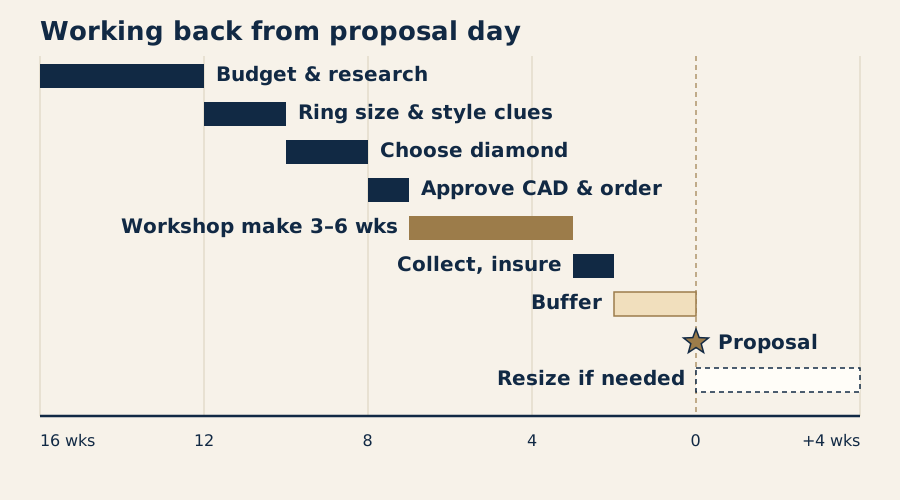
For most people the comfortable answer is three to four months before the proposal date. That is not because a ring takes four months to make. It is because the making is only one part of the job. You also need time to settle a budget, learn the basics of diamonds, find out their ring size without giving the game away, compare stones, approve a design and still have a few weeks spare in case something needs adjusting.
If you are starting from scratch, read our complete engagement ring buying guide first, then come back to this timeline. Any unfamiliar word on a quote or grading report (a document from an independent lab describing the diamond) is explained in our plain-English jewellery glossary.
Can you do it faster? Yes. A ring chosen from ready-made stock can be ready within days to a fortnight, and a custom ring can sometimes be finished in under three weeks if the design is simple and the stone is on hand. But a short timeline leaves no room for a resize, a remake or a delayed courier, and those are the things that cause stress the week before a proposal.
How long does a custom engagement ring take compared with a ready-made one?
Lead time is the time between paying a deposit and collecting the finished ring. It depends mostly on whether the setting already exists and whether the diamond is already in the jeweller's hands. These ranges are typical for an Australian workshop; your jeweller should give you a firm date when you order.
| Type of ring | Typical lead time | What takes the time |
|---|---|---|
| Ready-made ring in your size | Same day to a few days | Cleaning, checking, paperwork |
| Ready-made ring, resized | About 1–2 weeks | Cutting or adding metal to the shank, re-polishing |
| Loose diamond set into a stock setting | About 1–3 weeks | Sourcing the setting, setting the stone, finishing |
| Custom design (CAD) | About 3–6 weeks | Design, approval, casting, setting, polishing |
| Custom design with an intricate band or many small stones | About 6–8 weeks or more | Extra hand-setting and finishing |
| Remodelling an heirloom ring | About 3–8 weeks | Assessing old stones and metal, redesign, remaking |
A custom ring usually starts with CAD (computer-aided design): a 3D model of the ring you can view and change before any metal is used. Each round of changes adds a few days, so the quicker you approve the design, the quicker it goes to casting. Engraving inside the band typically adds a few working days.
If the custom timeline is tight, a common workaround is to propose with something simple and finish the real ring together afterwards. Our page on using a simple proposal ring to bridge the gap explains how that works.
What should you decide before you order the ring?
The ring cannot go into production until four decisions are made. Most delays happen here, not in the workshop, so give these the most time in your plan.
- Budget: a firm figure, including the setting and any wedding band you may want to match later. Our guide to setting a realistic engagement ring budget works through the numbers, and how shape changes the price per carat shows where a different outline can help.
- Diamond priorities: shape, carat, colour and clarity. Start with a side-by-side look at every diamond shape. Clarity is often where money can be saved without a visible difference; see why an eye-clean SI1 can stretch a budget.
- Style: solitaire, halo, three-stone or something unusual. If your partner has never liked classic rings, read engagement ring ideas for people who dislike traditional designs.
- Practical fit: metal, setting height and band width. A nurse, a climber and an office worker may want very different rings; our guide to designing around how someone works and lives covers this.
Band width is easy to overlook but affects comfort, strength and how big the centre stone looks. Most engagement ring bands sit between about 1.6 and 2.5 mm wide; our page on picking a band width that suits their hand compares the options.
How do you get the ring size right for a surprise proposal?
Ring size is the one detail that can't be guessed perfectly, so build time for a resize into your plan. Australia uses letter sizes (A to Z, with half sizes), the same system as the UK. Many women's engagement rings fall roughly between J and O, but hands vary widely and that range is only a starting point.
The usual tricks are borrowing a ring they wear on the same finger, asking a trusted friend, or measuring a ring's inside diameter with a ruler. Our guide on discreet ways to estimate a ring size goes through each method and how accurate it is.
- If unsure, go slightly larger. A ring that is too big can be worn carefully for a day or two; one that is too small may not go over the knuckle at all.
- Plain claw-set rings can usually be resized about one to two sizes up or down without trouble.
- Full eternity bands, channel-set and tension-style rings are hard or impossible to resize, so get the size right before ordering these.
- Wider bands fit more snugly than narrow ones of the same size, so a 3 mm band may need a quarter to half size larger.
Allow about one to two weeks after the proposal for a resize, and ask your jeweller whether the first resize is included in the price.
Not sure which one is right?
Send us the stones you are looking at and our gemologist will tell you which to choose and why.
Should you propose with a placeholder ring or choose the ring together?
Not every proposal needs the final ring. Plenty of Australian couples now propose with a simple band, a ring from a family member or a lower-cost stand-in, then design the real ring together over the following weeks. This takes the timing pressure off entirely and removes the size and style guesswork.
The trade-off is the surprise of the finished ring. Some people want the moment of opening the box to the ring they will wear for decades; others are happy to trade that for having a say in the design. Our guide to choosing the engagement ring as a couple covers how to keep it special when you shop together.
Related guideProposal Ring vs Engagement RingA middle path also works: choose the setting style yourself and propose with the diamond loose in a box, so your partner can help pick the setting. The diamond is the bigger decision and the setting is easier to get right with them there.
When to order an engagement ring for Christmas, Valentine's Day or a trip overseas?
Workshops get busy in the weeks before Christmas and Valentine's Day, and many close or slow down over the Christmas–New Year break. Couriers and overseas diamond suppliers slow down too. If you plan to propose at either time, treat the dates below as a guide and confirm the real cut-off with your jeweller.
| Proposal date | Start researching | Place the order by (custom) | Place the order by (ready-made) |
|---|---|---|---|
| Christmas Day | August–September | Mid-October | Mid-November |
| New Year's Eve | September | Late October | Late November |
| Valentine's Day | October–November | Mid-December (before the break) | Mid-January |
| Overseas trip | 3–4 months before you fly | 6–8 weeks before you fly | 3–4 weeks before you fly |
For a proposal overseas, the ring should be finished, sized and insured before you leave, with at least a week to spare. Keep it in your carry-on bag or wear it, never in checked luggage. If you are flying out from Australia, there is also a tax rule that may apply, which is the next section.
Can you claim GST back on an engagement ring through the Tourist Refund Scheme?
The Tourist Refund Scheme (TRS) is run by the Australian Border Force. It lets travellers claim back the GST (goods and services tax, 10%) paid on goods bought in Australia and taken out of the country. The refund is one eleventh of the GST-inclusive price, so on an $8,800 ring the GST portion is $800.
| TRS condition | What it means for an engagement ring |
|---|---|
| Spend at least $300 (incl. GST) with one business | Almost any engagement ring meets this; it can be on one or more tax invoices from the same business |
| Bought within 60 days of departure | Collect and pay in the 60 days before your flight; a deposit paid months earlier needs care, so ask how it is invoiced |
| Original tax invoice | The invoice must show the business's ABN, and your name if the invoice is $1,000 or more |
| Carry or wear the ring | It must go in your hand luggage or on your hand, and you may be asked to show it |
| Claim at the airport TRS facility | Lodge the claim after passport control, allowing enough time before your flight |
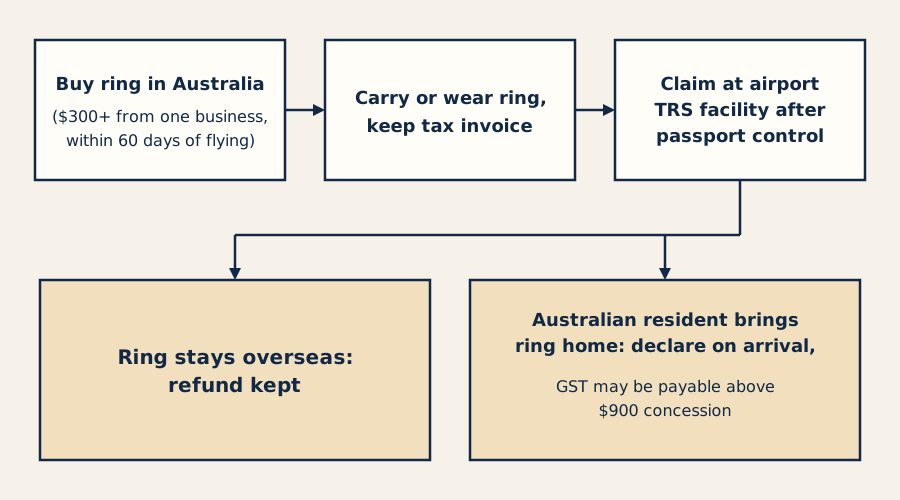
Here is the part most websites skip. Australian residents can use the TRS, but if you bring the ring back into Australia you must declare goods you claimed a TRS refund on when you return. The ring then counts toward your duty-free passenger concession (currently $900 for adults), and because an engagement ring is usually well above that, the GST is likely to be payable again at the border. So for a resident whose partner lives in Australia, the TRS is not a real saving. It mostly helps overseas visitors and people whose partner lives, and will keep the ring, overseas.
The same logic applies the other way. A ring bought overseas and brought into Australia above the concession limit generally attracts GST, and possibly customs duty, when you arrive. Buying abroad to avoid Australian GST rarely works the way people expect. Rules change, so check the current ABF guidance before you travel.
When should you insure an engagement ring before the proposal?
From the day you collect it. The weeks between collection and the proposal are a risky time: the ring is hidden in a drawer, a car or a backpack, it may be travelling, and it is usually not on anyone's finger. Arrange cover before you take it home.
- Home and contents insurance often limits unspecified jewellery to a modest amount per item, commonly a few thousand dollars at most. An engagement ring above that limit usually needs to be listed as a specified item.
- Specified item cover names the ring and its value on the policy. Ask whether it covers loss away from home and overseas, not just theft from the house.
- Agreed value versus market value: agreed value pays the figure on the policy; market value lets the insurer decide what replacement costs, and may replace the ring rather than pay cash.
- Travel insurance usually caps valuables per item and may exclude items left unattended, so it is rarely enough on its own for a ring.
- Paperwork: keep the tax invoice, the diamond's grading report and an insurance valuation. Insurers commonly ask for all three.
Once you are engaged, the ring will need its cover moved into your partner's name or onto a joint policy. Put a reminder in your calendar so it doesn't get forgotten in the excitement.
Does a natural or lab-grown diamond change the timeline?
Slightly. Lab-grown diamonds are real diamond grown in a laboratory rather than mined. They cost much less than natural diamonds and are widely available in most shapes and sizes, so a suitable stone is usually easy to find quickly. Natural diamonds in a very specific combination, such as a 1.5 carat oval diamond at a particular ratio, colour and clarity, may need to be sourced from a supplier, which can add one to two weeks.
Whichever you choose, allow time to review the grading report and a video of the actual stone. For lab-grown diamonds grown by the CVD method, you may see the term growth striations; our page on what CVD growth striations mean for a lab-grown stone explains when they matter and when they don't.
Browse natural and lab-grown diamonds
How do you plan the ring order? A week-by-week countdown
- 16–12 weeks out: set your budget, learn the basics of the four Cs and decide on natural or lab-grown.
- 12–10 weeks out: quietly find their ring size and gather style clues from photos, jewellery they wear and comments from friends.
- 10–8 weeks out: compare diamonds, check grading reports and reserve the stone.
- 8–7 weeks out: approve the CAD design and engraving wording, pay the deposit and confirm the collection date in writing.
- 3–2 weeks out: collect the ring, check the size, finish and engraving, and get the tax invoice, report and valuation.
- The same day you collect: add the ring to your insurance as a specified item and check overseas cover if you are travelling.
- Final 2 weeks: keep the ring hidden safely; if travelling, carry it in hand luggage and check the TRS rules if they apply.
- After the proposal: book any resize within a few weeks and move the insurance into your partner's name.
If your timeline is shorter than this, the steps still apply; you just compress the research and choose a ready-made or stock setting. Whatever the timeline, keep any word you meet in the paperwork handy in our glossary of ring and diamond terms, and use our guide to sizing a ring in secret early, because sizing is the step most people leave too late.
Free consultation
Talk to a gemologist
Compare stones in person or online with Raj Sood, Graduate Gemologist (GIA), AJP (GIA).
Book a consultationShop this shape
FAQ
Common questions
How far in advance should I order an engagement ring?
About three to four months before the proposal gives you time to research, order and collect without rushing. A custom ring usually takes three to six weeks to make once the design is approved.
Can I get an engagement ring made in two weeks?
Sometimes. A ready-made ring or a loose diamond in a stock setting can often be ready in one to two weeks, but a fully custom design usually needs longer and leaves no buffer for changes.
What if the engagement ring doesn't fit?
Most plain claw-set rings can be resized one to two sizes in about one to two weeks. Eternity, channel-set and tension-style rings are much harder to resize, so get the size right before ordering those.
Can Australians claim the TRS on an engagement ring?
Australian residents can lodge a TRS claim when leaving the country, but if they bring the ring back they must declare it and GST may be payable again. The scheme mainly benefits overseas visitors and people whose partner keeps the ring overseas.
When should I insure an engagement ring?
From the day you collect it, before the proposal. Contents policies often limit unspecified jewellery, so list the ring as a specified item and check it is covered away from home and overseas.
Is it okay to propose without the final ring?
Yes. Many couples propose with a simple proposal ring or a loose diamond and design the final ring together, which removes the pressure of sizing and style guesswork.

Ask a gemologist
Not sure which diamond to choose?
Raj Sood is a Graduate Gemologist (GIA) and master jeweller. Bring the stones you are considering, or send the reports, and he will tell you honestly which one is better and why.
Keep learning
Related guides
 Buying Knowledge & Custom ProcessProposal Ring vs Engagement Ring
 Buying Knowledge & Custom ProcessHow to Estimate Ring Size for a Surprise Proposal
 Buying Knowledge & Custom ProcessHow Much Should You Spend on an Engagement Ring?
 Diamond 4Cs & GradingWhen Can an SI1 Diamond Be a Smart Choice?
 Engagement Rings & SettingsHow to Choose an Engagement Ring When You Dislike Traditional Styles
 Buying Knowledge & Custom ProcessShould Couples Choose an Engagement Ring Together?
 Engagement Rings & SettingsWhat Engagement Ring Band Width Should You Choose?
Explore more
More guides on this topic
Education