
- Education
- Care, Repairs & Remodelling
- Engagement Ring Care Guide: Cleaning, Claw Checks, Metals and Repairs
Care, Repairs & Remodelling
Engagement Ring Care Guide: Cleaning, Claw Checks, Metals and Repairs
An engagement ring is worn every day for decades, so small habits decide whether it stays bright and secure. This engagement ring care guide comes from the repair bench, so it covers what actually goes wrong, not just how to make a ring shine.
 Reviewed by Raj Sood, Graduate Gemologist (GIA), AJP (GIA)Master jeweller and Graduate Gemologist (GIA) · reviewed 4 November 2026
Quick answer
Good engagement ring care comes down to four habits: take the ring off for gym, gardening, cleaning and swimming; clean it weekly in warm water with mild dishwashing liquid and a soft toothbrush; check the claws for movement or snagging every month; and have a jeweller inspect and professionally clean it every six to twelve months.
What does engagement ring care involve?
Engagement ring care is three jobs: keeping the ring clean so the stone returns light, keeping the setting secure so the stone stays put, and keeping the metal in good shape so the ring lasts for decades. Most people only think about the first. At the jeweller's bench, the second causes almost all the heartbreak: a centre stone lost from a worn or bent claw, usually without any warning the owner noticed.
A ring worn every day takes thousands of small knocks a year against benchtops, steering wheels, door handles and gym equipment. Each one wears away a tiny amount of metal. The claws (also called prongs, the small metal arms that hold the stone) are thin to begin with, and they wear fastest. The shank (the band of the ring) thins more slowly, mostly on the underside where it rubs against your palm and the wedding band beside it.
The good news is that nearly all of this wear is easy to catch early and cheap to fix if you catch it. A claw that is retipped in time costs far less than replacing a lost diamond. This guide focuses on engagement rings specifically; for necklaces, earrings and the rest of the jewellery box, see our wider guide to looking after all your jewellery. Any unfamiliar term here is explained in our glossary of settings, metals and stone terms.
When should you take your engagement ring off?
The most useful habit is taking the ring off for anything that knocks it, grinds grit into it or coats it in chemicals. A simple rule: if you would wear gloves for the job, the ring comes off first.
- Gym and weights: gripping a bar or kettlebell squeezes the band out of round and can bend claws outward. Our guide on whether it is safe to sleep or train in your ring goes through it sport by sport.
- Pools and spas: chlorine can attack the other metals mixed into gold alloys and weaken solder joints over time. Cold water also shrinks your fingers, so rings slip off in the water.
- Beach and garden: sand and soil contain quartz, about 7 on the Mohs hardness scale, which scratches gold, platinum and any gemstone softer than 7.
- Cleaning and cooking: bleach, oven cleaner and strong ammonia products dull metal, and dough or mince packs tightly under the stone.
- Sleep: claws catch on bedding and hair, and a ring pressed into a pillow night after night can slowly distort.
Creams are the everyday problem. Sunscreen, moisturiser and hand sanitiser leave a film on the back of the stone. Diamond is lipophilic, meaning it attracts oil and grease, so a film on the pavilion (the pointed underside) quickly turns a bright stone grey and glassy. Put creams on first, let them soak in, then put the ring on. Australian summers make this a daily issue; our page on how sunscreen and pool chlorine affect metal and stones explains the chemistry.
Where you take it off matters as much as when. Rings go missing beside basins, on beach towels and in the side pockets of gym bags. Keep a ring dish by the sink at home and use a zipped pocket or a small hard case when you are out.
How do you clean an engagement ring at home?
For most diamond, sapphire, ruby and moissanite rings, a weekly clean in warm soapy water is all the ring needs. Use a small bowl of warm (not hot) water with a few drops of mild dishwashing liquid, soak the ring for 20–30 minutes to soften built-up lotion, then brush gently with a soft toothbrush, working under the stone and around the base of each claw where grime collects. Rinse in a second bowl of clean water, never over an open drain, and dry with a lint-free cloth.
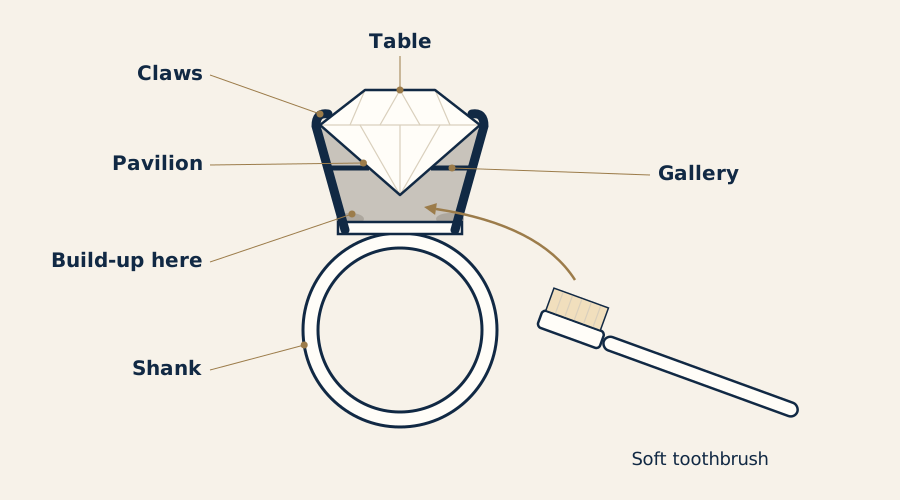
What to avoid at home:
- Toothpaste and baking soda: both are abrasive and leave fine scratches on gold, platinum and softer gems.
- Bleach, chlorine and acetone: they can pit metal and damage treatments such as fracture filling (a glass-like material injected into cracks to hide them).
- Paper towels and tissues: wood fibres are surprisingly scratchy on softer stones and can snag worn claws.
- Home ultrasonic cleaners (machines that use high-frequency vibration to shake dirt loose) on anything other than diamond, moissanite or untreated corundum, and never on a ring with a loose stone. The vibration that lifts grime also shakes a loose stone further out of its claws.
If your stone has a lot of inclusions (internal features), is fracture-filled, or sits in a pavé band of tiny stones, skip the machine entirely and stick to the brush. The full at-home diamond cleaning method covers stubborn build-up, and our cleaning rules for each gemstone type lists what is safe for coloured stones.
Related guideHow to Clean a Diamond Ring at HomeHow does engagement ring care differ by gemstone?
Hardness on the Mohs scale (a 1–10 ranking of scratch resistance) is the first thing to know about your stone, but it is not the whole story. Toughness (resistance to chipping), cleavage (a tendency to split along flat planes), treatments and sensitivity to heat all change how you should clean and wear a ring.
| Stone | Mohs hardness | Warm soapy water | Ultrasonic or steam | Watch out for |
|---|---|---|---|---|
| Diamond (natural or lab-grown) | 10 | Yes | Usually safe if the setting is sound | Grease build-up; chips on thin points and edges |
| Moissanite (lab-created) | 9.25 | Yes | Usually safe | Same as diamond |
| Sapphire and ruby | 9 | Yes | Safe unless fracture-filled | Glass-filled rubies: no ultrasonic, no acids |
| Emerald | 7.5–8 | Brief, lukewarm only | No | Oil or resin filling; brittle with knocks |
| Morganite and aquamarine | 7.5–8 | Yes | With caution | Included stones can crack |
| Blue topaz | 8 | Yes | No | Perfect cleavage; avoid heat |
| Amethyst | 7 | Yes | With caution | Some stones fade in prolonged strong light or heat |
| Tanzanite | 6–7 | Yes, gently | No | Heat and knocks; fragile for daily wear |
| Opal | 5.5–6.5 | Solid: damp cloth; doublets: never soak | No | Scratches, sudden temperature change, water in layers |
| Pearl | 2.5–4.5 | Damp cloth only | No | Perfume, cosmetics, acids, sweat |
Diamonds need the least special treatment, and there is no difference between mined and laboratory-grown stones here: both are real diamond with the same hardness and refractive index of about 2.42. Our guide explains why lab-grown diamonds are cared for exactly like natural ones. The one diamond to treat gently is a fracture-filled stone, which the seller must disclose in the sales paperwork (major labs such as GIA will not grade a filled diamond).
Softer and treated stones need more thought. Opal is popular in Australia but scratches on contact with everyday dust, and doublets and triplets (thin slices of opal glued to a backing) can lift if soaked; read about opal engagement rings and how to wear them day to day. Pearls are the softest of all and should be the last thing on and the first thing off, as our page on caring for pearls and when to restring explains. Purple and blue stones have their own quirks: see why amethyst can fade in strong sunlight and how blue topaz is treated and how to protect it. For every other stone, use our stone-by-stone care chart.
Not sure which one is right?
Send us the stones you are looking at and our gemologist will tell you which to choose and why.
How do you look after gold, platinum and white gold rings?
The metal wears too, and each one ages differently. Knowing what is normal stops you worrying about the wrong things.
| Metal | What happens with daily wear | How to care for it |
|---|---|---|
| Platinum (usually 95% pure) | Scratches push metal aside rather than removing it, forming a soft grey patina (a satin-like surface) | Enjoy the patina or have it polished; no plating needed |
| White gold (rhodium-plated) | Rhodium wears through, first on the underside, showing a warmer tone | Replate roughly every 12–18 months, sooner with heavy wear |
| 18ct yellow gold (75% gold) | Rich colour, softer surface that scratches and rounds off | Clean weekly; polish at each service |
| 14ct and 9ct gold (58.5% and 37.5% gold) | Harder surface but more alloy metals, so more prone to tarnish and chlorine damage | Keep away from pools and harsh cleaners |
| Rose gold | Copper gives the colour; it can darken slightly over years | Polish brings back the original tone |
White gold is not naturally bright white. It is a pale, slightly warm alloy that is rhodium plated: coated with a very thin layer of rhodium, a bright white metal from the platinum family. Plating wears faster on hands that work hard, and a hint of yellow at the back of the band is the usual first sign. Our guide to how often white gold needs replating gives timings by lifestyle.
With every metal, the claws and the base of the shank are what to watch. A shank worn to about 1 mm thick at its thinnest point is close to the end of its safe life, even if the ring still looks fine from the top.
How can you tell if a stone is loose in your engagement ring?
Claws rarely fail all at once. They thin, flatten and lift over months, and the ring usually gives you clues first. Check for these once a month:
- Snagging: the ring suddenly catches on jumpers, tights or hair. A claw tip has lifted or worn sharp.
- Rattling: a faint click when you tap the stone, or a stone that turns when you push it with a fingernail.
- Flat claw tips: under good light, the tips look flattened or thin instead of rounded beads sitting over the edge of the stone.
- A tilted stone: the table (top facet) no longer sits level with the band.
- Gaps: you can see light between a claw and the stone's girdle (the thin outer edge).
- An oval band: the shank has squeezed out of round, which pulls claws away from the stone.
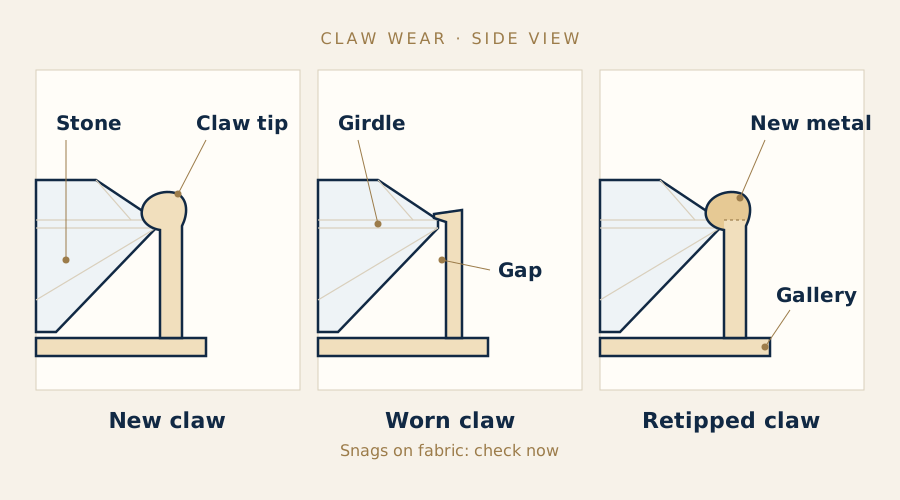
If you notice any of these signs, stop wearing the ring until it has been checked. Put it in a sealed bag or box, not loose in a pocket, and avoid running it through an ultrasonic cleaner, which can finish the job a worn claw has started.
How often should an engagement ring be checked by a jeweller?
Every six to twelve months for a ring worn daily, and more often if you work with your hands. A professional check is not just a clean. The jeweller looks at every claw under a 10× loupe (a small magnifying glass), tests each stone for movement, measures the thinnest point of the shank, looks for chips on the stone's edges and points, then cleans the ring with an ultrasonic bath and steam where the stones allow it.
- Weekly: home clean in warm soapy water.
- Monthly: your own claw check, the tap test and a look for snagging.
- Every 6–12 months: professional inspection and clean.
- Every 12–18 months: rhodium replating for white gold, if you like it bright.
- Every few years: claw retipping, depending on wear.
- Every 2–3 years: updated valuation for insurance.
Fine pavé and micro-claw settings (bands set with many tiny diamonds held by beads of metal) need more frequent checks, because each bead holding a 1 mm stone is small to begin with. Halos, three-stone rings and thin bands also benefit from a six-monthly visit.
Book a ring check: jewellery repairs service
What are the most common engagement ring repairs?
Most engagement rings need some repair work over their life. That is normal maintenance, like servicing a car, and it does not mean the ring was poorly made. These are the repairs we see most often:
| Repair | Signs you need it | What the jeweller does | Approximate price (AUD) |
|---|---|---|---|
| Claw retipping | Flat, thin or sharp claw tips | Adds new metal to each worn tip and reshapes it | about $50–$120 per claw |
| Claw rebuild | Claw cracked, missing or worn very thin | Replaces the whole claw by soldering or laser welding | about $100–$250 per claw |
| Re-setting or tightening | Stone rattles, turns or tilts | Tightens claws or resets the stone level | about $40–$150 |
| Resizing | Ring spins, slips off or is tight | Cuts the band, adds or removes metal, rejoins and polishes | about $60–$300; more for platinum |
| Sizing beads or bar | Ring spins but needs to pass the knuckle | Fits small metal beads or a bar inside the band | about $50–$150 |
| Reshanking | Band thin or cracked underneath | Replaces the lower part of the band | about $250–$900 |
| Rhodium replating | Yellow tint on white gold | Polishes, cleans and electroplates rhodium | about $60–$150 |
Resizing is the repair people ask about most. Whether it is possible depends on the metal, the setting and how far the ring has to move; eternity bands and channel settings are the hardest. Our page on what decides whether a ring can be resized covers each case, and if your knuckles are larger than the base of your finger, sizing beads and sizing bars can stop a ring spinning without making it harder to get on. If you are still choosing a ring, it is worth reading about designing a ring with future resizing in mind.
Sometimes a ring is worn past a sensible repair, or you simply want something new. The stone can usually be kept and reset: see redesigning a worn ring into a modern setting, or read about trading up to a larger centre diamond if that is the plan.
How should you store, travel with and insure your ring?
Store your engagement ring on its own, in a soft-lined compartment or a small pouch. Diamond scratches almost everything, including other diamonds, so a ring tossed into a jewellery box will mark your other pieces and can chip against another stone. Keep it away from heat: a car dashboard in an Australian summer can damage opal, tanzanite and treated stones.
When travelling, use a small hard ring case in your carry-on bag, never in checked luggage, and take the ring off before applying sunscreen or swimming at the hotel pool. Many people travel with a plain band instead and leave the engagement ring at home.
For insurance, keep a current valuation (a written description and replacement value from a qualified valuer) and photos of the ring. Replacement costs move with metal and diamond prices, so it is sensible to update the valuation every two to three years. Keep the grading report too; its measurements and any laser inscription help identify your stone if it is lost and found, or swapped during a repair. If your diamond is not inscribed, read about girdle inscriptions that help identify your diamond.
Engagement ring care routine: step by step
- Put creams on first. Apply sunscreen, moisturiser and sanitiser, let them soak in, then put the ring on.
- Take it off for hard or wet jobs. Gym, gardening, cleaning, pools, spas and the beach; place it in a ring dish or case, never beside a drain.
- Clean it weekly. Soak 20–30 minutes in warm water with mild dishwashing liquid, brush under the stone, rinse in a bowl and dry with a lint-free cloth.
- Check it monthly. Tap the stone near your ear, look at each claw tip and notice any snagging on fabric.
- Stop wearing it if anything moves. Seal it in a bag or box and book a check before wearing it again.
- See a jeweller every 6–12 months. Professional inspection, clean and polish, plus rhodium replating for white gold when needed.
- Keep the paperwork current. Store the grading report, photos and a valuation updated every two to three years.
Free consultation
Talk to a gemologist
Compare stones in person or online with Raj Sood, Graduate Gemologist (GIA), AJP (GIA).
Book a consultationShop this shape
FAQ
Common questions
How often should I clean my engagement ring?
A quick home clean once a week keeps a diamond bright, because lotion and skin oils build up fast. A professional clean and inspection every six to twelve months covers the parts you cannot see.
Can I wear my engagement ring in the pool or the ocean?
It is safer to take it off. Chlorine can weaken gold alloys and solder joints over time, and cold water shrinks fingers so rings slip off. Sand on the beach also scratches metal and softer stones.
Is an ultrasonic cleaner safe for my engagement ring?
It is usually safe for a diamond, moissanite or untreated sapphire in a sound setting. Avoid it for emerald, opal, pearl, tanzanite, fracture-filled stones and any ring with a loose stone.
How do I know if my claws need retipping?
Look for claw tips that are flat, thin or sharp, or a ring that has started snagging on clothing. A jeweller can measure the remaining metal under magnification and retip claws before the stone is at risk.
Do lab-grown diamond engagement rings need special care?
No. A lab-grown diamond is real diamond with the same hardness, so it is cleaned and maintained exactly like a natural diamond. The setting and metal need the same checks either way.
Why does my white gold ring look yellow?
White gold is usually coated with rhodium, and the plating wears thin with daily wear. Replating every 12–18 months or so restores the bright white colour.

Ask a gemologist
Not sure which diamond to choose?
Raj Sood is a Graduate Gemologist (GIA) and master jeweller. Bring the stones you are considering, or send the reports, and he will tell you honestly which one is better and why.
Keep learning
Related guides
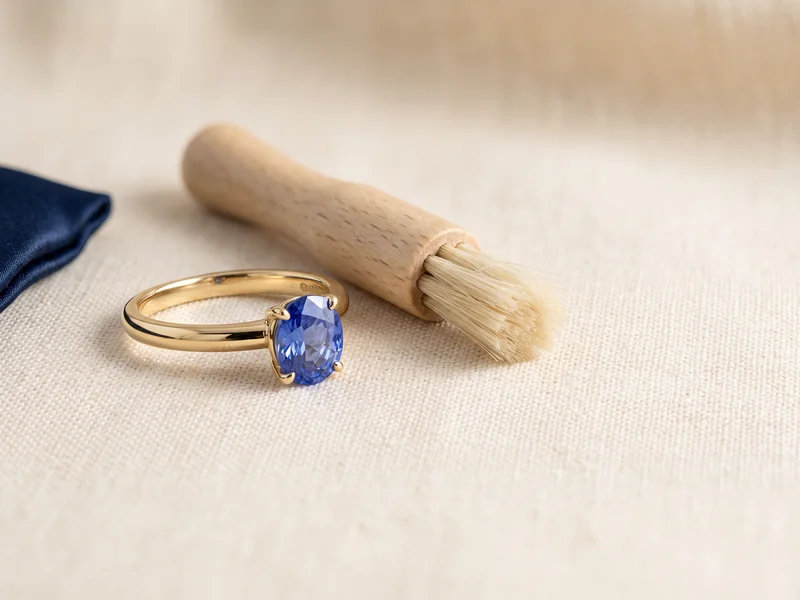
 Care, Repairs & RemodellingHow to Clean a Diamond Ring at Home
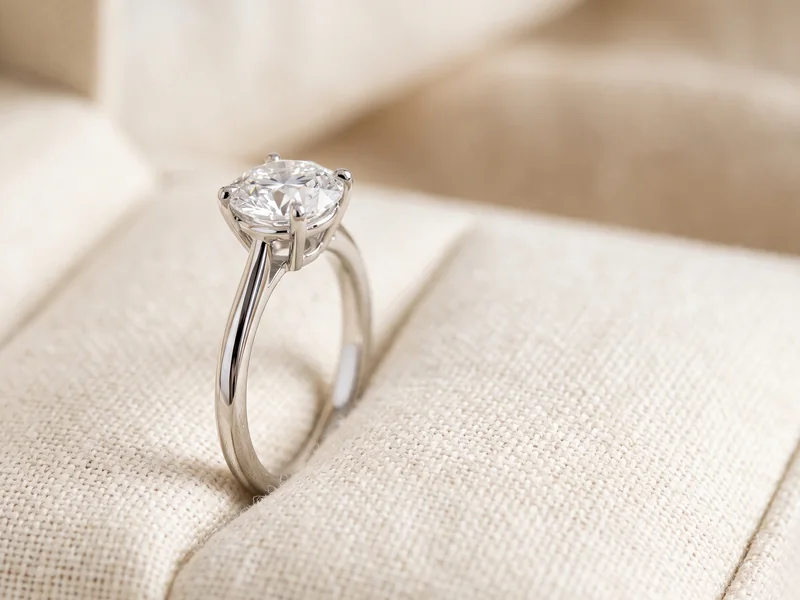
 GemstonesGemstone Care by Stone
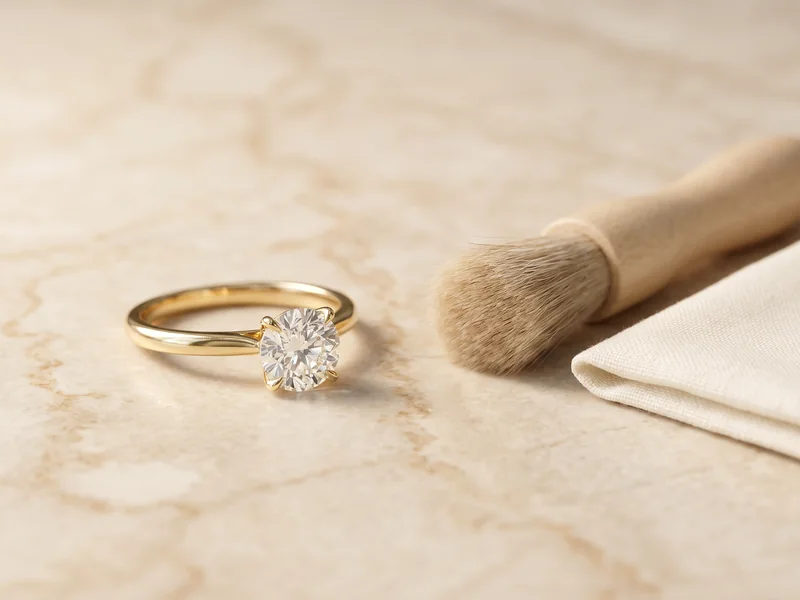
 Care, Repairs & RemodellingRhodium Replating Schedule
 Care, Repairs & RemodellingRing Resizing: What Determines Whether a Ring Can Be Resized?Care, Repairs & RemodellingJewellery Care and Maintenance
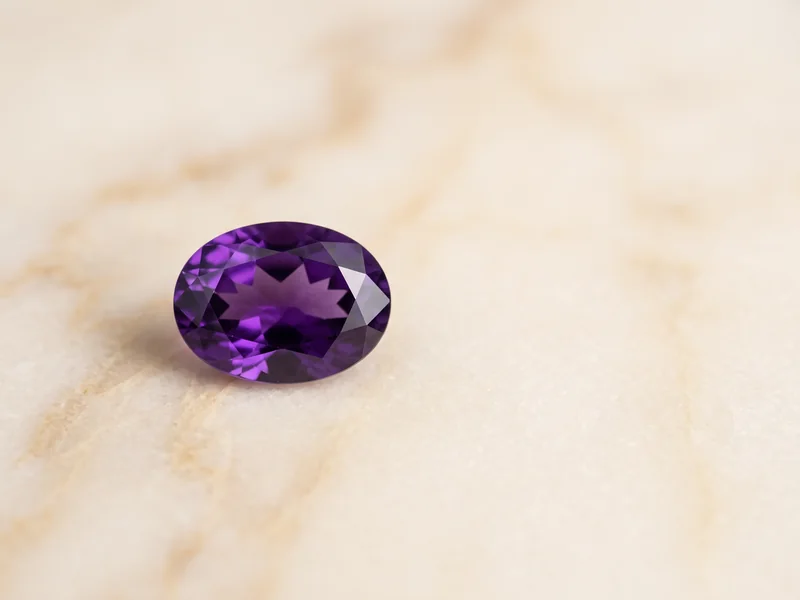 GemstonesAmethyst Jewellery: Colour, Fading and Care
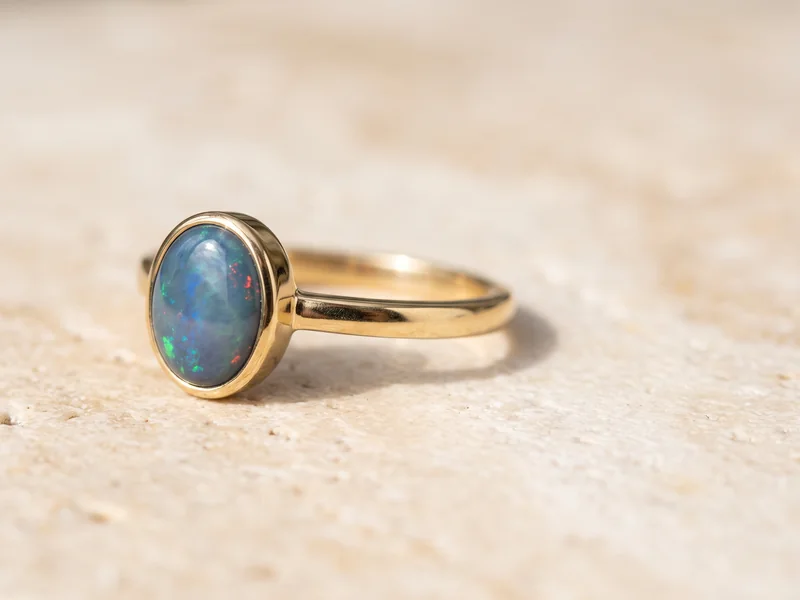 GemstonesAustralian Opal Engagement Rings: Wearability and Care
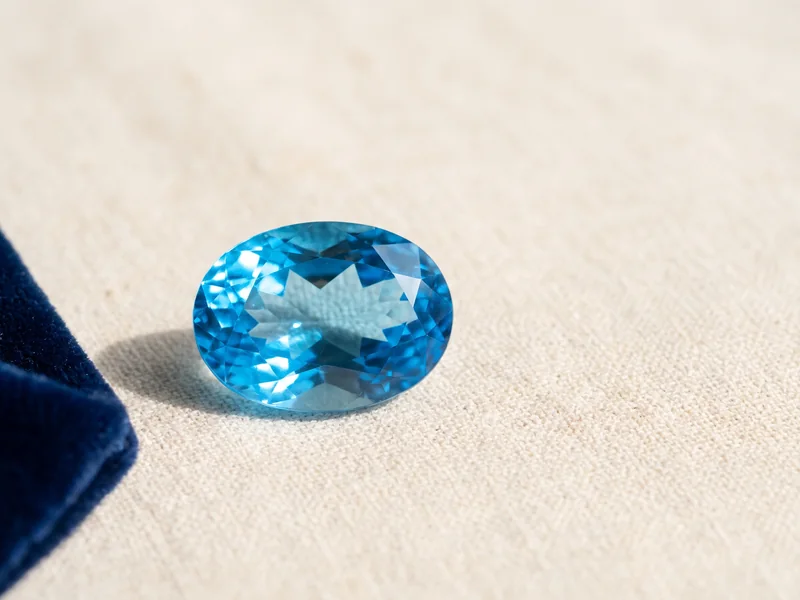 GemstonesBlue Topaz Jewellery: Treatment and Care
Explore more
More guides on this topic
Education