
- Education
- Buying Knowledge & Custom Process
- Australian Ring Sizes vs US, UK and EU: Conversion Chart and Guide
Buying Knowledge & Custom Process
Australian Ring Sizes vs US, UK and EU: Conversion Chart and Guide
Australia sizes rings with letters, most overseas websites use numbers, and a wrong guess usually means a resize. Here is how Australian ring sizes line up with US, UK and EU sizes, and how to convert by the millimetre so the ring fits first time.
 Reviewed by Raj Sood, Graduate Gemologist (GIA), AJP (GIA)Master jeweller and Graduate Gemologist (GIA) · reviewed 4 November 2026
Quick answer
Australian ring sizes use the same letter system as the UK, running from about A to Z+ in half sizes, so an Australian N is a UK N. The US uses numbers (an AU N½ is about US 7) and Europe uses inner circumference in millimetres (about 54). Convert by millimetres, not labels, for an exact match.
What are Australian ring sizes based on?
Australian ring sizes use letters. The scale starts at A, the smallest, at roughly 37.5 mm around the inside, and runs through to Z. Beyond Z it carries on as Z+1, Z+2 and so on for larger fingers. Each letter has a half size between it and the next, so you will see sizes written as M, M½, N and N½. It is the same letter system used in the UK, Ireland and New Zealand, and it traces back to the British standard for ring sizes, BS 6820.
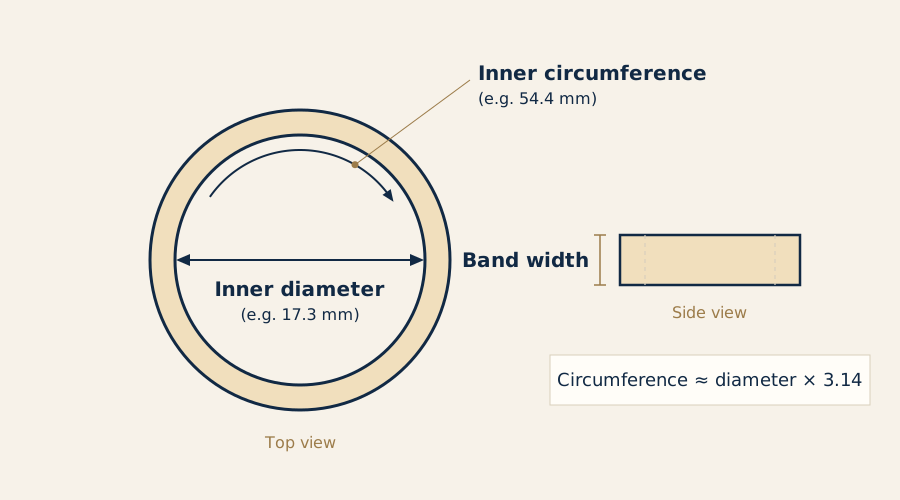
Every letter stands for a measurement of the inside of the ring. Jewellers describe that inside in two ways. The inner diameter is the distance straight across the inside, in millimetres. The inner circumference is the distance all the way around the inside edge, which is the diameter multiplied by about 3.14. One full letter adds roughly 1.25 mm of circumference, or about 0.4 mm of diameter. That is a small step, and it explains why half a letter can be the difference between a ring that spins and one that sits comfortably.
Because the letters describe a physical size, an Australian N is a UK N. The trouble starts when you shop with a US jeweller or a European website, which use numbers with different starting points and different step sizes. Our complete Australian ring size guide covers the letter scale on its own; this page is about converting it. If any of the terms are new, the GemTrove jewellery glossary defines them in plain language.
Australian ring sizes vs US, UK and EU: conversion chart
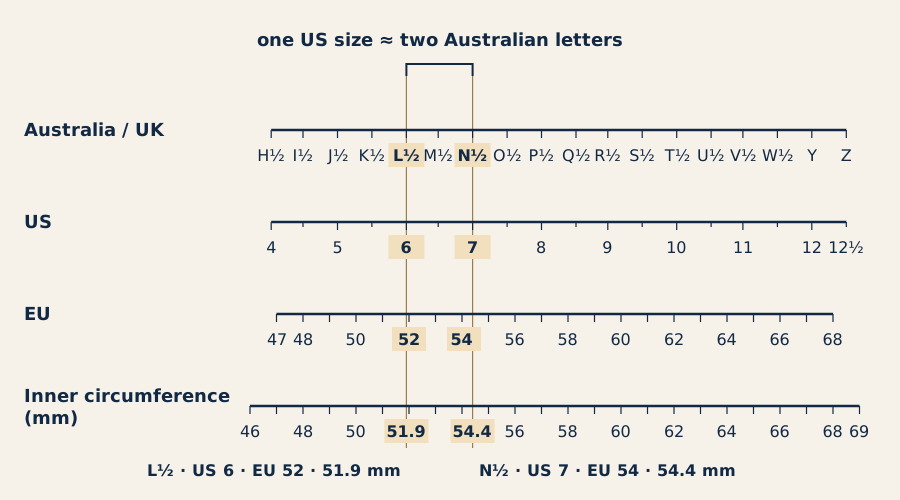
The chart below lines up the sizes most people wear. The US and EU columns use the standard international figures; the Australian letters are the nearest match on the A–Z scale. Charts from different jewellers can disagree by half a letter, because each rounds slightly differently, so treat the two millimetre columns as the real reference.
| Australia / UK | US / Canada | EU | Inner diameter | Inner circumference |
|---|---|---|---|---|
| H½ | 4 | 47 | 14.9 mm | 46.8 mm |
| I½ | 4½ | 48 | 15.3 mm | 48.0 mm |
| J½ | 5 | 49 | 15.7 mm | 49.3 mm |
| K½ | 5½ | 51 | 16.1 mm | 50.6 mm |
| L½ | 6 | 52 | 16.5 mm | 51.9 mm |
| M½ | 6½ | 53 | 16.9 mm | 53.1 mm |
| N½ | 7 | 54 | 17.3 mm | 54.4 mm |
| O½ | 7½ | 56 | 17.7 mm | 55.7 mm |
| P½ | 8 | 57 | 18.1 mm | 57.0 mm |
| Q½ | 8½ | 58 | 18.5 mm | 58.3 mm |
| R½ | 9 | 60 | 19.0 mm | 59.5 mm |
| S½ | 9½ | 61 | 19.4 mm | 60.8 mm |
| T½ | 10 | 62 | 19.8 mm | 62.1 mm |
| U½ | 10½ | 63 | 20.2 mm | 63.4 mm |
| V½ | 11 | 65 | 20.6 mm | 64.6 mm |
| W½ | 11½ | 66 | 21.0 mm | 65.9 mm |
| Y | 12 | 67 | 21.4 mm | 67.2 mm |
| Z | 12½ | 68–69 | 21.8 mm | 68.5 mm |
| Z+1 | 13 | 70 | 22.2 mm | 69.7 mm |
Two patterns make the chart easier to read. First, one whole US size adds about 2.55 mm of circumference, which is roughly two Australian letters; a half US size is therefore close to one letter. Second, the EU number is simply the inner circumference rounded to the nearest millimetre, so EU 54 means a ring about 54 mm around the inside.
For sizes between the rows, or for quarter sizes, our interactive ring size converter does the maths for you. It works best when you start with a millimetre figure, which you can get by measuring your finger at home with a strip of paper or a plastic sizer.
Related guideHow to Measure Your Ring Size at HomeHow do the US, UK, EU and other ring size systems work?
Each system measures the same thing, the inside of the band, but labels it differently. Knowing the logic behind each one helps you spot a bad conversion before you pay for it.
| System | Where it is used | How sizes are labelled | Step between sizes | A ring of about 54.4 mm |
|---|---|---|---|---|
| Australia / UK | Australia, New Zealand, UK, Ireland | Letters A–Z, half sizes, then Z+1 and up | About 1.25 mm circumference per letter | N½ |
| US / Canada | United States, Canada and many online retailers | Numbers, usually 3–13, in halves and quarters | About 2.55 mm circumference per whole size | 7 |
| EU (ISO 8653) | Most of continental Europe | Inner circumference in millimetres | 1 mm | 54 |
| Switzerland | Swiss and some Swiss-made brands | Circumference minus 40 | 1 mm | 14 to 14½ |
| Japan, China, India | Asian retailers and some brands | Separate number scales | Varies by country | Ask for millimetres |
US sizes are built on diameter. Size 0 is about 11.6 mm across and each whole size adds about 0.81 mm, so a US 7 is roughly 17.3 mm across. US jewellers commonly sell quarter sizes, which is useful because a US quarter size is about half an Australian letter.
EU sizes follow the international standard ISO 8653, which uses the inner circumference directly. That makes them the easiest to convert: measure around the inside of a ring that fits, in millimetres, and you have your EU size. Swiss sizes are the same measurement with 40 taken off, so Swiss 14 equals EU 54.
Asian scales do not line up neatly with any of these, and they differ from each other. If you are buying from a Japanese, Chinese or Indian retailer, ask for the inner diameter or circumference in millimetres rather than relying on a printed chart.
Why don't ring size conversions match exactly?
People are often surprised that two conversion charts give different answers for the same size. There are honest reasons for it:
- Different step sizes: Australian letters step about 1.25 mm at a time and US sizes about 2.55 mm, so every second letter falls between two US sizes and has to be rounded.
- Rounding: EU sizes are rounded to the nearest millimetre, so EU 52 can be anything from about 51.5 to 52.5 mm.
- Tooling: a ring mandrel (the tapered steel rod jewellers size rings on) and a set of finger sizers can each vary slightly between makers.
- Band profile: a flat, thick band and a rounded, thin band of the same inside measurement feel different on the finger.
- Manufacturing tolerance: mass-produced rings are usually made to the nearest half or quarter size, not to the exact millimetre.
The practical answer is to convert in millimetres. If a US retailer lists a ring as size 6¾, ask for the inner diameter. If you measure 17.1 mm and the ring is 17.1 mm, it will fit the same way whatever the label says.
Not sure which one is right?
Send us the stones you are looking at and our gemologist will tell you which to choose and why.
Does band width change your ring size?
Yes. A wider band covers more of the finger, so it meets more resistance at the knuckle and feels tighter at the base, even when its inside measurement is identical. Most jewellers adjust for it like this:
| Band width | Typical adjustment | Notes |
|---|---|---|
| Up to about 4 mm | None | Most engagement rings and fine wedding bands |
| 5–6 mm | Consider half a letter up | Try the actual width if you can |
| 7–8 mm or more | About one letter up (half a US size) | Common for men's bands |
| Comfort-fit profile | May need half a letter down | The rounded inside slides on more easily |
Finger shape matters too. If your knuckles are much larger than the base of your finger, a ring that clears the knuckle may spin once it is on. Your dominant hand is often slightly larger, so measure the finger you will actually wear the ring on; our guide to engagement ring etiquette, including which hand to wear it on covers the customs. Finger size also changes how a centre stone looks: the same 1 carat diamond reads larger on a size J finger than on a size P, which you can preview with our diamond size visualiser by shape.
What is the average ring size in Australia?
There is no official national measurement, so treat any single answer with caution. Across the counter, the women's sizes we see most often fall roughly between L and O (about US 5¾ to 7¼), and men's roughly between S and V (about US 9¼ to 10¾). Plenty of people sit well outside those ranges, so an average is a starting point for a surprise, not a size to order.
Men's sizing has its own quirks, from wider bands to larger knuckles, and our men's ring size guide goes through them. If you are buying in secret, see our guide to estimating a ring size for a surprise proposal, which covers borrowing a ring, tracing one and asking a friend.
Some people sidestep the problem altogether. They propose with a simple stand-in proposal ring and size the real one afterwards, or they decide on choosing the engagement ring together so it can be measured properly.
What should you check when buying a ring from overseas or online?
Ring size is the most common reason an overseas ring needs work once it arrives in Australia. Before you order, check these points:
- Which system the retailer uses: a UK website uses the same letters as Australia; a US or EU website does not.
- The millimetre figure: ask for the inner diameter or circumference and compare it with your own measurement.
- Resizing and returns: find out whether the retailer resizes for free, who pays international postage both ways, and how long it takes.
- Whether the design can be resized at all: full eternity bands and some metals cannot, so the size has to be right first time.
- GST on imports: overseas sellers registered with the ATO generally collect 10% GST on goods up to AUD 1,000; above that, GST and possibly duty and processing charges are usually collected at the border.
- Consumer protection: buying from an Australian business makes your Australian Consumer Law rights much easier to enforce if something goes wrong.
Our guide to buying an engagement ring online versus in store weighs these trade-offs in more depth. If you are an overseas visitor buying jewellery in Australia, the Tourist Refund Scheme on jewellery may let you claim back the GST when you leave, provided you meet its conditions.
Size is only one part of the decision. The full engagement ring buying guide covers metal, setting and budget, our guide to choosing the diamond itself covers the 4Cs, and if you are weighing up stones from two sellers, see how to compare two diamonds side by side.
Can a ring be resized if the size conversion is wrong?
Most gold and platinum rings can be resized. To go down, a jeweller cuts out a small section of the shank (the band) and joins it; to go up, they stretch the band slightly or add a piece of matching metal. A change of a few letters either way is routine. Bigger changes may affect how the claws and setting sit, so they are assessed ring by ring.
Some rings are difficult or impossible to resize:
- Tungsten carbide, ceramic and most titanium bands: too hard to cut and rejoin in the usual way.
- Full eternity bands: stones all the way round leave no plain metal to work with.
- Tension settings: the band's spring holds the stone, so changing the size changes the grip.
- Engraved or patterned bands: the pattern or engraving can be interrupted where the band is cut.
As a rough guide, resizing a plain gold band one or two sizes often costs somewhere around AUD 60–200, with platinum, stone-set or larger changes costing more. It usually takes several working days. If you are working towards a proposal date, our guide to how long each step of an engagement ring takes shows where sizing fits in.
Ring resizing and made-to-size rings
How to convert Australian ring sizes: step by step
- Get a millimetre measurement. Have your finger sized by a jeweller, or measure the inside of a ring that already fits the right finger, as inner diameter or circumference.
- Find your Australian letter. Match the millimetres to the nearest letter or half letter in the chart above.
- Convert to the retailer's system. Use the US or EU column, or the converter tool for quarter sizes. Remember one US size is about two letters.
- Adjust for band width. For bands wider than about 6 mm, consider going up half to one letter; for comfort-fit bands, check whether you need to go down.
- Confirm in millimetres. Ask the seller for the ring's inner diameter or circumference and check it against your measurement before you order.
- Check the resizing policy. Make sure the design can be resized and know who pays if it needs adjusting.
Free consultation
Talk to a gemologist
Compare stones in person or online with Raj Sood, Graduate Gemologist (GIA), AJP (GIA).
Book a consultationShop this shape
FAQ
Common questions
Is an Australian ring size the same as a UK ring size?
Yes. Australia and the UK use the same letter scale from A to Z+, so an Australian N is a UK N. Individual jewellers' tools can differ slightly, so confirm in millimetres for a close fit.
What is Australian size N in US sizes?
An Australian N is about US 6¾, and N½ is about US 7. Both are close to EU 54, or roughly 54 mm around the inside of the ring.
What US size is an Australian size L?
An Australian L is about US 5¾, and L½ is about US 6. If the retailer sells quarter sizes, choose the one closest to your millimetre measurement.
How do I convert an EU ring size to an Australian size?
The EU number is the inner circumference in millimetres, so find that figure in the chart and read across to the nearest letter. For example, EU 52 is about L½ and EU 57 is about P½.
Should I go up a size for a wide wedding band?
Often, yes. Bands wider than about 6 mm usually feel tighter, so many people go up half to one Australian letter. Try the actual width before ordering if you can.
How much does ring resizing cost in Australia?
For a simple gold band, resizing by one or two sizes often costs around AUD 60–200. Platinum, stone-set rings and larger changes cost more, and some designs cannot be resized at all.

Ask a gemologist
Not sure which diamond to choose?
Raj Sood is a Graduate Gemologist (GIA) and master jeweller. Bring the stones you are considering, or send the reports, and he will tell you honestly which one is better and why.
Keep learning
Related guides
 Buying Knowledge & Custom ProcessRing Size Guide Australia
 Buying Knowledge & Custom ProcessRing Size Converter (Tool)
 Buying Knowledge & Custom ProcessHow to Measure Your Ring Size at Home
 Buying Knowledge & Custom ProcessMen's Ring Size GuideBuying Knowledge & Custom ProcessEngagement Ring Buying Guide
 Buying Knowledge & Custom ProcessDiamond Size Visualiser by Shape (Tool)
 Buying Knowledge & Custom ProcessHow to Estimate Ring Size for a Surprise Proposal
 Buying Knowledge & Custom ProcessTourist Refund Scheme on Jewellery Explained
Explore more
More guides on this topic
Education