
- Education
- Buying Knowledge & Custom Process
- How Much Should You Spend on an Engagement Ring?
Buying knowledge
How Much Should You Spend on an Engagement Ring?
There is no correct answer to how much you should spend on an engagement ring, only a budget that suits you. Here is how to set one, what actually moves the price, and the Australian costs most guides leave out.
 Reviewed by Raj Sood, Graduate Gemologist (GIA), AJP (GIA)Master jeweller and Graduate Gemologist (GIA) · reviewed 4 November 2026
Quick answer
Spend what you can pay comfortably without debt; salary rules began as advertising, not advice. Set a total budget first, then split it between the centre stone, the setting and the wedding band. Natural or lab-grown, carat weight, colour and clarity change the price most. Allow for insurance and, for visitors, the Tourist Refund Scheme.
How much should you spend on an engagement ring?
The honest answer is: an amount you can pay for without stress, debt or regret. A ring is worn every day for decades, so it is worth choosing well, but no jeweller, magazine or salary formula knows your finances better than you do. A ring that strains your savings before a wedding or a house deposit is not a better ring.
The most useful way to think about it is as a total budget that you then divide up. Decide the figure first, then work out how to spend it, rather than falling for a stone and stretching to fit. Our complete engagement ring buying guide walks through the whole decision; this page focuses on the money.
If you are deciding together, talk about the number early. Many couples now choose the ring as a couple, and even for a surprise proposal it helps to know whether your partner would rather have a larger stone, a finer one, or more money left over for the wedding and the years after it.
Is the three-month salary rule real?
No. The idea that you should spend one, two or three months' salary on a ring comes from diamond advertising campaigns in the twentieth century, not from any financial guideline. It survives because it is simple, but it ignores everything that matters: your savings, your debts, your other goals and what your partner actually wants.
A more sensible starting point is what is left after the essentials. Keep your emergency savings intact, keep paying down any high-interest debt, and look at the ring as one item in a year that may also include a wedding, travel or a move. The figure that comes out of that exercise is your budget, whether it is a fraction of a month's pay or more.
If you do use finance or an instalment plan, work out the total you will actually repay, including fees and interest, and treat that as the real price. Plenty of people spend far less than a month's pay on a ring they love, and a few spend more because it is a genuine priority for them. Both are fine; the formula is trivia.
How much should an engagement ring cost in Australia?
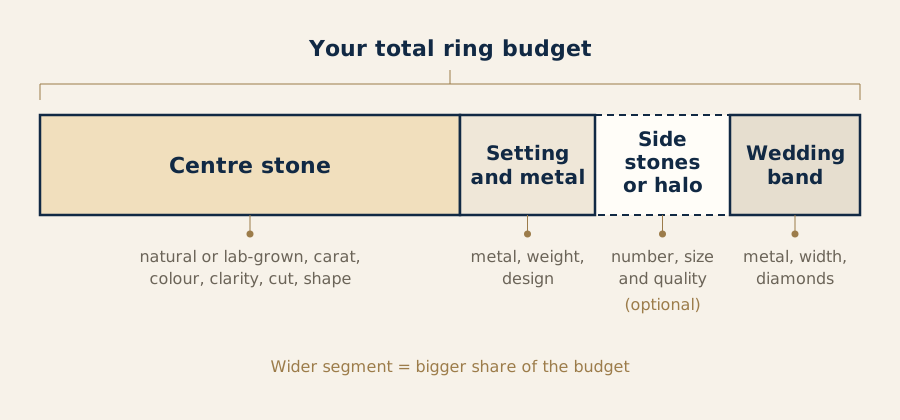
An engagement ring can cost anything from a few hundred dollars to well into six figures, so a single average figure tells you very little. What matters is what your budget buys. For a classic diamond ring, the money usually splits like this:
| Part of the ring | Share of the budget | What changes it |
|---|---|---|
| Centre stone | Usually the largest share | Natural or lab-grown, carat, colour, clarity, cut, shape |
| Setting and band | A smaller but real share | Metal (9ct, 18ct, platinum), weight, design complexity |
| Side stones or halo | Optional extra | Number, size and quality of the small diamonds |
| GST | 10%, already included | Included in the price you see at an Australian retailer |
As a very rough guide to what different budgets buy for a diamond solitaire in Australia (approximate AUD, prices move often, especially for lab-grown):
| Total budget (approx. AUD) | Lab-grown solitaire | Natural solitaire |
|---|---|---|
| $1,500–$3,000 | Around 0.70–1.50 ct in a simple setting | Around 0.25–0.40 ct |
| $3,000–$6,000 | Around 1.50–2.50 ct, or a halo design | Around 0.50–0.70 ct |
| $6,000–$12,000 | Larger stones or top grades with room for a diamond band | Around 0.90–1.20 ct in good grades |
| $12,000+ | Rarely needed for size alone | 1.50 ct and above, or top colour and clarity |
Treat these as orientation, not quotes. Our Australian diamond price guide shows how natural prices move with carat, colour and clarity, and the lab-grown diamond price guide does the same for laboratory-grown stones.
What makes an engagement ring cost more or less?
Five choices move the price far more than anything else. Knowing them lets you decide where to spend and where to save. If any term is unfamiliar, our jewellery glossary explains it.
- Natural or lab-grown. A laboratory-grown diamond costs much less than a natural diamond of the same size and grades. This is the single biggest lever.
- Carat weight. A carat is a unit of weight (0.2 grams), not size. Price rises faster than weight: a 2 carat stone usually costs well over twice a 1 carat stone of the same quality, because larger rough is rarer.
- Colour and clarity. Colour is graded from D (colourless) down the alphabet; clarity from Flawless down to Included, based on internal features called inclusions. Each step up costs more, often for differences you cannot see once the ring is on.
- Cut and shape. A well-cut stone costs more than a poorly cut one, and rounds generally cost more per carat than fancy shapes such as ovals and pears.
- Metal and design. 18ct gold and platinum cost more than 9ct gold, and a halo, pavé band (a band set with rows of tiny diamonds) or detailed gallery adds metal, small stones and hours at the bench.
Gold and platinum prices also move with world markets, so a quote for the same setting can change over a few months. Design choices matter as well: a ring built for an active, hands-on life may need a lower profile or a thicker band, which changes the metal cost. See how your lifestyle should shape the design.
Related guideShould You Choose a Custom Engagement Ring or a Ready-Made Ring?Not sure which one is right?
Send us the stones you are looking at and our gemologist will tell you which to choose and why.
How do you get more ring for your budget?
Most of the savings come from not paying for differences you will never see. A few reliable ways:
- Choose just under a popular weight. A 0.90 carat stone looks almost the same as a 1.00 carat (roughly 6.2 mm across against 6.4 mm for a round) but often costs noticeably less, because prices step up at round numbers.
- Choose near-colourless. G or H colour looks white in most settings; D to F costs more for a difference that is hard to see face-up.
- Aim for eye-clean, not flawless. Eye-clean means no inclusions visible to the naked eye at normal viewing distance. A carefully chosen VS2 or SI1 can look as clean as a VVS stone. Surface damage matters more than a tiny internal crystal, so learn about cavities and chips before you commit to a stone.
- Consider a fancy shape. Ovals, pears and cushions usually cost less per carat than rounds and can look larger for their weight.
- Let the metal help. Yellow and rose gold warm the stone, so a slightly lower colour grade can look just as good.
A clear shortlist also stops you drifting upwards one grade at a time. Our guide to building a diamond shortlist without getting lost in filters and our advice on judging a stone from a 360° video help you compare like with like.
How much should a wedding ring cost?
A wedding band usually costs much less than the engagement ring, but the range is wide. A plain band's price depends mainly on the metal, the width and the weight; a diamond band adds the cost of the stones and the setting work. As a rough guide, plain gold bands often start from a few hundred dollars, while diamond-set and platinum bands run into the low thousands.
| Band type | Relative cost | What drives it |
|---|---|---|
| Plain 9ct gold | Lowest | Width, thickness, profile |
| Plain 18ct gold or platinum | Moderate | Metal price and weight; platinum is denser, so the same band uses more metal |
| Diamond-set band | Higher | Number, size and quality of diamonds, setting style |
| Fitted or custom band | Higher | Shaped to sit against the engagement ring; design and labour |
Plan the two rings together. A curved or fitted band, or a gap between the rings, affects both cost and comfort; see how much gap to leave between the two rings and choosing the right band width. A wider engagement band uses more metal now and usually means a wider wedding band later.
What costs come after you buy the ring in Australia?
The price tag is not the whole cost. In Australia, plan for these as well:
- Insurance. Most home contents policies cap jewellery at a modest amount per item unless you list the ring as a specified item. Specifying usually needs a written valuation, and the premium is an ongoing yearly cost that varies by insurer, postcode and ring value. Check whether the policy replaces the ring or pays cash, and whether it covers loss away from home. Lab-grown rings need cover too; see whether to insure a lab-grown diamond.
- Valuation. An insurance valuation states a replacement value: what it would cost to replace the ring at retail. It is not what you could resell it for. Many insurers ask for it to be updated every few years as prices change.
- Resizing and maintenance. Resizing, claw re-tipping and rhodium plating for white gold are normal over a ring's life. If you are guessing a size for a surprise, our Australian ring size conversion chart helps, and a size or two of resizing is usually straightforward on a plain band.
GST and buying overseas. Prices shown to consumers by Australian retailers must include the 10% GST. A ring bought from an overseas website is not automatically cheaper: low-value imports have GST added at checkout, and higher-value goods can attract GST and other charges at the border, plus shipping, insurance and the cost of returns or repairs from abroad.
Tourist Refund Scheme (TRS). If you are leaving Australia soon, you may be able to claim the GST back at the airport. In broad terms, you need to spend at least $300 (including GST) with one business, purchase within 60 days of departure, keep the tax invoice, and carry or wear the ring through the TRS counter. Australian residents can claim too, but if the ring comes back into Australia it generally has to be declared and the GST repaid. Conditions are set by the Australian Border Force, so check them before you travel.
It also helps to be realistic about resale. A ring is not a financial asset: resale value is usually well below the retail price for natural diamonds and much lower again for lab-grown. Our guide to what diamonds are worth when resold explains why.
Natural or lab-grown: how does the choice change your budget?
For the same budget, a lab-grown diamond buys a much larger or higher-graded stone than a natural one. A natural diamond is rarer and keeps that rarity, but costs considerably more for the same carat, colour and clarity. Both are real diamonds with the same hardness (10 on the Mohs scale) and the same refractive index (2.42), so they look identical to the eye.
| Natural diamond | Lab-grown diamond | |
|---|---|---|
| Origin | Formed deep in the earth, mostly 1 to 3 billion years ago | Grown in a laboratory by HPHT or CVD in weeks |
| Price for the same grades | Considerably higher | Much lower |
| Rarity | Rare, especially in larger sizes | Widely available in large sizes |
| Resale | Well below retail | Very low |
| Grading report | GIA, IGI and others | IGI, GIA and others; marked as laboratory-grown |
Some lab-grown stones show faint internal growth patterns from the CVD process; our guide to CVD growth striations explains when they matter. Whichever you choose, compare stones with the same grades and report type so the price difference you see is real.
Compare natural and lab-grown diamonds in our stock
How to decide how much you should spend on an engagement ring: step by step
- Set a total you can pay comfortably. Include the wedding band if you are getting both, and leave room for insurance.
- Pick your priorities. Size, sparkle, colour, natural or lab-grown: rank them so you know where to spend.
- Choose the setting style. A simple solitaire leaves more for the stone; a halo or pavé band takes a bigger share. Put it in writing with our help on writing a clear design brief.
- Shortlist stones within the stone budget. Compare like-for-like grades and report types.
- Check the design before it is made. For custom rings, review the 3D model; see how to read a CAD render.
- Allow time. A custom ring takes weeks, not days. See when to order the ring before a proposal.
- Arrange insurance from day one. Get the valuation and cover in place before the ring leaves the store.
Free consultation
Talk to a gemologist
Compare stones in person or online with Raj Sood, Graduate Gemologist (GIA), AJP (GIA).
Book a consultationShop this shape
FAQ
Common questions
How much should you spend on an engagement ring in Australia?
Whatever you can pay comfortably without debt. There is no standard amount; set a total budget first and then decide how to divide it between the stone, the setting and the wedding band.
Should an engagement ring cost three months' salary?
No. Salary rules began as diamond advertising, not financial advice. Base the budget on your savings and priorities instead.
How much should a wedding ring cost?
Usually much less than the engagement ring. A plain band's price depends on the metal, width and weight; diamond-set, platinum and fitted bands cost more.
Is a lab-grown diamond a good way to stay on budget?
It is the biggest single saving: a lab-grown diamond costs much less than a natural diamond of the same size and grades. Resale value is very low, so choose it because you love it, not as an asset.
Do I need to insure an engagement ring?
It is strongly recommended. Many contents policies cap jewellery, so you may need to list the ring as a specified item, which usually requires a written valuation.
Can I get the GST back on an engagement ring?
Only through the Tourist Refund Scheme when leaving Australia, if you meet its conditions, such as spending at least $300 with one business within 60 days of departure. If you bring the ring back into Australia you generally have to declare it and repay the GST.

Ask a gemologist
Not sure which diamond to choose?
Raj Sood is a Graduate Gemologist (GIA) and master jeweller. Bring the stones you are considering, or send the reports, and he will tell you honestly which one is better and why.
Keep learning
Related guides
 Buying Knowledge & Custom ProcessDiamond Price Guide Australia
 Buying Knowledge & Custom ProcessLab-Grown Diamond Price Guide Australia
 Lab-Grown DiamondsShould a Lab-Grown Diamond Be Insured?Buying Knowledge & Custom ProcessPlanning a Proposal: When Should You Order the Engagement Ring?
 Wedding Bands & EternityHow Much Gap Should There Be Between an Engagement Ring and Wedding Band?
 Engagement Rings & SettingsWhat Engagement Ring Band Width Should You Choose?
 Engagement Rings & SettingsHow Lifestyle Should Influence Engagement Ring Design
Explore more
More guides on this topic
Education