
- Education
- Care, Repairs & Remodelling
- How to Clean Silver Jewellery Safely at Home
Care, Repairs & Remodelling
How to Clean Silver Jewellery Safely at Home
Silver is soft, reactive and worn through Australian summers of salt, chlorine and sunscreen. Here is how to clean silver jewellery safely at home, what damages it, and when a piece needs a jeweller instead.
 Reviewed by Raj Sood, Graduate Gemologist (GIA), AJP (GIA)Master jeweller and Graduate Gemologist (GIA) · reviewed 4 November 2026
Quick answer
To clean silver jewellery, wash it in warm water with a drop of mild, fragrance-free dishwashing liquid, brush gently with a soft toothbrush, rinse and dry fully. Remove light tarnish with a silver polishing cloth. Skip toothpaste, bleach and silver dips on gemstones or pearls, and take silver off before the pool, beach or gym.
Why does silver jewellery tarnish?
Most silver jewellery is sterling silver, stamped 925: 92.5% pure silver alloyed with 7.5% other metal, usually copper. Pure (fine) silver is too soft for rings, clasps and claws, and the copper gives it strength. Our guide to what sterling silver is made of and how it wears covers the alloy, hallmarks and newer tarnish-resistant blends in detail.
Tarnish is a thin film of silver sulfide (Ag2S) that forms when silver reacts with sulfur compounds in the air, mainly hydrogen sulfide. It is not dirt and it is not rust, and it does not mean the silver is fake. It starts as a faint yellow, moves through gold and brown, and ends up blue-black. The copper in sterling can also react, which is one reason two pieces stored side by side can darken at different rates.
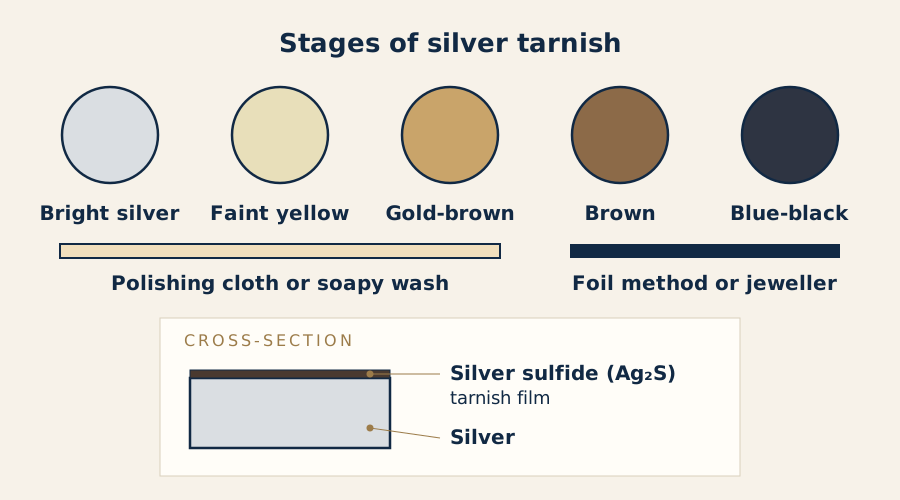
Several everyday things speed tarnish up:
- Humidity: damp coastal and tropical air, from a Sydney summer to Cairns or Darwin, tarnishes silver faster than dry inland air.
- Sulfur sources: eggs, onions, mayonnaise, rubber bands, latex gloves, wool and some felt or cardboard boxes.
- Skin and sweat: salts, acids and individual body chemistry; some medications make a difference too.
- Cosmetics: perfume, hairspray, moisturiser and sunscreen leave films that trap moisture against the metal.
- Chlorine and salt water: covered in detail further down, because they cause more than just tarnish.
Tarnish is reversible, and caught early it comes off with a cloth in seconds. Heavy black tarnish takes more work, and the methods that remove it fastest also remove a little silver each time. That trade-off sits behind most of the advice on this page. For the chemistry, see how tarnish and patina form on silver, and if a term here is new to you, the GemTrove jewellery glossary explains it.
Is it tarnish, patina or something else?
Before you clean anything, work out what you are looking at. Not every dark or dull patch is tarnish, and the wrong fix can strip a finish the maker put there on purpose.
| What you see | Likely cause | What to do |
|---|---|---|
| Even yellow-to-brown film over the whole piece | Early tarnish | Silver polishing cloth or a warm soapy wash |
| Black in the recesses only, bright on raised areas | A deliberate oxidised finish (patina) applied by the maker | Wash gently; do not dip or polish into the recesses |
| Grey, cloudy film after swimming | Chlorine or other pool chemicals | Rinse, wash, then cloth; see a jeweller if the surface looks pitted |
| Yellowish or darker patches on a bright white piece | Rhodium plating wearing through to the silver underneath | Replating, not polishing |
| White residue in crevices and behind stones | Sunscreen (zinc oxide) or soap build-up | Soapy soak and a soft brush |
| Fine scratches and a dull surface | Normal wear on a soft metal | Professional polish |
Patina here means darkening that adds depth to a design, usually in engraving, filigree or textured areas. Many makers apply it with a chemical called liver of sulfur. It looks like tarnish because it essentially is tarnish, placed deliberately. Our page on why some makers darken silver on purpose shows how to tell the two apart.
Many modern silver pieces are also rhodium-plated: given a thin coat of rhodium, a hard, bright white platinum-group metal, so they stay white and resist tarnish. Treated polishing cloths and dips wear that coat away faster. When the yellower silver starts showing through, it is time to look at how often rhodium plating needs renewing rather than reaching for the polish.
What is the safest way to clean silver jewellery?
For solid sterling silver with no stones, the gentlest method that works is almost always: wash, dry, then polish with a cloth. Everything stronger is for heavy tarnish and comes with a cost, either lost silver, lost finish or risk to stones.
| Method | Good for | Risk | Gemmologist view |
|---|---|---|---|
| Warm water and mild dishwashing liquid | Grime, sunscreen, skin oils, light tarnish | Very low | Start here, every time |
| Silver polishing cloth (treated) | Light to moderate tarnish on smooth surfaces | Removes a tiny layer; wears plating and patina | Ideal for regular upkeep |
| Aluminium foil, bicarb soda and hot water | Heavy tarnish on plain silver and chains | Strips oxidised finishes; unsafe for pearls, porous or glued stones | Useful occasionally |
| Commercial silver dip | Heavy tarnish deep in fine chains | Acidic; dulls the surface, attacks stones and patina if left too long | Seconds only, plain silver only |
| Bicarb or toothpaste paste | Very little | Abrasive; scratches a high polish | Avoid |
| Home ultrasonic cleaner | Solid silver with no stones | Can loosen stones and crack porous or fractured gems | Use with care |
| Bleach, vinegar, lemon juice | Nothing | Bleach pits and blackens silver; acids etch it and damage stones | Never |
If you want to clean silver jewellery with baking soda, the foil method is the safer way to use it, rather than scrubbing with a paste. Line a heatproof bowl with aluminium foil, add roughly a tablespoon of bicarbonate of soda per litre of very hot water, and lay the silver on the foil so it touches. The aluminium reacts with the silver sulfide and turns it back into silver metal instead of scraping it off, so less silver is lost than with a dip or polish. You may notice an eggy sulfur smell. After a few minutes, lift the pieces out, rinse, dry and buff with a soft cloth.
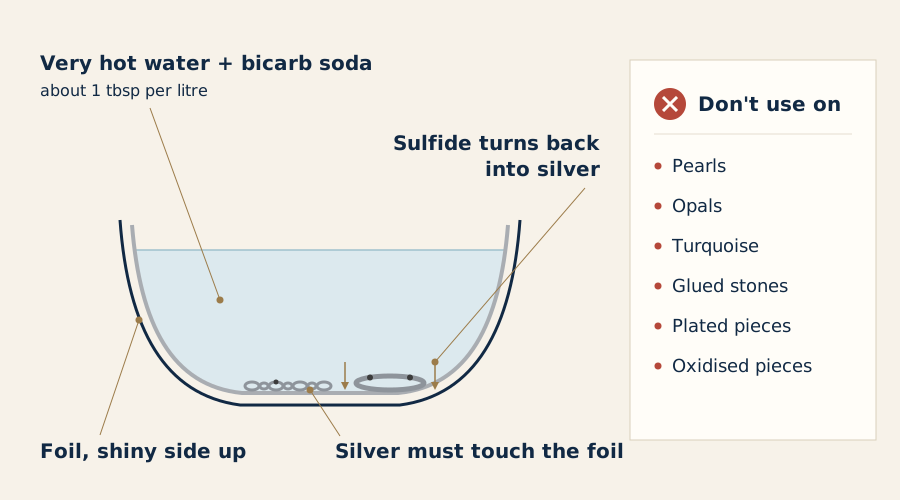
The foil method removes all darkening, including a maker's oxidised detail, and the hot alkaline water is not safe for pearls, opals, turquoise, glued stones or plated pieces. Silver dips work in seconds but can leave a flat, white-grey finish if left too long, and any residue left in a chain keeps working, so rinse thoroughly.
Does toothpaste clean silver? It removes tarnish, but it does so by scratching. Toothpaste contains abrasives designed for tooth enamel, which sits at about 5 on the Mohs scale (a 1–10 scale of scratch resistance), while sterling silver sits at only 2.5–3. The result is a haze of fine scratches that makes the piece look duller and tarnish faster afterwards.
How to clean silver jewellery with gemstones, pearls or plating?
Silver is often set with softer or porous materials, and when it is, the stone, not the metal, decides the method. A porous gem has tiny pores that soak up liquid, and any chemical that gets in can change its colour or lustre for good. Many fashion and vintage pieces also have stones held with glue rather than claws, which water and heat can loosen.
| Stone | Mohs hardness | Safe way to clean | Avoid |
|---|---|---|---|
| Pearl | 2.5–4.5 | Wipe with a soft damp cloth after each wear | Dips, foil method, ultrasonic, soaking, perfume |
| Amber | 2–2.5 | Damp cloth, dry straight away | Dips, solvents, heat |
| Turquoise | 5–6 | Damp cloth | Dips, soaking, oils, strong detergents |
| Opal (solid) | 5.5–6.5 | Brief wash in lukewarm soapy water | Ultrasonic, steam, sudden temperature changes |
| Opal doublet or triplet | 5.5–6.5 (glued layers) | Damp cloth only | Any soaking; water can lift the layers |
| Marcasite (pyrite) | 6–6.5 | Dry soft brush | Soaking; stones are often glued |
| Peridot | 6.5–7 | Warm soapy water, soft brush | Ultrasonic, acid dips, heat |
| Cubic zirconia | 8–8.5 | Warm soapy water, soft brush | Abrasive pastes |
| Diamond (natural or lab-grown) | 10 | Warm soapy water, soft brush | Dips that dull the silver around it |
Peridot catches people out. It looks robust, but at 6.5–7 on the Mohs scale it is no harder than quartz-based dust and is sensitive to acids and heat, so it should never go into a silver dip. Our guide to why peridot's green and its care are unusual explains the reasons.
A natural or lab-grown diamond in a silver setting can be cleaned like any diamond ring, with extra care for the soft metal around it. Grease on the underside of the stone dulls sparkle more than most people expect, and a clean stone shows its true clarity. See cleaning a diamond ring safely at home for the method, and what makes a diamond look eye-clean if you are wondering whether a mark is grime or an inclusion.
Plated silver, whether rhodium-plated or gold-plated (a thicker gold layer over sterling is often sold as vermeil), needs the gentlest treatment of all. The plating is very thin, from well under a micron for rhodium to a few microns for vermeil (a micron is a thousandth of a millimetre). Wash it in soapy water, dry it with an untreated microfibre cloth, and keep treated polishing cloths, dips and the foil method away from it.
Not sure which one is right?
Send us the stones you are looking at and our gemologist will tell you which to choose and why.
Can you wear silver jewellery at the beach, in the pool or in the shower?
Australian life is hard on silver. Summer means salt water, chlorinated pools, spas and a lot of sunscreen, often on the same day. Can sterling silver get wet? Yes, plain fresh water will not hurt it. The problem is what is in the water and on your skin.
| Exposure | What it does to silver | What to do |
|---|---|---|
| Pool chlorine | Forms a grey silver chloride film; repeated exposure can weaken solder joints | Take silver off; if it gets wet, rinse in fresh water and dry |
| Spa or hot tub | Heat plus chlorine or bromine speeds the reaction | Always remove |
| Salt water and sand | Salt residue speeds tarnish; sand scratches and wears clasps | Remove for swimming; rinse after a beach day |
| Sunscreen and insect repellent | Leaves a film, clogs settings and dulls stones | Apply, let it dry, then put jewellery on |
| Shower | Soap and shampoo film; hard water spots | Fine occasionally, but take it off for a proper wash |
Silver jewellery in the pool is the exposure to take most seriously. Chlorine reacts with silver far faster than air does, and a hot spa can turn a bright chain grey within one session. Over months, the same chemistry can attack the solder joints that hold jump rings, clasps and settings together, which is how links fail without warning. Cold water also shrinks fingers, so rings slide off in the surf; a ring lost at the beach is rarely found.
Sunscreen is the quiet one. Zinc oxide and titanium dioxide leave a white paste in claws and chain links, and the oils hold sand and salt against the metal. Our page on how sunscreen and chlorine affect metals and stones goes further, and if you are packing for a coastal trip, read packing jewellery sensibly for a holiday before you go.
Related guideCan You Wear Your Ring in the Shower, Pool or at the Beach?The same rules apply to gold and platinum rings, with different reasons. Our guide to wearing rings in the shower, pool or surf covers every metal side by side.
Should you take silver jewellery off for the gym or bed?
Sweat contains salt and, for some people, acids and sulfur compounds, so silver worn during exercise tarnishes faster. The bigger issue is physical. Silver is soft, and a barbell, kettlebell or rowing handle can squeeze a band out of round, crack it at a thin point, or push a claw back so a stone works loose.
These are typical kinds of silver damage jewellers repair, and almost all of them are avoidable:
- Rings bent oval from gripping weights or carrying shopping bags.
- Thin chains snapped or kinked overnight, or caught on a gym bag strap.
- Earring posts bent from sleeping on them.
- Claws lifted after catching on bedding, knitwear or towels.
- Shanks worn thin on rings worn every day for years, until they crack at the base.
For more on everyday wear, see whether it is safe to sleep or train in your ring. If your fingers swell after a workout but shrink in winter, so a ring spins or slips, sizing beads and bars can steady the fit without resizing the whole band.
How often should you clean silver jewellery, and how do you store it?
Wearing silver regularly slows tarnish on smooth surfaces, because skin contact and clothing gently buff it. The pieces that tarnish worst are the ones left in a drawer. A simple routine keeps most silver bright:
- After the beach, pool or gym: rinse in fresh water and dry the same day.
- Weekly, for daily-wear pieces: a quick wipe with a soft, untreated cloth.
- Every month or two: a warm soapy wash, then a silver polishing cloth on smooth areas.
- Heavy tarnish: the foil method or a jeweller, a few times a year at most.
- Once a year: a jeweller's check of claws, clasps and solder joints.
How to stop silver tarnishing between cleans comes down to keeping it dry and away from air. Store each piece in a small zip-lock bag with the air pressed out, or in an anti-tarnish cloth pouch, and add an anti-tarnish strip or a silica gel sachet to the box. Keep silver out of the bathroom, away from rubber bands and wool, and never put it away damp. Fasten chains before storing them so they do not tangle.
Our guide to storing jewellery so it tarnishes and scratches less covers boxes, travel rolls and mixing metals, and our complete jewellery care routine brings silver, gold, platinum and gemstones together in one schedule.
When should silver jewellery go to a jeweller instead?
Home cleaning maintains a surface. It cannot fix structural problems, and some finishes can only be restored at a bench. Bring a piece in when you see:
- Deep scratches or dents: a professional polish removes a fine layer of metal to level them, so it is worth doing occasionally, not constantly.
- Lost oxidised detail: a jeweller can re-oxidise recesses after a dip or foil clean has stripped them.
- Plating wearing through: rhodium or gold replating, not polishing, restores the colour.
- Loose stones, thin claws or a worn shank: these need re-tipping, re-setting or a new shank before a stone is lost.
- Broken clasps or jump rings: soldered repairs last far longer than squeezing a ring closed with pliers.
- Black tarnish in filigree or antiques: fine or sentimental pieces are safer cleaned by hand at a bench.
Our comparison of professional cleaning versus home cleaning explains what a bench clean does that you cannot. If an old silver piece is too worn to repair, which metals and stones can be safely reused in a remodel is a good next read, and for insured pieces, understand the difference between replacement value and resale value before you book a valuation.
Jewellery repairs service
How to clean silver jewellery at home: step by step
- Check what you have. Solid sterling, plated, oxidised detail or set with porous or glued stones? That decides the method.
- Mix a gentle bath. A bowl of warm (not hot) water with a few drops of mild, fragrance-free dishwashing liquid.
- Soak briefly. Two to five minutes for plain silver; skip the soak for pearls, opal doublets, turquoise and marcasite and use a damp cloth instead.
- Brush gently. Use a soft baby toothbrush around claws, behind stones and through chain links.
- Rinse well. Use clean fresh water, with the sink plug in so nothing slips down the drain.
- Dry completely. Pat dry with a lint-free cloth and leave chains flat in the air for an hour so no moisture stays in the links.
- Polish light tarnish. Use a silver polishing cloth on smooth areas, working in straight strokes, and keep it off plated pieces and oxidised recesses.
- Store it dry. Put each piece away separately in an airtight bag or anti-tarnish pouch.
Free consultation
Talk to a gemologist
Compare stones in person or online with Raj Sood, Graduate Gemologist (GIA), AJP (GIA).
Book a consultationShop this shape
FAQ
Common questions
Does toothpaste clean silver jewellery?
It removes tarnish, but by scratching. Toothpaste abrasives are made for tooth enamel, which is harder than silver, so they leave fine scratches that dull the surface and make it tarnish faster.
How do you clean tarnished silver quickly?
For light tarnish, a silver polishing cloth works in seconds. For heavy tarnish on plain silver with no stones, the aluminium foil, bicarb soda and hot water method is fast and removes less silver than a dip.
Can sterling silver get wet in the shower?
Fresh water will not harm sterling silver, but soap and shampoo leave a film and hard water leaves spots. An occasional shower is fine; pools, spas and the sea are the real risks.
Why does silver turn my skin black or green?
Black marks are usually tarnish rubbing off onto skin, often made worse by sweat or lotions. Green marks come from the copper in sterling reacting with moisture; keeping the piece clean and dry usually stops it.
Is it safe to clean silver jewellery with vinegar or lemon juice?
It is better not to. Acids can etch silver, strip oxidised finishes and damage pearls, opals, turquoise and peridot, and mild soap and water does the job more safely.
Does real silver tarnish?
Yes. Tarnish is a natural reaction between silver and sulfur in the air, so tarnish is normal and does not mean the piece is fake, although plated and base-metal pieces can darken too. Rhodium-plated silver tarnishes much less until the plating wears.

Ask a gemologist
Not sure which diamond to choose?
Raj Sood is a Graduate Gemologist (GIA) and master jeweller. Bring the stones you are considering, or send the reports, and he will tell you honestly which one is better and why.
Keep learning
Related guides
 MetalsSilver Tarnish and Patina
 MetalsSterling Silver Jewellery
 Care, Repairs & RemodellingSunscreen, Chlorine and Your JewelleryCare, Repairs & RemodellingJewellery Care and Maintenance
 Care, Repairs & RemodellingHow to Clean a Diamond Ring at Home
 Diamond 4Cs & GradingEye Clean DiamondsCare, Repairs & RemodellingHow to Store Jewellery
 Care, Repairs & RemodellingJewellery Remodelling: What Can Be Reused Safely?
Explore more
More guides on this topic
Education