
- Education
- Lab-Grown Diamonds
- How to Tell if a Diamond Is Real: Tests That Work and Their Limits
Lab-Grown Diamonds
How to Tell if a Diamond Is Real: Tests That Work and Their Limits
Knowing how to tell if a diamond is real stops you paying diamond prices for moissanite, cubic zirconia or glass. Here is what home tests, a loupe, a tester and a gem lab can each prove, and what they cannot.
 Reviewed by Raj Sood, Graduate Gemologist (GIA), AJP (GIA)Master jeweller and Graduate Gemologist (GIA) · reviewed 4 November 2026
Quick answer
To tell if a diamond is real, use a 10x loupe and a multi-tester that checks heat and electrical conductivity. Diamond passes; cubic zirconia, sapphire and glass fail, and moissanite is flagged electrically or by doubled facets. Home tests such as fogging only hint. Separating natural from lab-grown needs a gem lab or a matching grading report.
What counts as a real diamond?
When people ask how to tell if a diamond is real, they usually mean one thing: is this stone actually diamond, or a different material made to look like one? A real diamond is crystallised carbon, with its atoms locked in a tight cubic lattice. That is true whether it formed deep in the Earth, often billions of years ago (a natural diamond) or was grown over a few weeks in a laboratory (a lab-grown diamond, also called laboratory-grown). Both share the same chemistry, crystal structure, hardness and optics. Our explainer on whether lab-grown diamonds count as real diamonds sets out the science in detail.
A simulant is something else entirely: a different material that imitates diamond's look. The common ones are moissanite (silicon carbide), cubic zirconia (zirconium oxide, usually shortened to CZ), colourless sapphire, white topaz, synthetic spinel, older lab-made materials such as YAG and GGG, and plain glass. Several of these are perfectly good gems in their own right. The problem only arises when one is sold, inherited or remembered as diamond.
So there are really two separate questions. First: diamond or simulant? A clean stone, a loupe and a good tester usually answer that in a few minutes. Second: natural or lab-grown? That almost always needs a gem laboratory, and our complete lab-grown diamonds guide explains why. Any unfamiliar word on this page is defined in our plain-English jewellery glossary.
How does a real diamond compare with moissanite, cubic zirconia and sapphire?
Every gem material has measurable properties, and these are what testers and gemmologists rely on. Hardness on the Mohs scale tells you how well a surface resists scratching. Refractive index (RI) measures how strongly the stone bends light; the higher it is, the brighter a well-cut stone looks. Dispersion is how much the stone splits white light into rainbow colours, which you see as fire. Specific gravity (SG) is density compared with water, so it tells you how heavy a stone is for its size.
| Material | Mohs hardness | Refractive index | Dispersion | Specific gravity | Thermal tester | Approx. AUD, 6.5 mm round (1 ct diamond size) |
|---|---|---|---|---|---|---|
| Natural diamond | 10 | 2.42 | 0.044 | 3.52 | Passes | about $6,000–$14,000 (G–H, VS) |
| Lab-grown diamond | 10 | 2.42 | 0.044 | 3.52 | Passes | about $700–$2,500 (G–H, VS) |
| Moissanite | 9.25 | 2.65–2.69, doubly refractive | 0.104 | 3.22 | Usually passes | about $300–$1,200 |
| Cubic zirconia | 8–8.5 | 2.15–2.18 | 0.058–0.066 | 5.6–6.0 | Fails | about $10–$100 |
| White sapphire (natural or lab-created) | 9 | 1.76–1.77 | 0.018 | 4.00 | Fails | about $50–$1,500 |
| Glass | 5–6 | about 1.5 | varies | about 2.3–4.5 | Fails | under $20 |
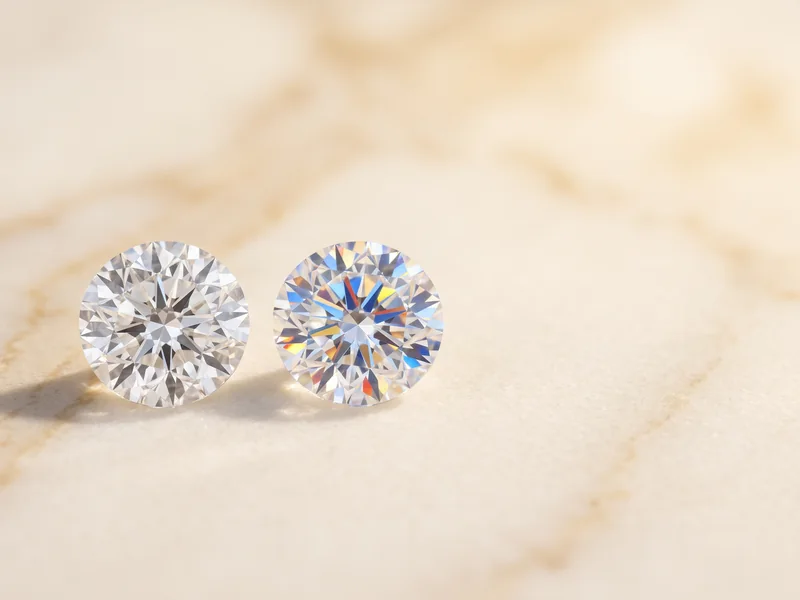
Moissanite is the simulant most likely to fool someone. It is almost as hard as diamond, conducts heat well enough to pass a basic tester, and has more than twice diamond's dispersion, so it throws strong rainbow flashes. Our page on moissanite compared with diamond covers the look side by side, and how moissanite is graded for colour and clarity explains why some moissanite shows a faint grey or yellow tint.
Cubic zirconia is much denser than diamond: a CZ cut to the same 6.5 mm size weighs roughly 1.6–1.7 times as much. It is also softer, so its facet edges wear and round off with daily wear. See how moissanite and cubic zirconia differ for more. White sapphire is tough and hard, but its much lower RI makes it look glassier and less bright; our comparison of lab-grown diamond versus white sapphire shows the difference. Colourless sapphire is often lab-created, and like lab-created sapphire, ruby and emerald generally, it is the same mineral as the natural gem, simply grown rather than mined.
How to tell if a diamond is real at home: which tests work?
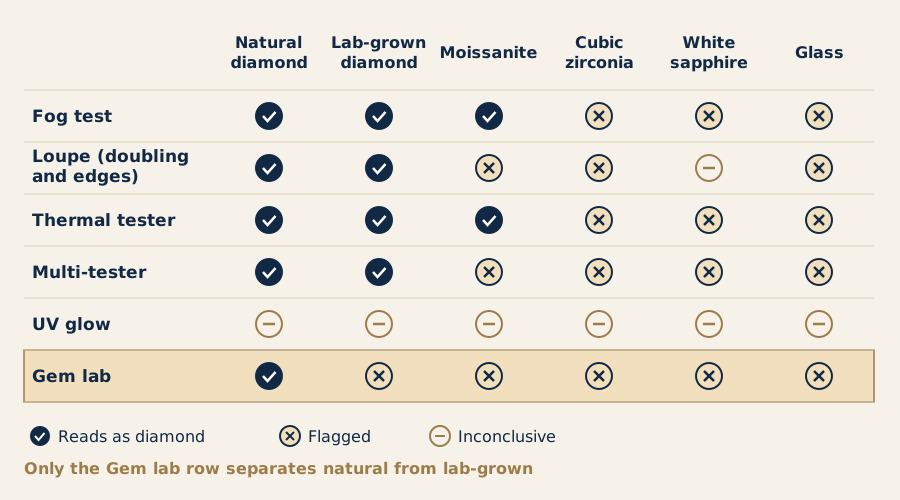
Home tests can raise or ease a suspicion, but none of them proves anything. Results change with how clean the stone is, how well it is cut and whether it is set. Treat them as a first filter before a loupe and a tester.
| Home test | How to do it | What it can catch | What it misses |
|---|---|---|---|
| Diamond fog test | Breathe on the clean, dry stone like a mirror; diamond clears in about 1–2 seconds | CZ, glass and sapphire often stay fogged noticeably longer | Moissanite also clears fast; any grease or lotion ruins the result |
| Read-through or dot test | Place a loose round stone table-down on newsprint or a pen dot | Glass and many CZs let you read print or see a ring around the dot | Only works on loose, well-cut round brilliants; fancy shapes and poorly cut diamonds can 'fail' |
| Watch the sparkle | Look under a single light, such as a desk lamp or phone torch | Heavy rainbow fire suggests moissanite or CZ; a dull, watery look suggests glass | Subjective; a large, well-cut diamond shows plenty of fire too |
| Weigh and measure | Loose stone on a 0.01 ct scale, with diameter measured in millimetres | CZ is far heavier than diamond for its size | Needs a precise scale, callipers and an unset stone |
| Check the stamps | Look inside the band with a loupe | 'CZ' marked on the shank, or 925 silver, hints at a simulant | Stamps can be wrong or missing, and some diamonds are set in silver |
A few popular tests are worth skipping altogether:
- Scratch test: diamond is the hardest gem, but moissanite, sapphire, CZ and even some hard glass all scratch ordinary window glass. Meanwhile a diamond can chip along its cleavage planes (natural planes of weakness) if you press an edge too hard.
- Water or sink test: diamond sinks, but so does almost every simulant. It tells you nothing.
- Heat or lighter test: heating a stone and dropping it in cold water can crack a diamond that has inclusions and can damage the setting. It proves nothing a tester cannot.
What does a real diamond look like under a 10x loupe?
A 10x loupe is a small folding magnifier and the standard magnification for grading diamonds. A decent one costs roughly $20–$60. Clean the stone first, hold the loupe close to your eye, then bring the stone towards it until it is sharp. These are the things a gemmologist looks for:
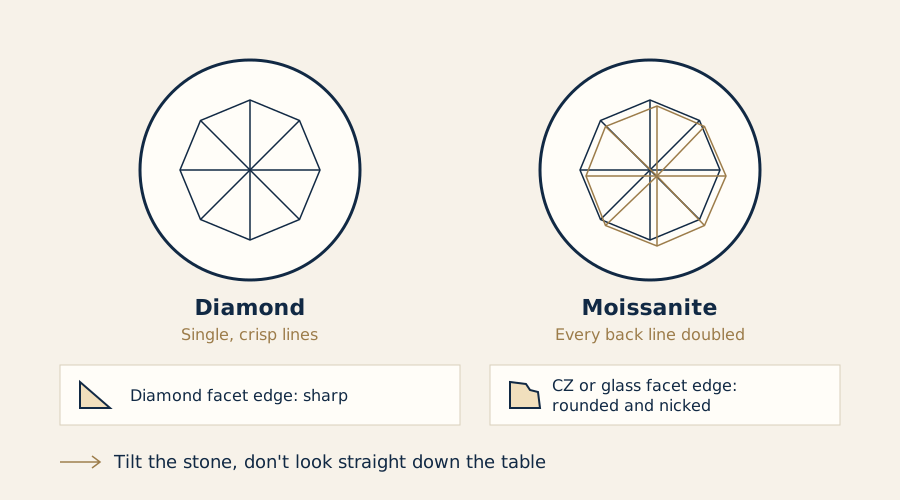
- Doubled facet edges: moissanite is doubly refractive, meaning it splits each light ray in two. Look through the stone at an angle and the back facet junctions appear as two lines instead of one. Diamond is singly refractive, so its lines stay crisp. Cutters often orient moissanite so you see little doubling straight down through the table, which is why tilting matters.
- Facet edges: at 10 on the Mohs scale, diamond keeps knife-sharp facet junctions for decades. CZ and glass, being softer, show rounded, nicked or scuffed edges, especially on the top of a ring worn daily.
- Inclusions: natural diamonds often show tiny crystals, feathers (small internal cracks), pinpoints or clouds. Glass shows round gas bubbles and swirl lines. CZ is usually free of inclusions altogether.
- The girdle: the thin outer edge. A diamond girdle is often frosted and granular, or finely faceted and polished, and may show a small 'natural', a patch of the original crystal surface left by the cutter.
- Laser inscription: many graded diamonds carry the report number, and sometimes 'LG' for lab-grown, inscribed on the girdle. It is just visible at 10x with patience and much easier under a microscope.
A stone that shows nothing under the loupe is not automatically a simulant. Truly flawless and internally flawless diamonds are rare among natural stones, but lab-grown diamonds are often very clean. When lab-grown stones do show something, it tends to follow a pattern: dark pinpoint or graphite-like specks in CVD-grown stones and metallic flux inclusions in HPHT-grown stones. Our guide to the inclusions typical of lab-grown stones has examples. Large metallic inclusions can even make a loose HPHT diamond respond to a strong magnet, though most stones show no reaction.
Not sure which one is right?
Send us the stones you are looking at and our gemologist will tell you which to choose and why.
Does a diamond tester work, and can it be fooled?
A thermal tester is a pen-shaped probe with a heated tip. Diamond conducts heat better than almost any other material, several times better than copper, so heat drains from the tip into the stone very quickly. CZ, glass, sapphire and topaz conduct heat far more slowly and read as 'not diamond'. The catch is moissanite: it also conducts heat very well, so a basic thermal tester usually reads it as diamond. Our page on why moissanite often fools a basic thermal tester explains the physics.
A multi-tester adds an electrical conductivity check. Moissanite conducts electricity slightly, diamond normally does not, so the tester can flag moissanite separately. There is one known exception: diamonds containing boron conduct electricity. That includes rare natural blue diamonds and some lab-grown diamonds, mainly HPHT-grown stones, so these can read as moissanite. Testers also give false readings if the probe touches metal, the stone is cold or wet, or the battery is low.
| Stone | Thermal tester | Multi-tester (heat and electrical) |
|---|---|---|
| Natural diamond | Diamond | Diamond (rare boron-bearing blues may read moissanite) |
| Lab-grown diamond | Diamond | Diamond (some boron-bearing stones may read moissanite) |
| Moissanite | Usually diamond | Moissanite |
| CZ, sapphire, topaz, glass | Not diamond | Not diamond |
Most importantly, neither tester can separate natural from lab-grown, because both are diamond and conduct heat the same way. Some newer devices are sold as lab-grown detectors; our page on what a tester can and cannot say about lab-grown covers what these screening units really measure.
Related guideDoes Moissanite Pass a Diamond Tester?What does a diamond UV test show?
Fluorescence is a glow some stones give off under ultraviolet light. An inexpensive long-wave UV torch (365 nm) is enough to see it. Roughly 25–35% of natural diamonds show some fluorescence, most often blue, occasionally yellow, orange or green. The rest show nothing.
A blue glow is a mild hint of natural diamond, but it is not proof. Some CZ glows, often a yellowish or orange colour. Many lab-grown diamonds show little or no reaction to long-wave UV. Under short-wave UV, some HPHT-grown diamonds glow blue-green and keep glowing for a few seconds after the lamp is switched off (called phosphorescence), while some CVD-grown stones show orange or red. A cluster ring set with many small natural diamonds often shows a patchwork of different strengths, because each stone came from a different crystal.
Gem labs go much further. Instruments such as the DiamondView use very short-wave UV to photograph the stone's growth pattern: CVD diamonds show fine parallel layers, HPHT diamonds show a geometric cross-like pattern, and natural diamonds show irregular growth zones. Our guide to the differences between HPHT and CVD growth explains where those patterns come from. One safety note: short-wave UV harms eyes and skin, so leave it to the lab and use only long-wave at home.
How do you tell a lab-grown diamond from a natural one?
You cannot do it by eye, with a loupe, with the fog test or with a standard tester. Lab-grown and natural diamonds are the same material, with the same 10 hardness, the same 2.42 refractive index and the same thermal conductivity. Neither is fake; they are simply formed differently and priced very differently, so you deserve to know which one you are paying for.
Gem labs use spectroscopy (measuring how the stone absorbs and emits light) and growth-pattern imaging. One quick screening clue is diamond type. About 98% of natural diamonds are Type Ia, containing small amounts of clustered nitrogen. Type IIa diamonds contain almost no nitrogen; they make up only around 1–2% of natural diamonds, yet most CVD and many HPHT lab-grown diamonds are Type IIa. Screening devices flag Type IIa stones for full laboratory testing. Our page on why Type IIa diamonds get flagged for testing goes into the detail.
In practice, your protection is paperwork that matches the stone. A grading report from a lab such as GIA or IGI states clearly whether a diamond is natural or laboratory-grown, and lab-grown stones are usually laser-inscribed to say so. In Australia, sellers are expected to describe lab-grown diamonds clearly, using terms such as lab-grown, laboratory-created or synthetic; see the words Australian sellers must use for lab-grown for the ACCC guidance.
Shop lab-grown diamonds
Does a grading report prove a diamond is real?
A report proves what the laboratory saw, and only for the stone it graded. It confirms your diamond only if the stone in your hand is that same stone. Before relying on a report, check:
- The inscription: the number on the girdle matches the report number.
- Measurements: diameter and depth match to within a few hundredths of a millimetre.
- Weight: for a loose stone, the carat weight matches to 0.01 ct.
- Inclusions: the plotting diagram (a map of the inclusions) matches what you see under the loupe.
- The lab: it is a recognised, independent laboratory, and the report can be looked up on the lab's own website.
A report also tells you more than natural versus lab-grown. A natural diamond can be genuinely diamond and still be treated, for example colour-improved by HPHT processing, fracture-filled or laser-drilled to lighten an inclusion. A reputable report notes these. What it does not cover, such as how bright the stone looks in real light or how well it is set, is explained in our guide to the gaps in a diamond grading report.
How to tell if a diamond is real: step by step
- Clean the stone. Soak it in warm water with a drop of dishwashing liquid, brush gently with a soft toothbrush and dry it with a lint-free cloth. Grease ruins every test.
- Check the paperwork and stamps. Look for a grading report, a girdle inscription and metal marks such as 750, 18ct or PT950 inside the band, and note any 'CZ' or 925 stamp.
- Use a 10x loupe. Tilt the stone to look for doubled facets, then check the facet edges for wear, inclusions or bubbles, and the girdle.
- Try the quick home checks. Fog test, sparkle under a single light and, for a loose stone, weight against diameter. Treat the results as hints only.
- Test with a multi-tester. Hold the probe at right angles to the table without touching metal. If it reads moissanite, go back to the loupe for doubling.
- Note the UV reaction. A long-wave torch adds one more clue, but a glow or no glow proves nothing on its own.
- Get lab confirmation for natural versus lab-grown. Match the stone to its report, or have a qualified gemmologist send it to an independent gem laboratory.
Free consultation
Talk to a gemologist
Compare stones in person or online with Raj Sood, Graduate Gemologist (GIA), AJP (GIA).
Book a consultationShop this shape
FAQ
Common questions
Can a jeweller tell if a diamond is real?
Yes. A jeweller with a loupe and a multi-tester can usually separate diamond from moissanite, CZ, sapphire and glass in a few minutes. Telling natural from lab-grown diamond needs laboratory equipment or a matching grading report.
Does a real diamond fog up?
Only briefly. Because diamond disperses heat quickly, breath fog usually clears in 1–2 seconds, while CZ and glass stay fogged longer. Moissanite clears quickly too, so the fog test is a hint, not proof.
Do simulants sparkle more than real diamonds?
Moissanite and CZ often show more rainbow fire than diamond because of their higher dispersion. Diamond shows strong white brilliance with balanced fire. Glass tends to look duller.
Will a diamond tester detect a lab-grown diamond?
No. A standard thermal or multi-tester reads lab-grown diamond as diamond, because it is diamond. Separating it from natural needs specialised screening or a gem laboratory.
Can moissanite pass as a real diamond?
It can pass a basic thermal tester, and many people cannot tell the two apart at a glance. A multi-tester with an electrical check, or doubled facet edges seen under a loupe, will usually identify it.
Does a real diamond scratch glass?
Yes, but so do moissanite, sapphire, CZ and some hard glass, so it proves nothing. Rubbing an edge against glass can also chip a diamond along its cleavage planes.

Ask a gemologist
Not sure which diamond to choose?
Raj Sood is a Graduate Gemologist (GIA) and master jeweller. Bring the stones you are considering, or send the reports, and he will tell you honestly which one is better and why.
Keep learning
Related guides
 Lab-Grown DiamondsCan a Diamond Tester Tell Natural From Lab-Grown?
 Lab-Grown DiamondsDoes Moissanite Pass a Diamond Tester?
 Lab-Grown DiamondsMoissanite vs DiamondLab-Grown DiamondsAre Lab-Grown Diamonds Real DiamondsLab-Grown DiamondsLab-Grown Diamonds Guide
 Diamond 4Cs & GradingFL and IF Clarity Diamonds
 Certificates & ValuationsWhat a Diamond Report Doesn't Tell YouLab-Grown DiamondsLab-Grown Diamonds vs White Sapphire
Explore more
More guides on this topic
Education