
- Education
- Lab-Grown Diamonds
- CVD Growth Striations: Should Buyers Worry About Layers in Lab-Grown Diamonds?
Lab-Grown Diamonds
CVD Growth Striations: Should Buyers Worry About Layers in Lab-Grown Diamonds?
CVD growth striations can sound alarming when you first read about them, but most are invisible and harmless. This guide shows how to tell the harmless kind from the visible graining that can dull a lab-grown diamond.
 Reviewed by Raj Sood, Graduate Gemologist (GIA), AJP (GIA)Master jeweller and Graduate Gemologist (GIA) · reviewed 4 November 2026
Quick answer
CVD growth striations are faint parallel layers left as a lab-grown diamond builds up, atom layer by layer, on a seed plate. Most are only visible under lab UV imaging and do not affect beauty or durability. Worry only if graining is visible as haze or brown banding; choose an eye-clean stone and ask whether graining is noted.
What are CVD growth striations?
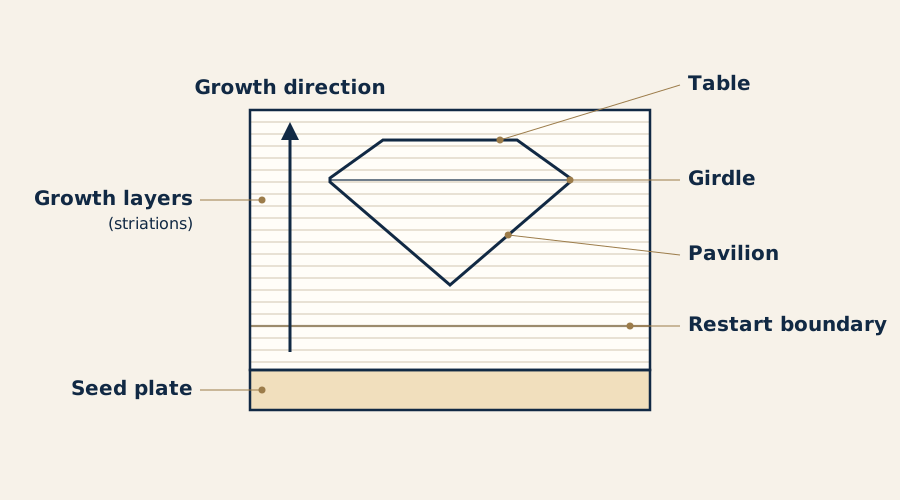
CVD growth striations are faint, parallel layers inside a diamond grown by chemical vapour deposition (CVD), one of the two main ways laboratory-grown diamonds are made. They record how the crystal was built: layer upon layer, on top of a flat diamond seed plate, over days or weeks. Think of them like the growth rings in a tree trunk or the layers in sedimentary rock. If you are new to the topic, start with our complete guide to lab-grown diamonds.
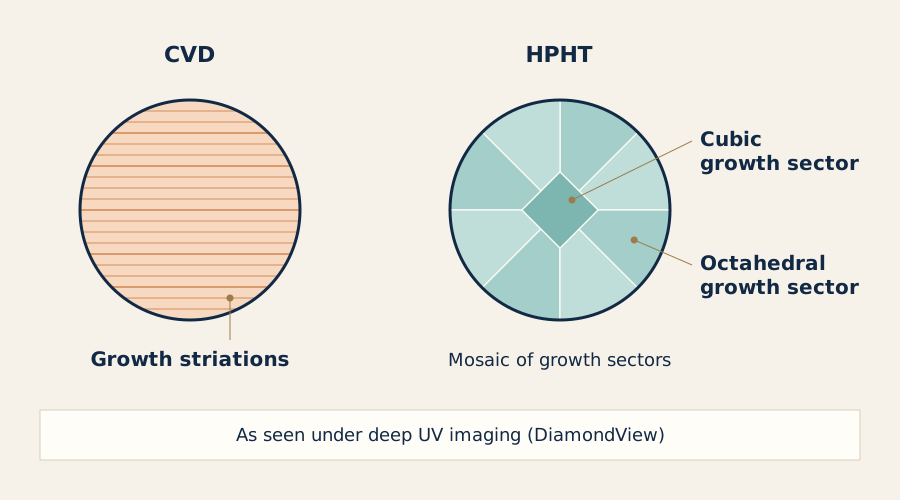
The word striation simply means a series of fine parallel lines or bands. In most CVD diamonds you cannot see them with your eyes, or even with a 10× loupe (the small magnifier a jeweller uses). They show up clearly under a laboratory instrument called a DiamondView, which shines deep ultraviolet light onto the stone and photographs how it glows. That layered glow is one of the main features gem labs use to confirm that a diamond was CVD-grown rather than mined or grown by another method.
A lab-grown diamond is real diamond: the same carbon crystal as a natural diamond, 10 on the Mohs hardness scale, with a refractive index of about 2.42 and a density of about 3.52 g/cm3. Growth striations do not change any of those properties. They are part of the crystal itself, not cracks, coatings or foreign material. Any unfamiliar term in this article is also defined in our plain-English jewellery glossary.
How does CVD growth create striations?
In a CVD reactor, thin square plates of diamond (the seed plates) sit in a sealed chamber filled with a gas mix that is mostly hydrogen with a small amount of methane. Microwave energy turns the gas into a glowing plasma, and carbon atoms settle onto the seed and bond into its crystal structure. Growth is slow, typically a few to a few tens of micrometres (thousandths of a millimetre) per hour, so building a slab thick enough to cut a 1 carat stone can take several weeks.
Conditions inside the chamber are never perfectly steady. Small shifts in temperature, gas mix, pressure or trace nitrogen change how many tiny defects get locked into each layer. Many growers also stop the run, take the slab out, clean or polish the growth surface and start again. Every change leaves a boundary, and those boundaries are what show up as striations. The steadier the growth, the fainter and more even the layers tend to be.
This is quite different from HPHT growth (high pressure, high temperature), where a diamond crystallises out of molten metal and grows outward in sectors, forming a crystal with many faces rather than a flat slab. Our page on how the HPHT and CVD growth methods differ covers both processes in detail.
Many CVD diamonds come out of the reactor with a brownish tint and are then heated, often by HPHT annealing, to improve their colour. That heating can change how the stone fluoresces under UV, but the layered structure remains, which is why labs can still identify the growth method afterwards. Our guide to post-growth treatment explained simply shows what the heating does and how it is disclosed.
Can you see CVD growth striations with the naked eye?
Usually not. Striations exist in every CVD diamond, but in a well-grown stone they are only visible with laboratory equipment. What matters to you is whether the layering has become visible in normal light. The table below sets out the levels, from invisible to a real concern.
| Where the layering shows | Visible to you? | Effect on appearance | Worth worrying about? |
|---|---|---|---|
| Under DiamondView UV imaging only | No | None | No; this is how labs identify CVD growth |
| As strain under crossed polarising filters | No; needs lab equipment | None | No |
| Faint internal graining under a 10× loupe | Rarely, and only magnified | Usually none face-up | Only if it adds up to haze |
| Visible graining or haze | Sometimes, at certain angles | Lower brightness and contrast, a 'sleepy' look | Yes; compare with other stones |
| Brown or grey colour banding | Sometimes, mainly side-on | Tinted or uneven colour | Yes; check colour carefully |
Internal graining is the gemmologist's term for growth irregularities you can see under magnification: faint lines, planes, or whitish or brownish bands inside the stone. It is not unique to lab-grown diamonds; natural diamonds show graining too, especially some type IIa and coloured diamonds. In a CVD stone, graining appears when the layer boundaries carry enough defects to bend or scatter light. When graders can see it at 10×, it can count towards the clarity grade or be mentioned in the report comments. Our page on what clarity grades are typical in lab-grown stones puts this in context.
The cut style matters too. Brilliant cuts such as rounds, ovals and pears break light into many small flashes, which helps hide faint graining. Step cuts such as emerald and asscher have long, open facets and a large table, so haze or banding is easier to notice. Our overview of every diamond shape and the guide to all 34 diamond cuts show which styles are brilliant and which are step cut.
Colour is the other place layering can show. Defect-rich layers sometimes carry a brown or grey tint, and in a stone that has not been fully treated you may see that colour as faint parallel bands when you look through the side. Our guide to why some CVD stones carry a brown or grey tint explains how to spot it before you buy.
Do growth striations affect sparkle, clarity or durability?
Here is how CVD diamond striations relate to each of the things buyers care about:
- Durability: no practical effect. Striations are part of the crystal lattice, not cracks or weak seams, and a CVD diamond is still Mohs 10. Real durability risks are surface-reaching features such as feathers, cavities and chips.
- Sparkle: invisible striations make no difference. Strong graining can scatter light inside the stone, which lowers contrast and gives a soft, hazy look, even when the cut grade is high.
- Clarity: only graining that graders can see at 10× affects the clarity grade. Faint, invisible layering does not.
- Colour: defect-rich layers can add brown or grey. Post-growth heating usually reduces this, and the colour grade on the report reflects the finished stone.
- Strain: CVD diamonds often show internal stress, called strain, as banded patterns between crossed polarising filters. This is an identification feature for labs, not something you see or feel in wear.
If you want to understand the features that genuinely can weaken a diamond, our page on cavities and chips, the real durability issues explains where they occur and how settings protect against them. Striations are not on that list.
Related guideBrown or Grey Tint in CVD Lab-Grown DiamondsNot sure which one is right?
Send us the stones you are looking at and our gemologist will tell you which to choose and why.
Should buyers worry about CVD growth striations?
We sell both natural and lab-grown diamonds, so we have no reason to talk CVD stones up or down. Our honest view: in the large majority of CVD diamonds, growth striations are a technical fingerprint of how the stone was made and nothing more. They help labs confirm a diamond is lab-grown, which also protects anyone buying a natural diamond.
Where it is worth looking harder is when the layering has become visible. Take more care if:
- The stone looks slightly milky, hazy or flat next to another of the same grade.
- You can see faint parallel bands of colour when you look through the side of the stone.
- The report comments mention internal graining, or the clarity grade is lower than the stone's lack of crystals or pinpoints would suggest.
- The price is well below similar lab-grown stones with the same grades, which can point to hidden haze or tint.
- There is no independent grading report, so the growth method and any treatment are unknown.
How do CVD and HPHT diamonds differ in growth patterns?
The two lab-growing methods leave different fingerprints, and labs use those differences to identify how a stone was made. This is also how screening instruments flag lab-grown stones among natural ones. The comparison below covers the main features.
| Feature | CVD lab-grown | HPHT lab-grown | Natural |
|---|---|---|---|
| Growth shape | Flat layers on a seed plate | Faceted crystal growing in sectors | Varied, often octahedral |
| DiamondView pattern | Parallel striations | Mosaic of growth sectors, often with strong after-glow | Irregular, often concentric growth zones |
| Strain under polarisers | Often strong, banded or columnar | Usually very little | Varies; type IIa often shows a crosshatch 'tatami' pattern |
| Typical inclusions | Dark non-diamond carbon pinpoints | Metallic flux inclusions, sometimes weakly magnetic | Crystals, feathers, clouds |
| Colour straight from growth | Often brownish before treatment | Colourless to yellowish or bluish | Full range |
| Visible graining | Occasional | Less common | Occasional |
Neither method is automatically better. A well-grown CVD stone and a well-grown HPHT stone can be equally clean and equally white; you choose on the individual diamond's grades and appearance, not the label. For the pros and cons of each method in more depth, see our full HPHT vs CVD comparison.
What does a grading report say about striations and graining?
An independent report from a lab such as IGI or GIA states that the diamond is laboratory-grown and usually names the growth method. It will not normally mention invisible striations, because they do not affect the grades. It does record anything that matters to the look of the stone. Wording varies between labs and changes over time, but these are the kinds of lines to look for:
- Origin: 'Laboratory-Grown Diamond', usually on the front of the report and laser-inscribed on the girdle (the thin outer edge).
- Growth method: a statement such as 'CVD growth process' or 'created by Chemical Vapor Deposition'.
- Treatment: a line such as 'As grown, no indication of post-growth treatment' or 'Indications of post-growth treatment'.
- Clarity: the grade, plus a key to characteristics such as pinpoints, clouds or internal graining.
- Comments: notes such as 'Internal graining is not shown', which means graining is present but not plotted on the diagram.
A comment about graining is not a red flag on its own. Plenty of diamonds with that comment look perfectly bright. It is a cue to look at the stone itself, or a good video, rather than buying on the grades alone. Our guide to clarity characteristics graders list for lab stones explains each one, and our page on what a treatment statement on a report means covers the treatment line.
GIA has changed the format of its lab-grown reports in recent years, so a GIA lab-grown report may describe quality differently from an IGI report. Always check the report number against the lab's online database and the laser inscription on the girdle.
What do Australian rules say about selling CVD lab-grown diamonds?
Under the Australian Consumer Law, businesses must not mislead you about what a product is, what it is made of or where it came from. For diamonds, that means a lab-grown stone must be clearly described as lab-grown or laboratory-grown. Calling it simply a 'diamond' in a way that suggests it was mined, or using vague terms that blur the difference, risks misleading buyers. The same rules apply to price comparisons and to any claims about how a stone was produced.
There is no requirement that every seller tell you the growth method in their advertising, but you are entitled to ask, and an independent report will normally state it. Growth features recorded on the report, such as graining, are part of the diamond you are choosing rather than a hidden fault. If something important was not disclosed, or the stone was described inaccurately, your consumer guarantees still apply. Our explainer on how lab-grown diamonds are made and described covers the terms you will see in Australian shops.
Are CVD diamonds good quality, and what do they cost?
Yes, CVD diamonds can be very high quality, and many top-colour, high-clarity lab-grown diamonds sold today are CVD-grown. Quality varies stone by stone, which is why the report and your own eyes matter more than the growth method. Visible graining, haze or tint are the things that separate an average CVD stone from a good one.
| 1 ct round, G–H, VS | Approximate price range (AUD) |
|---|---|
| Lab-grown, CVD | about $800–$2,500 |
| Lab-grown, HPHT | about $800–$2,500 |
| Natural | about $7,000–$15,000 |
These are broad ranges only; lab-grown prices in particular have fallen quickly and keep moving. The growth method makes little difference to price on its own. Carat, colour, clarity, cut and any visible haze move the price far more, and so does shape: our page on how shape changes the price per carat sets out the pattern. A stone with noticeable graining should sit at the lower end for its grades, but a lower price does not make up for a diamond that looks dull to you.
If you are weighing up how much to put into the centre stone, our guide to setting a realistic engagement ring budget helps. Once you have chosen, it is worth reading whether a lab-grown diamond needs insurance. And if you are still deciding between materials, see a lab-grown diamond compared with white sapphire, which is softer (Mohs 9) and has a much lower refractive index of about 1.76.
Shop lab-grown diamonds
How do you check a CVD diamond for visible graining? Step by step
- Read the report first. Confirm it says laboratory-grown, note the growth method and treatment line, and look for any comment about internal graining.
- Verify the report. Check the number on the lab's website and against the laser inscription on the girdle.
- Look face-up in two lights. View the stone under a desk lamp and in daylight. It should look crisp and bright in both, not milky.
- Tilt and look side-on. Watch for faint parallel bands of haze or colour through the side of the stone, a sign of a brown or grey cast in the layers.
- Compare like with like. Put it beside another diamond of the same colour and clarity. Graining shows up most clearly in a side-by-side comparison.
- Ask for a loupe check. Ask the jeweller to show you the stone at 10×, pointing out any graining or dark pinpoints and explaining whether they affect the look face-up.
Free consultation
Talk to a gemologist
Compare stones in person or online with Raj Sood, Graduate Gemologist (GIA), AJP (GIA).
Book a consultationShop this shape
FAQ
Common questions
Do all CVD diamonds have growth striations?
Yes. Every CVD diamond grows in layers, so every one carries some striations. In most stones they are only visible under laboratory UV imaging and have no effect on appearance.
Can you see growth lines in a CVD diamond?
Usually not with the naked eye. Occasionally the layering shows as internal graining, faint haze or colour bands, and that is worth checking in person or on a 360° video.
Do growth striations make a CVD diamond weaker?
No. Striations are part of the diamond crystal, not cracks, and a CVD diamond is still 10 on the Mohs scale. Surface-reaching feathers and chips are the features that affect durability.
How can you tell if a diamond is CVD or HPHT?
Not by eye. Labs use UV imaging, strain patterns and inclusions to identify the method, and an independent grading report will normally state it.
Does internal graining lower a diamond's value?
It can, if it is visible under magnification and lowers the clarity grade or makes the stone look hazy. Faint graining noted only in the comments often makes little visible difference.
Are CVD diamonds real diamonds?
Yes. CVD lab-grown diamonds are real diamond, with the same chemistry, hardness and refractive index as natural diamond. They must always be described as lab-grown or laboratory-grown.

Ask a gemologist
Not sure which diamond to choose?
Raj Sood is a Graduate Gemologist (GIA) and master jeweller. Bring the stones you are considering, or send the reports, and he will tell you honestly which one is better and why.
Keep learning
Related guides
 Lab-Grown DiamondsHPHT vs CVD Lab-Grown Diamonds
 Lab-Grown DiamondsLab-Grown Diamond Clarity: What's Typical
 Lab-Grown DiamondsBrown or Grey Tint in CVD Lab-Grown DiamondsLab-Grown DiamondsWhat Is Post-Growth Treatment in a Lab-Grown Diamond?Lab-Grown DiamondsLab-Grown Diamonds GuideDiamond 4Cs & GradingDiamond Cavities and Chips: What Buyers Should KnowLab-Grown DiamondsShould a Lab-Grown Diamond Be Insured?
 Buying Knowledge & Custom ProcessHow Much Should You Spend on an Engagement Ring?
Explore more
More guides on this topic
Education