
- Education
- Buying Knowledge & Custom Process
- Buying a Diamond Overseas vs in Australia: Costs, Rules and Risks
Buying Knowledge & Custom Process
Buying a Diamond Overseas vs in Australia: Costs, Rules and Risks
Buying a diamond overseas can look cheaper on the price tag, but GST, customs, exchange rates and after-sales care all change the sum. Here is how to compare the real cost and risk with buying at home.
 Reviewed by Raj Sood, Graduate Gemologist (GIA), AJP (GIA)Master jeweller and Graduate Gemologist (GIA) · reviewed 4 November 2026
Quick answer
Buying a diamond overseas is rarely much cheaper once you add 10% GST, any customs duty, import fees, card charges and shipping. Anything over A$900 carried home, or A$1,000 imported, is taxed on arrival. You also lose easy access to Australian Consumer Law rights, local resizing and returns, so compare the full landed price in AUD.
Is buying a diamond overseas cheaper than in Australia?
Sometimes by a little, often not at all. Diamonds are traded around the world in US dollars, so the wholesale price for a given shape, carat, colour and clarity is broadly similar in Antwerp, Mumbai, New York, Dubai, Hong Kong or Melbourne. What differs is the retail margin, local taxes, the exchange rate on the day, and what is included: a grading report, the setting, resizing, servicing and the right to return.
The number on an overseas website or a shop window is rarely what you end up paying. Australia charges GST (Goods and Services Tax, 10%) on most goods brought into the country, and a price abroad may include a foreign sales tax you cannot recover, or exclude a tax you will pay at the border. Before you compare, check current AUD diamond prices for the same specification, and for laboratory-grown stones the lab-grown prices in Australian dollars. GemTrove's price guides use AUD prices from our live stock, refreshed monthly, so you are comparing against real stones rather than list prices.
Where an overseas price is genuinely lower, the gap usually shrinks to a few per cent once tax, fees and shipping are added. It can close entirely if the Australian dollar falls between the day you agree the price and the day your payment is converted, or if you need to send the stone back.
- Where a saving can appear: large markets with heavy competition, very common specifications, and buyers who already know exactly what they want.
- Where it tends to disappear: GST and fees at the border, card and exchange margins, insured shipping, and the cost of fixing a sizing or setting problem from the other side of the world.
- What price alone does not show: cut quality, fluorescence, how the stone looks in person, and who stands behind it if something goes wrong.
Do you pay GST and customs duty when bringing a diamond into Australia?
Usually yes, once the value passes a set threshold. How much you pay depends on whether you carry the diamond home yourself or have it posted, and whether it is a loose stone or finished jewellery. Customs duty is a separate tax on some imported goods; GST applies on top of it.
| Situation | What you pay | Notes |
|---|---|---|
| Carried in your luggage, total goods A$900 or less (adult) | Usually nothing | Passenger allowance for general goods; A$450 for travellers under 18 |
| Carried in your luggage, total goods over A$900 | GST 10% plus any duty on the full value | Declare it on your Incoming Passenger Card; the allowance is not deducted from the total |
| Posted or couriered, A$1,000 or less | GST 10%, collected by the seller if they are registered | Low value imports rule in place since July 2018 |
| Posted or couriered, over A$1,000 | GST, any duty, an import processing charge | Needs a formal import declaration, usually lodged by the courier or a customs broker |
| Jewellery you owned before leaving Australia | Nothing | Carry receipts or a valuation to prove you already owned it |
Loose, unset diamonds are generally free of customs duty. Finished jewellery in gold or platinum can attract duty of up to about 5%, although free trade agreements reduce this to zero for many common source countries. GST is worked out on the customs value plus international shipping, insurance and any duty, not on the item price alone.
The rules also run the other way. If you buy in Australia before an overseas trip, you may be able to claim the GST back at the airport under the Tourist Refund Scheme for jewellery: spend A$300 or more with one business, buy within 60 days of departure and carry the piece with you. Australian residents who bring that piece home again must declare it, and GST may then be payable.
Not declaring a diamond is not a minor slip. Australian Border Force can seize undeclared goods and issue penalties, and a diamond ring is easy for an officer to spot on an X-ray or on your hand.
What happens when you buy a diamond online from overseas?
A loose diamond or ring ordered from an overseas website usually travels by insured express courier and needs a signature on delivery. If the value is over A$1,000, the courier will clear it through customs, pay the GST, duty and processing charge on your behalf and bill you before or on delivery. Expect a hold of a few days if paperwork is missing or the declared value looks wrong.
Returns are where online imports get expensive. You pay insured shipping back, the seller may charge a restocking fee, and any refund arrives at a different exchange rate from the one you paid. Recovering the GST and duty you paid at the border is sometimes possible through a refund or drawback claim, but it involves forms and time, and fees are not always refundable.
Many of the same trade-offs apply to Australian online sellers too, minus the border. Our guide to online versus in-store ring buying goes through photos, videos, inspection and returns, and if you are leaning towards a laboratory-grown stone, see choosing a lab-grown stone online or in a showroom.
How do you compare an overseas diamond price in AUD?
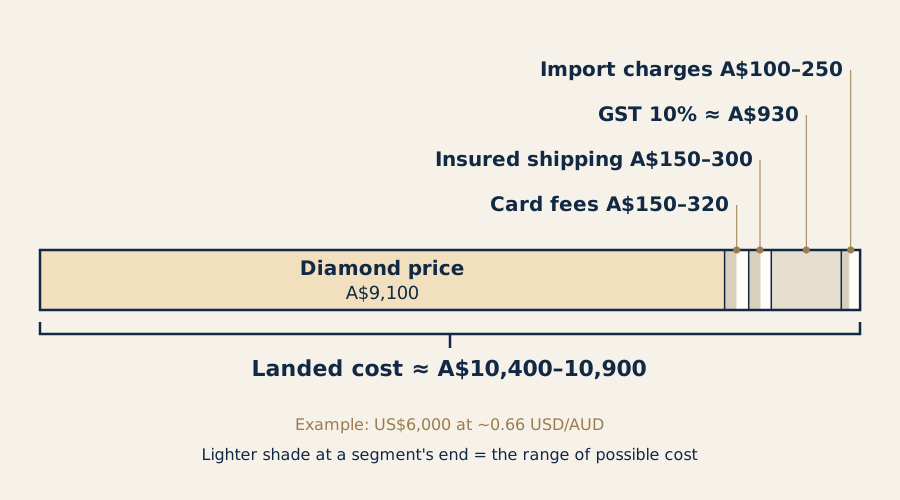
Work out the landed cost: everything you pay until the diamond is in your hand in Australia. Here is a worked example for a loose natural diamond priced at US$6,000 and couriered to Melbourne.
| Cost item | Example | Notes |
|---|---|---|
| Diamond price | US$6,000 ≈ A$9,100 | At about 0.66 US dollars to the Australian dollar; rates move daily |
| Card or transfer fees | ≈ A$150–A$320 | Foreign transaction fees of roughly 0–3.5%, plus the bank's exchange margin |
| Insured shipping | ≈ A$150–A$300 | Express courier with signature on delivery |
| GST (10%) | ≈ A$930 | On the value plus shipping and insurance |
| Import processing charge and broker fees | ≈ A$100–A$250 | Applies to imports over A$1,000 |
| Customs duty | A$0 for a loose diamond | Up to about 5% on some finished jewellery |
| Landed cost | ≈ A$10,400–A$10,900 | Compare this figure, not the sticker price |
Then make sure you are comparing like for like. Two '1 carat G VS2' diamonds can differ by thousands of dollars because of cut quality, fluorescence, depth, the grading lab and how big the stone looks face-up. Match the report lab, the cut grade (for rounds), the measurements in millimetres and the fluorescence before you compare prices. Our guide on how to judge the 4Cs and cut lists what to line up.
Not sure which one is right?
Send us the stones you are looking at and our gemologist will tell you which to choose and why.
How do Australian ring sizes compare with US, UK and EU sizes?
Australia uses letter sizes, the same system as the UK, with half sizes in between (for example M½). The US uses numbers in quarter and half steps, and most of Europe uses the inside circumference in millimetres. A ring ordered in the wrong system can be two or three sizes out, and some designs, such as full eternity bands, cannot be resized at all.
| Australia / UK | US / Canada | EU (circumference) | Inside diameter |
|---|---|---|---|
| J½ | 5 | about 49 mm | about 15.7 mm |
| L½ | 6 | about 52 mm | about 16.5 mm |
| N½ | 7 | about 54 mm | about 17.3 mm |
| P½ | 8 | about 57 mm | about 18.1 mm |
| R½ | 9 | about 59.5 mm | about 19.0 mm |
| T½ | 10 | about 62 mm | about 19.8 mm |
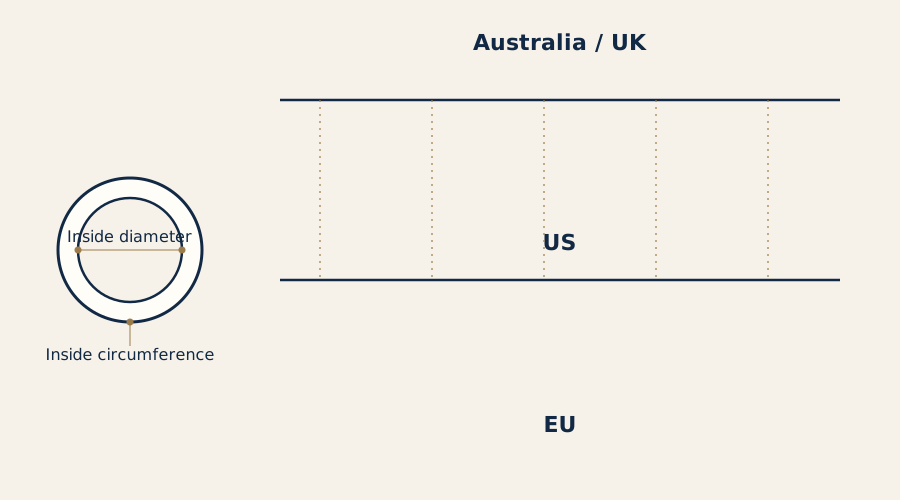
Get sized by an Australian jeweller in letters, then convert, rather than relying on a printed strip or a guess. Our page on measuring your ring size at home explains how fingers change with heat and time of day, and the full ring size conversion chart covers every half size.
What consumer protection do you have when buying a diamond overseas?
When you buy from an Australian business, the Australian Consumer Law gives you automatic rights: goods must match their description, be of acceptable quality and be fit for purpose, and a major failure entitles you to choose a refund or replacement. These rights sit alongside any store warranty and cannot be signed away.
Overseas, you rely on the law of the country where you bought, the seller's own policy and, if you paid by card, a possible chargeback through your bank. Overseas sellers who target Australians can be covered by Australian law in principle, but enforcing it against a business with no presence here is slow and uncertain.
- Misdescribed stones: a colour or clarity that does not match the report, or a report from a lab with looser standards.
- Substitution: the stone you were shown is not the stone that is set or shipped.
- Tourist pressure sales: 'today only' prices, touts who steer you to a shop, or promises of easy resale back home.
- Setting faults: loose claws or thin metal that only show up after months of wear.
Wherever you shop, it pays to ask the same things. Our list of questions worth asking any jeweller works just as well for natural diamonds: who graded it, can I verify the report, what is the return policy, and who services the ring.
Does natural or lab-grown make a difference when you buy abroad?
Yes, in two ways: how the stone is described, and what it might be worth later. Natural and laboratory-grown diamonds look the same to the eye and share the same hardness (10 on the Mohs scale) and refractive index (about 2.42). Only a lab test can tell them apart reliably.
Disclosure rules vary by country. In Australia, a lab-grown diamond must be clearly described as lab-grown or laboratory-grown; our guide to how the ACCC expects lab-grown diamonds to be described explains the wording. Abroad you may see other labels, so rely on the grading report, which should state the origin plainly, and on the laser inscription on the girdle (the thin outer edge of the stone).
Resale is the other difference. Natural diamonds usually resell for well below what you paid at retail, wherever you bought them, and lab-grown diamonds resell for much less again. Neither is an investment. See what diamonds really resell for and these lab-grown resale questions before letting any 'it will hold its value' pitch tip the decision.
Compare natural and lab-grown diamonds in our stock
Who resizes, repairs and insures a ring bought overseas?
Any skilled Australian jeweller can resize, re-tip claws or repair most rings, wherever they were made. The catch is that the work is paid for by you, not covered by the original seller, and some designs are hard to alter: eternity bands, tension settings and rings in alloys that are not marked or are unusual.
Check the metal stamp. Gold purity is shown in carats or parts per thousand, such as 18 carat (750) or 14 carat (585); platinum is usually stamped 950 or PT950. Rings from some markets are made in 10 or 14 carat gold, or plated metal, which looks similar new but wears differently.
Insurance needs planning too. Travel insurance often limits cover for valuables, and many home and contents policies cap jewellery unless it is listed with a valuation. Our guide to insuring jewellery in Australia covers valuations and agreed value cover. For the whole process, from budget to band, start with planning the whole engagement ring.
Overseas vs in Australia: how do they compare side by side?
| Buying overseas | Buying in Australia | |
|---|---|---|
| Price shown | May exclude Australian GST and fees | Includes GST |
| Tax on arrival | GST 10% plus any duty above the thresholds | None |
| Exchange rate risk | Yes, on payment and on any refund | No |
| Consumer rights | Local law and seller policy; hard to enforce from home | Australian Consumer Law applies automatically |
| Returns | International insured shipping and paperwork | Local, usually in person |
| Ring sizing | Often US or EU sizes; convert carefully | Australian letter sizes |
| Resizing and servicing | Paid locally, outside the original seller | Usually through the jeweller who sold it |
| Seeing the stone first | Only if you are there in person | Yes, in a showroom |
If you are planning to propose on a trip, the timing and logistics deserve thought as well; our page on engagement ring etiquette covers who chooses, when and how. Any unfamiliar word on a receipt or report is explained in jewellery terms explained.
Related guideDiamond Buying GuideHow to buy a diamond overseas safely: step by step
- Price it at home first. Note the AUD price of the same shape, carat, colour, clarity, cut and lab in Australia.
- Work out the landed cost. Convert at today's rate, then add card fees, shipping, 10% GST, any duty and import charges.
- Verify the report. Check the report number on the lab's website and match the laser inscription with a loupe.
- Confirm the origin in writing. The invoice and report should say natural or laboratory-grown, plus the metal and its purity.
- Get your size in Australian letters. Convert to the seller's system and ask whether the design can be resized.
- Read the return terms. Note who pays shipping, any restocking fee and how refunds are converted.
- Declare it on arrival. Keep the invoice handy, and arrange insurance with a valuation once you are home.
Free consultation
Talk to a gemologist
Compare stones in person or online with Raj Sood, Graduate Gemologist (GIA), AJP (GIA).
Book a consultationShop this shape
FAQ
Common questions
Is it cheaper to buy a diamond overseas?
Usually not by much once you add 10% GST, any duty, import fees, card charges and shipping. Compare the full landed cost in AUD against an equivalent stone in Australia.
Do I have to declare a diamond ring at Australian customs?
Yes, if your goods bought overseas total more than A$900 (A$450 for under 18s). GST and any duty are then charged on the full value, not just the amount above the allowance.
Do I pay GST on a diamond bought online from overseas?
Yes. For items of A$1,000 or less, a registered overseas seller should charge GST at checkout; above A$1,000, GST, any duty and an import processing charge are collected when the item clears customs.
Can an Australian jeweller resize a ring bought overseas?
Most rings can be resized locally, but you pay for the work and it falls outside the original seller's warranty. Eternity bands, tension settings and unusual alloys can be difficult or impossible to resize.
Is a GIA or IGI report from overseas valid in Australia?
Yes. Grading reports from major labs are recognised internationally; just verify the report number on the lab's website and check it matches any laser inscription on the stone.
Can I claim GST back if I buy a diamond in Australia before travelling?
Often, yes. Under the Tourist Refund Scheme you can claim the GST if you spend A$300 or more with one business within 60 days of departure and carry the item with you; residents who bring it back must declare it.

Ask a gemologist
Not sure which diamond to choose?
Raj Sood is a Graduate Gemologist (GIA) and master jeweller. Bring the stones you are considering, or send the reports, and he will tell you honestly which one is better and why.
Keep learning
Related guides
 Buying Knowledge & Custom ProcessTourist Refund Scheme on Jewellery Explained
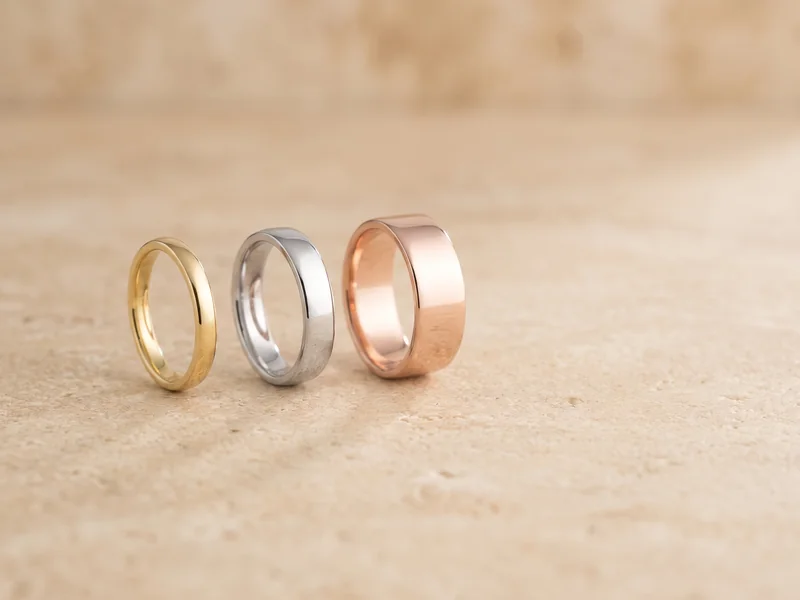 Buying Knowledge & Custom ProcessAustralian Ring Sizes vs US, UK and EU
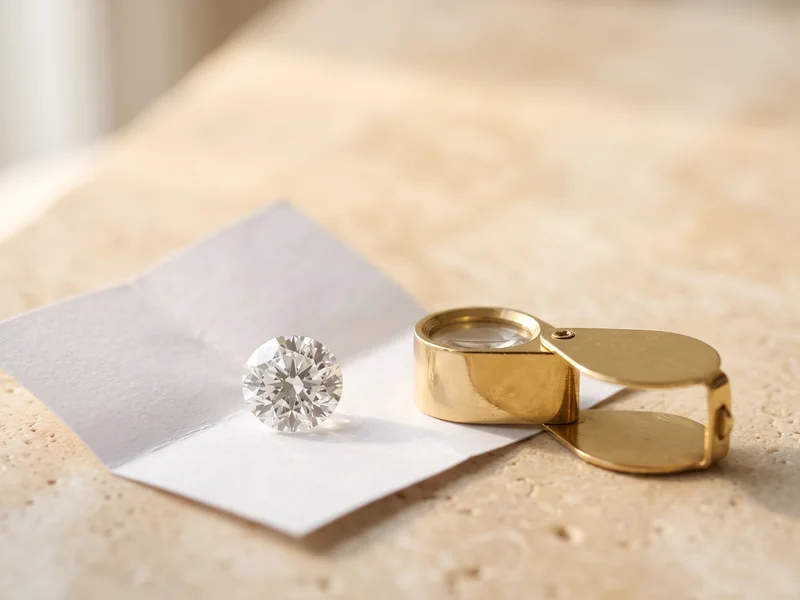 Buying Knowledge & Custom ProcessDiamond Price Guide AustraliaBuying Knowledge & Custom ProcessBuying an Engagement Ring Online vs In-StoreBuying Knowledge & Custom ProcessEngagement Ring Buying GuideBuying Knowledge & Custom ProcessDiamond Buying Guide
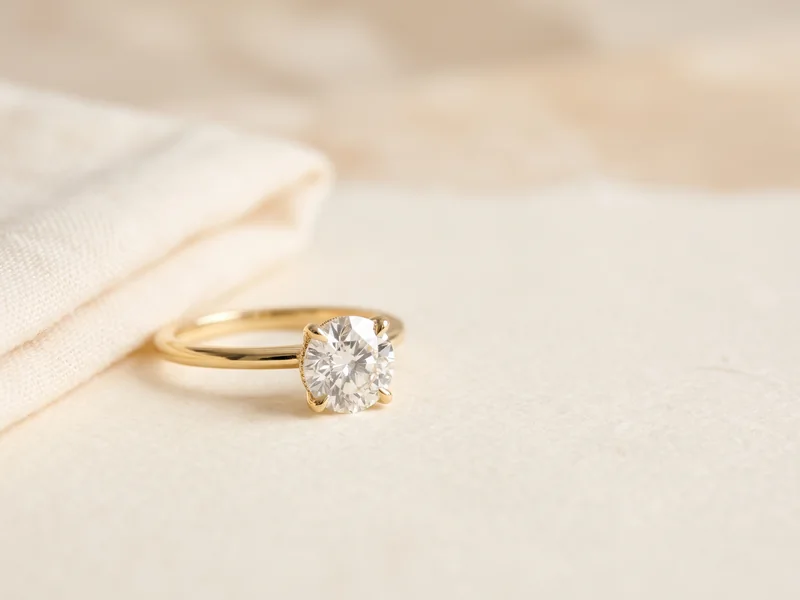 Buying Knowledge & Custom ProcessRing Size Guide Australia
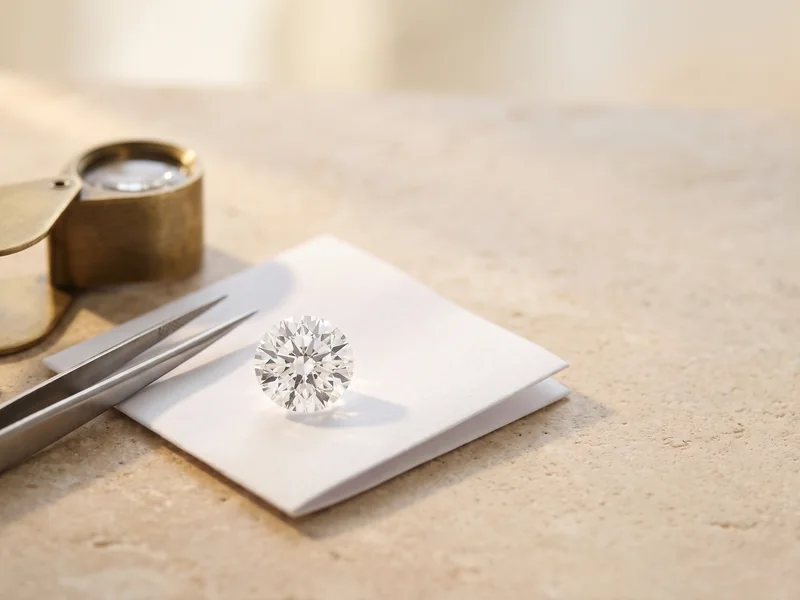 Buying Knowledge & Custom ProcessLab-Grown Diamond Price Guide Australia
Explore more
More guides on this topic
Education