
- Education
- Lab-Grown Diamonds
- Do Lab-Grown Diamonds Test as Diamonds? Testers, Reports and the Law
Lab-Grown Diamonds
Do Lab-Grown Diamonds Test as Diamonds? Testers, Reports and the Law
People often ask: do lab-grown diamonds test as diamonds, or will a jeweller's tester expose them? The short answer is yes, they test as diamond, and the real question is how anyone tells lab-grown from natural.
 Reviewed by Raj Sood, Graduate Gemologist (GIA), AJP (GIA)Master jeweller and Graduate Gemologist (GIA) · reviewed 4 November 2026
Quick answer
Yes. Lab-grown diamonds are carbon crystallised in the same cubic structure as natural diamond, so standard diamond testers read them as diamond, apart from rare boron-bearing stones. A tester cannot tell lab-grown from natural. That needs laboratory equipment such as spectroscopy and UV imaging, which is why every lab-grown diamond should carry a report and laser inscription.
Do lab-grown diamonds test as diamonds?
Yes. A lab-grown diamond is not a look-alike made from another material. It is carbon atoms locked into the same cubic crystal structure as a natural diamond, with the same hardness (10 on the Mohs scale), the same refractive index (about 2.42, the measure of how strongly a material bends light) and the same density (about 3.52). If you want the background on that, our page on whether lab-grown diamonds are real diamond goes through the chemistry and the trade definitions.
Because the material is identical, anything that tests for the material reads a lab-grown stone as diamond. That includes the handheld testers jewellers keep on the counter, a reflectivity meter, a scale for density and a scratch test (which you should never do to anyone's ring). What changes between natural and laboratory-grown is how the crystal formed: deep in the earth over a very long time, or in a growth chamber over a few weeks. Our explainer on how CVD and HPHT growth works covers both methods.
So the useful question is not whether a lab-grown diamond passes a tester. It is how a gemmologist proves where a diamond came from, and how you can check the paperwork yourself. If you are new to the subject, start with our complete lab-grown diamond guide and come back here for the testing detail.
How does a diamond tester work?
Most counter testers measure one or two physical properties and compare the reading with the range for diamond. They were designed to separate diamond from simulants (materials that imitate diamond, such as cubic zirconia and moissanite), not to separate natural diamond from lab-grown.
- Thermal conductivity testers heat a fine metal tip and measure how quickly the stone draws heat away. Diamond moves heat extremely well, roughly four to five times better than moissanite and on the order of a thousand times better than cubic zirconia.
- Electrical conductivity testers pass a tiny current through the stone. Colourless diamond is an electrical insulator, while moissanite conducts. This is how a multi-tester catches moissanite that a thermal probe would pass.
- Multi-testers combine both readings in one pen and are what most jewellers use today.
- Reflectivity meters measure how much light bounces off a polished facet. Diamond, moissanite and cubic zirconia each sit in a different band.
| Tester | What it measures | Lab-grown diamond | Natural diamond | Moissanite | Cubic zirconia |
|---|---|---|---|---|---|
| Thermal probe | Heat flow | Diamond | Diamond | Diamond (false pass) | Not diamond |
| Electrical | Current flow | Diamond (rare boron stones conduct) | Diamond | Moissanite | Not diamond |
| Multi-tester | Heat and current | Diamond | Diamond | Moissanite | Not diamond |
| Reflectivity meter | Surface lustre | Diamond band | Diamond band | Moissanite band | CZ band |
| Lab-grown screener | Diamond type and UV response | Refer for testing | Usually passes; some referred | Not a diamond | Not a diamond |
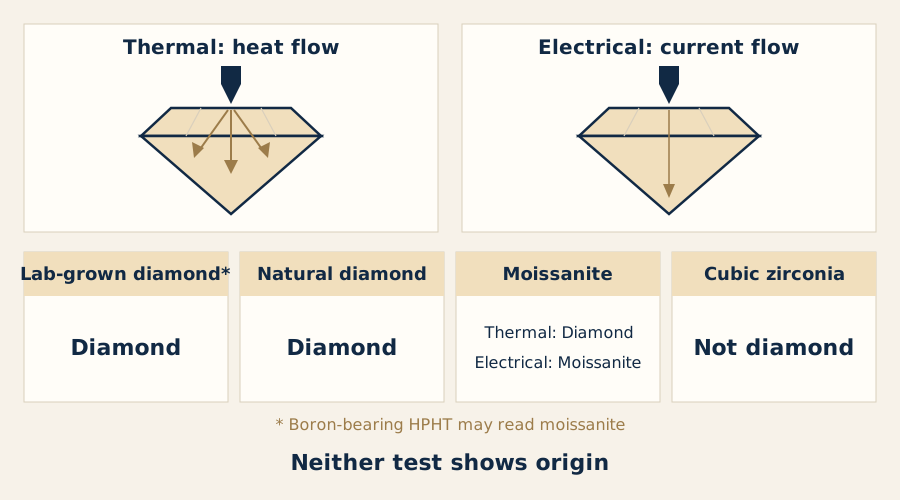
The practical upshot: a thermal probe alone will pass moissanite, so it is not enough on its own. Our comparison of how lab-grown diamond and moissanite differ explains the optical differences you can also see, such as moissanite's doubled facet edges. Cubic zirconia fails every diamond tester and is much heavier for its size; see lab-grown diamond against cubic zirconia for the full side-by-side.
When do lab-grown diamonds not test as diamonds?
There is one well-known exception. Some lab-grown diamonds grown by HPHT (high pressure, high temperature, a method that recreates the conditions of the earth's mantle in a press) pick up a little boron during growth. Boron makes a diamond type IIb, which can look faintly to strongly blue and, importantly, conducts electricity.
Put a boron-bearing stone under a multi-tester and the electrical reading can trigger the moissanite alarm, even though the stone is diamond. Natural type IIb diamonds, such as natural blue diamonds, can do the same, but they are extremely rare. Near-colourless HPHT stones sometimes carry just enough boron to show the faint blue nuance some HPHT stones show, and deliberately blue stones are covered in our guide to blue and other lab-grown fancy colours.
Testers can also misread when the battery is low, when the stone is warm from someone's hand, when the probe touches metal instead of a facet, or when the stone is very small. Treat any surprising reading as a reason to retest carefully, not as an answer.
How do lab-grown diamonds compare with natural diamonds and simulants?
This table sets out the properties gemmologists rely on. The first two columns are effectively the same; the differences only appear at the level of trace elements and growth structure.
| Property | Natural diamond | Lab-grown diamond | Moissanite | Cubic zirconia |
|---|---|---|---|---|
| Material | Carbon (diamond) | Carbon (diamond) | Silicon carbide | Zirconium oxide |
| Mohs hardness | 10 | 10 | about 9.25 | about 8–8.5 |
| Refractive index | 2.42 | 2.42 | about 2.65–2.69, doubly refractive | about 2.15–2.18 |
| Density (SG) | 3.52 | 3.52 | about 3.22 | about 5.6–6.0 |
| Diamond type | About 98% type Ia (nitrogen) | Mostly type IIa; some IIb or Ib | n/a | n/a |
| Passes diamond tester | Yes | Yes, with rare boron exceptions | Thermal only | No |
| Origin proven by | Lab testing and report | Lab testing, report and inscription | Simple tests | Simple tests |
Diamond type is the key column. Gemmologists sort diamonds by whether they contain nitrogen and how it is arranged. Most natural diamonds are type Ia, with nitrogen atoms clustered in groups. Most lab-grown diamonds are type IIa, with almost no nitrogen, which is rare in nature (roughly 1–2% of natural diamonds). That is why type is the first thing screening machines check.
For every other difference, from price to resale and how each is graded, read our full lab-grown vs natural comparison. Any term in the table you have not met before is explained in our jewellery glossary.
Not sure which one is right?
Send us the stones you are looking at and our gemologist will tell you which to choose and why.
How do gem labs tell lab-grown from natural diamonds?
Identifying origin is a laboratory job. A jeweller can see clues under a microscope, but a firm answer needs instruments that read the stone's trace elements and growth pattern. Labs such as GIA and IGI use several layers:
- Screening devices check diamond type by how the stone transmits short-wave ultraviolet light. Natural type Ia stones pass; type II stones, natural or lab-grown, are referred for full testing. Examples include De Beers' DiamondSure and SYNTHdetect and GIA's iD100.
- Spectroscopy shines infrared or laser light through the stone and reads the absorption or glow. Photoluminescence can show features linked to growth, such as a silicon-related peak near 737 nm that is common in CVD diamonds.
- Deep-UV fluorescence imaging (DiamondView is the best-known instrument) photographs the growth structure. CVD diamonds often show fine parallel layers; HPHT diamonds show a cross-shaped pattern of growth sectors; natural diamonds show irregular or octahedral growth.
- Microscopy finds inclusions. HPHT stones can hold metallic flux from the growth press, sometimes enough for the stone to be drawn to a strong magnet; CVD stones can show dark pinpoint inclusions and distinctive strain.
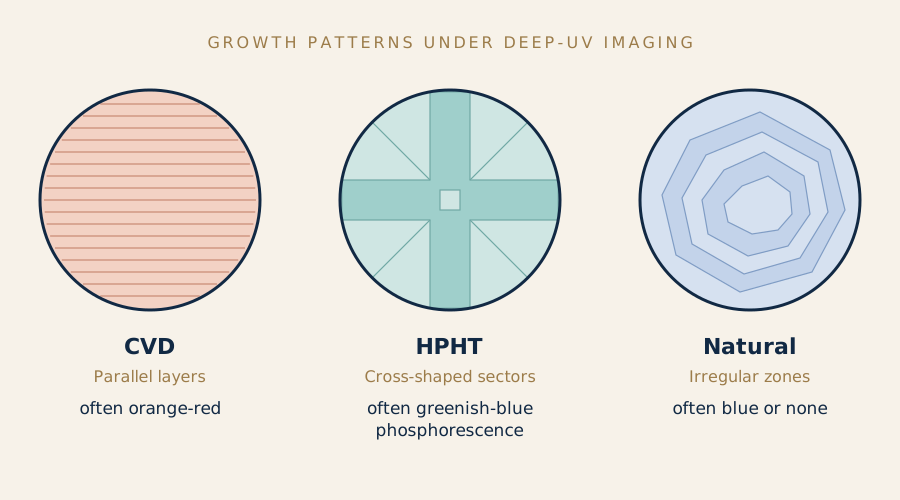
Fluorescence and phosphorescence (a glow that lingers after the UV lamp is switched off) are useful clues too. HPHT stones often phosphoresce greenish-blue; CVD stones commonly fluoresce orange or red. Our page on how lab-grown diamonds fluoresce under UV goes deeper. Many CVD stones are also treated after growth to remove the brown or grey tint in CVD stones, and labs report that treatment.
Labs test natural diamonds for the same reason: some natural diamonds are HPHT-treated to improve their colour, and that must be disclosed. Origin and treatment are part of the same check.
What should a lab-grown diamond report say?
Because a counter tester cannot prove origin, the report and the laser inscription carry the weight. An inscription is a tiny line of text lasered onto the girdle (the thin outer edge of the stone), readable with a 10× loupe. Here is what to check on a lab-grown diamond report in Australia, whichever lab issued it:
| On the report | What to look for |
|---|---|
| Title and origin | The words laboratory-grown or lab-grown stated clearly, not hidden in a comment |
| Growth method | CVD or HPHT, if the lab states it |
| Treatment | Any post-growth treatment, such as colour improvement, noted in the comments |
| Inscription | Report number plus a lab-grown marker, such as LG followed by the number (IGI) or LABGROWN (GIA) |
| Grades | Colour, clarity and, for rounds, cut; check which grading format the lab used |
| Measurements and weight | Millimetre measurements and carat weight that match the stone in front of you |
Grading formats have changed over time. GIA has revised its lab-grown reports more than once and has announced a move to simpler descriptive quality terms instead of the full colour and clarity scales, so check the date and format of any GIA report. Our guides to how lab-grown colour grades are assigned and judging cut quality in lab-grown stones explain what each grade means in practice.
Related guideLab-Grown Diamonds vs Natural DiamondsWhat does Australian law say about describing lab-grown diamonds?
Australia has no separate diamond law. The rules come from the Australian Consumer Law, which bans misleading or deceptive conduct and false or misleading claims about goods, and the ACCC enforces it. For lab-grown diamonds that means the origin must be clear before you buy, in the listing, on the tag, in what the salesperson says and on the invoice.
- Clear origin words: lab-grown, laboratory-grown, laboratory-created or synthetic, placed next to the word diamond, not in fine print.
- Words to be careful with: international trade standards such as CIBJO's nomenclature advise against using natural, cultured, genuine or real to describe lab-grown stones, because those words blur origin. A lab-grown diamond is diamond in every physical sense, but the description must still say how it was made.
- Simulants are different: moissanite and cubic zirconia are not diamond at all and must never be sold as diamond, with or without a qualifier.
- Environmental claims: phrases such as eco-friendly or sustainable need evidence. The ACCC has published guidance on environmental claims, and our page of questions to ask about sustainability claims helps you test them.
Natural diamonds deserve accurate wording too. A natural diamond should not be described as an investment, and any treatment must be disclosed. Whether you buy in person or on a screen, the same rules apply; our comparison of buying online or in a showroom covers what to ask in each case.
If lab-grown diamonds test as diamonds, why do they cost so much less?
Testing tells you what a stone is made of. Price reflects how scarce it is and what it costs to produce. Laboratory-grown diamonds can be made to order, production has expanded quickly and retail prices have fallen sharply over the past several years. Natural diamonds are limited by what is mined. As a broad guide only:
| 1 ct round, G–H, VS | Approximate price range (AUD) |
|---|---|
| Lab-grown | about $800–$2,500 |
| Natural | about $7,000–$15,000 |
These ranges move with the market and with exact grades and cut. Our page on what really moves lab-grown prices explains why two stones with the same grades can be priced differently. Because a lab-grown diamond costs less to replace, it is worth reading about insuring a lab-grown diamond and making sure any valuation names it as lab-grown.
Since lab-grown stones are easy to find in consistent grades, they are often chosen for pairs and lines of stones. If that is your plan, our guide to matching a pair for earrings shows what to compare beyond the report.
Browse lab-grown diamonds
How do you check a lab-grown diamond before you buy? Step by step
- Ask for the report first. Read the origin line and confirm it says laboratory-grown or lab-grown.
- Check the inscription. Ask to see the girdle under a 10× loupe or microscope and match the number to the report.
- Read the comments. Note the growth method and any post-growth treatment.
- Treat a tester as a first check only. It confirms diamond versus simulant; it cannot confirm origin. A moissanite reading on an HPHT stone calls for screening, not a conclusion.
- Compare measurements. Make sure the millimetre size and carat weight match the report.
- Get the wording on the invoice. It should state laboratory-grown diamond, the grades and the report number, which you will need for insurance.
- Keep the paperwork together. Store the report and invoice safely; the stone itself needs only routine care, as our page on caring for a lab-grown diamond explains.
Free consultation
Talk to a gemologist
Compare stones in person or online with Raj Sood, Graduate Gemologist (GIA), AJP (GIA).
Book a consultationShop this shape
FAQ
Common questions
Will a lab-grown diamond pass a diamond tester?
Yes. Lab-grown diamonds pass thermal and multi-testers because they are diamond. The rare exception is a boron-bearing HPHT stone, which can read as moissanite on the electrical test.
Can a jeweller tell if a diamond is lab-grown?
Not with a standard tester. A jeweller can spot clues under magnification and check the inscription and report, but proving origin needs screening devices or a gem laboratory.
Why does my lab-grown diamond read as moissanite?
Some HPHT lab-grown diamonds contain boron, which conducts electricity, and multi-testers use conductivity to flag moissanite. A loupe look for doubled facet edges, a reflectivity reading or lab screening will confirm it is diamond.
Do lab-grown diamonds have a laser inscription?
Most graded lab-grown diamonds do. Labs usually inscribe the report number with a lab-grown marker, such as LG followed by the number on IGI stones, readable with a 10× loupe.
Can a home test tell lab-grown from natural?
No. Fog, water and loupe tests can only hint at diamond versus some simulants, and lab-grown and natural diamonds behave the same in all of them.
Does a lab-grown diamond need a different report from a natural one?
Yes. Labs issue a separate laboratory-grown diamond report that states the origin clearly, often with the growth method and any post-growth treatment noted.

Ask a gemologist
Not sure which diamond to choose?
Raj Sood is a Graduate Gemologist (GIA) and master jeweller. Bring the stones you are considering, or send the reports, and he will tell you honestly which one is better and why.
Keep learning
Related guides
 Lab-Grown DiamondsAre Lab-Grown Diamonds Real Diamonds
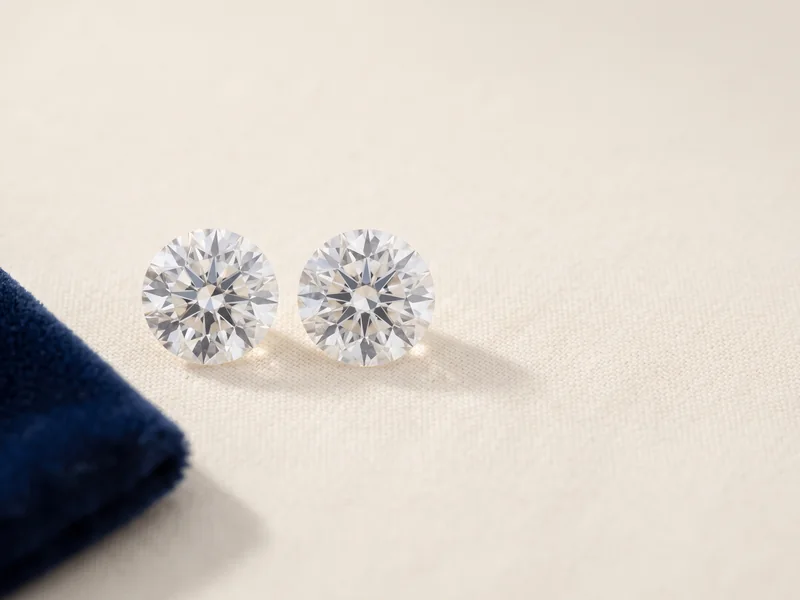 Lab-Grown DiamondsLab-Grown Diamonds vs Natural Diamonds
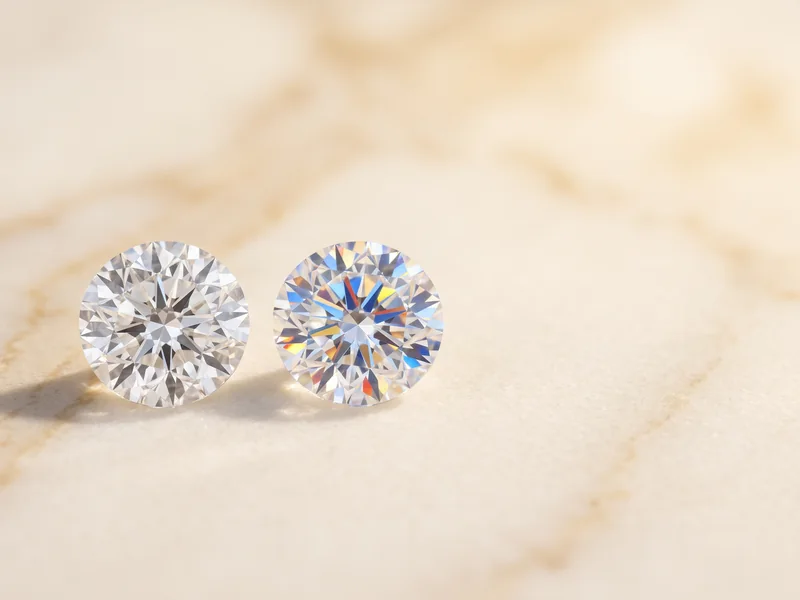 Lab-Grown DiamondsLab-Grown Diamond vs Moissanite
 Lab-Grown DiamondsHow Are Lab-Grown Diamonds Manufactured?Lab-Grown DiamondsLab-Grown Diamonds GuideLab-Grown DiamondsShould a Lab-Grown Diamond Be Insured?
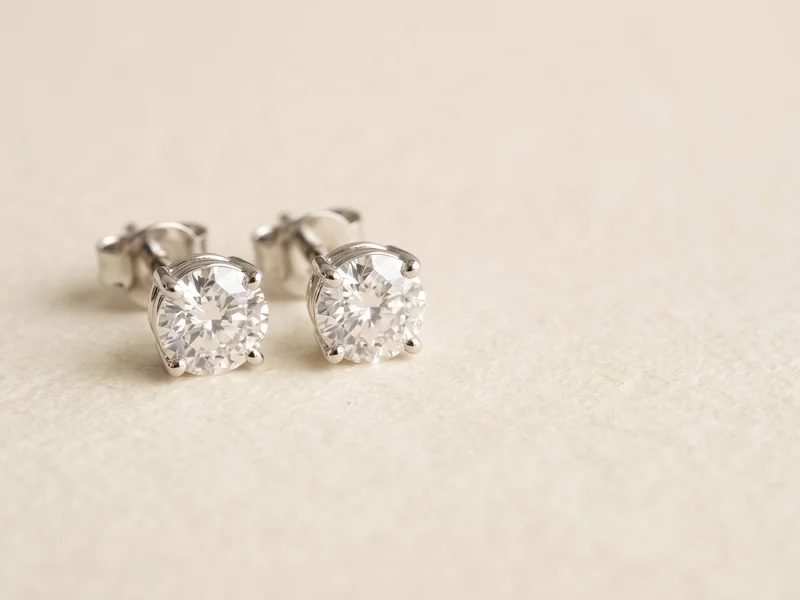 Lab-Grown DiamondsMatching Two Lab-Grown Diamonds for Earrings
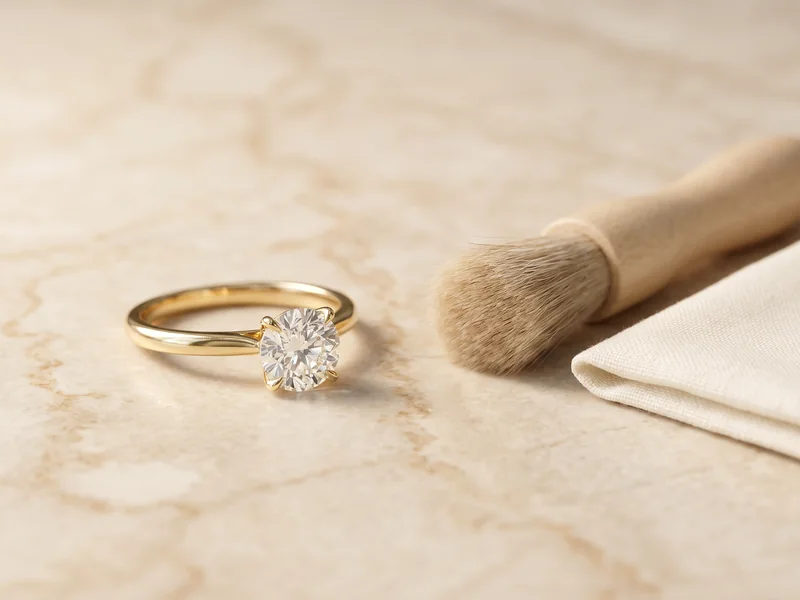 Lab-Grown DiamondsDo Lab-Grown Diamonds Need Different Care?
Explore more
More guides on this topic
Education