
- Education
- Engagement Rings & Settings
- Hidden Halo Engagement Rings: The Complete Australian Guide
Engagement Rings & Settings
Hidden Halo Engagement Rings: The Complete Australian Guide
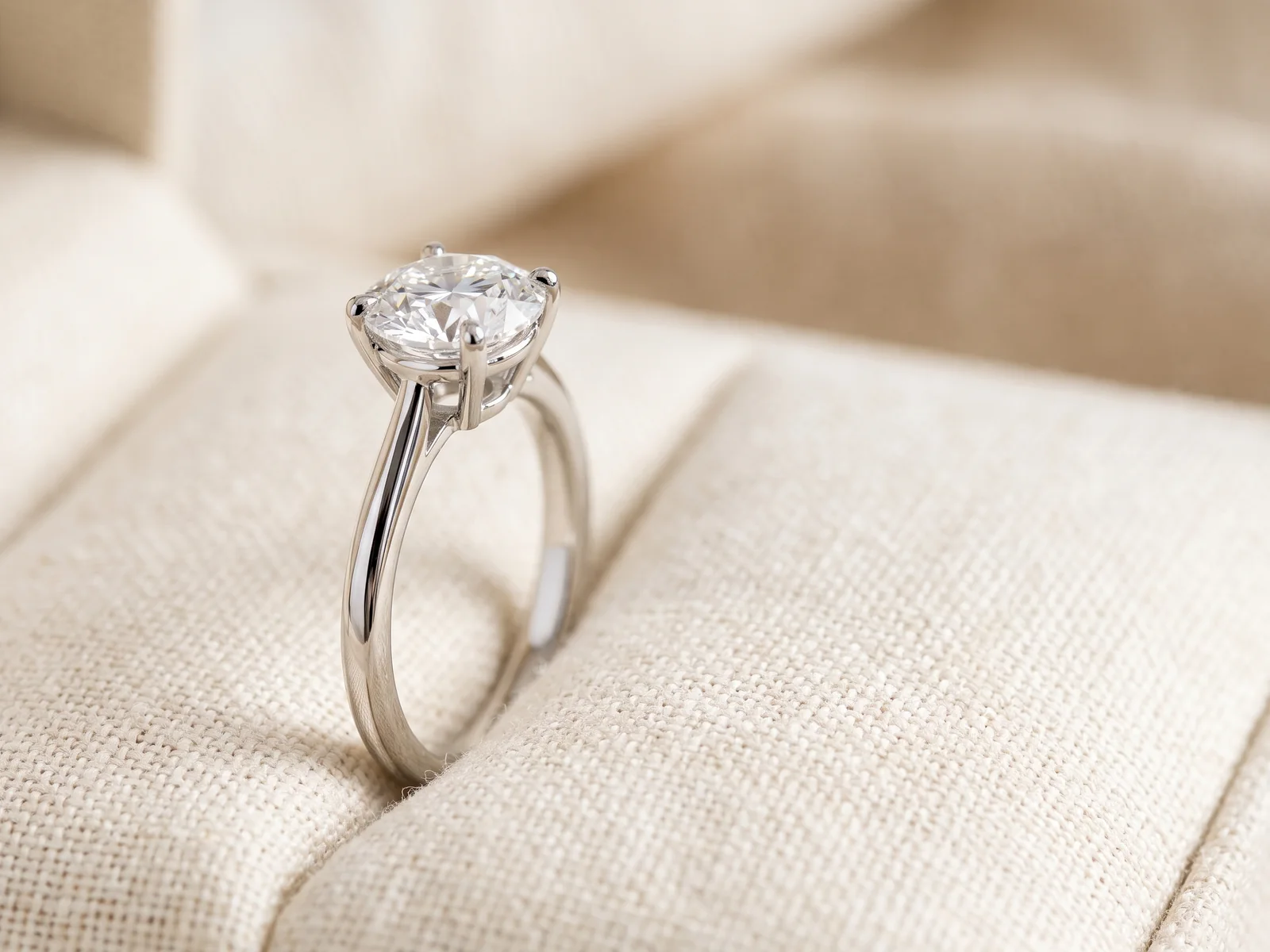
Hidden halo engagement rings keep the clean face of a solitaire but add a line of sparkle you only see from the side. Here is how they are made, how they wear over the years and what to check before you choose one.
 Reviewed by Raj Sood, Graduate Gemologist (GIA), AJP (GIA)Master jeweller and Graduate Gemologist (GIA) · reviewed 4 November 2026
Quick answer
A hidden halo engagement ring has a ring of small diamonds set around the gallery, just below the centre stone's girdle. Face-up it looks like a solitaire; from the side it shows a line of sparkle. It adds little height or face-up size, suits most shapes, and needs the small stones checked every six to twelve months.
What is a hidden halo engagement ring?
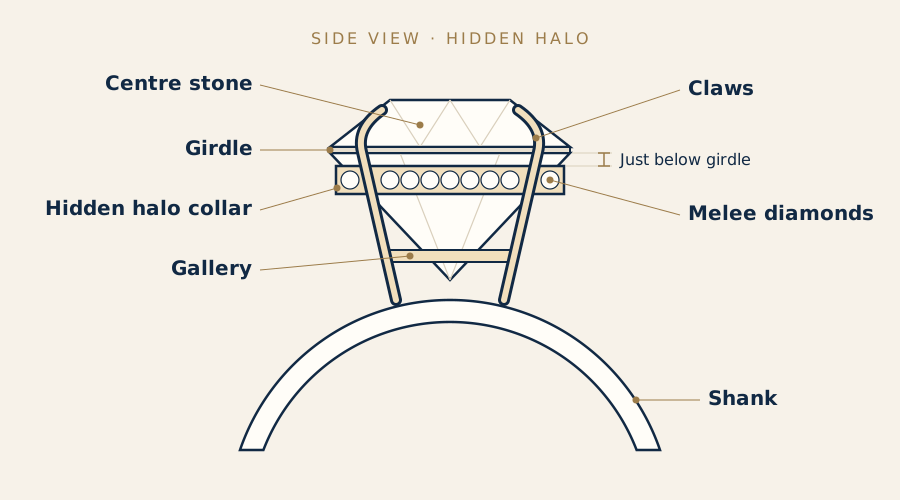
A hidden halo is a single row of small diamonds, called melee (pronounced 'mel-ay', the trade word for diamonds under about 0.18 carat), set in a narrow metal collar that wraps around the gallery of the ring. The gallery is the part of the head that sits under the centre stone, between the claws. The halo sits just below the girdle, the thin outer edge of the centre diamond, so it is tucked under the stone rather than beside it.
Look down at the ring and you see a solitaire: the centre stone and its claws, nothing else. Turn your hand and the side view shows a bright band of diamonds under the stone. That is why it is also called an under halo, secret halo or surprise halo. Our guide to the parts of an engagement ring shows exactly where the gallery, basket and girdle sit.
Classic halos, where the small diamonds frame the stone face-up, became popular in the 1920s and have come back several times since; the story of how engagement rings evolved covers those waves. The hidden version is a much newer idea and is now one of the most requested details in modern solitaires. To see how it fits among claws, bezels, pavé and the rest, start with our overview of engagement ring setting styles.
How are hand crafted hidden halo rings made?
A hidden halo is a small piece of engineering. The collar has to follow the outline of the centre stone within a fraction of a millimetre, sit low enough to stay out of sight face-up, and still leave the claws free to grip the stone. Most hidden halos are made in four stages:
- Design: the head is modelled around the exact measurements of the centre stone, including its girdle diameter and pavilion depth (the part below the girdle).
- Casting or fabrication: the head is cast in 18ct gold or platinum, or built by hand, then the seats for each small stone are cut.
- Stone setting: each melee diamond is set under a microscope, usually held by tiny raised beads of metal or by shared micro-claws between stones.
- Finishing: the collar is polished, the centre stone is set, and the claws are shaped so they do not crowd the halo.
Melee size depends on the size of the centre stone. Bigger stones have a longer outline, so they take more and slightly larger diamonds. These are typical figures for a round centre stone:
| Centre stone | Typical melee size | Approx. number of stones | Approx. total halo weight |
|---|---|---|---|
| 0.50 ct round (about 5.1 mm) | 1.0 mm | 12–16 | 0.06–0.08 ct |
| 1.00 ct round (about 6.4 mm) | 1.1–1.2 mm | 14–20 | 0.08–0.15 ct |
| 1.50 ct round (about 7.4 mm) | 1.2–1.3 mm | 16–22 | 0.12–0.20 ct |
| 2.00 ct round (about 8.1 mm) | 1.3–1.5 mm | 18–24 | 0.15–0.30 ct |
The melee can be natural or laboratory-grown. Lab-grown melee is common and costs less; it should always be named as lab-grown on your quote and valuation. Our guide to lab-grown melee in pavé and halo work explains how it is graded and matched.
Hidden halo vs halo: what is the difference?
Both use a row of melee around the centre stone. The difference is where the row sits, and that changes almost everything about how the ring looks and wears.
| Hidden halo | Classic halo | Plain solitaire | |
|---|---|---|---|
| Face-up look | Solitaire | Stone framed by small diamonds | Solitaire |
| Added face-up width | None | About 2–3 mm across | None |
| Side view | Line of sparkle under the stone | Halo edge visible | Plain basket or claws |
| Melee exposure | Tucked under the girdle | On the top edge, most exposed | No melee |
| Cleaning | Brush underneath regularly | Brush top and underneath | Easiest |
| Extra cost | Moderate | Moderate to higher | None |
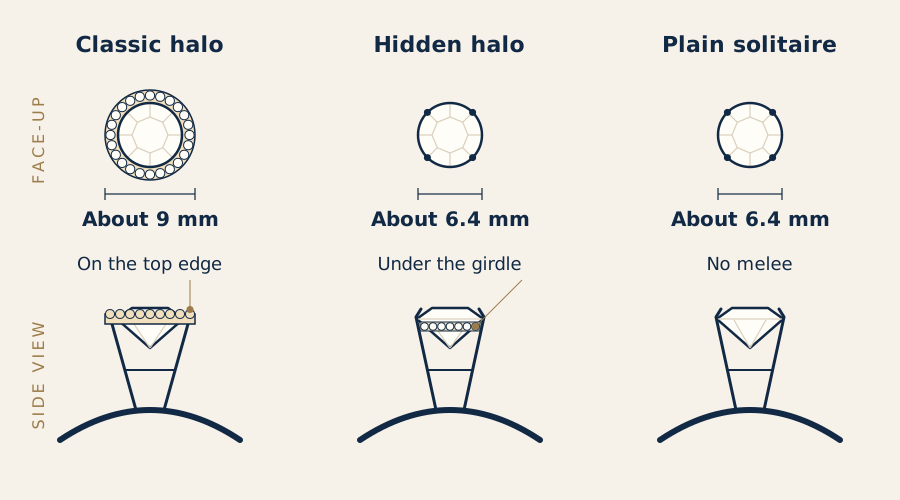
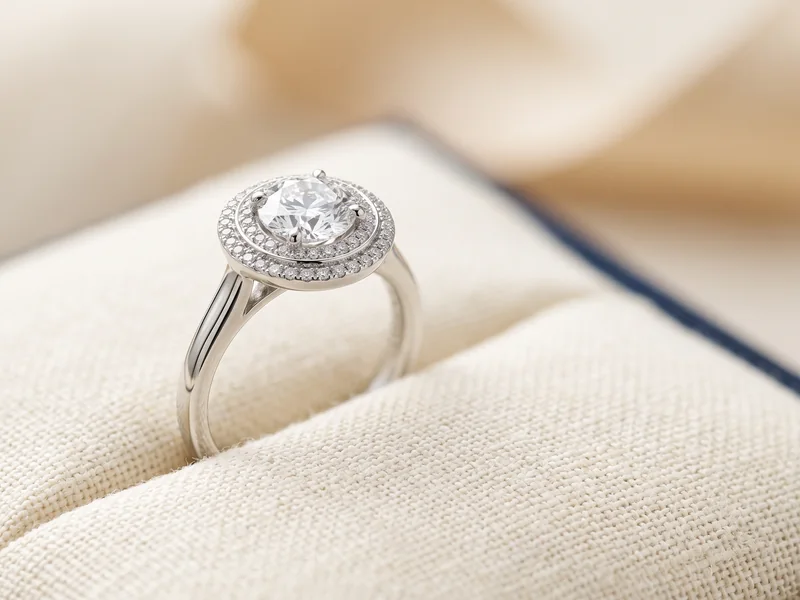
A classic face-up halo makes a centre stone look noticeably larger, which is its main appeal. A hidden halo does not change face-up size at all; it is about the side view and the extra light around the stone. If you want even more presence, a double halo design stacks two rows face-up, and some rings combine a face-up halo with a hidden one underneath.
Related guideHalo vs Hidden Halo Engagement RingsWhich diamond shapes suit hidden halo engagement rings?
Almost every shape works, because the collar is made to follow the girdle outline. The things to watch are corners, points and depth.
| Shape | How the hidden halo follows it | Watch for |
|---|---|---|
| Round | Even circle under the girdle | Very forgiving; the most common choice |
| Oval | Smooth elongated curve | Popular choice; check the collar is even at both ends |
| Cushion | Rounded square, follows the curved sides | Deep cushions need a taller basket |
| Pear | Rounded end plus a point | The point needs a V-claw; the halo stops short of the tip |
| Emerald and radiant | Straight sides with cut corners | Clean corners on the collar; claws at each corner |
| Marquise | Two points | Both points protected; halo kept back from the tips |
| Old mine and old European | Follows the softer antique outline | Stone measurements vary, so the head is best made to the stone |
With pointed shapes, the collar usually stops just short of the point, because the point needs a protective V-claw and there is no room under it for melee. Our page on how halo outlines follow each diamond shape shows the differences side by side.
Depth matters too. A deep stone carries more of its weight below the girdle, so the basket has to be taller to fit both the pavilion and the halo. If you are looking at cushions, read about cushion depth and the weight it hides first. Antique cuts are a lovely match because the hidden halo adds side sparkle without modernising the face-up look; see our settings guide for old mine diamonds.
Not sure which one is right?
Send us the stones you are looking at and our gemologist will tell you which to choose and why.
Is a hidden halo worth it?
It comes down to what you value in the ring. Here is the honest balance from the bench:
- For: a solitaire look from above with extra sparkle from the side, which is the angle most people see when you talk with your hands.
- For: it adds no face-up size, so the centre stone is judged on its own.
- For: the melee is tucked under the girdle, so it takes fewer direct knocks than a face-up halo.
- Against: more small stones means more to check and occasionally replace over the years.
- Against: soap and lotion collect under the stone faster, dulling both the halo and the centre diamond.
- Against: it can affect how a straight wedding band sits beside the ring.
A hidden halo suits people who want something a little personal but not obvious. If you find most rings too traditional, our article on choosing a ring when classic styles do not appeal gives more ideas, and small hidden touches that personalise a custom ring covers engraving, peekaboo stones and coloured accents that pair well with a hidden halo.
Does a hidden halo make the ring sit higher?
Usually only slightly, and sometimes not at all. The halo sits in space that is already there between the girdle and the shank. On a typical claw setting with a 1 ct round, where the top of the stone sits around 5.5–7 mm above the finger, a hidden halo often fits without changing the height.
On a very low setting there may not be enough room under the girdle for the collar and the stone's pavilion, so the stone can rise by roughly 0.5–1 mm. That is small, but it is worth knowing if you want the lowest ring possible. Our comparison of low and high profile settings explains the trade-offs for snagging, gloves and comfort.
The shape of the band underneath matters as much as the head. A rounded inside edge makes a slightly taller ring feel more comfortable through the day; see what a comfort-fit band changes on the finger.
Which wedding band works with a hidden halo diamond ring?
Because the hidden halo widens the head just below the stone, a straight band can meet the collar before it meets the engagement ring's shank, leaving a small gap. There are three common ways to handle it:
- Raise the head: a cathedral setting (where the shank sweeps up to meet the head) lifts the halo high enough for a straight band to slide underneath.
- Shape the band: a gently curved or notched band is made to sit around the collar.
- Accept the gap: some people like a small space between the rings; it is a matter of taste.
It is easiest to plan the band at the same time as the engagement ring. Our guide to the wedding bands that pair well with halo rings goes through each option with fit notes.
How do hidden halo engagement rings wear over the years?
This is where repair experience matters. The centre stone's claws wear first, as on any ring. The hidden halo is better protected than a face-up halo, because the girdle and claws shield it from most direct knocks. The sides of the ring still take hits on doorframes, bench tops and gym equipment, and over years the tiny beads holding each melee stone wear thinner.
Typical signs of wear are a small stone that looks darker than its neighbours (it has lifted or tilted), a faint rattle when you tap the ring near your ear, or a gap where a stone has gone. A lost melee stone is usually a simple repair: the seat is re-cut, a matched stone is set and the beads are rebuilt.
Other practical points:
- Resizing: a plain shank resizes as normal; a pavé shank limits how far it can go.
- Retipping claws: the jeweller needs to protect or allow for the melee when heat is used near the head.
- Cleaning: warm water, mild dishwashing liquid and a soft toothbrush under the stone every week or two.
- Ultrasonic cleaners: fine for diamonds in a sound setting, but have loose stones checked first, because vibration can shake a worn stone out.
Similar wear patterns show up in other settings with many small stones; our page on channel-set diamonds and their repairs compares how each method holds up. Terms like bead setting and gallery are also defined in our jewellery terms glossary.
How much do hidden halo engagement rings cost?
The hidden halo is an add-on to the setting, so its cost depends on the metal, the size of the centre stone (more melee for bigger stones), whether the melee is natural or lab-grown, and how much hand finishing the design needs. These are approximate ranges in Australia:
| Item | Approximate cost (AUD) |
|---|---|
| Hidden halo added to a solitaire, natural melee, 18ct gold | about $600–$1,500 |
| Hidden halo added to a solitaire, lab-grown melee, 18ct gold | about $400–$1,000 |
| Platinum instead of 18ct gold | adds roughly a few hundred dollars or more |
| Replacing one lost melee stone | about $80–$200 |
| Professional check, clean and tighten | about $50–$150 |
Natural and laboratory-grown centre stones both work with either type of melee. Lab-grown diamonds cost much less than natural diamonds of the same size and grade, and look identical to the eye; natural diamonds are rarer. Whatever you choose, the paperwork should state which is which for the centre stone and the halo.
Design a ring with a hidden halo
Floral and organic designs often use a hidden halo too, where the collar becomes a ring of petals under the stone; our floral setting ideas shows how that is done.
How to choose a hidden halo engagement ring: step by step
- Choose the centre stone first. The collar is made to its exact outline and depth, so the stone's measurements come before the setting.
- Decide on natural or lab-grown melee. Ask for it in writing, along with the melee size and approximate total weight.
- Check the side view. In a render or finished photo, the halo should sit in an even line just below the girdle, with clean corners or point protection on fancy shapes.
- Confirm the height. Ask how far the top of the stone sits above the finger, and whether the halo changes it.
- Plan the wedding band now. Decide on a raised head, a shaped band or a small gap before the ring is made.
- Book regular checks. Have the claws and melee looked at every six to twelve months, and clean under the stone often.
Free consultation
Talk to a gemologist
Compare stones in person or online with Raj Sood, Graduate Gemologist (GIA), AJP (GIA).
Book a consultationShop this shape
FAQ
Common questions
What is a hidden halo on an engagement ring?
It is a row of small diamonds set in a collar under the centre stone's girdle. You see it from the side, not from above, so the ring still looks like a solitaire face-up.
Does a hidden halo make the diamond look bigger?
No. It does not add any face-up size, because it sits under the stone. It adds sparkle from the side and a little extra light around the centre diamond.
Are hidden halos hard to clean?
They need a little more attention because soap and lotion collect under the stone. A soft toothbrush with warm water and mild dishwashing liquid every week or two keeps it bright.
Can you add a hidden halo to an existing engagement ring?
Often, yes, by replacing the head with a new one that includes the halo. It depends on the shank's condition and the centre stone, so it needs to be assessed in person.
Do hidden halo stones fall out?
They can after years of wear, as with any small set stones, though they are better protected than a face-up halo. Regular checks catch loose stones early, and replacing one is a routine repair.
Will a straight wedding band sit flush with a hidden halo?
Not always, because the collar widens the head under the stone. A raised cathedral head or a shaped band solves it; plan both rings together.
Terms in this guide

Ask a gemologist
Not sure which diamond to choose?
Raj Sood is a Graduate Gemologist (GIA) and master jeweller. Bring the stones you are considering, or send the reports, and he will tell you honestly which one is better and why.
Keep learning
Related guides
 Engagement Rings & SettingsHalo vs Hidden Halo Engagement Rings
 Engagement Rings & SettingsHalo Engagement Rings
 Engagement Rings & SettingsHalo Shapes Explained
 Wedding Bands & EternityBest Wedding Band for Halo Engagement RingsEngagement Rings & SettingsEngagement Ring Setting Styles Guide
 Engagement Rings & SettingsDouble Halo Engagement Rings
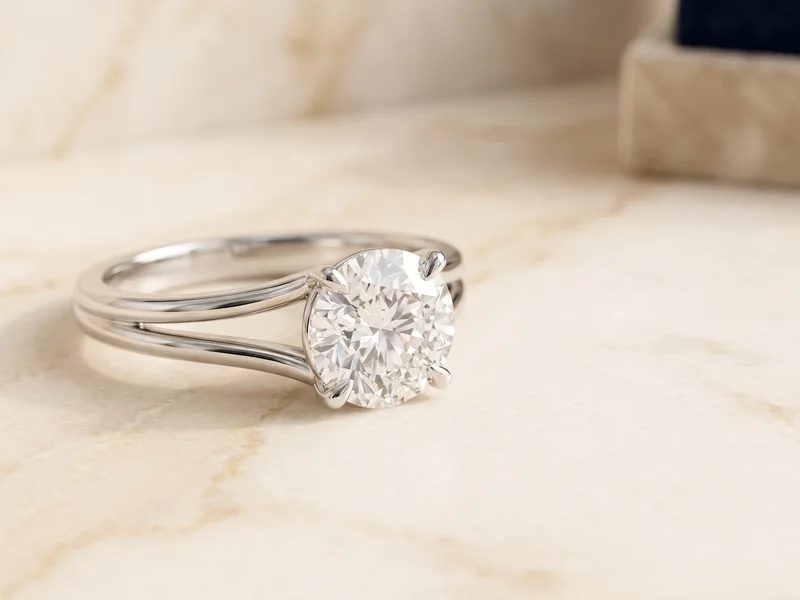 Engagement Rings & SettingsHidden Details That Make a Custom Engagement Ring Personal
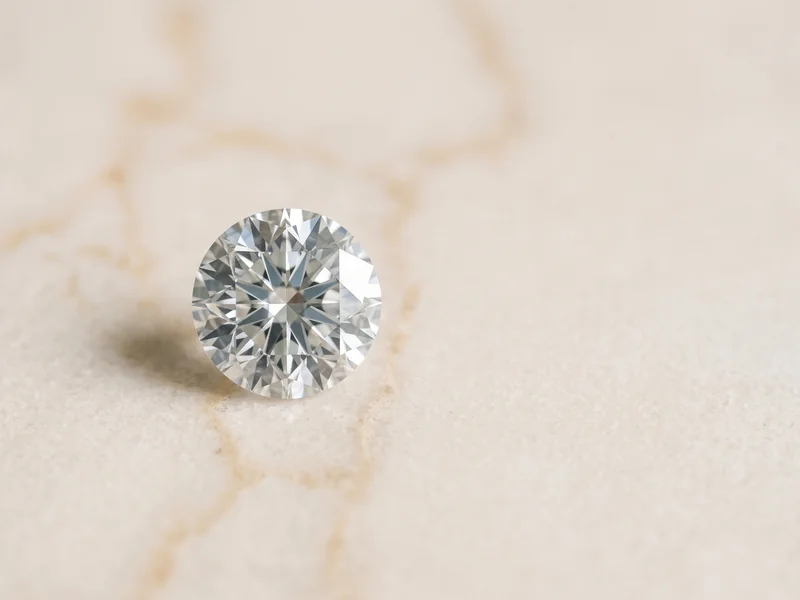 Lab-Grown DiamondsLab-Grown Diamond Melee in Pavé and Halo Settings
Explore more
More guides on this topic
Education