
- Education
- Care, Repairs & Remodelling
- Can You Sleep or Work Out in Your Ring? A Jeweller's Guide to Everyday Wear
Care, Repairs & Remodelling
Can You Sleep or Work Out in Your Ring? A Jeweller's Guide to Everyday Wear
Most ring damage that reaches a jeweller's bench comes from everyday habits rather than one big knock. The two questions we hear most are whether you can sleep or work out in your ring.
 Reviewed by Raj Sood, Graduate Gemologist (GIA), AJP (GIA)Master jeweller and Graduate Gemologist (GIA) · reviewed 4 November 2026
Quick answer
You can usually sleep in a smooth, low band, but take off rings with raised claws or prongs: they snag bedding, hair and skin, and pressure bends claws over time. Take every ring off for weightlifting, climbing and contact sports, where bars crush claws and bands go out of round. A silicone band covers the gym.
Is it safe to sleep or work out in your ring?
It depends on two things: how the ring is made and what your hands are doing. A plain, smooth band is about as tough as jewellery gets, and most people can sleep in one without a second thought. A ring with raised claws (also called prongs: the small metal tips that hold a stone in place) is a different story. Claw tips are often around a millimetre across. They are designed to grip a stone, not to carry a load.
Diamond is the hardest natural material, 10 on the Mohs scale, but hardness only means it resists scratching. Toughness, or resistance to chipping, is a separate property. A diamond can chip along its cleavage planes (natural planes of weakness in the crystal) if a thin edge takes a sharp knock against a dumbbell. The metal around it is far softer. Gold sits around 2.5–3 on the Mohs scale (18ct alloys a little harder) and platinum around 4–4.5, so a steel bar, a kettlebell handle or even beach sand will mark it.
So here is the honest answer. Sleeping in a simple band is usually fine. Sleeping in a claw-set engagement ring wears it faster. Lifting weights or climbing in any ring risks both the ring and your finger. The rest of this page covers the detail. Our full engagement ring care guide and the broader guide to everyday jewellery care and maintenance go wider, and any unfamiliar term is explained in our plain-English jewellery glossary.
Can you sleep with your engagement ring on?
You can, but many jewellers take theirs off at night. While you sleep you roll over, tuck your hands under the pillow and clench them, usually without knowing. Three things happen to a claw-set ring:
- Snagging: claws catch on knitted blankets, sheets, pillowcases and hair. Each tug lifts a claw a fraction of a millimetre, and over months that adds up to a loose stone.
- Pressure: sleeping on a clenched fist pushes the head of the ring (the part that holds the stone) sideways. High cathedral settings, where the stone sits well above the band, take the most leverage.
- Scratches: a diamond will scratch your skin, your partner, and the other rings in a stack if they rub against each other all night.
There is also comfort to think about. Fingers swell slightly overnight, especially in a hot Melbourne January or after a salty meal or a few drinks. A ring that fits well at 3 pm can feel tight at 3 am. Soap and moisture trapped under a band can also irritate the skin, sometimes called ring rash.
| Ring style | Sleep in it? | Why |
|---|---|---|
| Plain or comfort-fit band | Usually fine | Smooth, low and nothing to catch |
| Bezel or low-set solitaire | Usually fine | Metal rim protects the edge; check it now and then |
| High-set claw solitaire | Take it off | Claws snag and the tall head takes leverage |
| Halo, pavé or micro-pavé | Take it off | Tiny claws and metal beads lift easily |
| Pearl, opal or emerald | Take it off | Soft or brittle stones crack or scratch |
| Stacked rings | Take off or reduce | Rings rub and wear each other down |
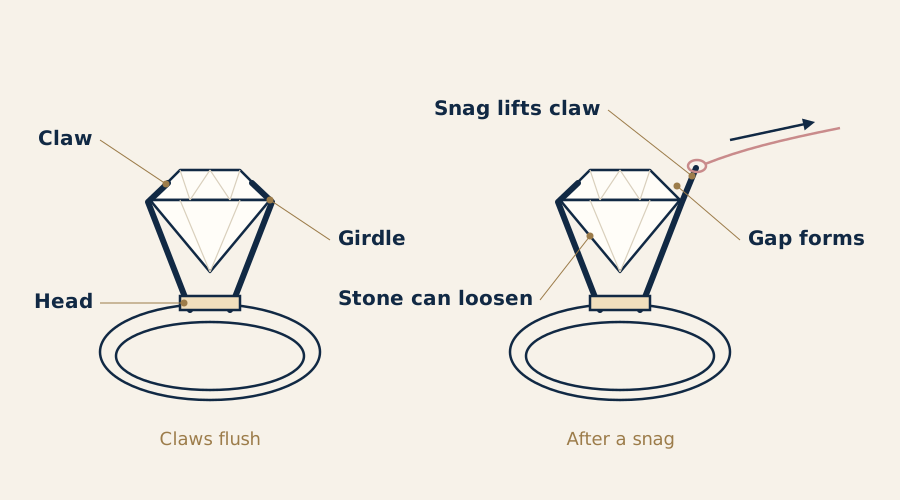
If you do sleep in your ring, have the claws checked more often, about every six months, and read how loose stones are re-tightened before one goes missing. White gold worn day and night also loses its rhodium plating (a thin, bright white coating) faster on the palm side of the band. Our white gold replating schedule shows typical intervals.
Should you take your ring off at the gym?
Yes, for anything that involves gripping. A barbell, dumbbell or pull-up bar squeezes the ring between steel and bone under the full load of the lift. The band flattens into an oval. Claws get pushed into the stone or bent outwards. The knurling (the cross-hatched grip pattern on bars) files away at the metal like a rasp, and gym chalk is mildly abrasive too.
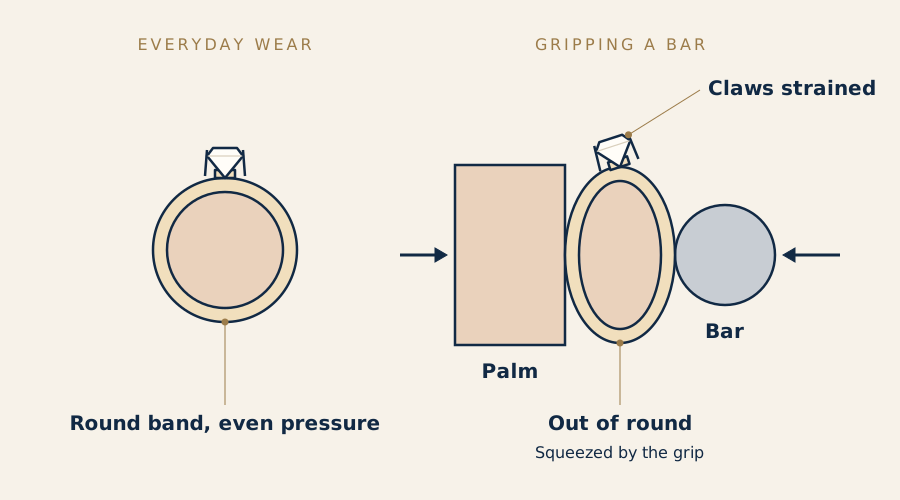
Bands squeezed out of shape are one of the most common repairs after exercise. A ring that is out of round also puts uneven pressure on the setting, which loosens stones. Our page on why bands lose their round shape explains the causes. Light damage can be reshaped on a mandrel (a tapered steel rod) and polished. A band worn thin at the base may need a new shank fitted below the setting, and our guide on whether to repair or replace a damaged band helps you weigh up the options.
The more serious risk is to you. If a ring catches on equipment while your body keeps moving, such as when you drop from a climbing hold or a pull-up bar, it can cause a ring avulsion injury, where the ring strips soft tissue from the finger. It is uncommon but can be severe. That is why climbing gyms, many workplaces and hand surgeons advise taking rings off.
Cardio is gentler. Running, walking and cycling rarely damage a ring, though fingers swell with heat and effort, so a snug ring can become hard to remove afterwards. Yoga and pilates are mostly fine in a smooth band, but planks and downward dog press a claw setting into the mat and your palm.
Which sports and activities are riskiest for rings?
Here is how common activities compare, from the riskiest down. The pattern is simple: anything that grips, crushes, catches or involves cold water is where rings come to grief.
| Activity | Main risk | What to do |
|---|---|---|
| Weightlifting, CrossFit, kettlebells | Crushed band, bent claws, scratched metal | Take it off; wear a silicone band |
| Climbing, bouldering, gymnastics | Ring avulsion injury | Take it off, every time |
| Ball and contact sports (netball, basketball, cricket, footy) | Jammed or swollen fingers, hard knocks | Take it off |
| Swimming, surfing, snorkelling | Cold-shrunk fingers, chlorine, sand, loss | Leave it at home |
| Gardening, cleaning, DIY | Grit, bleach, crushing | Take it off or wear gloves |
| Yoga, pilates | Pressure on claws in planks | Smooth band fine; remove claw settings |
| Running, cycling, walking | Swelling from heat and effort | Usually fine in a plain band |
If you work with your hands, the same logic applies all day, not only at the gym. Tradespeople, nurses, chefs and farmers often wear a plain band at work, or a silicone stand-in. Our guide to men's wedding bands built for hands-on work compares widths, profiles and metals for that kind of wear.
Not sure which one is right?
Send us the stones you are looking at and our gemologist will tell you which to choose and why.
Can you wear your ring at the beach, in the pool or with sunscreen on?
This is the most Australian part of the question, and the one most care guides skip. Leave rings at home, or locked away, for a day at the beach or the pool, for four reasons:
- Cold water shrinks fingers. In the surf or a cold pool your fingers get smaller, and a ring that is snug on land can slide off during one duck-dive or a dumping wave. Rings lost in the ocean are rarely found.
- Sand is harder than gold. Beach sand is mostly quartz, about 7 on the Mohs scale. It scratches and dulls gold and platinum, and it packs into claws and under settings.
- Chlorine attacks gold alloys. Pool and spa chlorine can cause stress corrosion, tiny cracks that form where chemical attack meets stress in the metal. Lower-carat gold and solder joints are most at risk, and repeated exposure can weaken a claw until it snaps.
- Sunscreen coats the stone. Zinc oxide, titanium dioxide and oils build a film on the back of a diamond, where light should reflect back up through the top. The stone looks grey and flat until it is cleaned.
Showers sit somewhere in the middle. Water itself is harmless, but soap, shampoo and conditioner leave the same dulling film. Our shower, pool and beach guide covers each situation, and what sunscreen and chlorine do to gold and gemstones goes into the chemistry.
Which ring metals and gemstones cope with everyday wear?
No metal is immune to a barbell, but they wear in different ways. Knowing yours tells you what to watch for.
| Metal | How it wears | Watch for |
|---|---|---|
| 18ct yellow or rose gold (75% gold) | Scratches into a soft satin look; bends if crushed | Out-of-round bands, thinning claws |
| 18ct white gold | Same strength, usually rhodium plated | Plating wearing through to a warmer tint |
| 9ct and 14ct gold (37.5% and 58.5% gold) | Harder alloys that scratch a little less | More prone to chlorine stress corrosion |
| Platinum (usually 95%) | Dense; scratches push metal aside rather than remove it | Grey patina; needs polishing to brighten |
| Sterling silver (92.5%) | Soft; bends, scratches and tarnishes | Not suited to the gym or to holding valuable stones |
| Titanium, tungsten carbide, ceramic | Very light or very hard; resist scratches | Tungsten and ceramic can crack and cannot be cut off with a standard ring cutter |
The stone matters as much as the metal. Diamond (Mohs 10), and sapphire and ruby (both corundum, Mohs 9), handle daily wear well. Emerald (7.5–8) is hard but usually included and brittle, so a knock on gym equipment can crack it. Opal (5.5–6.5), tanzanite (6–6.5) and pearl (2.5–4.5) are best taken off for sleep, sport and the beach. Lab-created gems share the hardness of their natural counterparts: a lab-created sapphire is as hard as a natural one, and a lab-grown diamond is as hard as a natural diamond. See the care needs of each gemstone for specifics. If your everyday pieces are sterling, our guide to cleaning tarnished silver will help.
What damage do jewellers see from sleeping and exercise?
These patterns cross a jeweller's bench again and again, and almost all of them are preventable:
- Bent or flattened claws on solitaires worn to bed, usually on the side that rests against the pillow.
- Missing pavé or halo stones after gym sessions, because the tiny beads of metal holding 1–1.5 mm diamonds wear and bend easily.
- Oval, cracked or thinned bands from barbells, kettlebells and pull-up bars.
- White gold turning yellowish where rhodium has worn through on the palm side.
- Cracked opals and emeralds from knocks against equipment, door frames and bedheads.
- Rings lost at the beach or pool after slipping off cold, wet fingers or being left on a towel.
- Chips on the girdle (the thin outer edge of a diamond), especially at the points of pear, marquise and princess shapes.
A chipped diamond can sometimes be re-polished, which removes a little weight, or it can be replaced. Some people use the repair as the moment for upgrading to a larger or different centre stone in the same setting.
What should you do if your ring won't come off?
Swollen fingers after a hot day, a long run or a flight are the usual reason a ring gets stuck. Try these in order, gently:
- Raise your hand above your heart for a few minutes to let fluid drain.
- Cool it down with cold water (not ice held on the skin for long).
- Lubricate with soap, hand cream or a little oil, then twist the ring slowly rather than pulling straight.
- Don't force it. Yanking over a swollen knuckle bruises the finger and can bend the band.
If the finger is injured, turning pale or blue, or very painful, go to a GP or emergency department. They can cut a gold, platinum or silver band with a ring cutter, and a jeweller can usually repair the cut afterwards. Tungsten carbide and ceramic cannot be cut this way and have to be cracked off with special tools.
If your ring is often tight in the evening but loose in the morning, the fit may be the real problem. People with knuckles larger than the base of the finger often do well with sizing beads and sizing bars, which stop a slightly larger ring spinning without needing to squeeze over the knuckle.
Are silicone rings a good idea for the gym?
For most people, yes. A silicone ring is light, soft and designed to stretch or tear if it catches, which greatly reduces the risk of a ring avulsion injury. Plain silicone bands generally cost about AUD 15–60, so losing one at the beach is no great drama. They can still trap sweat and soap, so rinse them and take them off now and then to let the skin dry.
Avoid swapping a ring onto a necklace for training. Chains catch on equipment and break, and a ring on a chain swinging against a barbell gets scratched anyway. Leave it in a zipped pocket or at home.
How do you protect your ring when you sleep or work out in it?
The rings that last decades usually belong to people with a simple habit, not a perfect one. Here is a routine that works:
- Pick one safe place. A ring dish on the bedside table, a lidded box or a zipped inner pocket in your gym bag. Never the edge of a sink, a pocket you'll forget or a beach towel.
- Take it off before, not during. Remove rings before you start lifting, apply sunscreen or get in the water, and put them back once your hands are clean and dry.
- Swap in a stand-in. A silicone band or a plain, low-profile band covers the gym, sport and the beach.
- Check the claws weekly. Look under bright light, run a fingertip around the setting and listen for a rattle.
- Clean it every few weeks. Warm water, a drop of mild dishwashing liquid and a soft toothbrush clear sunscreen, soap and hand cream film.
- Book a professional check every 6–12 months. A jeweller tests claws under magnification, re-tips worn ones, rounds the band and replates white gold before small problems become lost stones.
- Keep records. Photos, the grading report and a current valuation make an insurance claim much simpler if a ring is ever lost.
For the cleaning step in detail, including what to avoid on porous or treated gems, see our guide to cleaning a diamond ring at home. If a claw has already lifted or a band has lost its shape, a repair is usually straightforward.
Book a ring check: jewellery repairs service
Free consultation
Talk to a gemologist
Compare stones in person or online with Raj Sood, Graduate Gemologist (GIA), AJP (GIA).
Book a consultationShop this shape
FAQ
Common questions
Is it bad to sleep with your engagement ring on?
It isn't dangerous, but it wears a claw-set ring faster. Claws snag on bedding and bend under pressure, which can loosen the stone over time. A smooth band is usually fine to sleep in.
Can I lift weights with my wedding band on?
It's safer to take it off. Gripping a bar can squeeze the band out of round, and a ring caught on equipment can seriously injure your finger. A silicone band is a common stand-in.
Does chlorine damage gold rings?
Yes, over time. Pool and spa chlorine can cause stress corrosion in gold alloys, especially lower-carat gold and solder joints, which can weaken claws. Take rings off before swimming.
Can sunscreen damage a diamond ring?
Sunscreen won't harm the diamond itself, but it leaves a film on the stone that makes it look dull and grey. A wash in warm water with mild dishwashing liquid and a soft brush restores the sparkle.
Are lab-grown diamonds less durable for everyday wear?
No. Lab-grown diamonds are real diamond, with the same hardness of 10 on the Mohs scale as natural diamonds. The same care advice applies to both.
Why does my ring feel tighter at night or after exercise?
Heat, exertion, salt and alcohol all make fingers swell, sometimes by half a ring size or more. If it happens often, sizing beads or a sizing bar can help the ring fit comfortably at both ends of the day.

Ask a gemologist
Not sure which diamond to choose?
Raj Sood is a Graduate Gemologist (GIA) and master jeweller. Bring the stones you are considering, or send the reports, and he will tell you honestly which one is better and why.
Keep learning
Related guides
 Care, Repairs & RemodellingEngagement Ring Care Guide
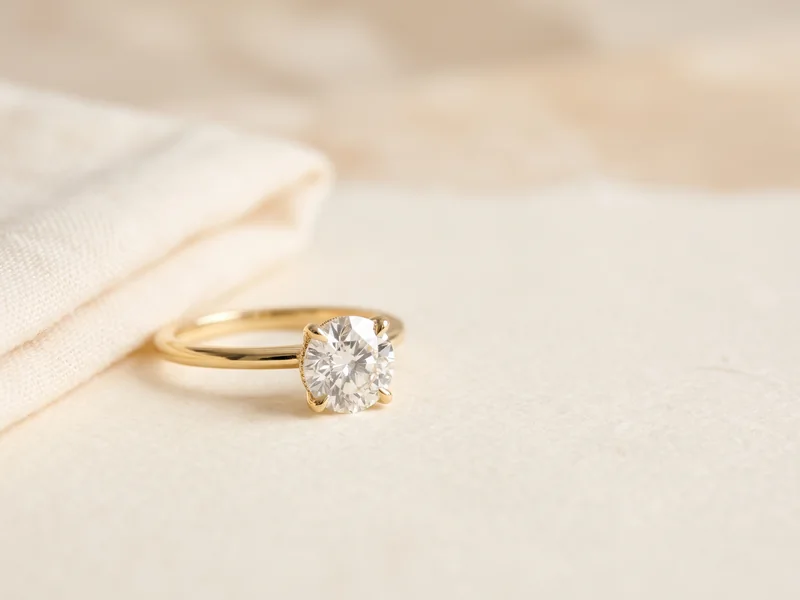 Care, Repairs & RemodellingWhy Rings Go Out of RoundCare, Repairs & RemodellingSunscreen, Chlorine and Your JewelleryCare, Repairs & RemodellingCan You Wear Your Ring in the Shower, Pool or at the Beach?Care, Repairs & RemodellingJewellery Care and Maintenance
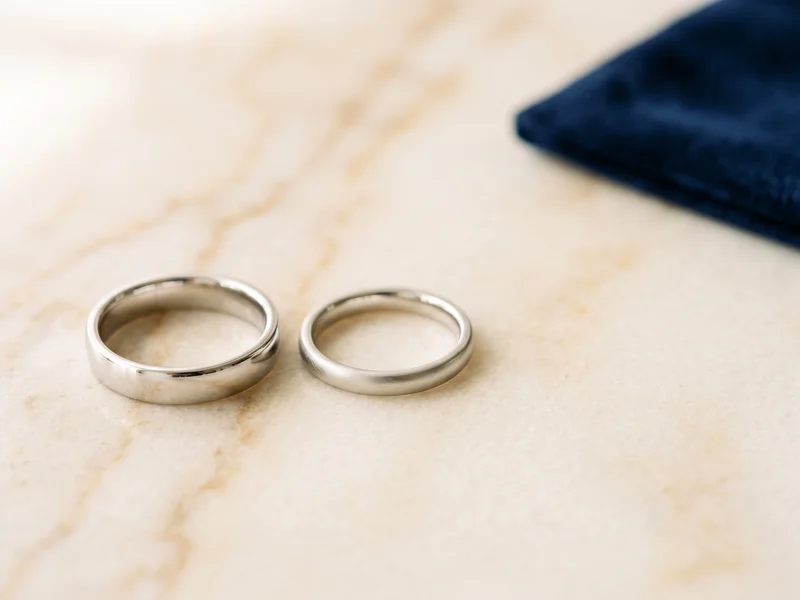 Wedding Bands & EternityHow to Choose a Men’s Wedding Band for Hands-On Work
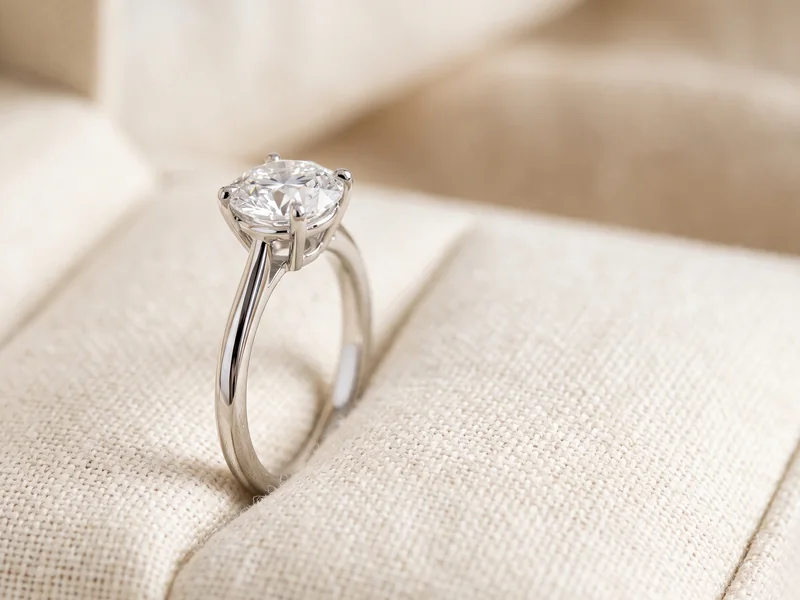 Care, Repairs & RemodellingRhodium Replating ScheduleCare, Repairs & RemodellingRing Sizing Beads and Sizing Bars
Explore more
More guides on this topic
Education