
- Education
- Engagement Rings & Settings
- The Three Stone Engagement Ring: A Complete Australian Guide
Engagement rings & settings
The Three Stone Engagement Ring: A Complete Australian Guide
A three stone engagement ring looks simple, but three stones means three sets of decisions: shape, size, matching and claws. Here is how to balance them so the ring looks right on the day and still holds tight in twenty years.
 Reviewed by Raj Sood, Graduate Gemologist (GIA), AJP (GIA)Master jeweller and Graduate Gemologist (GIA) · reviewed 4 November 2026
Quick answer
A three stone engagement ring sets a centre stone between two smaller side stones, often read as past, present and future. For balance, choose side stones about 55–75% of the centre's width, matched within one colour grade, in a shape that suits the centre, with secure claws checked every year.
What is a three stone engagement ring?
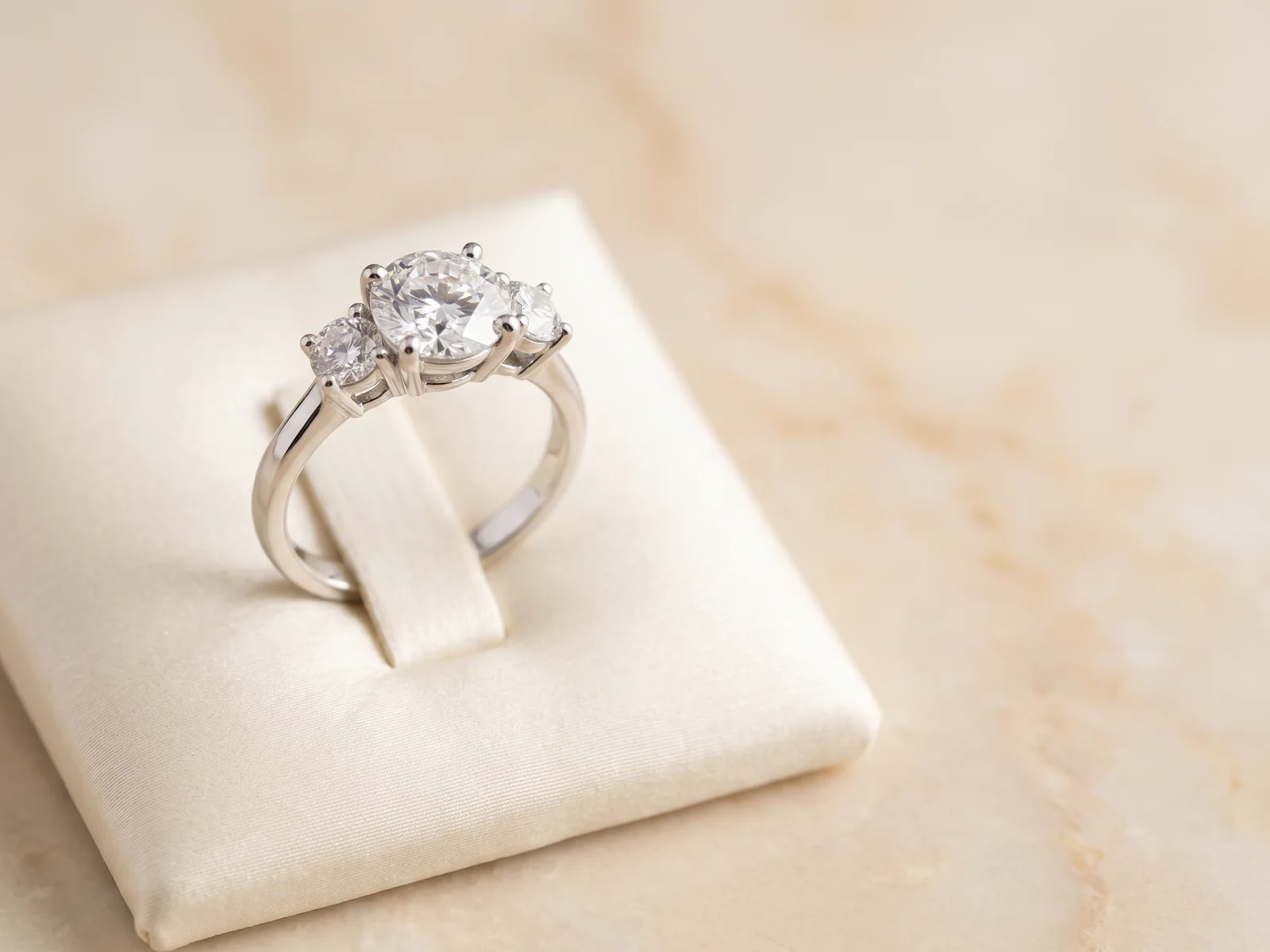
A three stone engagement ring, also called a trilogy ring or trinity ring, has one centre stone flanked by two smaller side stones, set in a row across the top of the ring. The centre is usually a diamond. The sides can be diamonds or coloured gemstones, and they can match the centre's shape or deliberately contrast with it.
The three stones are most often read as past, present and future. Some couples read them as friendship, love and fidelity, or as two people and the relationship between them. None of these meanings is official. The past, present and future idea was heavily promoted by the diamond trade around the turn of this century, although rings with three stones in a row are far older. If you are curious, read about how engagement ring traditions developed and the much older story of the wedding band.
The layout is not only for engagements. A smaller three stone diamond ring is a popular promise ring, a right-hand ring bought for yourself, or an anniversary ring to mark ten or twenty years or the birth of a child.
What makes the style work, or not, is balance. A single stone only has to relate to the band. With three, the side stones have to suit the centre in shape, size, colour and height, and the claws have to hold three stones that take knocks from three directions. The rest of this guide goes through each decision in the order we work through them at the bench.
Which side stone shapes suit a three stone ring?
The side stones set the character of the ring. Round sides beside a round centre give an even, classic line. Pointed sides like pears and trilliants draw the eye towards the centre. Step-cut sides such as baguettes and trapezoids give clean, geometric shoulders that suit an emerald cut or radiant centre.
| Side stone shape | How it looks | Pairs well with | Watch for |
|---|---|---|---|
| Round brilliant | Matching sparkle, classic and even | Round, oval, cushion centres | Can look busy beside a step-cut centre |
| Pear | Points usually face the centre, drawing the eye in; lengthens the finger | Round, oval, cushion | Fragile tips need V-claws or a bezel |
| Trilliant (triangle) | Sharp, modern, sits close to the centre | Round, cushion, princess, oval | Thin corners chip if left unprotected |
| Tapered baguette | Clean lines, Art Deco feel | Emerald cut, Asscher, radiant, princess | Step facets show inclusions more readily |
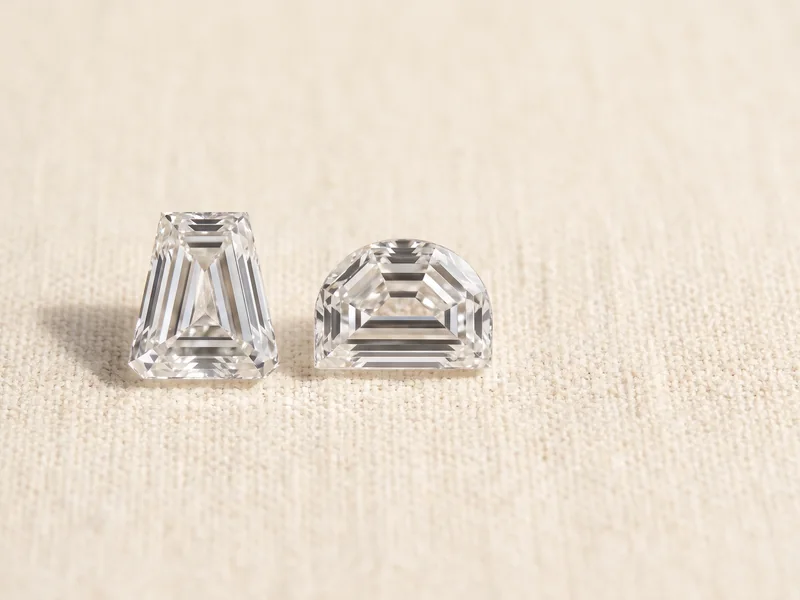
| Trapezoid | Wider, geometric shoulders | Emerald cut, radiant, oval | Must be cut and bought as a matched pair |
| Half moon | Curved inner edge that hugs the centre | Oval, round, cushion, emerald cut | Often cut to fit one centre, so harder to replace |
A useful rule of thumb is to pair brilliant with brilliant and step with step. Brilliant cuts break light into small, lively flashes; step cuts show broad, mirror-like planes of light. Mix them on purpose for contrast, not by accident. Our guide to trapezoid, half moon, bullet and baguette side stones shows each cut in detail, and trilliant versus pear side stones compares the two most popular pointed options.
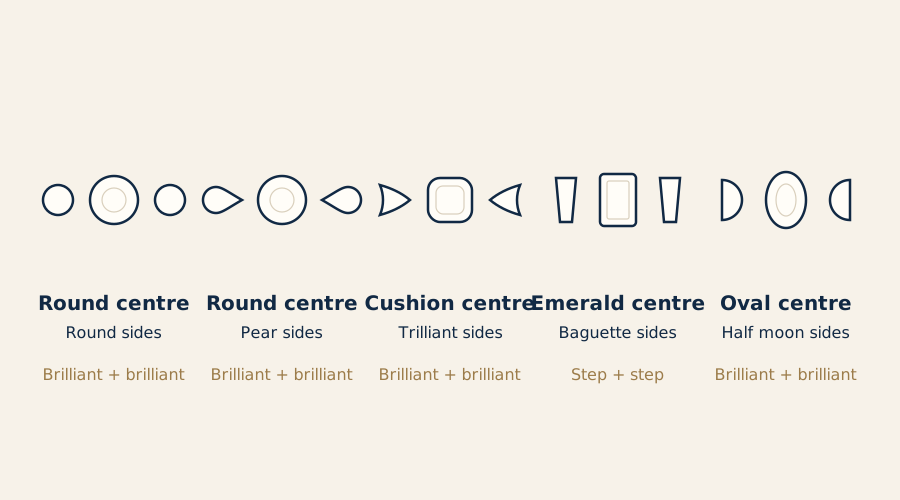
Orientation matters too. Pears are most often set with the point towards the centre and the rounded end facing out along the band, though some designs reverse this. Trilliants can be straight-sided or slightly curved (sometimes called curved or convex trilliants); curved sides sit more neatly against a round or oval centre.
How do you proportion a three stone engagement ring?
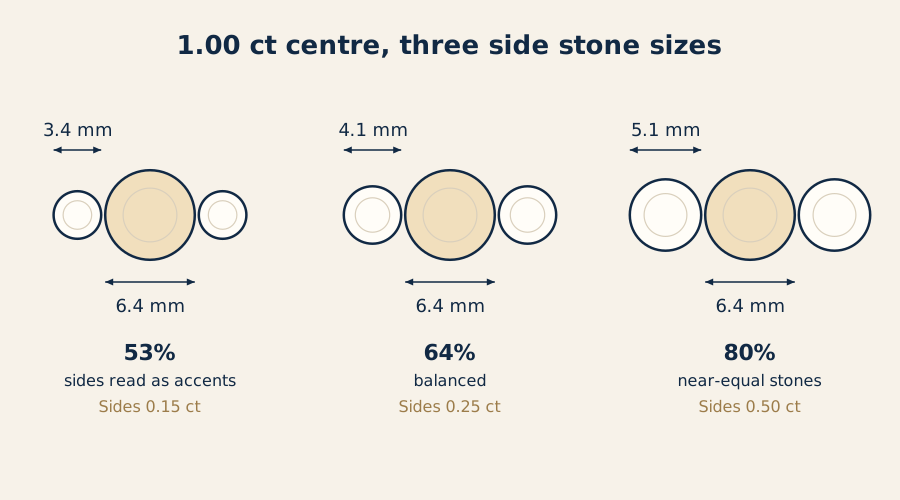
Proportion is the question we are asked most about three stone engagement rings. Our guideline: each side stone's face-up width should be about 55–75% of the centre's width. Below about half, the sides read as small accents and the ring looks like a solitaire with extras. Above about 80%, the three stones look almost equal, which some people love, but the centre loses its focus.
| Centre (round) | Centre width | Each side stone | Side width | Total carat weight |
|---|---|---|---|---|
| 0.50 ct | about 5.1 mm | 0.10–0.15 ct | about 3.0–3.4 mm | 0.70–0.80 ct |
| 0.75 ct | about 5.8 mm | 0.15–0.25 ct | about 3.4–4.1 mm | 1.05–1.25 ct |
| 1.00 ct | about 6.4 mm | 0.20–0.33 ct | about 3.8–4.4 mm | 1.40–1.66 ct |
| 1.50 ct | about 7.4 mm | 0.30–0.50 ct | about 4.3–5.1 mm | 2.10–2.50 ct |
| 2.00 ct | about 8.1 mm | 0.40–0.70 ct | about 4.8–5.7 mm | 2.80–3.40 ct |
Notice how small the side weights are. Carat measures weight, and weight grows with volume, so a stone with 65% of the centre's width weighs only about 27% as much (0.65 × 0.65 × 0.65). That is why a pair of 0.25 ct sides already looks generous beside a 1 carat centre. Side stones are often described in points, where 1 point is 0.01 ct; our guide to pointer sizes and what they look like in millimetres has a full chart.
For elongated centres such as ovals, pears and emerald cuts, compare the side stones with the centre's width, not its length, so the sides tuck in neatly at the widest point. An 8 × 6 mm oval, for example, usually suits sides around 3.5–4.5 mm wide.
Watch the phrase total carat weight (often shortened to TW or TCW) on any listing. A 1.50 ct TW three stone ring might be a 1.00 ct centre with two 0.25 ct sides, or a 0.70 ct centre with two 0.40 ct sides. They look quite different, so always ask for the centre weight on its own.
How closely should the side stones match the centre?
The eye compares stones sitting side by side far more harshly than it judges a single stone. Here is what to match, and where you can relax:
- Colour: keep the sides within one grade of the centre. Small stones show less body colour, so G sides beside an F centre are usually invisible, but a J side beside an E centre is not.
- Clarity: aim for eye-clean sides. Small brilliant sides hide inclusions well, so SI1 or SI2 is often fine; step-cut sides like baguettes need cleaner stones, usually VS.
- Cut: round sides should be well cut (Excellent or Very Good) so their sparkle keeps pace with the centre.
- The pair: the two sides must match each other closely, ideally within about 0.1 mm in width, with the same outline and, for fancy shapes, the same length-to-width ratio.
- Origin: most people keep all three stones natural or all three laboratory-grown. Mixing is possible, but the ring must be described accurately, and lab-grown stones must always be disclosed as lab-grown.
Coloured centres work beautifully in this style. Sapphire and ruby (both corundum, 9 on the Mohs hardness scale) are durable enough for daily wear. Emerald is softer at 7.5–8 and is usually treated with oil or resin, so it needs a protective setting and gentler cleaning. Lab-created sapphires and rubies have the same hardness as natural ones and must always be sold as lab-created or synthetic.
Diamond has a refractive index of about 2.42, against about 1.76–1.77 for sapphire, so diamond sides throw back noticeably more sparkle than a sapphire centre. Many people choose diamond sides a little smaller than usual so the colour stays the focus. Before you settle on a combination, check how to care for each gemstone, because the softest stone in the ring sets the cleaning rules for all three.
Not sure which one is right?
Send us the stones you are looking at and our gemologist will tell you which to choose and why.
Which settings and metals work best for three stone rings?
The setting decides how the ring wears, how high it sits and whether a wedding band fits beside it. The main choices:
- Separate claws: each stone has its own four claws, twelve in total. The most secure option, and if one claw fails only one stone is at risk.
- Shared claws: the inner claws are split to hold two stones at once, usually eight claws in total. More of each stone shows and the stones sit closer, but a broken shared claw loosens two stones.
- V-claws and bezels: pear and trilliant sides need their points wrapped by a V-shaped claw or a thin rim of metal (a bezel). A bezel on the sides and claws on the centre is a popular, hard-wearing combination.
- Basket or gallery: the metal structure under the stones. An open gallery lets light and cleaning water through; a low basket keeps the ring closer to the finger.
- Cathedral shoulders: the band sweeps up to meet the stones, giving extra height and strength under the side stones.
Height matters more than most people expect. The centre usually sits slightly higher than the sides so it reads as the focus, and the sides should sit low enough that a straight wedding band can sit flush. If the sides overhang the band, you may need a contoured or notched band. Our guide to the parts of an engagement ring, from gallery to shank explains each term, and our overview of every engagement ring setting style compares three stone settings with solitaires, halos and bezels.
On metals: platinum is dense and, when it wears, the metal tends to move rather than disappear, which suits claws. 18ct gold (75% pure gold) is harder-wearing than many people think, and 18ct white gold is usually rhodium-plated to keep it bright white, with replating every year or two. A slightly thicker or flatter band under a three stone top also helps stop the ring spinning, because the top is heavier than a solitaire's.
How does a three stone ring wear over the years?
This is the view from the repair bench. A three stone ring has more claws and more exposed edges than a solitaire, and the side stones sit at the outer edges of the ring where they take the knocks: car doors, bench tops, gym equipment, the side of a shopping trolley. In our experience the outer claws on the side stones wear first, followed by any shared claws in the middle.
Signs a claw needs attention:
- The ring starts catching on knitwear or hair.
- A claw tip looks flat, thin or shiny-worn rather than rounded.
- A stone looks slightly tilted, or sits at a different height from before.
- You hear a faint rattle when you tap the ring gently near your ear.
Book a claw check every 6–12 months, and straight away if you notice any of the above. Worn claws can be re-tipped (new metal added to the tip) or fully replaced, long before a stone is lost. Our guide to loose stones and claw tightening explains what happens at each stage.
Comfort is the other long-term question. A 1 carat centre with two 0.25 ct sides measures roughly 15–17 mm across the finger once claws are included, compared with about 7 mm for a 1 carat solitaire. On a slim finger, very large sides can reach past the edges and rub the neighbouring fingers. Try the width against your hand, and remember which finger the ring will be worn on beside a wedding band, because the two rings together add width too.
Three stone vs five stone, toi et moi and side-stone rings
If you are weighing a three stone diamond ring against other multi-stone styles, the differences come down to layout, look and how many claws there are to maintain.
| Style | Layout | Look on the hand | Claws to maintain | Suits |
|---|---|---|---|---|
| Solitaire | One centre stone | Minimal; all focus on one stone | 4–6 | People who want the simplest line |
| Three stone | Centre plus two sides | Balanced, symbolic, wider across the finger | 8–12 | Most centre shapes; meaning-led choices |
| Five stone | Centre plus four graduated or equal stones | Band-like sweep across the finger | 10–20 | Anniversary rings and wide fingers |
| Toi et moi | Two stones side by side | Asymmetric and personal | 6–8 | Two different shapes or gems |
| Side-stone or pavé shoulders | Centre plus small stones set into the band | Sparkle along the band | Many tiny claws or beads | Adding sparkle without width |
A 5 stone diamond ring is usually either graduated, with each stone stepping down in size from the centre, or made of five equal stones that read like a short half-eternity ring. It covers more of the finger and is often chosen as an anniversary or eternity-style ring rather than an engagement ring. With five stones there are more claws to check, so the same 6–12 month rule applies.
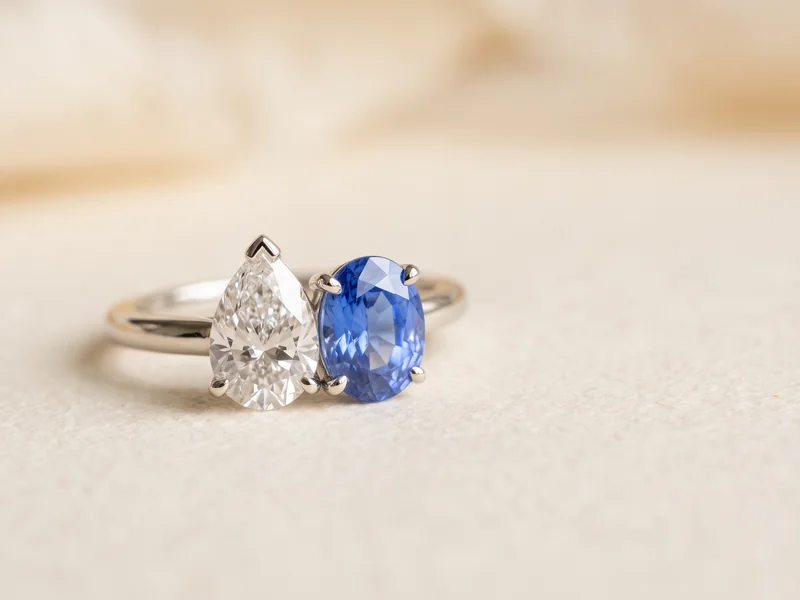
If you want small stones along the band rather than two larger stones beside the centre, look at side-stone engagement rings in general. If you want two stones of equal importance instead of three, our guide to balancing two stones in a toi et moi covers the different proportion rules that apply.
Related guideTrilliant vs Pear Side StonesHow much does a three stone engagement ring cost?
Diamond prices per carat rise steeply with size, so three smaller stones usually cost less than one stone of the same total weight. A 1.00 ct centre with two 0.25 ct sides (1.50 ct TW) normally costs well under a single 1.50 ct diamond of the same colour and clarity, while looking wider on the finger.
| Part of the ring | Lab-grown (approx. AUD) | Natural (approx. AUD) |
|---|---|---|
| 1.00 ct round centre, G–H, VS, well cut | 800–2,500 | 7,000–15,000 |
| Pair of 0.25 ct round side stones | 300–900 | 1,000–2,500 |
| 18ct gold three stone setting | 1,800–3,500 | 1,800–3,500 |
| Platinum three stone setting | 2,500–4,500 | 2,500–4,500 |
| Typical finished ring | 3,000–7,500 | 10,000–21,000 |
These are rough ranges only; actual prices depend on the exact stones, the metal weight and how intricate the setting is. Laboratory-grown diamonds are real diamonds with the same chemistry and hardness as natural ones; they cost much less and are easy to find in matched pairs and larger sizes. Natural diamonds are rarer, formed over geological time, and their price reflects that rarity. Neither should be thought of as an investment; choose the one that suits your values and budget.
Design a three stone ring with our settings
For setting a budget, ignore rules of thumb that tell you what to spend. Our piece on where the three-month salary rule came from explains why it is a marketing line, not a guideline. Spending on a well-cut centre and a well-made setting usually matters more than squeezing in larger sides.
How to choose a three stone engagement ring: step by step
- Choose the centre first. Decide its shape, size and whether it is natural, lab-grown or a coloured gemstone. Everything else is sized from it.
- Pick the side stone shape. Brilliant sides (round, pear, trilliant, half moon) for brilliant centres; step-cut sides (baguette, trapezoid) for emerald cut, Asscher and radiant centres.
- Size the sides. Aim for about 55–75% of the centre's face-up width, and check the total width across your finger.
- Match the stones. Sides within one colour grade of the centre, eye-clean, and the two sides matched to each other within about 0.1 mm.
- Choose the setting. Separate or shared claws, V-claws or bezels for pointed sides, and a height that lets your wedding band sit beside it.
- Review the design before it is made. Look at the CAD render from the top and side, checking the gaps between stones and the claw thickness on the outer edges.
- Plan the upkeep. Book a claw check every 6–12 months. If any term on a quote is unfamiliar, look it up in our jewellery glossary before you commit.
Free consultation
Talk to a gemologist
Compare stones in person or online with Raj Sood, Graduate Gemologist (GIA), AJP (GIA).
Book a consultationShop this shape
FAQ
Common questions
What does a three stone engagement ring mean?
Most people read the three stones as past, present and future. Others choose them to represent friendship, love and fidelity. There is no official meaning, so the story is yours to decide.
What size side stones suit a 1 carat centre?
For a 1.00 ct round of about 6.4 mm, most people choose round sides of 0.20–0.33 ct each, about 3.8–4.4 mm wide. That keeps the sides at roughly 60–70% of the centre's width.
Can the side stones be a different gemstone from the centre?
Yes. Sapphire or ruby sides beside a diamond, or diamond sides beside a sapphire, are both common. Check that every stone is hard enough for daily wear and follow the care rules for the softest one.
Do three stone rings need more maintenance than a solitaire?
Yes, a little. There are 8–12 claws instead of 4–6, and the side stones take knocks at the edges, so a claw check every 6–12 months is worth booking.
What is the difference between a 3 stone and a 5 stone diamond ring?
A 3 stone ring has a centre and two side stones; a 5 stone ring adds two more, either graduated or all the same size. The five stone version covers more of the finger and is often chosen as an anniversary ring.
Does a wedding band sit flush with a three stone ring?
It can, if the side stones are set low enough and do not overhang the band. Otherwise a contoured or notched band fits around them, so plan the wedding band when you design the engagement ring.

Ask a gemologist
Not sure which diamond to choose?
Raj Sood is a Graduate Gemologist (GIA) and master jeweller. Bring the stones you are considering, or send the reports, and he will tell you honestly which one is better and why.
Keep learning
Related guides
 Engagement Rings & SettingsSide-Stone Engagement Rings
 Diamond ShapesTrilliant vs Pear Side StonesDiamond ShapesSide Stone Diamond Cuts: Trapezoid, Half Moon, Bullet, Baguette, TrilliantEngagement Rings & SettingsEngagement Ring Setting Styles Guide
 Buying Knowledge & Custom ProcessThe Three-Month Salary Rule
 GemstonesGemstone Care by Stone
 Engagement Rings & SettingsHow to Balance Two Stones in a Toi et Moi Ring
 Care, Repairs & RemodellingLoose Stones and Stone Tightening
Explore more
More guides on this topic
Education