
- Education
- Jewellery Types
- Bracelet Size Guide: How to Measure Your Wrist for Every Bracelet Style
Jewellery types
Bracelet Size Guide: How to Measure Your Wrist for Every Bracelet Style
This bracelet size guide shows you how to measure your wrist in centimetres and turn that number into the right length for a chain, tennis bracelet, men's diamond bracelet, bangle or cuff. A few millimetres decide whether a bracelet sits well, spins, pinches or slides off.
 Reviewed by Raj Sood, Graduate Gemologist (GIA), AJP (GIA)Master jeweller and Graduate Gemologist (GIA) · reviewed 4 November 2026
Quick answer
Measure your wrist just above the wrist bone with a soft tape or a strip of paper, then add about 1.5–2 cm for a comfortable fit (1 cm snug, 2.5 cm loose). Most women's bracelets are 17–19 cm and men's 20–22 cm. Bangles are sized by inside diameter, from a measurement around your hand. Chunky links need a little more.
What does a bracelet size guide actually measure?
Bracelets are sized in two different ways, and mixing them up is the most common reason people order the wrong size. Flexible bracelets (chains, link bracelets, tennis bracelets and beaded strands) are sized by their length, measured end to end from the tip of the clasp to the last link when laid flat. Rigid bracelets (bangles and cuffs) are sized by their inside diameter or inside circumference, because they have to pass over your hand or wrap around your wrist without bending.
For flexible bracelets, the number that matters is your wrist circumference: the distance around your wrist at the point where you wear the bracelet. The bracelet is then made longer than your wrist by a fit allowance, the extra length that lets it move, sit comfortably and close without strain. For a solid bangle, the number that matters is the widest part of your hand, not your wrist at all.
If you are still deciding which kind of bracelet suits you, our overview of the main jewellery types explains how bracelets, bangles and cuffs differ in wear and care. Any unfamiliar word in this guide, from lobster clasp to curb link, is also defined in our plain-English jewellery glossary.
| Bracelet type | Sized by | Typical fit allowance | Can it be resized? |
|---|---|---|---|
| Chain or link bracelet | Length (cm) | +1.5–2 cm | Usually, by adding or removing links |
| Tennis bracelet | Length (cm) | +1–1.5 cm | Yes, by adding or removing set links |
| Men's chunky link (curb, Cuban) | Length (cm) | +2–2.5 cm | Usually, by links |
| Beaded or pearl strand | Length (cm) | +2–2.5 cm | Yes, by restringing |
| Bangle | Inside diameter (mm) | Must pass over the hand | Rarely; solid bangles are difficult |
| Cuff | Inside circumference plus opening | Opening of about 2.5–3.5 cm | Small adjustments only |
How do you use a bracelet size guide to measure your wrist?
You need a soft tailor's tape, or a strip of paper or non-stretch string and a ruler. Wrap it around your wrist just above the wrist bone (the knobbly bone on the little-finger side), on the side towards your hand, because that is where a bracelet naturally sits. Keep the tape flat and snug against the skin, but not tight enough to press in.
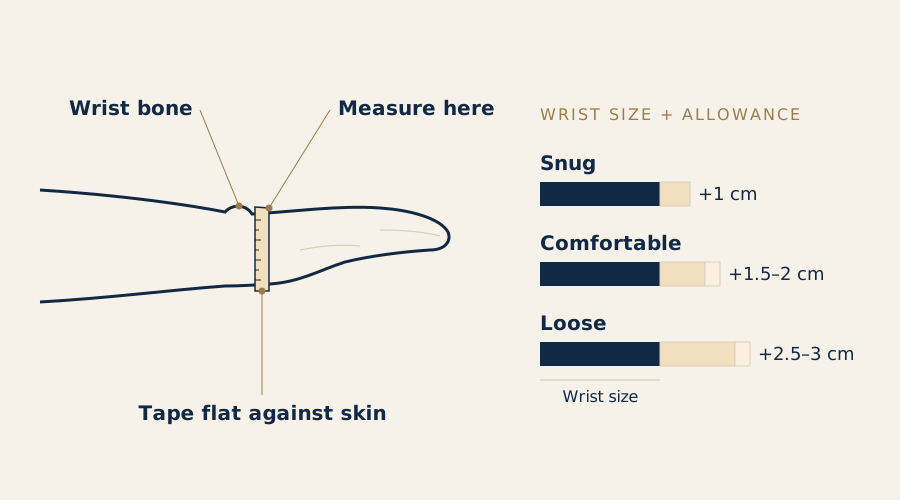
If you are using paper or string, mark where the end overlaps, lay it flat against a ruler and read the length in millimetres. It is the same idea as the paper-strip method in our guide to measuring your ring size at home, and it has the same weak spots: stretchy string reads short, and a strip held at an angle reads long.
- Measure twice, once in the morning and once in the late afternoon. Wrists can swell slightly through the day and in hot weather, so a Melbourne summer reading may be a few millimetres larger than a winter one.
- Measure the wrist you will wear it on. Most people's dominant wrist is slightly larger.
- Write it down in centimetres to one decimal place, for example 16.4 cm. That is your wrist size, not your bracelet size.
- Check against a bracelet that already fits. Lay it flat, close it, and measure end to end. This is often the most reliable number of all.
Australian jewellers generally quote bracelet lengths in centimetres, while many imported pieces are listed in inches. One inch is 2.54 cm, so a 7 inch bracelet is about 17.8 cm and an 8 inch bracelet about 20.3 cm. Ring sizes work differently again, using letters in Australia; our Australian ring size chart covers that system if you are sizing a ring at the same time.
What bracelet size do I need? Bracelet size chart in cm
Take your wrist measurement and add the allowance for the fit you like. A snug fit (about +1 cm) stays put and suits thin chains and bracelets worn with a watch. A comfortable fit (+1.5–2 cm) moves a little and is what most people choose. A loose fit (+2.5–3 cm) drapes down towards the hand and suits charm bracelets and statement chains.
| Wrist (cm) | Snug (+1 cm) | Comfortable (+1.5–2 cm) | Loose (+2.5–3 cm) | Nearest length in inches |
|---|---|---|---|---|
| 14 | 15 cm | 15.5–16 cm | 16.5–17 cm | 6–6.5 in |
| 15 | 16 cm | 16.5–17 cm | 17.5–18 cm | 6.5–6.75 in |
| 16 | 17 cm | 17.5–18 cm | 18.5–19 cm | 7 in |
| 17 | 18 cm | 18.5–19 cm | 19.5–20 cm | 7.25–7.5 in |
| 18 | 19 cm | 19.5–20 cm | 20.5–21 cm | 7.75–8 in |
| 19 | 20 cm | 20.5–21 cm | 21.5–22 cm | 8–8.25 in |
| 20 | 21 cm | 21.5–22 cm | 22.5–23 cm | 8.5–8.75 in |
Most adult women's wrists measure somewhere between about 14 and 17 cm, which is why the most common women's bracelet lengths are 17–19 cm. Most adult men's wrists sit between about 16.5 and 20 cm, giving men's bracelet lengths of 20–22 cm. These are averages only. Your own measurement always beats a standard size.
Between two sizes? For a flexible bracelet, go up rather than down. A bracelet that is 5 mm too long simply moves a little more; one that is 5 mm too short presses on the clasp every time you bend your wrist, and that is how clasps wear out.
What does a men's bracelet size guide look like?
Men's bracelets follow the same rule, but the links are usually wider and thicker, and that changes the maths. A wide link takes up space on the inside of the bracelet, so the inner circumference is smaller than the measured length suggests. As a guide, add 2–2.5 cm to your wrist for links 8 mm wide or more, rather than the usual 1.5–2 cm.
| Men's wrist (cm) | Fine chain or tennis (+1.5 cm) | Link 5–7 mm (+2 cm) | Chunky link 8 mm+ (+2.5 cm) |
|---|---|---|---|
| 16.5 | 18 cm | 18.5 cm | 19 cm |
| 17.5 | 19 cm | 19.5 cm | 20 cm |
| 18.5 | 20 cm | 20.5 cm | 21 cm |
| 19.5 | 21 cm | 21.5 cm | 22 cm |
| 20.5 | 22 cm | 22.5 cm | 23 cm |
A men's diamond bracelet usually takes one of three forms: a tennis bracelet with a single row of stones, typically 3–5 mm across; a curb or Cuban link chain (flattened, interlocking oval links) with diamonds set into the links or the clasp; or an ID-style bar bracelet with a diamond-set plate. Tennis styles should sit closer to the wrist so the stones stay on top. Heavy Cuban links look right with a little more drape, but not so much that they slide over the hand.
If you wear a watch, think about which wrist the bracelet goes on. On the opposite wrist, choose your normal comfortable fit. On the same wrist, a snug bracelet sits neatly above the watch; a loose one will knock against the case and can scratch the crystal or the diamonds' neighbours. Weight matters too: a solid 18ct gold link bracelet is dense, and a wide one can weigh well over 50 grams, which is comfortable only if it is not too tight.
Men often buy a bracelet and a ring together. Our men's ring sizing guide explains why wide men's bands need a slightly larger size, much like wide bracelet links, and if a signet is on the list, how signet rings are made and worn covers face sizes and weights.
Not sure which one is right?
Send us the stones you are looking at and our gemologist will tell you which to choose and why.
How should a tennis bracelet fit, and does size change the carat weight?
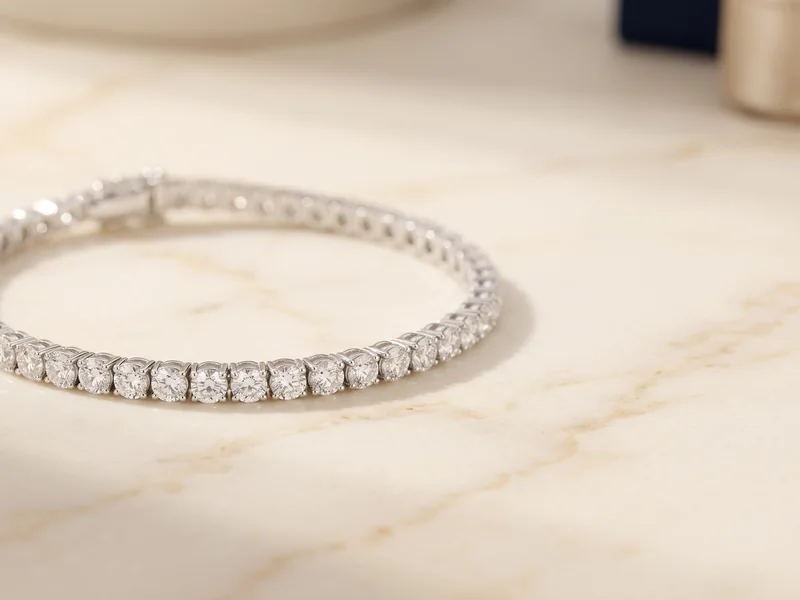
A tennis bracelet is a flexible line of individually set stones, usually diamonds, joined by small hinged links. It should sit close to the wrist: about 1–1.5 cm longer than your wrist measurement. Too loose and it rolls, so the backs of the settings face up and the stones grind against desks and keyboards. Too tight and the hinges strain. Our guide to how tennis bracelets are built and set goes through the settings, clasps and safety catches in detail.
Length directly changes the total carat weight, because a longer bracelet holds more stones. That is why two bracelets described as the same style can carry different weights: one is 17 cm and the other 19 cm. A diamond's carat weight is a measure of mass, not size; the link between the two is explained in our page on why carat weight and millimetre size differ.
| Stone diameter | Approx. carat each | Stones in an 18 cm bracelet | Approx. total carat weight |
|---|---|---|---|
| 2.0 mm | 0.03 ct | about 75–80 | about 2.0–2.5 ct |
| 2.5 mm | 0.06 ct | about 62–66 | about 3.5–4 ct |
| 3.0 mm | 0.10 ct | about 52–56 | about 5–5.5 ct |
| 3.5 mm | 0.15 ct | about 45–48 | about 7 ct |
Every extra centimetre of a tennis bracelet adds roughly three to four stones, depending on their size. Small round diamonds follow the same size-to-weight pattern you see in earrings; our chart of diamond stud sizes in millimetres by carat is a handy cross-check when you compare stone sizes.
Tennis bracelets are made with both natural and laboratory-grown diamonds. Lab-grown diamonds are real diamond (10 on the Mohs hardness scale, with the same refractive index of about 2.42) grown in a laboratory rather than mined, and they cost much less, so many people choose a longer or heavier lab-grown line for the same budget. As a broad guide only, a 3 ct lab-grown tennis bracelet might be about AUD 2,500–6,000 and a natural one about AUD 8,000–20,000, depending on colour, clarity and metal. Our guide to lab-grown diamonds in bracelets and earrings compares the two in detail.
Related guideTennis Bracelets ExplainedHow do you size a bangle or cuff?
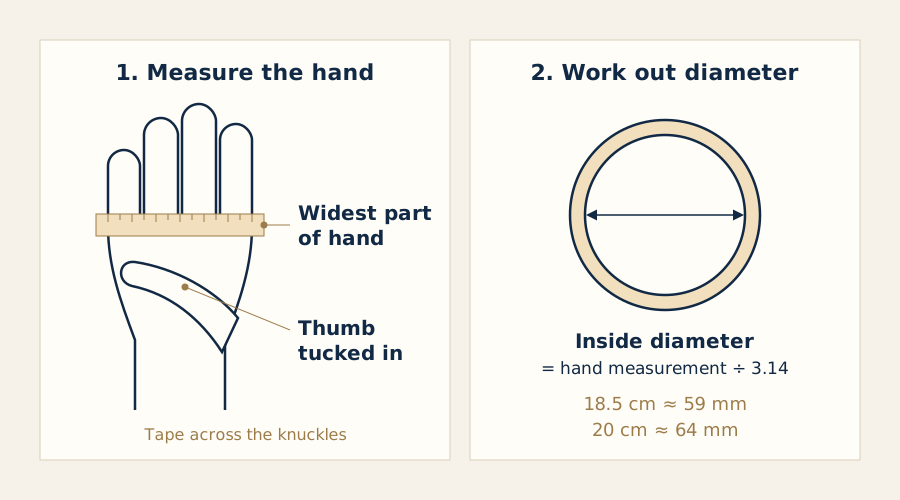
A solid bangle is a closed, rigid circle, so it has to slide over the widest part of your hand. To measure, bring your thumb and little finger together as if putting on a bangle, then wrap a tape around the widest part of your hand, across the knuckles. Divide that number by 3.14 to get the inside diameter you need. A hinged bangle opens, so it can be sized closer to the wrist instead.
| Hand measurement (cm) | Inside diameter needed | Typical label |
|---|---|---|
| 17–18 | about 54–57 mm | Small |
| 18.5–19.5 | about 59–62 mm | Medium |
| 20–20.5 | about 64–65 mm | Large |
| 21 and over | about 67 mm or more | Extra large |
Size labels vary between makers, so always check the millimetre figure. Some bangles are made slightly oval rather than perfectly round, which makes a well-shaped bangle easier to put on than its diameter suggests.
A cuff is an open bangle with a gap that slides over the narrow side of the wrist. Look for an opening of about 2.5–3.5 cm and an inside circumference roughly equal to your wrist measurement plus 1 cm. Cuffs can be gently adjusted, but gold and silver work-harden (become stiffer and more brittle) each time they are bent, so do not keep squeezing and opening one to fit.
Does bracelet width, chain style or clasp change the size you need?
Yes, and it is the detail most size charts skip. Three things change how a bracelet of the same length fits:
- Width and thickness. Fine chains up to about 3 mm need the standard +1.5–2 cm. Links 5–7 mm wide need about +2 cm, and 8 mm or wider about +2.5 cm.
- Chain style. Rope, box and snake chains are stiffer and fit slightly smaller than a soft cable or figaro chain of the same length. The guide to chain and link styles shows how each one drapes.
- Clasp type. A lobster clasp or box clasp adds little length. A toggle clasp (a bar that passes through a ring) needs about 1 cm of slack to fasten, so add that on top. Magnetic clasps are easy to use but less secure for valuable pieces.
- Extender chains. A short extra chain of about 2.5–5 cm at the clasp lets one bracelet fit several wrists, which helps with gifts.
Beaded and pearl bracelets need more allowance than you might expect, because round beads fill the inside of the circle. For 6–8 mm pearls, add about 2–2.5 cm to your wrist. Pearls are also soft, about 2.5–4.5 on the Mohs scale, so a strand that is too loose knocks against everything; our page on how pearls are graded by lustre, surface and size explains why bigger pearls also change the fit.
If you are building a matching set, size each piece on its own terms. A tennis bracelet and a matching tennis necklace are made in the same way but sized very differently, and necklace lengths have their own standard steps, set out in our necklace length chart from choker to opera.
Can a bracelet be resized if it does not fit?
Most flexible bracelets can. A link bracelet is usually shortened by removing links or lengthened by adding matching ones, ideally from the same chain. A tennis bracelet is resized by removing set links, or by adding new links set with matched stones, which takes more work because each new stone must match the colour and size of the rest. Beaded and pearl strands are simply restrung, often with a knot between each pearl.
Rigid pieces are harder. A solid bangle can sometimes be cut and a section added or removed, but the join has to be soldered and refinished, and patterned or gem-set bangles may not allow it at all. Hollow bangles and cuffs are easily dented, so they are rarely resized. That is the main reason to measure carefully before buying a rigid style.
Fit matters for other everyday jewellery too. Earrings that move, such as larger hoops and drops, have their own comfort checks; see hoop and huggie sizes and fittings and how drop earring settings carry their weight.
Browse jewellery: bracelets, chains and more
How do you choose the right bracelet size? Step by step
- Measure your wrist. Use a soft tape or paper strip just above the wrist bone, on the wrist you will wear it on, and note it in centimetres.
- Measure again later in the day. Use the larger reading if they differ by more than a few millimetres.
- Choose your fit. Add about 1 cm for snug, 1.5–2 cm for comfortable or 2.5–3 cm for loose.
- Adjust for the style. Add a little more for links 8 mm or wider, beaded strands or a toggle clasp; tennis bracelets stay at about +1–1.5 cm.
- For a bangle, measure your hand instead. Measure across the knuckles with the thumb tucked in and divide by 3.14 for the inside diameter.
- Check against one you own. Lay a bracelet that fits well flat and measure it end to end.
- Ask about resizing. Before you commit, confirm whether the piece can be lengthened or shortened later.
Free consultation
Talk to a gemologist
Compare stones in person or online with Raj Sood, Graduate Gemologist (GIA), AJP (GIA).
Book a consultationShop this shape
FAQ
Common questions
What is the average bracelet size in Australia?
Most women's bracelets are about 17–19 cm long and most men's are about 20–22 cm. Your own wrist measurement plus a fit allowance is more reliable than any average.
How much should I add to my wrist measurement for a bracelet?
Add about 1.5–2 cm for a comfortable fit, around 1 cm for a snug fit and 2.5–3 cm for a loose one. Wide links and beaded bracelets need a little extra.
What size men's diamond bracelet should I get?
Measure your wrist and add about 1.5 cm for a diamond tennis bracelet, or 2–2.5 cm for a wide link style. Most men end up between 20 and 22 cm.
How tight should a tennis bracelet be?
Close to the wrist, about 1–1.5 cm longer than your wrist measurement. That keeps the stones facing up and stops the bracelet rolling and knocking.
How do I measure my bangle size at home?
Tuck your thumb towards your little finger and measure around the widest part of your hand with a soft tape. Divide the measurement by 3.14 to get the inside diameter in millimetres.
Can a bracelet be made bigger?
Chain and tennis bracelets can usually be lengthened by adding links, and pearl or beaded strands can be restrung. Solid bangles and cuffs are much harder to resize, so measure carefully before choosing one.

Ask a gemologist
Not sure which diamond to choose?
Raj Sood is a Graduate Gemologist (GIA) and master jeweller. Bring the stones you are considering, or send the reports, and he will tell you honestly which one is better and why.
Keep learning
Related guides
 Jewellery TypesTennis Bracelets Explained
 Buying Knowledge & Custom ProcessMen's Ring Size Guide
 Jewellery TypesNecklace Length GuideJewellery TypesJewellery Types Guide
 Jewellery TypesDiamond Stud Earring Sizes by Carat
 GemstonesGemstone Carat vs Size (Density)
 Buying Knowledge & Custom ProcessRing Size Guide Australia
 PearlsPearl Grading: Lustre, Nacre, Surface, Shape, Size
Explore more
More guides on this topic
Education