
- Education
- Engagement Rings & Settings
- Oval Engagement Rings: The Complete Australian Guide
Engagement Rings & Settings
Oval Engagement Rings: The Complete Australian Guide
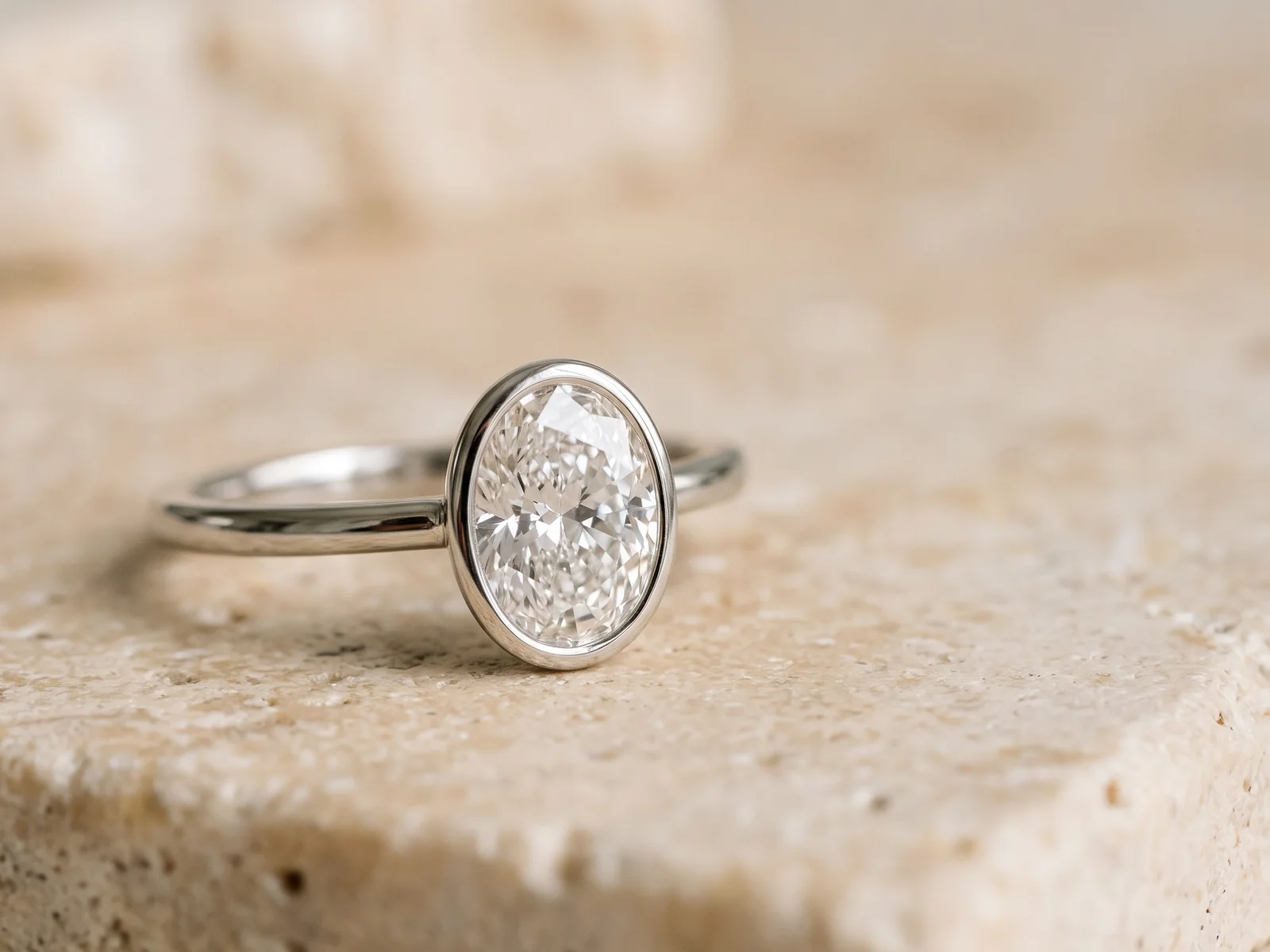
Oval engagement rings look larger per carat than rounds and flatter almost every hand, but the stone's outline and the setting around it decide how they look on day one and after twenty years of wear.
 Reviewed by Raj Sood, Graduate Gemologist (GIA), AJP (GIA)Master jeweller and Graduate Gemologist (GIA) · reviewed 4 November 2026
Quick answer
Oval engagement rings feature an elongated brilliant-cut diamond that looks larger per carat than a round and lengthens the finger. Choose a length-to-width ratio of about 1.30–1.50, a bow-tie that is faint rather than solid black, and a four- or six-claw, halo, bezel or hidden-halo setting matched to how you live.
What are oval engagement rings?
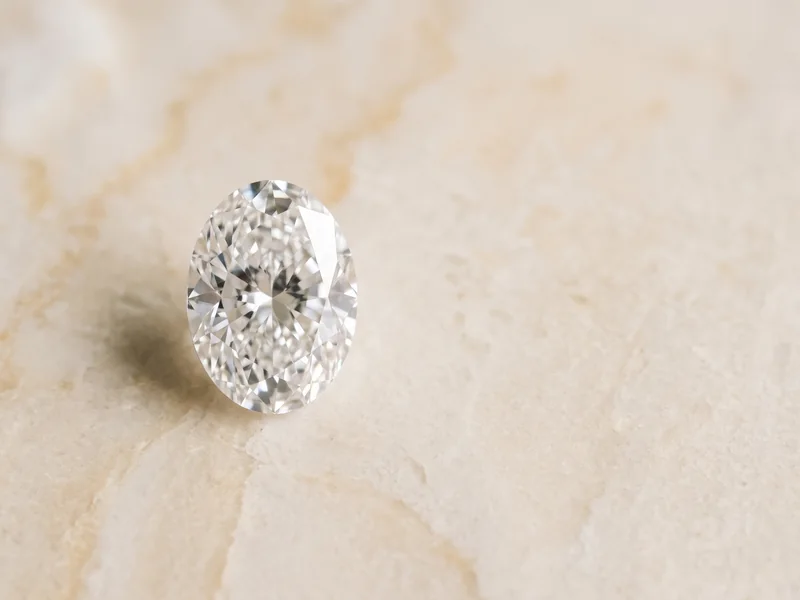
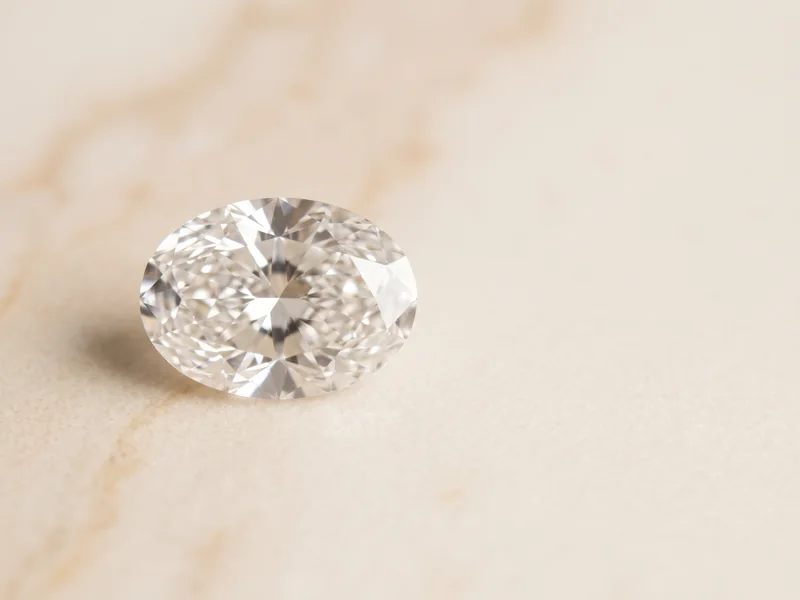
An oval engagement ring is built around an oval-cut diamond: a modified brilliant cut, meaning it uses the same triangular and kite-shaped facets as a round brilliant, rearranged around a stretched-circle outline. Most ovals have around 56 to 58 facets, which gives them brightness and sparkle very close to a round.
Because an oval is longer than it is wide, it covers more of the finger than a round of the same carat weight. That is the main reason people choose it: the stone reads larger, and the length draws the eye along the finger so the hand looks slimmer. Unlike a pear or marquise, an oval has no sharp points, so it is one of the more practical shapes for everyday wear.
Ovals sit in the family of elongated brilliant cuts alongside the pear, marquise and moval. Getting an oval ring right comes down to three decisions: the outline of the stone, the setting that holds it and the band beside it. This guide takes each in turn. For the wider picture on styles, metals and budgets, start at our engagement ring education hub.
What is the best ratio for an oval engagement ring?
The length-to-width ratio compares how long the stone is with how wide it is. Divide the length by the width from the grading report: a 7.70 × 5.50 mm oval has a ratio of 1.40. This one number changes the look of the ring more than any grade on the report.
| Ratio | How it looks | Who tends to choose it |
|---|---|---|
| Below 1.30 | Short and full, close to round | People who want a softer, rounder look |
| 1.30–1.40 | Classic, balanced oval | Most engagement rings |
| 1.40–1.50 | Slimmer and more elongated | Longer fingers, or anyone wanting maximum length |
| Above 1.50 | Long and narrow | A personal preference; bow-tie and colour at the ends show more |
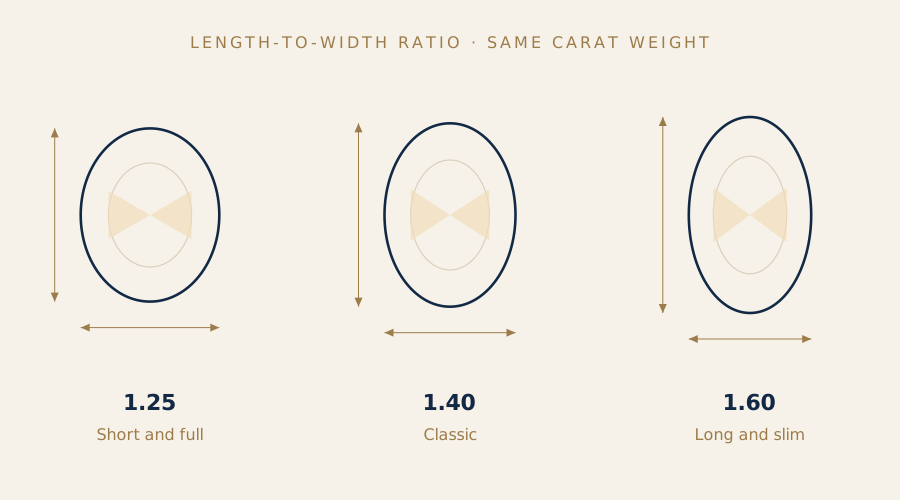
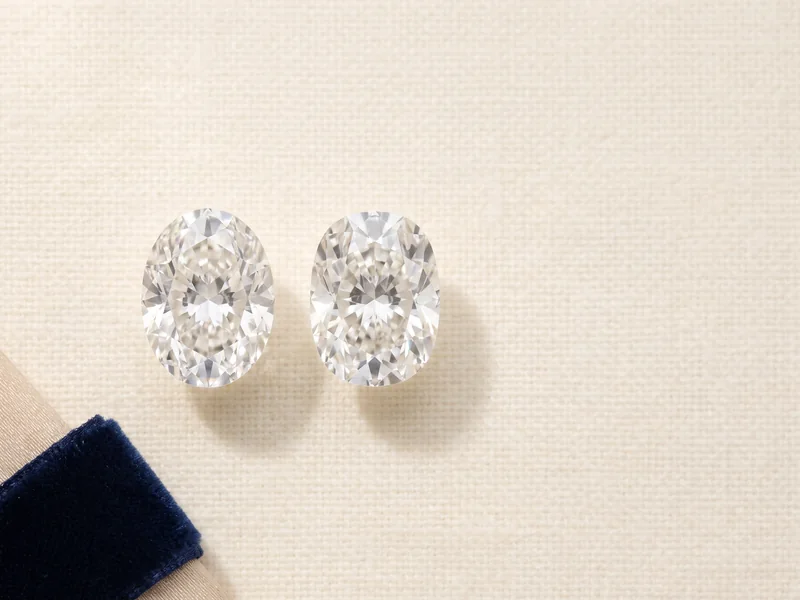
There is no single correct ratio, and our guide to the ideal oval ratio shows how each range looks on different hand sizes. Ratio is not the whole outline, though. Two ovals at 1.40 can look quite different depending on their shoulders, the curve between the long sides and the ends. Full, rounded shoulders look soft and classic; flatter shoulders look slightly boxy. Our page on rounded versus boxy oval shoulders compares them.
GIA does not give ovals an overall cut grade, so proportions matter. As a rough starting point, many well-cut ovals have a table of about 53–63% and a depth of about 58–63%. Our oval proportions chart sets out the ranges in full.
Do oval diamonds have a bow-tie, and does it matter?
Almost every oval has some bow-tie effect: a darker band across the middle of the stone, shaped like a bow-tie, where light passes out the bottom instead of returning to your eye. It comes from the way the long facets underneath meet in the centre. The question is not whether there is one, but how strong it is.
- Acceptable: a soft, grey bow-tie that shifts and flickers as the stone moves. It adds contrast and many people never notice it.
- Worth avoiding: a solid black band that stays put from every angle and dominates the face of the stone.
- Hard to judge from photos: still images exaggerate or hide it. Ask for a 360° video and watch the centre as the stone turns.
Depth affects the bow-tie and the size. An oval cut too deep carries weight in its belly (the lower half), so it looks smaller face-up for its carat weight, and the bow-tie often darkens. Our guide to how deep ovals hide carat weight explains what to look for on the report.
How big does an oval diamond look on the hand?
Face-up size is the area you actually see from above. Because an oval spreads its weight along its length, it usually shows a little more surface than a round of the same weight, and it looks noticeably longer.
| Carat weight | Typical oval (length × width, ≈1.40 ratio) | Typical round (diameter) |
|---|---|---|
| 0.50 ct | about 6.0 × 4.3 mm | about 5.1 mm |
| 0.75 ct | about 7.0 × 5.0 mm | about 5.8 mm |
| 1.00 ct | about 7.7 × 5.5 mm | about 6.4 mm |
| 1.50 ct | about 8.8 × 6.3 mm | about 7.4 mm |
| 2.00 ct | about 9.7 × 6.9 mm | about 8.1 mm |
| 3.00 ct | about 11.1 × 7.9 mm | about 9.3 mm |
These are typical figures; individual stones vary by a few tenths of a millimetre with depth and ratio. A 1 carat oval is over a millimetre longer than a 1 carat round is wide, which is why ovals are a popular way to get more presence without moving up in weight. Our oval versus round comparison goes through sparkle, price and size side by side.
Not sure which one is right?
Send us the stones you are looking at and our gemologist will tell you which to choose and why.
Which oval engagement ring settings wear best over time?
The setting holds the stone, protects its edge (the girdle) and decides how high it sits on the finger. The main options for an oval:
- Four claws: shows the most diamond and gives a clean outline. The claws usually sit at the four shoulders.
- Six claws: adds a claw at each end for security, and keeps the stone held if one claw is damaged.
- Halo: a ring of small diamonds around the oval, making it look larger and framing the outline. An oval halo engagement ring can add the look of a millimetre or so all round.
- Hidden halo: small diamonds set under the stone, visible from the side, so the top view stays a solitaire.
- Bezel: a thin rim of metal around the whole girdle. The most protective option, with a modern look.
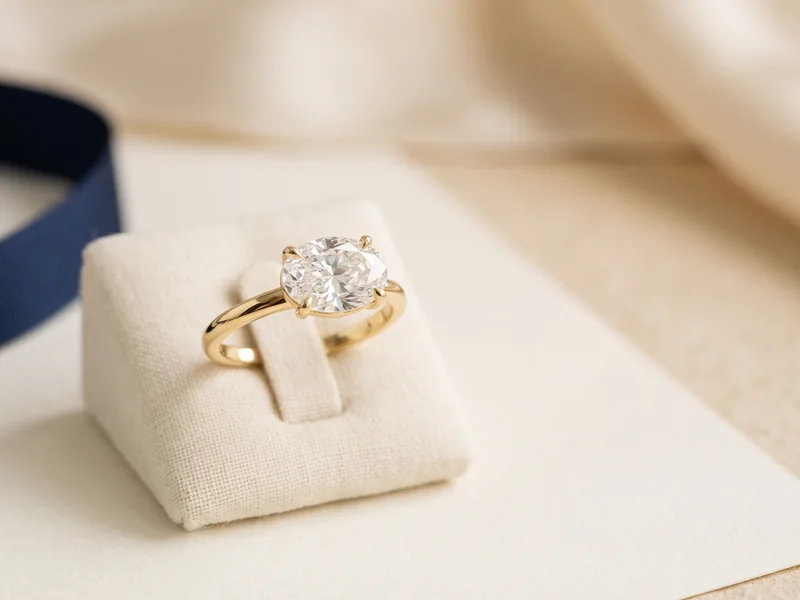
- East-west: the oval sits sideways across the finger. Lower and distinctive, with the ends facing the sides of the hand.
- Cathedral: arches of metal rise from the band to hold the head, lifting the stone and giving the ring height.
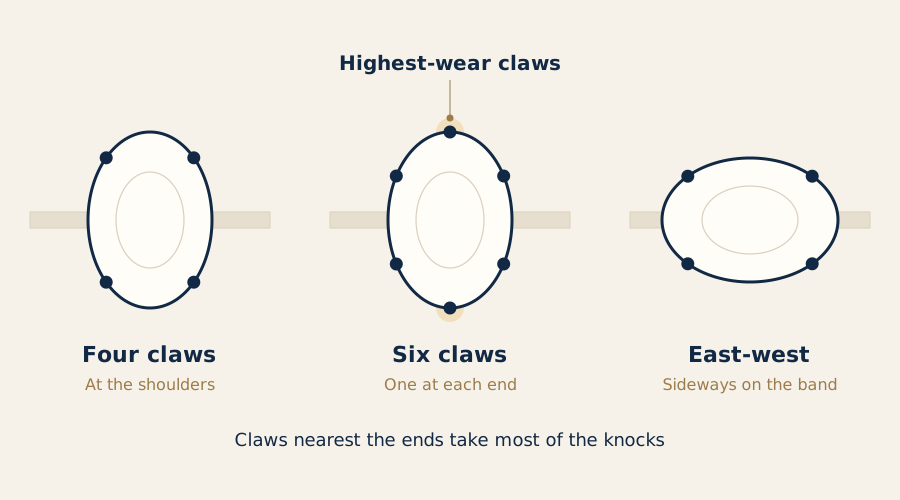
| Setting | Look | How it wears over the years |
|---|---|---|
| Four claws | Open, maximum light | Fewer claws to share knocks; check yearly and re-tip when the claw tips thin |
| Six claws | Secure, slightly busier | Load is spread, so each claw wears more slowly; ends are better protected |
| Halo | Larger, framed | Small stones and fine claws can loosen with hard wear; expect occasional tightening |
| Hidden halo | Solitaire from above | Small stones sit under the head, so they are fairly sheltered |
| Bezel | Smooth, modern | Most protective; the metal rim can dent but rarely lets go of the stone |
| East-west | Low, sideways | Low profile catches less, but the exposed ends face doorframes and benches |
| Cathedral | Tall, elegant | Higher stones catch more knocks; a lower cathedral is a good compromise |
Our guide to engagement ring setting styles covers every option in detail, and if you want height and a classic profile, see how cathedral settings lift the stone.
What colour and clarity should an oval diamond be?
Elongated shapes show colour more than rounds, and in an oval it gathers at the two ends, where the facet arrangement concentrates the stone's body colour. In white gold or platinum, most people are happy from H colour or better; if you are sensitive to warmth, consider G or higher. Longer ovals (above about 1.50) show colour at the ends more, so lean towards the better grade. In yellow or rose gold, I or J often looks just as white, because the metal warms everything around it.
For clarity, the goal is an eye-clean stone, meaning no inclusions (internal features) visible without magnification at a normal viewing distance. Brilliant faceting hides small inclusions well, so VS2 or a carefully chosen SI1 is usually enough. Check that inclusions are not sitting under a claw at the ends or right at the girdle edge. If any grading term is unfamiliar, our jewellery and diamond glossary explains it.
Oval vs round, pear, moval and elongated cushion: which is right?
| Oval | Round | Pear | Moval | Elongated cushion | |
|---|---|---|---|---|---|
| Outline | Smooth elongated curve | Circle | One round end, one point | Oval with tapered, near-pointed ends | Rectangle with rounded corners |
| Typical ratio | 1.30–1.50 | 1.00 | 1.45–1.75 | 1.50–1.80 | 1.15–1.50 |
| Bow-tie | Common | No | Common | Common | Sometimes |
| Fragile point | No | No | Yes, one | Ends are finer | No |
| Looks per carat | Larger | Smallest | Larger | Larger | Similar to round |
| Price per carat | Usually below a round | Highest | Usually below a round | Varies; less common | Usually below a round |
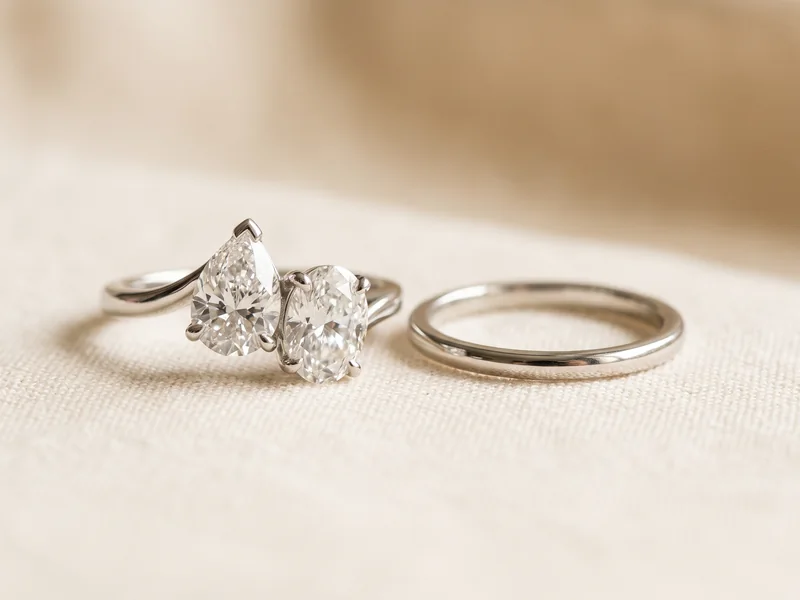
If you like the oval's length but want a point, compare it with the pear in our oval and pear comparison. The moval, a hybrid of marquise and oval, is longer and more tapered; see how the moval differs from a classic oval. For a softer rectangle with chunkier sparkle, read oval versus elongated cushion, and if you prefer straight sides and clipped corners, look at radiant cut engagement rings.
Related guideOval vs Round DiamondsWhat wedding band goes with an oval engagement ring?
Ovals are one of the easier shapes to pair with a band, because the rounded ends do not dig into a neighbouring ring the way a pear's point can. What matters most is how low the oval sits:
- Straight band, sitting flush: works when the setting is raised high enough for the band to slide underneath. Plan this when the ring is designed.
- Curved or contoured band: follows the outline of a low-set or halo oval and closes the gap.
- Diamond or eternity band: adds sparkle and suits four- and six-claw solitaires; match the metal colour and the band width (often 1.8–2.5 mm beside a 1 carat oval).
- Plain band in contrast metal: yellow gold beside platinum, for example, for a deliberate two-tone look.
Our guide to the wedding bands that suit an oval ring shows each pairing, including east-west and halo designs.
Natural or lab-grown oval engagement ring: what is the difference?
Ovals are cut from both natural and laboratory-grown diamond. A lab-grown diamond is real diamond with the same chemistry, hardness (10 on the Mohs scale) and refractive index (2.42) as a natural one; it is made in a laboratory rather than formed in the earth. The two look identical to the eye and are graded by labs such as IGI and GIA (GIA now uses a simplified descriptive system for lab-grown stones rather than its full natural-diamond scales), and both should come with an independent grading report that states their origin.
Browse natural and lab-grown oval diamonds
The difference is rarity and price. Lab-grown ovals cost much less than natural ovals and are easy to find above 2 carats. As a broad guide, a well-made 1 carat lab-grown oval stone might sit around AUD 800–2,500, while a natural 1 carat oval in G–H colour and VS clarity is more often around AUD 6,000–12,000, before the setting. Natural diamonds are rarer and some people value their geological origin; lab-grown suits people who want more size for their budget. Neither choice is wrong; it is about what matters to you.
How to choose an oval engagement ring: step by step
- Set the ratio. Decide whether you want a fuller (1.30–1.40) or slimmer (1.40–1.50) oval, using the measurements on the report.
- Check the outline. Look for even, rounded shoulders and ends that match each other.
- Watch a 360° video. Accept a soft bow-tie that moves; avoid a solid black band.
- Compare face-up size. Measure length and width, not just carat; a deep oval can look smaller than its weight suggests.
- Choose colour and clarity. H or better in white metal, I–J in yellow or rose gold; eye-clean, with nothing under the end claws.
- Pick the setting for your life. Six claws or a bezel for hands-on work, four claws for maximum light, a halo for extra presence.
- Plan the band now. Check how a wedding band will sit before the setting is finalised, then compare stones against the table and depth ranges for ovals.
Free consultation
Talk to a gemologist
Compare stones in person or online with Raj Sood, Graduate Gemologist (GIA), AJP (GIA).
Book a consultationFAQ
Common questions
Are oval engagement rings more expensive than round?
Usually not. An oval typically costs less per carat than a round of the same weight, colour and clarity, and it looks larger face-up.
What is the best ratio for an oval engagement ring?
Most people prefer 1.30 to 1.50. Around 1.35–1.45 is the classic oval; above 1.50 looks long and slim, and below 1.30 starts to look round.
Do all oval diamonds have a bow-tie?
Most have some bow-tie. A soft one that moves as the stone turns is normal; a solid black band that stays in every position is worth avoiding.
Should an oval have four or six claws?
Four claws show more diamond and a cleaner outline. Six claws add one at each end, spreading the wear and holding the stone more securely if a claw is damaged.
Can an oval be set east-west?
Yes. An east-west oval engagement ring sets the stone across the finger for a lower, more unusual look; the ends face the sides of the hand, so a sturdy claw or bezel there helps.
Are lab-grown oval diamonds real diamonds?
Yes. Lab-grown ovals are real diamond, made in a laboratory, and cost much less than natural ovals. The grading report states that the stone is laboratory-grown.

Ask a gemologist
Not sure which diamond to choose?
Raj Sood is a Graduate Gemologist (GIA) and master jeweller. Bring the stones you are considering, or send the reports, and he will tell you honestly which one is better and why.
Keep learning
Related guides
 Diamond ShapesBest Length-to-Width Ratio for an Oval Diamond?
 Wedding Bands & EternityBest Wedding Band for Oval Engagement Rings
 Diamond ShapesOval DiamondsEngagement Rings & SettingsEngagement Ring Setting Styles Guide
 Diamond ShapesOval vs Round Diamonds
 Diamond ShapesOval vs Pear DiamondsDiamond ShapesWhy Some Oval Diamonds Hide Weight
 Diamond ShapesOval vs Moval Diamonds
Explore more
More guides on this topic
Education