
- Education
- Buying Knowledge & Custom Process
- Ring Size Guide Australia: Find Your Size and Get the Fit Right
Buying Knowledge & Custom Process
Ring Size Guide Australia: Find Your Size and Get the Fit Right
A ring that spins, pinches or won't pass the knuckle spoils even a beautiful diamond. This ring size guide for Australia covers the letter system, conversions, accurate measuring and what happens if the size is wrong.
 Reviewed by Raj Sood, Graduate Gemologist (GIA), AJP (GIA)Master jeweller and Graduate Gemologist (GIA) · reviewed 4 November 2026
Quick answer
Australia uses the same letter ring sizes as the UK, with half sizes in between; each full letter adds about 1.25 mm to the inside circumference. Most women wear about J to O and most men R to V. For accuracy, get sized on metal sizers at the end of the day, in a width like your ring's.
How does the ring size guide in Australia work?
Australia uses the British letter system. Sizes run from A, the smallest (about 12.1 mm across the inside), to Z (about 22.1 mm), with sizes beyond Z written as Z+1, Z+2 and so on. Between each letter is a half size, written like M½, and some jewellers also work in quarter sizes for a very precise fit.
Each full letter adds roughly 1.25 mm to the inside circumference (the distance around the inside of the band), or about 0.4 mm to the inside diameter (the distance straight across). That sounds tiny, but a full letter is easy to feel: one size too small and the ring catches on the knuckle, one too large and it turns so the stone sits sideways.
The US and Canada use numbers instead (US 7 is about an Australian N to N½), and most of Europe uses the inside circumference in millimetres, so an EU 54 is a ring about 54 mm around. Our guide to how Australian sizes compare with US, UK and EU goes through each system. If any term here is new, the GemTrove jewellery glossary explains it, and sizing is one step in our wider engagement ring buying guide.
Ring size guide Australia: what size am I in millimetres?
Use this Australian ring size chart if you know the inside diameter or circumference of a ring that already fits. Measure the ring that fits the same finger, not just any ring, because fingers on the same hand can differ by a full size or more.
| Australian size | Inside diameter | Inside circumference |
|---|---|---|
| H | about 14.9 mm | about 46.8 mm |
| I | about 15.3 mm | about 48.0 mm |
| J | about 15.7 mm | about 49.3 mm |
| K | about 16.1 mm | about 50.6 mm |
| L | about 16.5 mm | about 51.8 mm |
| M | about 16.9 mm | about 53.1 mm |
| N | about 17.3 mm | about 54.3 mm |
| O | about 17.7 mm | about 55.6 mm |
| P | about 18.1 mm | about 56.8 mm |
| Q | about 18.5 mm | about 58.1 mm |
| R | about 18.9 mm | about 59.3 mm |
| S | about 19.3 mm | about 60.6 mm |
| T | about 19.7 mm | about 61.8 mm |
| U | about 20.1 mm | about 63.1 mm |
| V | about 20.5 mm | about 64.3 mm |
| W | about 20.9 mm | about 65.6 mm |
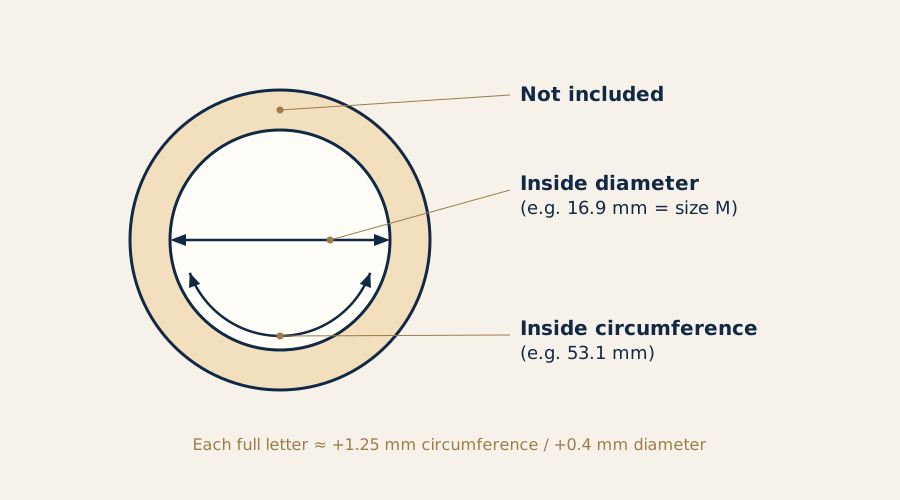
Charts from different jewellers can vary by up to half a size, because sizing sticks (called mandrels, the tapered rods rings are measured on) are made to slightly different standards. Treat any chart as a starting point, then confirm on a proper sizer.
As for the average ring size in Australia, most women's engagement ring fingers sit between about J and O, with L to N very common. Most men fall between R and V, though larger hands often need W or beyond. These are broad patterns, not targets: your size is simply your size. Our men's ring sizing guide covers wider bands and larger knuckles in detail.
How do Australian ring sizes convert to US and EU sizes?
This matters when you are comparing a ring online from an overseas seller, or a family ring bought abroad. Roughly, every two Australian letters equals one US whole size.
| Australia / UK | US / Canada | EU (circumference, mm) |
|---|---|---|
| H | 4 | 47 |
| I | 4½ | 48 |
| J | 5 | 49 |
| K | 5½ | 51 |
| L | 6 | 52 |
| M | 6½ | 53 |
| N | 7 | 54 |
| O | 7½ | 56 |
| P | 8 | 57 |
| Q | 8½ | 58 |
| R | 9 | 59 |
| S | 9½ | 61 |
| T | 10 | 62 |
| U | 10½ | 63 |
| V | 11 | 64 |
| W | 11½ | 66 |
Conversions are never perfectly exact, because each system steps up by a slightly different amount. A US half size is about 1.27 mm of circumference, an Australian full letter about 1.25 mm, so the two drift apart over the range. Our interactive ring size converter does the maths for you, including half and quarter sizes, but if a ring is being made to order, quote your size in millimetres as well as the letter so nobody has to guess.
How do you measure your ring size accurately?
There are five common ways to find a ring size. They are not equally reliable.
| Method | Accuracy | What to watch |
|---|---|---|
| Metal ring sizers at a jeweller | High (to a quarter or half size) | Ask for a sizer in a similar width to your ring |
| Existing ring on a mandrel | High, if it fits the same finger | The ring must be comfortable, not just wearable |
| Measuring a ring's inside diameter with a ruler | Fair (about ±½ size) | A 0.4 mm misread is a full letter |
| Plastic adjustable sizer | Fair | Can be pulled too tight; repeat a few times |
| String or paper around the finger | Poor | Stretches, and ignores the knuckle |
The most accurate option is a set of metal ring sizers: rigid sample bands in every half size. You slide them over the knuckle exactly as a real ring would go on, so you feel both how easily it passes the knuckle and how secure it sits at the base of the finger. String and paper only measure the base of the finger, which is why they so often produce a ring that won't go on.
If you can't get to a jeweller, our guide to measuring your ring size at home explains how to get a reasonable result with a ruler and a ring that already fits, and how to reduce the usual errors.
Not sure which one is right?
Send us the stones you are looking at and our gemologist will tell you which to choose and why.
What affects ring fit: band width, temperature and knuckles?
Two people with the same finger measurement can need different sizes. These are the factors a good fitting accounts for:
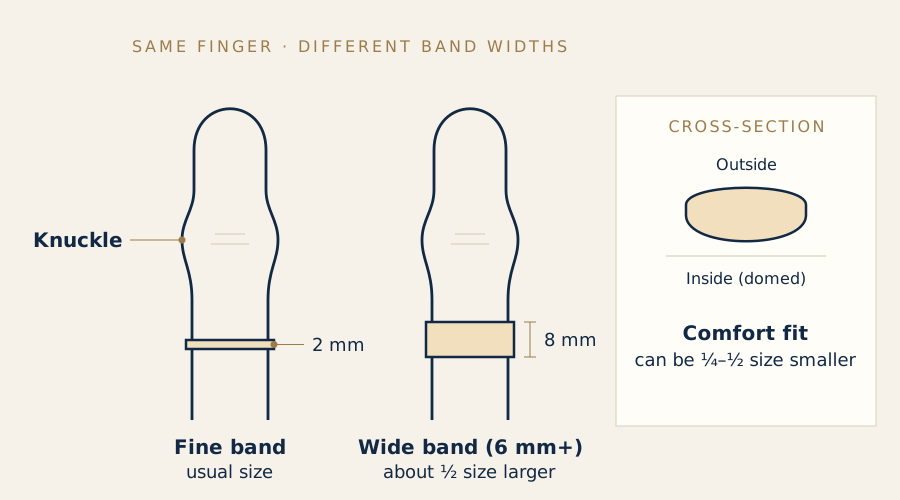
- Band width: a wide band covers more skin, so it feels tighter. For bands about 6 mm or wider, most people go up a half size; for a fine 1.5–2 mm band, the measured size usually suits.
- Comfort fit: a band domed on the inside slides over the knuckle more easily and can often be a quarter to half size smaller than a flat-inside band.
- Temperature: fingers swell in heat and shrink in cold. A Melbourne winter morning and a humid summer evening can differ by a half size or more.
- Time of day: fingers are often slimmest first thing in the morning and fuller by evening, after activity, salty food or a drink.
- Knuckles: if your knuckle is much larger than the base of your finger, size to the knuckle and keep the ring upright with sizing beads or a sizing bar inside the band.
- Which hand: the dominant hand is often slightly larger, so measure the hand the ring will actually be worn on.
Finger size also changes how a stone looks. The same diamond appears larger on a size J finger than on a size P, so try the diamond size visualiser for each shape and check face-up millimetres on our mm-to-carat chart for every shape. If you're weighing up a larger centre, the guide to lab-grown diamond sizes from 1 to 5 carats shows how each weight sits on a hand. The same warm-versus-cold rule applies to bangles too, covered in our bracelet sizing guide.
How can you find a ring size for a surprise proposal?
You can't use a sizer without giving the game away, so the aim is a close estimate that can be adjusted later. The most reliable options, in order:
- Borrow a ring she already wears on the ring finger for an hour and have a jeweller measure it on a mandrel. A ring from another finger is far less useful.
- Trace or press a ring: trace the inside of the band on paper, or press it into a bar of soap, for the inside diameter.
- Ask a close friend or family member who knows her size, or can find out naturally.
- Estimate from her other jewellery or her height and build only as a last resort; this can be out by two sizes.
If you have to guess, guess slightly large. Making a ring smaller is usually simpler than making it bigger, and a slightly loose ring can be worn safely on a chain or a larger finger until it is resized. Our guide to estimating a ring size without asking has more discreet ideas.
Related guideHow to Estimate Ring Size for a Surprise ProposalCan a ring be resized, and what does ring resizing cost in Australia?
Most gold and platinum rings can be resized. A jeweller cuts the band (the shank) at its base, then removes a small section to go smaller or adds metal to go bigger, solders or welds it closed and repolishes. Small changes of a size or so can sometimes be done by stretching or compressing a plain band instead. The design decides how far you can go.
| Ring type | Can it be resized? | Approximate cost (AUD) |
|---|---|---|
| Plain gold band | Yes, usually up or down about 2 sizes easily | about $60–$150 |
| Platinum band | Yes, needs platinum welding | about $100–$250 |
| Claw-set solitaire | Yes, usually; claws are checked afterwards | about $80–$200 |
| Half-eternity or stones down the shoulders | Often, within about 1 size; stones near the cut can loosen | about $150–$350 |
| Full eternity band | Rarely; usually remade in the new size | quoted individually |
| Tungsten, ceramic | No; replaced rather than resized | replacement cost |
| Titanium | Very limited | quoted individually |
White gold usually needs rhodium replating after resizing (rhodium is the bright white metal coating most white gold carries), which adds to the cost. Engraving inside the band can be cut through, and a large resize can thin the shank or distort the setting, which is why a ring more than two or three sizes out is sometimes better rebuilt. That is also why full eternity bands and tungsten rings are worth sizing carefully before you order.
If a ring is being made for you, the size goes on the design from the start. Include it, in letters and millimetres, when you put together a clear engagement ring design brief, and check the band width and finger size on the drawing as you read the CAD render (CAD is the computer model of your ring). Resizing costs sit alongside the stone in your budget; our Australian diamond price guide covers the bigger numbers.
Create your ring or book a resize
Does ring size matter when buying overseas, claiming TRS or insuring a ring?
Sizing feels like a small detail until a ring has crossed a border or needs an insurance claim. Three situations catch people out:
- Buying overseas: a ring bought abroad will be sized in that country's system, and resizing it back home is an extra cost and an extra job for a jeweller who didn't make it. GST and possibly duty can also apply when you bring it in. Our guide on buying a diamond overseas versus at home covers the full picture.
- The Tourist Refund Scheme (TRS): if you're leaving Australia with a ring bought here, TRS lets you claim back the GST when you spend AUD 300 or more (GST included) with one business within 60 days of departure. The ring must leave with you, usually worn or in hand luggage, so any resizing has to be finished before you fly, not after.
- Insurance: a valuation records the metal, weight and stones. A resize changes the metal weight slightly and may change the description, so ask for the valuation to be updated and tell your insurer. Many policies also expect reasonable care, so wearing a ring you know is loose can complicate a claim for loss; check your product disclosure statement.
Our explainer on how jewellery insurance works in Australia goes through valuations, agreed value and claims. The same sizing rules apply whether the centre is natural or laboratory-grown; if you are comparing costs, see the lab-grown diamond prices in Australia.
How to use this ring size guide in Australia: step by step
- Choose the finger and hand. Measure the exact finger the ring will be worn on.
- Pick the right time. Measure at the end of the day, at a comfortable room temperature, not straight after exercise or a hot shower.
- Use metal sizers if you can. Ask for a sizer in a similar width to the ring you want. It should pass the knuckle with slight resistance and not spin at the base.
- Repeat on another day. Two or three readings that agree are worth far more than one.
- Adjust for the band. Go up about a half size for bands 6 mm or wider; consider a slightly smaller size for comfort-fit bands.
- Record it in two systems. Write down the Australian letter and the inside circumference in millimetres.
- Choose the stone with the size in mind. Use a focused diamond shortlist and judge each stone from its 360-degree video, thinking about how its millimetre size will sit on your finger.
- Check the fit when the ring arrives. Wear it for a few days, warm and cold, before deciding whether it needs adjusting.
Free consultation
Talk to a gemologist
Compare stones in person or online with Raj Sood, Graduate Gemologist (GIA), AJP (GIA).
Book a consultationShop this shape
FAQ
Common questions
What is the average ring size for women in Australia?
Most women's ring fingers in Australia fall between about J and O, with L to N very common. Your own size can sit well outside that range, so always measure rather than assume.
Are Australian ring sizes the same as UK sizes?
Yes. Australia uses the British letter system, A to Z with half sizes, so an Australian M is a UK M. US sizes use numbers and EU sizes use the inside circumference in millimetres.
What ring size am I if I'm a US 7?
A US 7 is about an Australian N to N½, with an inside circumference of roughly 54.4 mm. Charts vary by up to half a size, so confirm on a sizer if you can.
Should an engagement ring be tight or loose?
It should slide over the knuckle with slight resistance and sit snugly at the base of the finger without spinning. If it leaves a deep mark or you can't get it off, it is too small.
How much does ring resizing cost in Australia?
A plain gold band typically costs about AUD 60–150 to resize, while platinum, stone-set shoulders and white gold that needs replating cost more. Full eternity bands and tungsten rings usually can't be resized.
How many sizes can a ring be resized?
Most plain gold and platinum rings can go up or down about two sizes without trouble. Beyond that, or on stone-set bands, the ring may need extra metal, a new shank or a remake.

Ask a gemologist
Not sure which diamond to choose?
Raj Sood is a Graduate Gemologist (GIA) and master jeweller. Bring the stones you are considering, or send the reports, and he will tell you honestly which one is better and why.
Keep learning
Related guides
 Buying Knowledge & Custom ProcessHow to Measure Your Ring Size at Home
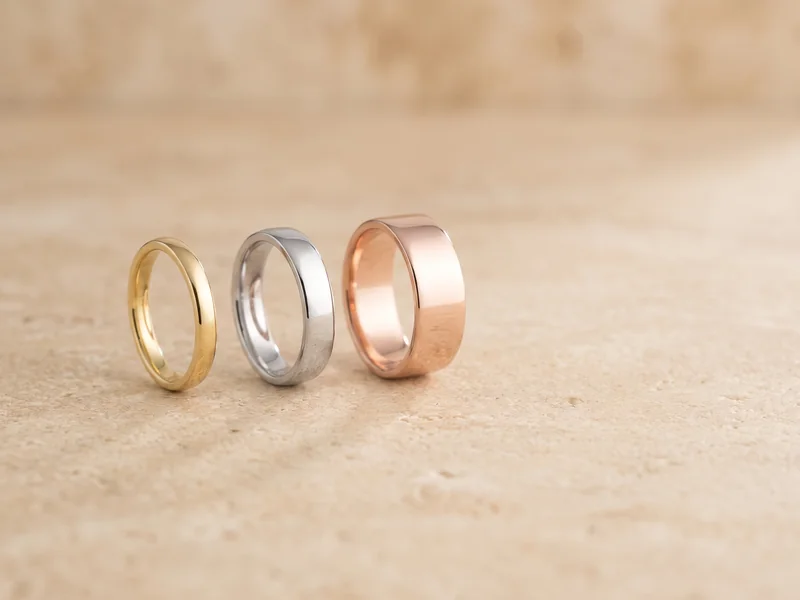 Buying Knowledge & Custom ProcessAustralian Ring Sizes vs US, UK and EU
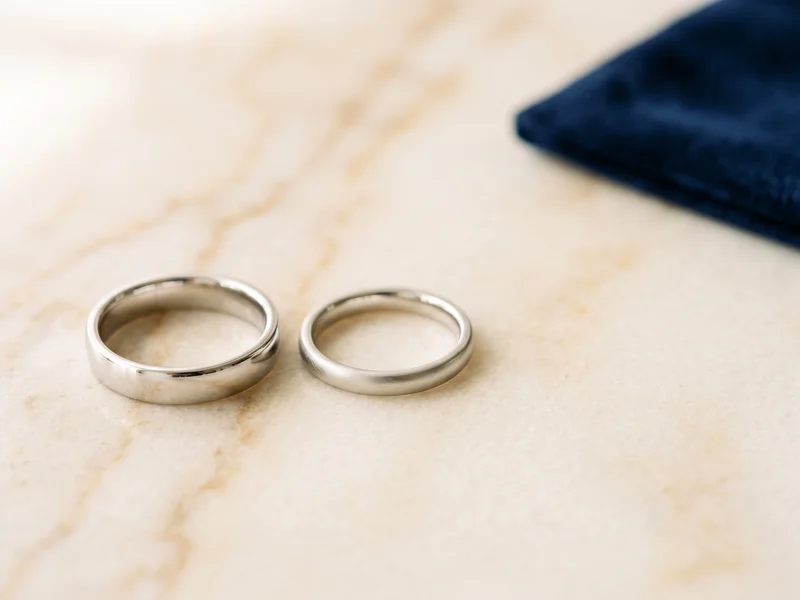 Buying Knowledge & Custom ProcessMen's Ring Size Guide
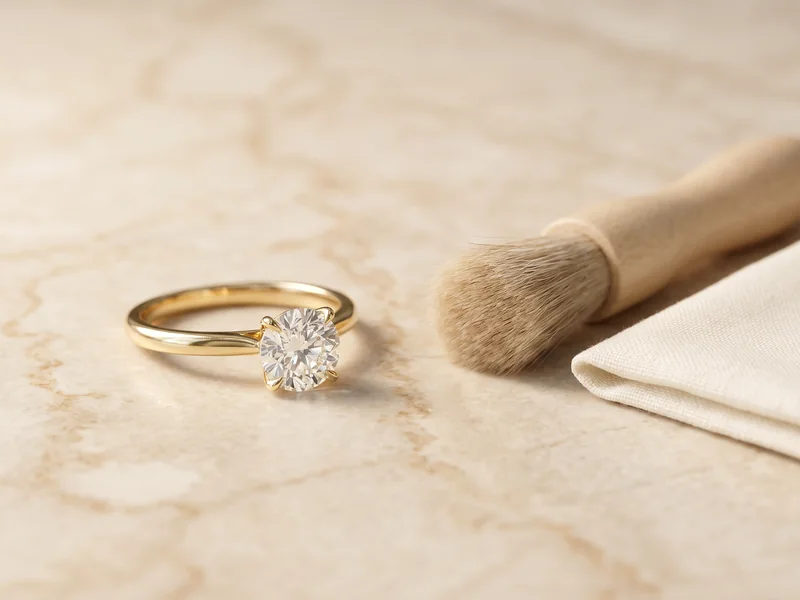 Buying Knowledge & Custom ProcessHow to Estimate Ring Size for a Surprise ProposalBuying Knowledge & Custom ProcessEngagement Ring Buying Guide
 Buying Knowledge & Custom ProcessDiamond Price Guide AustraliaBuying Knowledge & Custom ProcessBuying a Diamond Overseas vs in Australia
 Buying Knowledge & Custom ProcessLab-Grown Diamond Price Guide Australia
Explore more
More guides on this topic
Education