
Pearls
Mabe Pearl Guide: How Half Pearls Are Made, Graded, Set and Cared For
A mabe pearl gives you a large dome of pearl for much less than a round pearl of similar size. It is built differently, though, so it needs a different setting and gentler care.
 Reviewed by Raj Sood, Graduate Gemologist (GIA), AJP (GIA)Master jeweller and Graduate Gemologist (GIA) · reviewed 4 November 2026
Quick answer
A mabe pearl is a cultured half pearl grown against the inside of an oyster's shell, not inside its body. A dome-shaped nucleus is glued to the shell, the oyster coats it in nacre, then the dome is cut out, filled and backed with mother-of-pearl. It is real pearl nacre, assembled, with a flat back for setting.
What is a mabe pearl?
A mabe pearl (said MAH-bay) is a cultured blister pearl: a pearl that grows attached to the inside of the shell instead of loose in the oyster's soft tissue. The farmer glues a half-round nucleus (the form the pearl grows over) to the inner shell wall, and the oyster slowly covers it with nacre. Nacre is the layered mix of aragonite crystals and an organic binder called conchiolin that makes up every pearl, and the same material lines the shell as mother-of-pearl.
The name comes from mabe-gai, the Japanese name for the penguin wing oyster (Pteria penguin), the species first used to grow these pearls commercially. Today the word covers cultured half pearls from several oysters, including Australia's silver-lipped pearl oyster. If the difference between natural and cultured pearls is new to you, start there; mabes sit firmly on the cultured side.
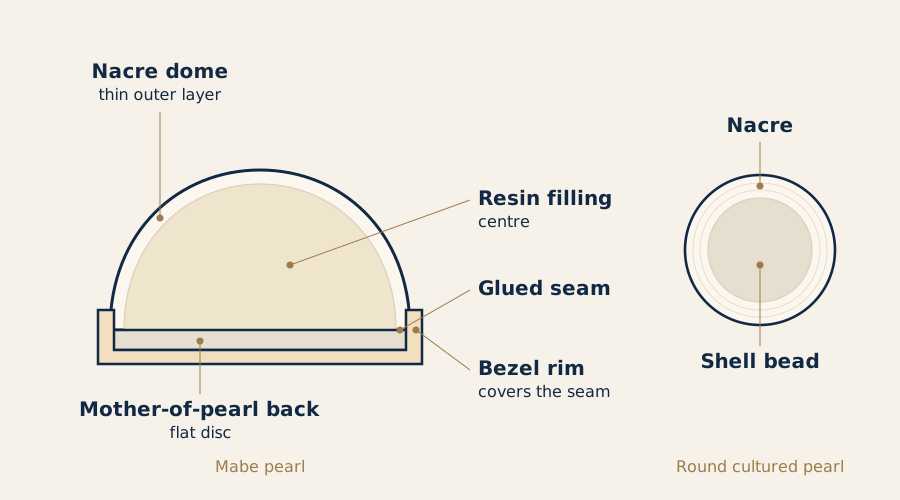
Once the nacre is thick enough, the dome is cut from the shell, the nucleus is removed, the hollow is filled with resin and a disc of mother-of-pearl is glued over the back. That makes a mabe an assembled cultured pearl, and trade guidelines such as the CIBJO Pearl Book expect it to be described that way. It is real pearl on the face, not an imitation, but it is not solid pearl all the way through.
Because the visible face is nacre, a mabe shares the physical properties of other pearls: a Mohs hardness of about 2.5–4.5 (softer than the quartz dust in everyday grime, which sits at 7), a refractive index of about 1.53–1.68 for the aragonite, and sensitivity to acids, perfume and heat. The difference is underneath. The filling and the glued back behave like any adhesive joint, which is why mabes need slightly stricter care than round pearls. For a map of where mabes sit among all the other pearl types, see how to tell the main pearl types apart, and any unfamiliar word here is in our A–Z jewellery glossary.
How are mabe pearls made?
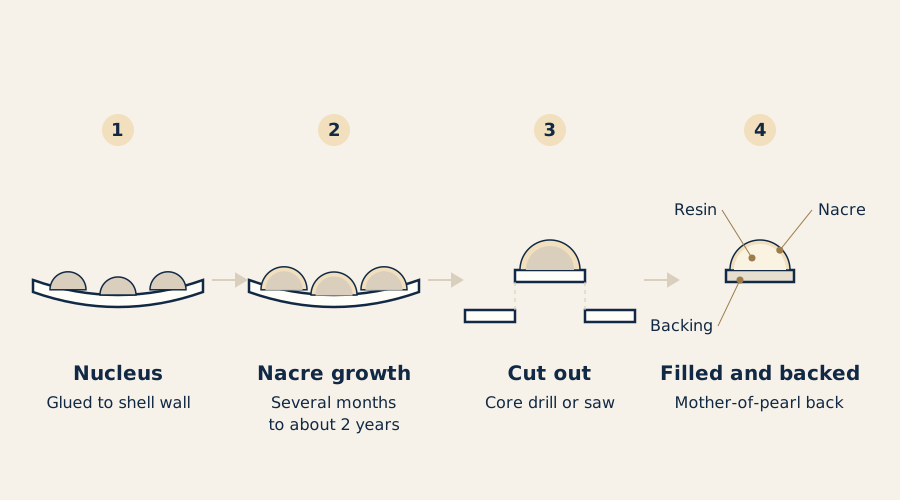
Mabe culturing is simpler than growing a round pearl, because nothing is implanted inside the oyster's body. The broad process is much the same from Japan to Western Australia:
- Choosing the nucleus: half-domes of plastic, resin, soapstone or shell, usually about 10–20 mm across. The farmer picks the outline, so round, oval, teardrop and heart shapes are all possible.
- Attaching it: the live oyster is opened slightly and several nuclei, often three to five depending on the shell size, are glued to the inner shell wall away from the muscle.
- Growing: the oyster goes back into the sea and lays nacre over the domes, usually for somewhere between several months and about two years.
- Harvesting: the shell is opened and each dome is cut out with a core drill or saw, taking a ring of surrounding shell with it.
- Assembling: the nucleus is removed, the hollow is cleaned and filled with resin, a mother-of-pearl backing is glued on, and the edge is ground and polished smooth.
Because the farmer controls the outline, mabes come in neat, repeatable shapes that make matched earrings easy. Because they grow against the shell wall, they can be far larger than a round pearl from the same oyster, and much quicker to produce. The trade-off is the nacre layer, which is usually thin, often a fraction of a millimetre to about 1 mm, laid over a dome that was hollowed out after harvest.
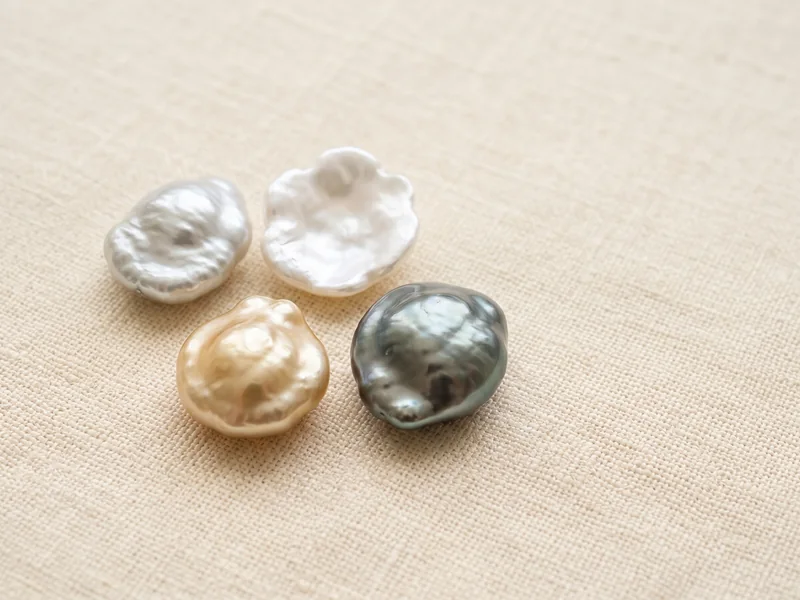
Mabes are not the only by-product of pearl farming. When an implanted round-pearl nucleus is rejected, the oyster can still form a small solid pearl of pure nacre; those are keshi pearls, which form without any nucleus, and they are almost the opposite of a mabe: small, irregular and solid nacre right through.
Which oysters produce mabe pearls, including Australian mabe pearls?
Any oyster with a large, flat inner shell can carry a mabe, but four sources supply most of what you will see in jewellery:
| Mollusc | Main sources | Typical colour | Typical size |
|---|---|---|---|
| Penguin wing oyster (Pteria penguin) | Japan (Amami Islands), Southeast Asia | Silver to grey with strong rainbow overtones | about 10–16 mm |
| Silver-lipped or gold-lipped pearl oyster (Pinctada maxima) | Northern Australia, Indonesia, the Philippines | White, silver and cream; golden from gold-lipped shells | about 12–20 mm |
| Black-lipped pearl oyster (Pinctada margaritifera) | French Polynesia, Cook Islands | Grey to near-black with green, aubergine or peacock overtones | about 12–18 mm |
| Freshwater mussels (Hyriopsis species) | China | White, pastel pink and lavender; often dyed | about 10–20 mm |
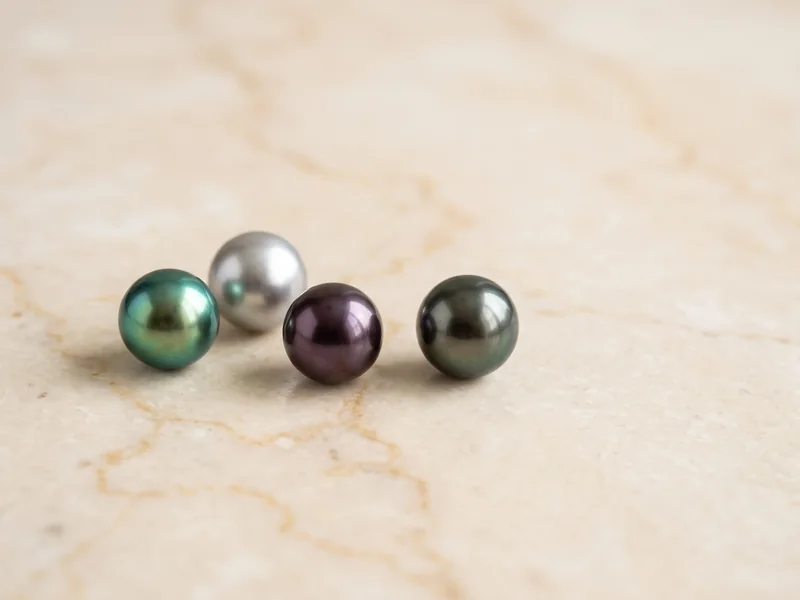
The penguin wing oyster gives the classic Japanese mabe, prized for an iridescent, rainbow-like overtone (a second colour that floats over the body colour). The black-lipped oyster that grows dark Tahitian pearls produces mabes with the same moody greens and purples. Chinese mussels are the source of most low-priced half pearls, and they share their character with freshwater pearls grown in Chinese mussels: pale natural colours and frequent dyeing, which should always be disclosed.
Australian mabe pearls belong to a much older story. From the 1880s, pearling luggers worked the Kimberley coast around Broome for wild silver-lipped oysters, valued then mainly for their mother-of-pearl shell, which was made into buttons, knife handles and inlay. Cultured pearl farming arrived in the 1950s, beginning at Kuri Bay, and Australia is now known for large, lustrous pearls from Pinctada maxima. Mabes grown in these shells, often on oysters that have finished producing round pearls, carry the same satiny silver-white nacre. Read more about Broome's pearling history and its South Sea pearls, and about the round pearls from the same species in our guide to white and golden South Sea pearls.
The small Akoya oyster that grows classic round Akoya pearls is rarely used for mabes, because its shell is too small to carry a sizeable dome.
Mabe pearl vs blister pearl, keshi and round pearls: what's the difference?
People often use mabe and blister pearl as if they mean the same thing. They overlap, but they are not identical. Here is how a mabe compares with its closest relatives:
| Mabe pearl | Natural blister pearl | Keshi pearl | Round cultured pearl | |
|---|---|---|---|---|
| How it forms | Cultured: dome glued to inner shell | Natural: irritant or growth against the shell | Cultured by-product, no nucleus | Cultured: bead implanted in the oyster's body |
| Shape | Regular dome chosen by the farmer | Irregular, one-off | Irregular, often petal-like | Round to near-round, also baroque |
| Inside | Resin filling after the nucleus is removed | Often shell or a hollow | Solid nacre | Shell bead under the nacre |
| Back | Flat mother-of-pearl, glued on | Cut from the shell | Fully nacreous | Fully nacreous |
| Drilled | No, set by its edge | No, usually set | Yes, can be strung | Yes, strung or half-drilled |
| Typical use | Earrings, pendants, rings, brooches | Collector and art jewellery | Strands, earrings, clusters | Strands, studs, pendants |
| Relative price | Low for its size | Varies widely | Moderate to high | Higher, rising steeply with size |
A blister pearl is any pearl attached to the shell. Natural blisters form by accident when something lodges against the shell wall, and they come out irregular and one of a kind. A mabe is a cultured blister that has been cut out, filled and backed, so the word mabe on a label should tell you two things: it was farmed, and it was assembled.
A round cultured pearl is a whole sphere of nacre over a shell bead. That is why a 14 mm round South Sea pearl and a 14 mm mabe look similar face-up in a bezel, yet sit at very different prices: the round pearl took years inside the oyster, only some come out round, and it can be drilled and strung.
Not sure which one is right?
Send us the stones you are looking at and our gemologist will tell you which to choose and why.
How are mabe pearls graded?
There is no single international grading scale for mabes. Dealers judge them on the same factors used for round pearls, set out in our guide to how lustre, nacre, surface, shape and size are graded, with one extra check that matters only for assembled pearls: the quality of the assembly itself.
| Factor | What good looks like | Warning signs |
|---|---|---|
| Lustre | Sharp, mirror-like reflections across the dome | Chalky or milky look, often a sign of thin nacre |
| Colour and overtone | Even body colour; rainbow, pink or silver overtone | Patchy colour, dark or yellow areas showing through |
| Surface | Clean dome with few small marks | Pits, bumps, scratches or fine cracks |
| Shape | Symmetrical dome of even height | Lopsided dome, flat spots, uneven outline |
| Assembly | Tight, even seam and a clean backing | Gaps, glue smears, lifting edges, yellowing at the join |
| Size | Measured in millimetres across the face | Size alone does not show quality |
Lustre is the best single clue to nacre quality. Thin or poorly formed nacre over a hollow dome looks flat and slightly glassy, while healthy nacre throws back crisp reflections. Colour should look natural for the oyster in the table above; a vivid pink, blue or purple mabe from freshwater mussels has almost certainly been dyed, which is acceptable as long as it is disclosed.
Are mabe pearls real, and are they durable for everyday wear?
Yes, mabe pearls are real cultured pearls: the dome you see was grown by a living oyster. What makes them different is that they are assembled. Imitations do exist, such as domes of shell, glass or plastic with a pearly coating, and these should be sold as imitation, never as mabe. A gemmologist can usually tell them apart with magnification, and a genuine mabe's nacre shows a fine, layered structure at its edge.
Durability is where honesty matters. A mabe has three weak points:
- The thin dome: the nacre sits over resin, not solid pearl, so a sharp knock can crack or dent it.
- The glued seam: heat, steam, solvents and long soaking can weaken the adhesive and let the back lift.
- Soft nacre: at 2.5–4.5 on the Mohs scale, the face scratches easily against harder stones, metal and grit.
That is why earrings, pendants and brooches suit mabes so well: they sit away from the knocks the hands take. A mabe pearl ring can last for years if it is worn with care and taken off for gardening, gym work and cleaning, but it is a better choice for occasional wear than for a daily ring. If you want a pearl for a June birthday, mabe earrings are an approachable way into the stone; our guide to pearl as a June birthstone compares it with moonstone and alexandrite.
Related guideTypes of Pearls and Pearl Identification GuideWhat jewellery suits a mabe pearl: earrings, rings or pendants?
A mabe cannot be drilled and strung, so it is always set by its edge, usually in a bezel (a continuous rim of metal that wraps the stone). A good bezel does two jobs: it holds the pearl and it covers the glued seam, protecting it from knocks, water and skin oils. Common designs include:
- Mabe pearl earrings: clip-ons and posts with domes of about 10–16 mm, the most popular use. Larger domes are light for their size, because the centre is resin, not solid pearl.
- Pendants: a single large dome, often 15–20 mm, in a plain or diamond-edged bezel.
- Rings: the dome sits flat on top of the finger, a little like the face of a flat-topped signet ring. A raised bezel lip helps protect the edge.
- Brooches and inlay pieces: mabes pair well with flat stones such as deep blue lapis lazuli, onyx or mother-of-pearl.
Mabes look softer and more relaxed than a strand, which makes them easy to layer. A mabe pendant worn above a fine diamond tennis necklace gives a mix of glow and sparkle. For strands, studs and bespoke work, see our pearl jewellery, strands and custom pearl designs.
How much is a mabe pearl worth in Australia?
Mabe pearl value depends on the oyster, the size, the lustre, the quality of the assembly and, above all, the metal and setting around it. The pearl itself is usually a modest part of the price. These are broad, approximate ranges only:
| Piece | Approximate price range (AUD) |
|---|---|
| Loose mabe, 12–16 mm, commercial quality | about $20–$200 |
| Mabe pearl earrings in sterling silver | about $80–$400 |
| Mabe pendant in 9ct or 18ct gold | about $300–$1,500 |
| Mabe ring in 18ct gold, with or without diamonds | about $800–$3,000+ |
| Round South Sea pearl of similar size, single pearl | often several times the price of a mabe |
Japanese penguin wing mabes with strong rainbow overtones and Australian Pinctada maxima mabes with fine lustre sit towards the top of the loose-pearl range. Dyed freshwater half pearls sit at the bottom. A mabe is chosen for how it looks and wears, not as a store of value; like most pearls, it is a jewellery purchase first.
Shop natural gemstones
How do you care for mabe pearl jewellery?
Mabe pearl care follows the usual pearl rules, with extra caution for the adhesive:
- Last on, first off: put mabes on after perfume, hairspray and sunscreen, and take them off before swimming, showering or exercise.
- Wipe, don't soak: after wearing, wipe the face with a soft, slightly damp cloth and let it dry flat. Never soak a mabe, because water can creep into the seam.
- No machines: keep mabes out of ultrasonic cleaners and steamers, and away from heat sources such as a jeweller's torch or a hot car dashboard.
- Store separately: keep each piece in a soft pouch so diamonds and metal cannot scratch the dome.
- Check the seam: a few times a year, look for lifting, a dark line or yellowing at the edge, which mean the piece needs a jeweller.
Older mabes sometimes show a yellow or brown tint through the dome as the resin ages, and occasionally a backing comes loose. Re-setting in a fresh bezel can often save the piece, but a cracked dome cannot be repaired. Mabes are not strung, yet they often appear in pieces alongside strung pearls, which we restring in our Melbourne workshop. Our guide to caring for and restringing pearls covers cleaning, storage and how often a strand needs new silk.
How to choose a mabe pearl: step by step
- Check the description. It should say mabe or assembled cultured blister pearl, name the oyster or water type, and disclose any dyeing.
- Look at the lustre. Turn the piece under a light; the dome should show crisp reflections, not a chalky haze.
- Inspect the surface. Look for cracks, dents and deep pits, especially near the edge of the dome.
- Turn it over. The back and seam should be clean and tight, with no gaps, glue lines or yellowing.
- Check the setting. The bezel should sit evenly all the way round, cover the seam and hold the pearl without movement.
- Match the piece to how you'll wear it. Choose earrings or a pendant for everyday use; save a mabe ring for occasions, or choose a high protective bezel.
Free consultation
Talk to a gemologist
Compare stones in person or online with Raj Sood, Graduate Gemologist (GIA), AJP (GIA).
Book a consultationShop this shape
FAQ
Common questions
What is a mabe pearl?
A mabe pearl is a cultured half pearl grown against the inside of an oyster's shell. After harvest the dome is filled with resin and backed with mother-of-pearl, so it is an assembled pearl with a flat back.
Are mabe pearls real pearls?
Yes. The dome is genuine nacre grown by an oyster, so a mabe is a real cultured pearl. It is assembled rather than solid, and it should always be described as mabe or assembled.
What is the difference between a mabe pearl and a blister pearl?
A blister pearl is any pearl attached to the shell, and natural blisters form by chance in irregular shapes. A mabe is a cultured blister grown over a chosen nucleus, then cut out, filled and backed.
Why are mabe pearls cheaper than round pearls?
Mabes grow faster, the farmer controls their shape and several can grow on one shell, while round pearls take longer and only some come out round. The mabe's thin nacre over a resin centre also makes it less durable than a solid pearl.
Can you wear a mabe pearl ring every day?
You can, but it needs care, because the dome is soft and can crack if knocked. Earrings and pendants suit daily wear better; take a mabe ring off for sport, gardening and cleaning.
Can a mabe pearl be repaired?
A loose or yellowed piece can often be reset in a new bezel, and sometimes the backing can be re-secured. A cracked or dented dome cannot be repaired and the pearl would need replacing.

Ask a gemologist
Not sure which diamond to choose?
Raj Sood is a Graduate Gemologist (GIA) and master jeweller. Bring the stones you are considering, or send the reports, and he will tell you honestly which one is better and why.
Keep learning
Related guides
Explore more
More guides on this topic
Education