
- Education
- Certificates & Valuations
- GSI and EGL Diamond Reports: What to Know Before You Rely on One
Certificates & Valuations
GSI and EGL Diamond Reports: What to Know Before You Rely on One
GSI and EGL diamond reports turn up on second-hand rings, overseas listings and jewellery-store diamonds. Knowing how strict each lab is, and how to check a report, stops a grade on paper from setting the price of a stone that does not match it.
 Reviewed by Raj Sood, Graduate Gemologist (GIA), AJP (GIA)Master jeweller and Graduate Gemologist (GIA) · reviewed 4 November 2026
Quick answer
GSI (Gemological Science International) and EGL (European Gemological Laboratory) are independent labs that grade diamonds, but many in the trade find their colour and clarity grades softer than GIA's, often by one grade or more. GSI and EGL diamond reports are still useful records; verify the number online, check the inscription and compare price to GIA- or IGI-graded stones.
What are GSI and EGL diamond reports?
A diamond grading report (often called a certificate) is a document from an independent laboratory that records a diamond's measurements, weight, colour, clarity and, for round brilliants, cut. It does not put a dollar value on the stone. That is the job of a valuation, which is a different document; our guide to the difference between certificates, reports and valuations explains how they fit together.
GSI stands for Gemological Science International and EGL for European Gemological Laboratory. Both are commercial labs, independent of the stores that sell the diamonds, and both use the familiar D–Z colour scale and FL–I3 clarity scale that GIA (the Gemological Institute of America) developed. The words on the page look the same as on a GIA report. The difference is in how strictly those grades are applied.
That matters because a diamond's price is set largely by its grades. If one lab calls a stone G colour and another would call it I, the two reports describe the same diamond but imply very different prices. To see where GSI and EGL sit among all the main labs, start with our side-by-side comparison of diamond grading labs. Any grading term you have not met before is defined in our plain-English jewellery glossary.
Who is GSI and is it a good diamond lab?
GSI was founded in New York in 2005. It has grown quickly and now runs labs in several countries, including the United States, India, Israel and Belgium. Much of its work comes from large jewellery manufacturers and chain stores, particularly in North America, so a GSI diamond report is common on mass-produced engagement rings, tennis bracelets and studs set with smaller diamonds.
GSI grades both natural and laboratory-grown diamonds and offers several report formats, from full grading reports with a clarity plot to short jewellery reports that describe a whole finished piece. Its reports are clearly laid out, carry a report number, and the stone is usually laser-inscribed on the girdle (the thin outer edge) with that number.
So is GSI a good diamond lab? It is a legitimate, established laboratory with real gemmological equipment and staff. The concern is consistency of grading rather than honesty. Dealers who regularly compare stones commonly describe GSI colour and clarity grades as running about one grade softer than GIA's, sometimes more on larger or borderline stones. That is not universal, and individual stones vary, but it is the reason a GSI-graded diamond usually trades below a GIA-graded stone with the same grades on paper.
If you want to see what a strict report looks like for comparison, our walk-through on reading each section of a GIA report and our explainer on what an IGI natural diamond report covers use the same layout points you will find on a GSI document.
What is EGL and is EGL certification reliable?
EGL began in Antwerp in 1974 and was one of the first labs to issue reports for smaller diamonds and for the mid-market. It is best understood not as one lab but as a name used by several separately run labs. Over the years there have been EGL International, EGL USA, EGL Israel, EGL South Africa and other branches, with different owners and, crucially, different grading standards. An EGL diamond certificate from one branch could be far stricter, or far looser, than one from another.
EGL was also the lab that introduced the SI3 clarity grade in the 1990s, sitting between SI2 and I1. GIA and most other labs never adopted it. If you see SI3 on a report, you know it is EGL (or a lab copying EGL), and a GIA grader would usually call that stone I1.
Reliability became a public issue in 2014, when RapNet, one of the largest online diamond trading networks, stopped listing EGL-graded diamonds after widespread concerns about overgrading (grades written higher than the stone deserves). Trade comparisons at the time described some EGL branches as two or more grades generous on colour and clarity. Several branches have since closed, changed ownership or changed their name, and the online verification databases for some older reports are no longer available.
Is EGL certification reliable, then? An EGL report is a genuine record that a lab examined the stone, and its measurements and weight are generally sound. Treat its colour and clarity grades with caution, especially on reports from the 2000s and early 2010s, and never pay for an EGL stone as though the grades were GIA grades.
How do GSI and EGL grades compare with GIA?
Strictness is about two things: whether a lab grades to the same boundaries as GIA, and whether it does so consistently from stone to stone. The table below summarises how the trade generally views the main labs. It describes reputation and typical experience; any single diamond can differ.
| Lab | Began | Base | Trade view of colour and clarity grading | Online report check |
|---|---|---|---|---|
| GIA | 1931 | United States | The reference standard most others are measured against | Yes, report check by number |
| AGS Laboratories | 1996 | United States | Strict, known for science-based cut grading | Now via GIA, which absorbed AGS Labs |
| HRD Antwerp | 1973 | Belgium | Generally close to GIA | Yes |
| IGI | 1975 | Belgium | Close to GIA on many stones; slightly softer at times | Yes |
| GSI | 2005 | United States | Often about one grade softer than GIA | Yes |
| EGL (various) | 1974 | Belgium, then many branches | Varies by branch; some historically two or more grades softer | Depends on branch; some databases offline |
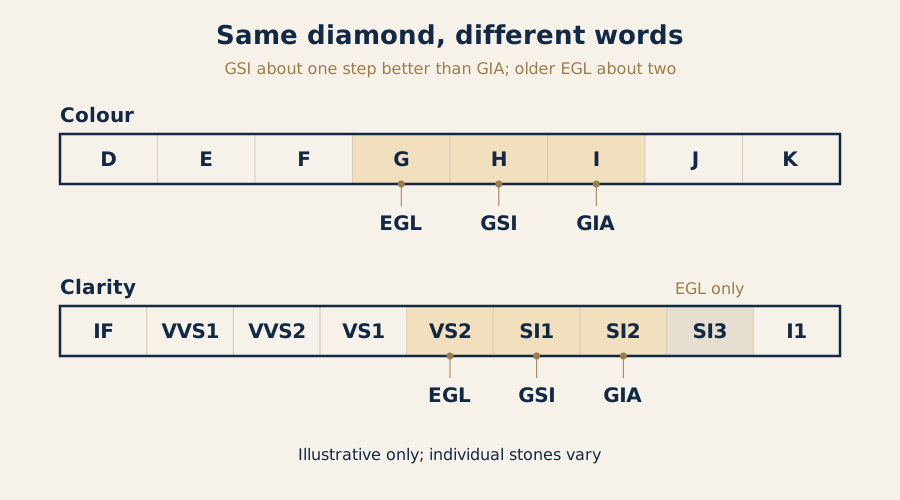
A one-grade difference sounds small, but it shows up in price. Moving from H to G colour, or from SI1 to VS2 clarity, can change the value of a 1 carat natural diamond by roughly many hundreds to a few thousand Australian dollars. If a report is generous by a grade in both colour and clarity, you may be paying for a stone two steps better than the one you are getting.
The strictest labs share a few habits: graders work blind (without knowing the client), each stone is checked by more than one grader, and colour is judged against master stones under controlled light. For how two of the stricter labs do this, see our explainers on AGS reports and their 0–10 cut scale and the HRD Antwerp grading report.
Not sure which one is right?
Send us the stones you are looking at and our gemologist will tell you which to choose and why.
What does a GSI or EGL diamond report include?
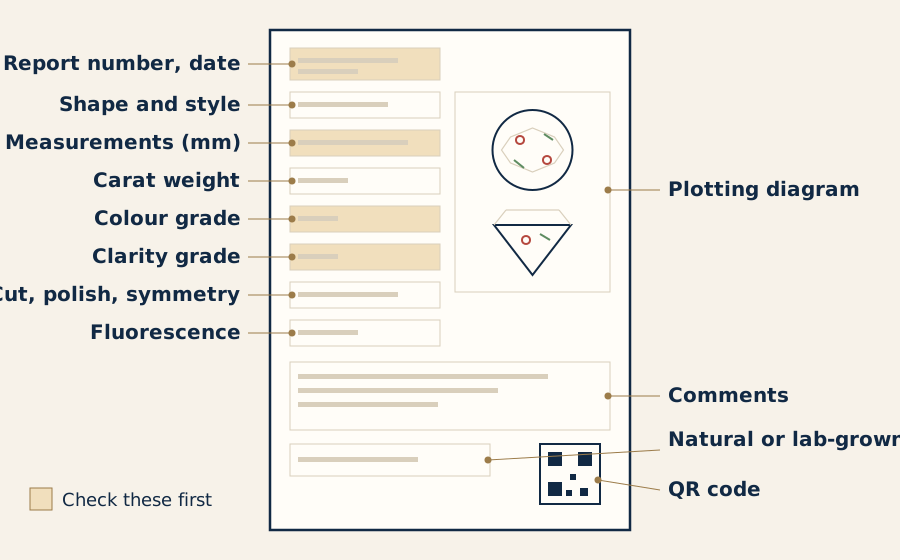
Layouts differ between labs and between report types, but a full GSI or EGL diamond report covers the same core sections as any grading report. Here is what each one tells you and what to look at closely.
| Report section | What it shows | What to check |
|---|---|---|
| Report number and date | Unique reference for this stone | Matches the girdle inscription and the lab's online record |
| Shape and cutting style | For example round brilliant, oval modified brilliant | Matches the stone in front of you |
| Measurements | Length, width and depth in millimetres | Tightest physical check; a jeweller can confirm with a gauge |
| Carat weight | Weight to two decimal places | Can be re-weighed on a calibrated scale |
| Colour grade | D–Z for colourless diamonds | The grade most often softened by lenient labs |
| Clarity grade | FL to I3 (EGL may also use SI3) | Compare with the plot and your own eye |
| Cut, polish, symmetry | Cut grade for rounds; finish grades for all | Not every GSI or EGL report gives a cut grade |
| Fluorescence | Strength of glow under ultraviolet light | Strong blue can make some stones look hazy |
| Plotting diagram | Map of inclusions (internal features) and blemishes | Look for features near the edge or reaching the surface |
| Comments and origin | Treatments, inscriptions, natural or lab-grown | Any treatment or lab-grown statement must be clear |
Smaller stones are often issued a shorter report without a clarity plot, similar to the difference covered in our comparison of a GIA Dossier and a full GIA grading report. GSI also issues jewellery reports that describe a finished ring or bracelet with a total diamond weight and a range of colour and clarity, rather than grading each stone.
Even a strict report leaves things out. None of them records how bright a stone looks in a real room, how its inclusions affect durability, or how well it has been set. Our guide to the gaps every diamond report leaves covers these, and if light return is what you care about, GCAL light performance reports measure it directly. A clarity plot can also flag surface damage; learn how to read those symbols in our page on cavities and chips on a diamond.
Do GSI and EGL grade lab-grown diamonds?
Yes. GSI issues a large number of reports for laboratory-grown diamonds, and EGL branches have graded them too. A lab-grown diamond is real diamond, with the same hardness (10 on the Mohs scale) and refractive index (about 2.42) as a natural one; it is simply grown in a laboratory instead of mined. Any reputable report must state clearly that the stone is lab-grown, and the girdle inscription usually says so as well, for example "LAB GROWN" or "LG" before the report number.
A GSI lab-grown diamond report usually records the growth method, either CVD (chemical vapour deposition, where carbon builds up layer by layer from a gas) or HPHT (high pressure, high temperature, which recreates conditions deep in the earth), and notes any post-growth treatment used to improve colour. Grading leniency matters less in money terms for lab-grown diamonds, because prices per grade are much closer together, but you still want the grades to be accurate.
To compare how labs present the two types, see our guide to how natural and lab-grown reports differ. For lab-grown stones, IGI is the most widely used lab in Australia, and our walk-through on reading an IGI lab-grown report line by line is a useful benchmark. If you want to know where a natural diamond was mined, that is a separate document again, covered in our explainer on diamond origin reports.
Which diamond labs do Australian diamonds come with?
Most certified loose diamonds sold in Australian jewellery stores come with GIA or IGI reports, with some natural stones graded by HRD or AGS. GSI and EGL reports are less common here, but you will meet them in a few situations:
- Second-hand and estate rings, especially pieces bought in the 2000s when EGL reports were widespread.
- Rings bought overseas, particularly from North American chain stores, where GSI is a major lab.
- Online listings from marketplaces and private sellers, where the report may be the only information given.
- Mass-produced jewellery such as tennis bracelets and cluster rings, which may carry a GSI jewellery report rather than individual grading.
In Australia, a lab report is also separate from an insurance valuation. A valuer will often re-check the grades, and if they disagree with an older EGL or GSI report, the valuation will reflect what they see, not what the report says.
Browse certified natural and lab-grown diamonds
Is a GSI or EGL graded diamond worth buying?
It can be, as long as the price reflects the stone rather than the paper. A GSI or EGL diamond is not a lesser diamond; it is a diamond described by a lab whose grades many buyers do not take at face value. Here is how to think about it:
- Judge the diamond, not the grade. Compare it in person or on video against GIA- or IGI-graded stones of the same stated colour and clarity.
- Expect the price to be lower. In the trade, GSI and especially EGL-graded diamonds sell below GIA equivalents with the same grades, because buyers assume some softness.
- Consider regrading. For a natural stone of about 1 carat or more, a fresh GIA or IGI report (roughly AUD $100–$300 plus postage and time, depending on size) can settle the question.
- Be wary of SI3 and older EGL reports. These deserve the most scepticism.
How do you verify GSI and EGL diamond reports? Step by step
Verifying a report confirms two things: that the document is genuine, and that it belongs to the diamond you are looking at. The process is similar to checking a GIA report number online.
- Find the report number. It is printed at the top of the report and usually on the back or on a QR code.
- Check it on the lab's website. GSI has an online report check; for EGL, find the specific branch named on the report, as each runs its own database and some older records are no longer online.
- Compare every detail. The shape, measurements to 0.01 mm, carat weight, colour and clarity on the website must match the paper exactly.
- Read the girdle inscription. Under a 10× loupe or a jeweller's microscope, the laser-inscribed number on the girdle should match the report.
- Confirm natural or lab-grown. Make sure the report and inscription agree; for lab-grown stones, follow our guide on matching a lab-grown report to its inscription.
- Get an independent check. Ask a qualified gemmologist or valuer to measure, weigh and look at the stone. For a valuable natural diamond, consider a GIA or IGI regrade.
If the number cannot be found online, the measurements do not match or there is no inscription, do not rely on the report at all. Have the diamond examined before any money changes hands.
Free consultation
Talk to a gemologist
Compare stones in person or online with Raj Sood, Graduate Gemologist (GIA), AJP (GIA).
Book a consultationShop this shape
FAQ
Common questions
Is GSI as good as GIA?
GSI is a legitimate lab, but most of the trade views GIA as stricter and more consistent. GSI colour and clarity grades are often described as about one grade softer, so GSI-graded diamonds usually sell for less than GIA-graded stones with the same grades.
Is an EGL certificate worth anything?
It is a genuine record that a lab examined the diamond, and its measurements and weight are generally reliable. Its colour and clarity grades, especially on older reports, are often generous, so value the stone on what it is rather than on the EGL grades.
What does SI3 clarity mean?
SI3 is a clarity grade EGL introduced between SI2 and I1. GIA does not use it, and a stone graded SI3 by EGL would usually be graded I1 by GIA.
Should I get an EGL or GSI diamond regraded by GIA?
For a natural diamond of around 1 carat or more, a GIA or IGI regrade is often worth the modest fee because it gives a widely recognised grade for resale, insurance and peace of mind. For small or lab-grown diamonds the cost may outweigh the benefit.
How do I check a GSI report number?
Enter the report number on GSI's online report check and compare the shape, measurements, weight and grades with your paper report. Then check the laser inscription on the girdle under magnification to confirm it is the same diamond.
Do GSI reports say if a diamond is lab-grown?
Yes. GSI issues separate reports for laboratory-grown diamonds that state the stone is lab-grown and usually note the growth method, CVD or HPHT. The girdle inscription normally identifies it as lab-grown too.

Ask a gemologist
Not sure which diamond to choose?
Raj Sood is a Graduate Gemologist (GIA) and master jeweller. Bring the stones you are considering, or send the reports, and he will tell you honestly which one is better and why.
Keep learning
Related guides
 Certificates & ValuationsDiamond Grading Labs Compared
 Certificates & ValuationsHow to Read a GIA Diamond Report
 Certificates & ValuationsIGI Natural Diamond Report Explained
 Certificates & ValuationsWhat a Diamond Report Doesn't Tell YouCertificates & ValuationsDiamond Certificates & Jewellery Reports
 Certificates & ValuationsDiamond Origin Reports ExplainedCertificates & ValuationsAGS Diamond Reports ExplainedCertificates & ValuationsGCAL and Light Performance Reports
Explore more
More guides on this topic
Education