
- Education
- Natural Diamonds
- Canadian Diamonds: Geology, Mines, Origin and What They Mean for Buyers
Natural diamonds
Canadian Diamonds: Geology, Mines, Origin and What They Mean for Buyers
Canadian diamonds are some of the youngest mined diamonds on the market and among the most closely documented. Here is how they formed, where they come from, how they compare with Australia's Argyle diamonds, and what Canadian origin does and does not change when you buy.
 Reviewed by Raj Sood, Graduate Gemologist (GIA), AJP (GIA)Master jeweller and Graduate Gemologist (GIA) · reviewed 4 November 2026
Quick answer
Canadian diamonds are natural diamonds mined in Canada's Arctic, mainly at the Ekati, Diavik and Gahcho Kué mines in the Northwest Territories. Discovered in 1991, they formed 150–200 km underground over a billion years ago. They are graded exactly like other diamonds; the difference is documented origin, which can add a modest premium.
What are Canadian diamonds?
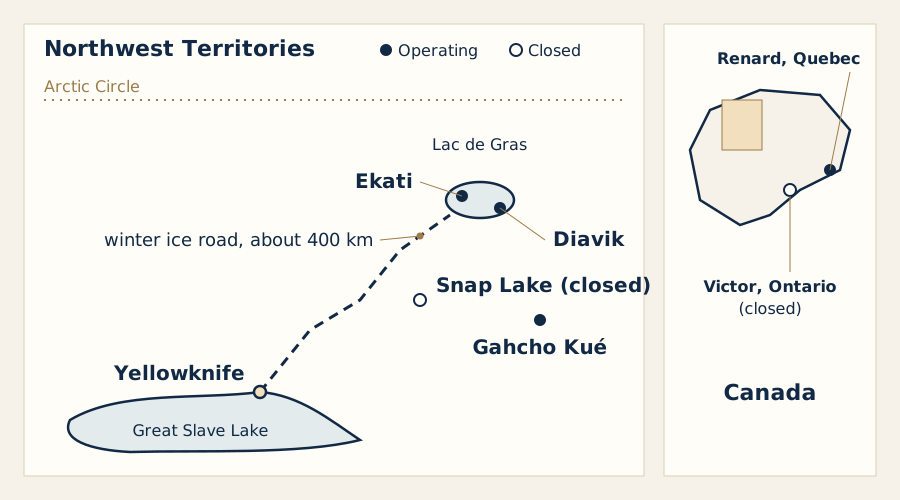
Canadian diamonds are natural diamonds mined in Canada, almost all of them from the tundra of the Northwest Territories, about 300 km north-east of the city of Yellowknife and roughly 200 km south of the Arctic Circle. Smaller amounts have come from northern Ontario and Quebec. They are ordinary diamond in every physical sense: pure carbon, 10 on the Mohs hardness scale, with a refractive index of about 2.42. What makes them distinct is where they were found and the paperwork that often follows them.
Canada is a newcomer to diamond mining. South Africa has produced diamonds since the 1870s and Australia on a large scale since the 1980s, but Canada's first commercial mine only opened in 1998. Within a decade the country had become one of the world's largest producers by value. If you are new to the subject, our natural diamonds guide covers the basics, and a map of where the world's diamonds are mined puts Canada alongside Russia, Botswana and the other major sources.
Canadian diamonds are not a separate grade or a different kind of stone. A 1 carat G colour VS1 diamond from Ekati and one from Botswana are graded on exactly the same scales and can look identical. Any unfamiliar term in this article is explained in our plain-English jewellery glossary.
How did diamonds form under Canada's Arctic?
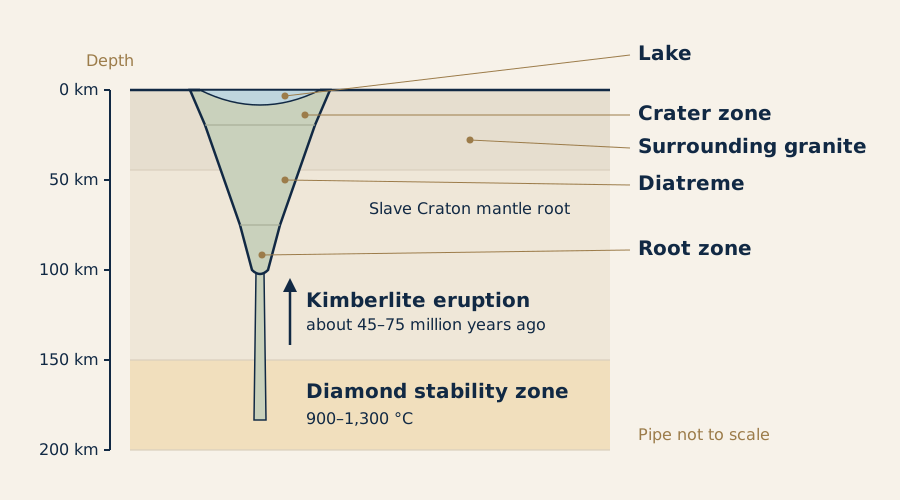
The Lac de Gras diamond field sits on the Slave Craton. A craton is a very old, thick and stable block of continental crust with a deep, cool root reaching into the mantle. The Slave Craton contains some of the oldest rocks known on Earth: the Acasta Gneiss, about 4 billion years old, lies on its western edge. Cold, thick roots like this are exactly where diamonds can survive, because the pressure is high enough for carbon to crystallise as diamond rather than graphite.
The diamonds themselves grew roughly 150–200 km down, at temperatures of around 900–1,300 °C, and most are believed to be between 1 and 3.5 billion years old. Our explainer on how natural diamonds form deep in the mantle goes through the chemistry step by step.
Diamonds only reach the surface when a kimberlite eruption carries them up. Kimberlite is a volcanic rock that rises extremely fast from the mantle, punching a carrot-shaped pipe through the crust. The Lac de Gras kimberlites erupted about 45–75 million years ago, which is geologically recent. Many of the pipes are small, often only 100–300 metres across at the surface, and because the softer kimberlite eroded faster than the surrounding granite, many now sit beneath lakes.
Most Canadian diamonds are type Ia, meaning they contain small amounts of nitrogen grouped in clusters, as most natural diamonds do. A small share are nitrogen-free. Our guides to diamond types Ia, Ib, IIa and IIb and to rare nitrogen-free type IIa stones explain why that chemistry matters for colour and for detecting treatments.
When were diamonds discovered in Canada?
For most of the 20th century geologists suspected there could be diamonds in northern Canada, but nobody could find the source. The clue lay in the ice age. Glaciers had ground across the tundra and spread indicator minerals downstream from the kimberlite pipes. Indicator minerals are far more abundant companions of diamond, such as red pyrope garnet, emerald-green chrome diopside and black ilmenite. Find them, and you can follow the trail back towards the pipe.
Geologists Chuck Fipke and Stewart Blusson spent most of the 1980s doing exactly that, sampling sand and gravel across hundreds of kilometres of tundra. In 1991, drilling with the Australian mining company BHP at Point Lake near Lac de Gras confirmed diamond-bearing kimberlite. The announcement set off one of the largest staking rushes in Canadian history, with claims eventually covering tens of millions of hectares.
- 1991: diamond-bearing kimberlite confirmed at Point Lake, Lac de Gras.
- 1998: Ekati, operated by BHP, opens as Canada's first diamond mine.
- 2003: Diavik opens on an island in Lac de Gras.
- 2008: Snap Lake (NWT) and Victor (Ontario) begin production.
- 2015: Diavik recovers the Foxfire, a 187.66 carat rough diamond.
- 2016–2017: Gahcho Kué (NWT) and Renard (Quebec) begin production.
The Foxfire is still described as the largest gem-quality diamond found in North America. For the stones that made history elsewhere, see our guide to famous diamonds from around the world.
Where are the Canadian diamond mines?
Canada's diamond mines are remote even by Australian outback standards. There is no permanent road to Lac de Gras. Heavy fuel, equipment and supplies travel north on the Tibbitt to Contwoyto Winter Road, an ice road of about 400 km, most of it over frozen lakes, which is usually open for only around eight to ten weeks from late January. Workers fly in and out, as they do on many West Australian mine sites.
| Mine | Location | Opened | Status |
|---|---|---|---|
| Ekati | Lac de Gras, NWT | 1998 | Operating |
| Diavik | Lac de Gras, NWT | 2003 | Operating; closure planned around 2026 |
| Snap Lake | NWT | 2008 | Closed 2015 |
| Victor | Northern Ontario | 2008 | Closed 2019 |
| Gahcho Kué | Kennady Lake, NWT | 2016 | Operating |
| Renard | Northern Quebec | 2017 | Operations suspended in recent years |
Because so many pipes sit under lakes, Canadian mining involves unusual engineering. At Diavik, the operators built dykes in Lac de Gras and pumped the water out to reach pipes beneath the lakebed. Ekati has drained several small lakes over its life. Mining starts as an open pit and moves underground as the pit gets too deep.
There is a strong Australian thread through all of this. BHP developed Ekati, and since 2023 it has been owned by Perth-based Burgundy Diamond Mines. Rio Tinto, which ran Australia's Argyle mine for decades, operates Diavik and has owned all of it since 2021.
Not sure which one is right?
Send us the stones you are looking at and our gemologist will tell you which to choose and why.
How many diamonds does Canada produce?
In recent years Canada has produced roughly 15–20 million carats a year, which places it among the world's top three or four producers by both volume and value, behind Russia and Botswana. Production peaked in 2017–2018 at over 20 million carats, after Gahcho Kué and Renard opened, and has eased as older pipes are mined out. With Diavik due to close in the next few years, output is expected to fall further unless new mines open.
What stands out about Canadian production is quality. A good share of the rough is gem quality and white to near-colourless, rather than the brown industrial material that dominates some other mines. That is why Canadian diamonds carry a relatively high average value per carat. Even so, the large majority of stones are small: most of what comes out of the ground would cut to well under half a carat. Our page on how rarity climbs with carat weight shows how quickly large clean stones thin out, in Canada as everywhere else.
| Measure | Approximate figure |
|---|---|
| Yearly production (recent) | about 15–20 million carats |
| World ranking by value | top three or four |
| Typical rough colour | white to near-colourless, some brown and yellow |
| Largest gem rough found | Foxfire, 187.66 ct (Diavik, 2015) |
| Age of the diamonds | about 1–3.5 billion years |
| Age of the kimberlite eruptions | about 45–75 million years |
None of this makes a Canadian diamond physically better than one from elsewhere. The things that make any diamond remarkable, its hardness, its light performance and its age, are shared by all natural diamonds. Our article on what makes a diamond special covers those qualities in more depth.
How do Canadian diamonds compare with Argyle diamonds?
For Australians, the natural comparison is Argyle, in the East Kimberley region of Western Australia. The two fields are almost opposites, which is a neat way to see how geology shapes what a mine produces.
| Canada (Lac de Gras) | Argyle (WA) | |
|---|---|---|
| Host rock | Kimberlite | Lamproite |
| Discovered | 1991 | 1979 |
| Production began | 1998 | 1985 |
| Status | Several mines operating | Closed November 2020 |
| Typical colour | White to near-colourless | Mostly brown, some yellow, rare pink |
| Typical size | Mostly small, good gem share | Mostly very small, high volume |
| Famous for | Documented origin, white stones | Pink, red and champagne diamonds |
| Rio Tinto link | Operates Diavik | Operated Argyle |
Argyle produced enormous volumes, at its peak more than a third of the world's diamonds by carat weight, but most were small and brown. Under 1% were pink, yet those pinks made it world-famous. The Canadian mines produce far fewer carats than Argyle did at its height, but a much higher share of white gem material. One practical difference for buyers today: Argyle's closure means new Argyle stones are no longer being mined, while Canadian production continues.
The geology explains part of it. Argyle's diamonds came up in lamproite, a different volcanic rock, at the edge of an ancient block of crust that was squeezed and deformed. That stress is linked to the lattice distortion that gives Argyle pinks and browns their colour. The Slave Craton's root was colder and more stable, which suits colourless growth. For the full story of Australia's own mines, see our history of Argyle and Australian diamonds.
How can you tell if a diamond is Canadian?
You cannot tell by looking. Canadian diamonds are not a different colour, shape or sparkle, and a standard grading report from GIA or IGI grades the stone, not its birthplace. Origin is proven by chain of custody: records that follow the diamond from the mine, through cutting and polishing, to the finished stone.
- Origin programmes: schemes such as CanadaMark track rough from specific Canadian mines through cutting and assign the polished stone a serial number.
- Girdle inscriptions: many tracked stones carry a microscopic laser inscription on the girdle (the thin outer edge), often a maple leaf or polar bear logo with a serial number. It does not affect the grade and is only visible with a loupe.
- Certificates: the Government of the Northwest Territories has run a certified Canadian diamond programme for stones cut and polished in the territory.
- Laboratory origin services: some labs, including GIA, offer origin reports for diamonds that were registered as rough before cutting.
Canada has been a participant in the Kimberley Process since it began in 2003. That scheme certifies shipments of rough diamonds between countries to keep diamonds that fund armed conflict out of the trade; our guide to how the Kimberley Process works explains what it covers and where its limits are. Canadian mines also operate under Canadian labour and environmental law and agreements with local Indigenous communities, which is a large part of why some buyers seek out Canadian origin. For how GemTrove approaches sourcing more broadly, see responsible sourcing and what 'conflict-free' does and does not mean.
Origin paperwork also does not replace a grading report. A report is still what tells you whether a diamond has been treated, for example whether a brown natural stone has been whitened under high pressure and temperature. Our page on HPHT-treated natural diamonds explains how labs detect that.
Are Canadian diamonds worth it?
It depends on what you value. If documented, traceable origin matters to you, a Canadian diamond with a serial number and paperwork gives you something most diamonds cannot: a known mine. If you simply want the most diamond for your budget, origin does not change the colour, clarity, cut or carat, and a well-graded natural diamond from another Kimberley Process country will look the same.
| 1 ct round, G–H, VS, excellent cut | Approximate price range (AUD) |
|---|---|
| Lab-grown diamond | about $1,000–$3,000 |
| Natural diamond, origin not documented | about $7,000–$15,000 |
| Natural Canadian diamond with origin tracking | similar, sometimes with a modest premium |
These are broad ranges only, and prices move with the market and the exact grades. Documented Canadian stones can cost somewhat more than comparable diamonds without origin records, mainly because the tracking adds cost and supply is limited. Laboratory-grown diamonds are real diamond grown in a laboratory rather than mined; they cost much less, but they have no mine origin to trace.
Choose a Canadian diamond because you love it and value its documented story, not with resale in mind. Natural diamond retail prices do not reliably rise, and resale prices are usually well below what you paid. Our page on how natural diamond prices have moved over time sets out the history honestly. If origin and story are what draw you, it is also worth looking at old-stock and antique diamonds, or at whether you can reset a diamond already in the family.
Browse natural diamonds
How do you buy a Canadian diamond? Step by step
- Choose the diamond on its grades first. Settle on shape, carat, colour, clarity and cut, exactly as you would for any natural diamond.
- Ask what the origin claim rests on. A specific programme, a government certificate, a laboratory origin report, or only a supplier's word.
- Get the independent grading report. Confirm it says natural, and check for any treatment noted on the report.
- Match the serial number. Compare the girdle inscription under a loupe with the number on both the origin paperwork and the grading report.
- Compare like with like. Price a documented Canadian stone against an equivalent natural diamond without origin records, so you know what the origin costs you.
- Plan the setting. Decide on the metal and setting style, and keep the paperwork with your valuation and insurance documents.
Free consultation
Talk to a gemologist
Compare stones in person or online with Raj Sood, Graduate Gemologist (GIA), AJP (GIA).
Book a consultationShop this shape
FAQ
Common questions
Are Canadian diamonds better quality than other diamonds?
Not individually. A Canadian diamond is graded on the same colour, clarity and cut scales as any other, and the mines simply produce a relatively high share of white gem-quality rough.
Are Canadian diamonds more expensive?
A Canadian diamond with documented origin can cost somewhat more than a comparable diamond without origin records, because tracking adds cost. Without paperwork, a Canadian-mined stone is priced like any other natural diamond of the same grades.
How do I know my diamond is really Canadian?
Look for a girdle inscription that matches a serial number on origin paperwork from a recognised programme, a government certificate or a laboratory origin report. A standard grading report on its own does not prove origin.
Which diamond mines are in Canada?
The main operating mines are Ekati, Diavik and Gahcho Kué in the Northwest Territories. Snap Lake and Victor have closed, and Renard in Quebec has had its operations suspended.
What is the difference between Canadian and Argyle diamonds?
Canadian diamonds come from kimberlite and are mostly white to near-colourless, while Argyle diamonds came from lamproite and were mostly brown, with rare pinks. Argyle closed in 2020; the main Canadian mines are still producing.
Do Canadian diamonds hold their value?
Not reliably. Diamonds, Canadian or otherwise, usually resell well below their retail price, so choose one for its beauty, quality and the story it carries.

Ask a gemologist
Not sure which diamond to choose?
Raj Sood is a Graduate Gemologist (GIA) and master jeweller. Bring the stones you are considering, or send the reports, and he will tell you honestly which one is better and why.
Keep learning
Related guides
 Natural DiamondsArgyle Mine and Australian Diamonds
 Natural DiamondsWhere Diamonds Are MinedNatural DiamondsThe Kimberley Process ExplainedNatural DiamondsNatural Diamonds GuideNatural DiamondsWhat Makes a Diamond Special?
 Natural DiamondsConflict-Free Diamonds – Responsible Sourcing at GemTroveNatural DiamondsDiamond Types Ia, Ib, IIa and IIb
 Natural DiamondsReusing a Family Diamond
Explore more
More guides on this topic
Education