
- Education
- Certificates & Valuations
- Diamond Grading Labs Compared: GIA, IGI, HRD, AGS, GSI and EGL
Certificates & Valuations
Diamond Grading Labs Compared: GIA, IGI, HRD, AGS, GSI and EGL
Two diamonds with the same grades on paper can differ by a whole colour grade when their reports come from different diamond grading labs. Here is who each lab is, how strictly it grades, what its report shows and how to check that a report is genuine.
 Reviewed by Raj Sood, Graduate Gemologist (GIA), AJP (GIA)Master jeweller and Graduate Gemologist (GIA) · reviewed 4 November 2026
Quick answer
The main diamond grading labs are GIA, IGI, HRD, GSI and EGL, with AGS reports now folded into GIA. GIA is the benchmark for strict, consistent colour and clarity grading of natural diamonds; IGI grades most lab-grown diamonds and many naturals; HRD is respected in Europe. Always check the report number online and match the girdle inscription.
What are diamond grading labs and why do they matter?
A diamond grading lab is an independent laboratory that examines a loose diamond and records what it finds: its weight, measurements, colour, clarity, cut quality and whether it is natural or laboratory-grown. The result is a grading report, which most people call a certificate. The labs themselves prefer the word report, because it describes the stone rather than promising anything about its value. Our guide to diamond certificates and jewellery reports explains the different document types you will come across.
Grading is not fully automatic. Weight and measurements come from instruments, but colour and clarity are still judged by trained graders. Colour is assessed by comparing the diamond face-down against a set of master stones (reference diamonds of known colour) under controlled daylight-type lighting. Clarity is judged at 10× magnification, which is the standard magnification for diamond grading. Because people make these calls, a lab's training, procedures and checking systems decide how consistent its grades are from one stone to the next.
That consistency matters for your budget. At around 1 carat, one step of colour (say G to H) or one step of clarity (VS1 to VS2) can change the price by hundreds or even a few thousand dollars. If one lab tends to grade a little more generously, its H may look like another lab's I, and the price difference you see online may simply be the paperwork. Our page on how the D-to-Z colour scale works shows what each colour step looks like.
A report is also what makes a diamond comparable at all. Without one, you are relying on the seller's opinion; see buying a diamond with or without a report for when that is reasonable and when it is not. Any unfamiliar term on this page is explained in our plain-English jewellery glossary.
Which diamond grading labs should you know about?
Six names cover almost every report you will see on a diamond sold in Australia. Here is who each one is.
| Lab | Founded and base | Known for | Report notes |
|---|---|---|---|
| GIA (Gemological Institute of America) | 1931; Carlsbad, California, with labs in several countries | Non-profit; developed the 4Cs and the D-to-Z colour scale; the trade benchmark for natural diamonds | Cut grade (Excellent to Poor) for round brilliants only; clarity plot on full reports |
| IGI (International Gemological Institute) | 1975; Antwerp, with labs across Asia, the US and Europe | Grades most of the world's lab-grown diamonds; large volume of natural and set jewellery | States growth method (CVD or HPHT) and any post-growth treatment on lab-grown reports |
| HRD Antwerp | 1973 as Belgium's Diamond High Council; Antwerp | Respected European lab, strong on natural diamonds | Uses LC (loupe clean) as its top clarity grade instead of FL/IF |
| AGS Laboratory | AGS founded 1934; lab opened 1996; Las Vegas | Light-performance cut grading on a 0–10 scale, including fancy shapes | Became part of GIA in 2019; new AGS-branded reports have been phased out |
| GSI (Gemological Science International) | 2005; New York | High volume grading for jewellery chains, often stones already set | Generally seen in the trade as less strict than GIA |
| EGL (European Gemological Laboratory) | 1974; separate, independently run offices in several countries | Once widely used; known for generous grading | Many trade platforms stopped listing EGL-graded stones in 2014 |
GIA is the lab most other labs are measured against. It created the grading language almost everyone now uses, including the 11 clarity grades from Flawless (FL) to Included 3 (I3) and the colour scale from D (colourless) to Z (light yellow or brown). IGI has become the main lab for lab-grown diamonds and also grades many natural stones; our walk-through of an IGI natural diamond report shows what each section means.
HRD Antwerp grades to the same broad framework but with some European differences in wording; read the HRD diamond report, section by section if your stone has one. AGS reports are still common on older ideal-cut rounds bought in the 2000s and 2010s, and its 0 to 10 scale (where 0 is Ideal) is explained in our guide to reading an AGS report. If you are looking at a stone graded by GSI or EGL, read what to check on GSI and EGL reports first.
Which diamond lab grades most strictly?
No lab publishes a side-by-side study of its grades against the others, so what follows is the long-standing view of dealers, valuers and gemmologists who see thousands of reports. It is about consistency as much as strictness: how likely it is that the same stone would get the same grades if it were sent in again.
| Lab | Colour and clarity consistency | Common trade view | Where you will usually see it |
|---|---|---|---|
| GIA | Very consistent | The reference point; prices are often quoted against GIA grades | Natural diamonds of all sizes; increasingly lab-grown |
| AGS (older reports) | Very consistent, strict on cut | Treated much like GIA for colour and clarity | Older ideal-cut rounds |
| HRD | Consistent | Close to GIA on most stones | European-sourced natural diamonds |
| IGI | Generally consistent | Close to GIA; on natural stones some traders allow for up to one grade softer on colour | Lab-grown diamonds and many natural stones |
| GSI | More variable | Often one or two grades generous on colour | Jewellery from chain retailers |
| EGL | Varies between offices | Historically generous, sometimes by several grades | Older stock and resale pieces |
Even at the strictest lab, a stone that sits right on a grade boundary can come back one grade different if it is resubmitted. That is normal and is why a report is best read as a careful professional opinion, not a measurement like weight. For a deeper look at the three labs most Australians meet, see our GIA, IGI and HRD side-by-side comparison.
Related guideGIA vs IGI vs HRD Diamond CertificatesWhat does a diamond grading report include?
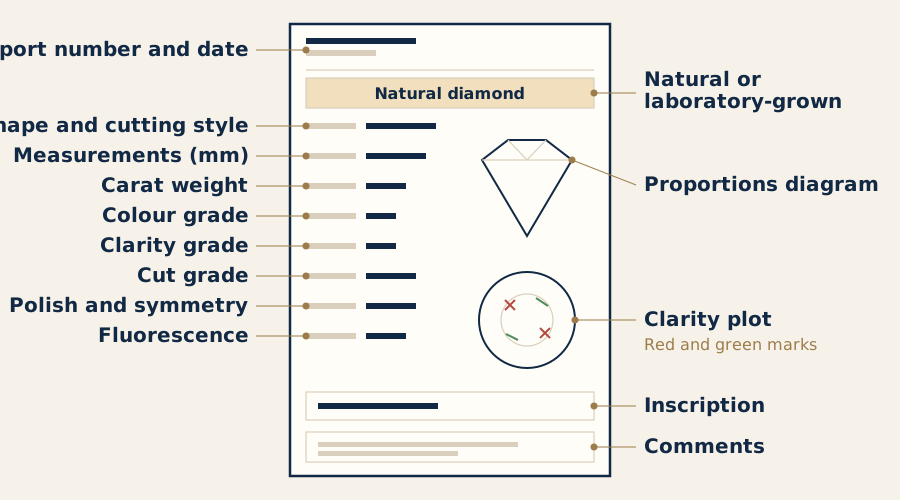
Layouts differ between labs, but a full grading report from any of the major labs covers the same core information:
- Report number and date: the unique number you use to check the report online.
- Shape and cutting style: for example round brilliant, oval modified brilliant or emerald step cut.
- Measurements: in millimetres, to two decimal places, such as 6.45–6.48 × 3.98 mm for a round.
- Carat weight: to two decimal places (0.01 ct). One carat is 0.2 grams.
- Colour grade: D to Z for near-colourless stones, or a fancy colour description such as Fancy Intense Pink.
- Clarity grade: FL to I3 at GIA and IGI, with a clarity plot (a map of the main inclusions) on full reports.
- Cut grade: for round brilliants at most labs; fancy shapes usually get polish and symmetry grades only.
- Polish and symmetry: how smooth the facets are and how precisely they line up.
- Fluorescence: the glow some diamonds give under ultraviolet light, graded None, Faint, Medium, Strong or Very Strong.
- Proportions diagram: table, depth, crown and pavilion angles, girdle thickness and culet.
- Inscription and comments: any laser inscription on the girdle, and notes such as treatments or features not shown on the plot.
- Natural or laboratory-grown: stated clearly, with a lab-grown report usually looking visibly different from a natural one.
Some labs also offer shorter formats. GIA's Diamond Dossier, for example, is a cheaper report for stones of about 0.15 to 1.99 carats that includes a laser inscription but leaves out the clarity plot. Our guide to the differences between a GIA Dossier and a full grading report sets out when each makes sense. Separate origin services, such as GIA's, can also trace where a natural diamond was mined; see how diamond origin reports work.
A report is detailed, but it is not the whole picture. It will not tell you whether an SI1 inclusion sits under the table where you will see it, whether a strongly fluorescent stone looks hazy, or how bright a fancy shape looks in real light. Our page on the gaps in a diamond report covers what to check with your own eyes or a video.
Not sure which one is right?
Send us the stones you are looking at and our gemologist will tell you which to choose and why.
How do labs grade lab-grown diamonds?
Lab-grown diamonds are real diamond, with the same hardness (10 on the Mohs scale) and refractive index (about 2.42) as natural diamond, but grown in a laboratory instead of mined. Grading labs identify them with specialised instruments that read growth patterns and trace elements, then issue a report that states clearly that the stone is laboratory-grown.
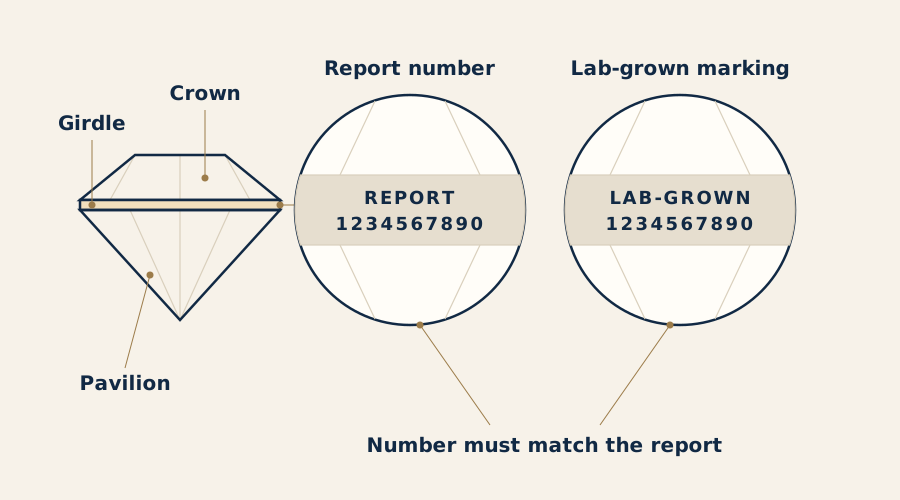
IGI grades the largest share of lab-grown diamonds sold worldwide. Its lab-grown reports list the growth method, either CVD (chemical vapour deposition, where diamond is built up layer by layer from a carbon-rich gas) or HPHT (high pressure, high temperature, which recreates conditions deep in the earth). They also note whether the stone has had post-growth treatment, which is common for improving colour. The girdle is usually laser-inscribed with the report number and the words laboratory-grown or LG.
GIA has graded lab-grown diamonds for years, and has announced a move away from the full D-to-Z and FL-to-I3 scales for them in favour of simpler quality descriptions. Because lab practice here is changing, check the date and wording on any lab-grown report you are comparing. Whatever the lab, natural and lab-grown reports should never be compared grade for grade on price: the two are priced as separate markets, and lab-grown costs much less than natural at the same grades.
Which grading reports come with diamonds sold in Australia?
Most grading reports on diamonds sold in Australia are issued by labs overseas, because the major diamond grading labs do their grading outside Australia. In practice, the pattern on Australian stock looks like this:
- Natural diamonds from about 0.30 carat: most often GIA, with some IGI and HRD.
- Lab-grown diamonds: mostly IGI, with a smaller share graded by GIA.
- Older and resale pieces: a mix, including AGS, EGL and reports from smaller labs.
- Small diamonds (melee) in set jewellery: usually no individual report; quality is described as a range on the valuation or invoice.
When you look at a stone with GemTrove, we can go through its actual report with you, line by line, and point out what the grades mean for that particular diamond. The same approach works when you bring in a report from elsewhere: the questions to ask are which lab issued it, when, and whether the details match the stone.
Browse natural and lab-grown diamonds with grading reports
Is a diamond grading report the same as a valuation?
No. A grading report describes the diamond's quality and identity, and it never states a price. A valuation is a separate document, written by a jewellery valuer, that puts a dollar figure on the whole piece for a specific purpose. Our page on the difference between a valuation and a diamond certificate explains how the two work together.
In Australia, the most common purpose is insurance. An insurer wants a replacement value, and the valuer uses the grading report as key evidence for the diamond's grades, then adds the metal, setting and any other stones. See what an insurance valuation includes. Different purposes call for different values: estates, deceased-estate probate and property settlements need a fair market figure rather than a replacement figure, as covered in valuations for estates and family law.
A grading report does not go out of date in the way a valuation does. The diamond's grades stay the same unless it is damaged or recut, but its replacement cost moves with the market, metal prices and exchange rates. Many insurers suggest updating a valuation every few years; our guide on how often to get jewellery revalued explains the usual timing.
How do you verify a diamond grading report? Step by step
Fake or altered reports are uncommon, but reports do get swapped between stones, and old reports can be attached to diamonds that have since been chipped or recut. Checking takes a few minutes.
- Find the lab and report number. Note exactly which lab issued the report and copy the full report number.
- Check it on the lab's website. GIA, IGI and HRD all have free online checks. The online record should match the paper report in every detail; for older AGS reports, check with GIA, which now holds those records.
- Match the measurements. Ask for the stone to be measured with a gauge; the millimetre figures should agree with the report to within a few hundredths of a millimetre.
- Match the weight. A loose diamond can be weighed on a carat scale and should match the report to 0.01 ct.
- Read the inscription. Look at the girdle under a 10× loupe or microscope and compare the inscribed number with the report. A lab-grown stone should also show its lab-grown marking.
- Compare the clarity plot. On a full report, the main inclusions on the plot should be visible in the same positions in the stone.
- Check the date and condition. On older reports, look for chips or wear on the girdle and facet edges that could have changed the grades since grading.
If anything does not match, ask why before going further. A diamond can be resubmitted for a fresh report; that is the cleanest way to settle doubts about an older or less strict lab's grades.
Free consultation
Talk to a gemologist
Compare stones in person or online with Raj Sood, Graduate Gemologist (GIA), AJP (GIA).
Book a consultationShop this shape
FAQ
Common questions
Is GIA better than IGI?
GIA is the trade benchmark for natural diamonds and is widely seen as the most consistent on colour and clarity. IGI is close on most stones, grades most lab-grown diamonds, and is a reliable choice there; on natural diamonds some traders allow for slightly softer colour grades.
Are EGL diamond certificates reliable?
EGL reports have a long reputation for generous grading, and many trade platforms stopped listing EGL-graded stones in 2014. Treat the grades as a starting point and have the diamond checked or regraded before relying on them.
Can I check a diamond certificate online?
Yes. GIA, IGI and HRD all offer free online report checks using the report number. The online record should match the paper report, and the number should match any laser inscription on the girdle.
Do lab-grown diamonds come with certificates?
Most lab-grown diamonds over about 0.30 carat come with a report, usually from IGI and sometimes from GIA. The report states that the stone is laboratory-grown and often lists the growth method and any post-growth treatment.
Does a diamond grading report show the value?
No. A grading report describes quality and identity but never gives a price. For a dollar figure you need a valuation from a jewellery valuer, who uses the report as evidence.
Is AGS still grading diamonds?
The AGS Laboratory became part of GIA in 2019, and new AGS-branded reports have since been phased out. Existing AGS reports remain valid descriptions of the stone, and GIA now holds those records.

Ask a gemologist
Not sure which diamond to choose?
Raj Sood is a Graduate Gemologist (GIA) and master jeweller. Bring the stones you are considering, or send the reports, and he will tell you honestly which one is better and why.
Keep learning
Related guides
 Certificates & ValuationsGIA vs IGI vs HRD Diamond Certificates
 Certificates & ValuationsWhat a Diamond Report Doesn't Tell YouCertificates & ValuationsCertified vs Uncertified DiamondsCertificates & ValuationsDiamond Certificates & Jewellery Reports
 Diamond 4Cs & GradingDiamond Colour GradingCertificates & ValuationsGIA Diamond Dossier vs Diamond Grading Report
 Certificates & ValuationsJewellery and Diamond ValuationCertificates & ValuationsInsurance Jewellery Valuation Explained
Explore more
More guides on this topic
Education