
- Education
- Certificates & Valuations
- Diamond Laser Inscription: What It Does and Does Not Prove
Certificates & Valuations
Diamond Laser Inscription: What It Does and Does Not Prove
A diamond laser inscription is the tiny link between a stone and its paperwork. Knowing what it can and cannot tell you protects you when you buy, insure or have a diamond valued.
 Reviewed by Raj Sood, Graduate Gemologist (GIA), AJP (GIA)Master jeweller and Graduate Gemologist (GIA) · reviewed 4 November 2026
Quick answer
A diamond laser inscription is a number or message etched into the girdle, usually a grading report number. It lets you link a stone to its report, and lab-grown diamonds are normally inscribed as such. It does not prove origin, grade, treatment status or value on its own: you must match the stone's measurements and inclusions to the report.
What is a diamond laser inscription?
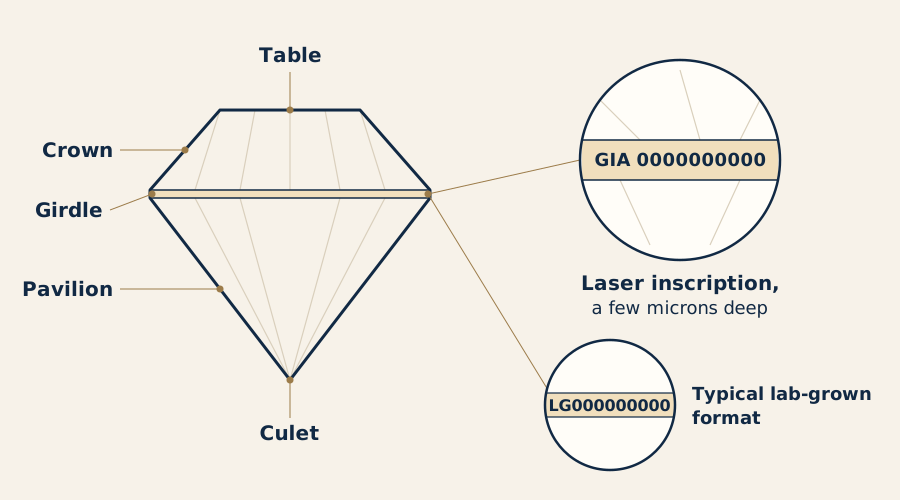
A diamond laser inscription is a line of tiny characters written onto the girdle, the thin band around the widest part of a diamond where the top (crown) meets the bottom (pavilion). Most inscriptions are the number of the diamond's grading report, often with the laboratory's initials in front, such as "GIA" or "IGI". Others carry a brand logo, the words "LAB-GROWN", or a personal message such as initials and a date.
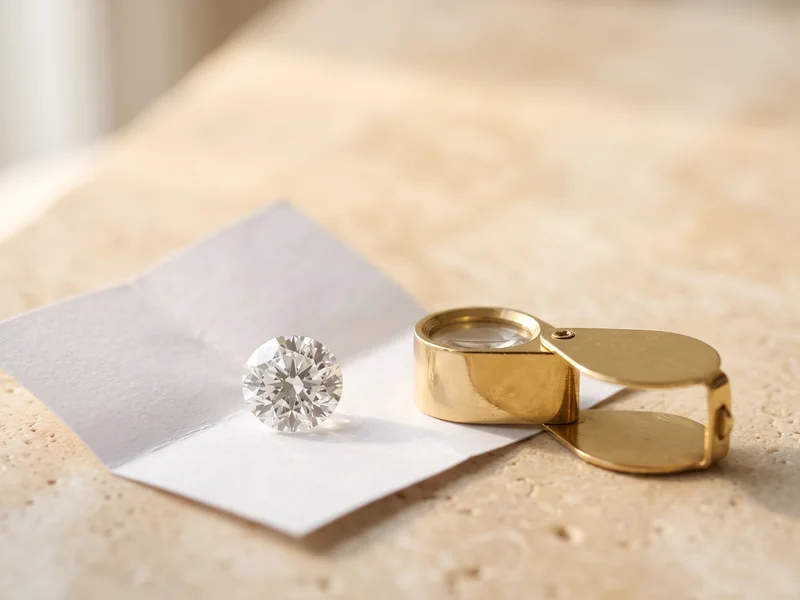
The characters are so small that you cannot see them with the naked eye. You need at least a 10× loupe (a small jeweller's magnifier), and they are much easier to read under a gemmological microscope at 20× to 40×. Once the stone is set, claws or a bezel can cover part of the girdle, so an inscription may be partly hidden in a finished ring.
The inscription exists for one reason: to tie a physical stone to a written record. That record is usually an independent laboratory report, and our guide to how diamond certificates and grading reports work explains what those documents contain. If you meet a term here you do not know, our plain-English jewellery glossary defines it.
How is a diamond laser inscription made, and does it harm the stone?
The inscription is made with a finely focused laser that marks the surface of the girdle. On diamond, the laser turns a very thin layer of the surface into a darker form of carbon, leaving characters that are only a few microns (thousandths of a millimetre) deep. Each character is typically a few hundredths of a millimetre tall.
Because the mark is so shallow, it has no measurable effect on carat weight, and laboratories generally do not treat a report-number inscription as a clarity characteristic. It will not lower a grade on the clarity scale, which runs from Flawless (FL) to Included (I3), and it does not affect brilliance, fire or durability. Diamond is 10 on the Mohs scale of hardness, and a surface mark this shallow does not create a weak point the way a deep chip or feather can.
- Where: on the girdle, usually on a polished or faceted section so the characters read cleanly.
- Depth: a few microns; far shallower than a polishing scratch you could feel.
- Effect on grade: none for colour or clarity; the inscription is noted on the report instead.
- Small stones: very small diamonds have narrow girdles, so inscriptions may be shortened or not offered at all.
Inscriptions can be added when a diamond is first graded, or later. A jeweller can send a stone to a laboratory to add its report number, and many jewellers offer personal messages as a separate service. Adding an inscription to a set diamond usually means unsetting it first.
What do diamond inscriptions usually say?
Inscriptions follow a few common patterns. The exact wording depends on the laboratory and the year the stone was graded, so always compare against the report itself rather than assuming a format.
| Inscription type | Typical example | What it tells you |
|---|---|---|
| Lab name and report number (natural) | GIA 1234567890 | Which report the stone was graded under |
| Lab-grown, GIA | LABORATORY-GROWN plus report number | GIA graded it as laboratory-grown |
| Lab-grown, IGI | LG followed by the report number | IGI graded it as laboratory-grown |
| Treatment note | HPHT PROCESSED | The lab identified a colour treatment |
| Brand mark | A logo and serial number | Which brand programme the stone belongs to |
| Personal message | Initials, a date or a short word | Nothing about quality; purely sentimental |
HPHT stands for high pressure, high temperature, a process that can change a diamond's colour after it has formed; laboratories detect it with advanced spectroscopic testing, not with a loupe. GIA report numbers are usually ten digits, and IGI lab-grown report numbers follow the "LG" prefix. The labs also differ in how they grade and what they inscribe as standard; see how GIA, IGI and HRD differ before you treat any two reports as equal. On a GIA report, the inscription appears in the grading details or comments, and our guide to where the inscription appears on a GIA report shows exactly where to look.
Are all lab-grown diamonds laser inscribed?
Most graded lab-grown diamonds are. GIA inscribes the lab-grown diamonds it grades with a statement that they are laboratory-grown and the report number. IGI, which grades a large share of lab-grown diamonds sold in Australia, usually inscribes "LG" and the report number. Many growers and cutters also inscribe their stones before they reach a laboratory.
That inscription is a helpful disclosure, but it is not the only safeguard. A lab-grown diamond is real diamond, chemically and physically the same material as a natural one, so it cannot be told apart by eye or with a loupe. If an inscription has been polished off, identifying the stone needs laboratory instruments such as spectroscopy and fluorescence imaging, or at least an independently tested screening device in a jeweller's hands.
Under Australian Consumer Law, a business must not mislead you about what you are buying, so a lab-grown diamond must always be described as lab-grown or laboratory-grown, inscription or not. For a detailed walk-through, see our step-by-step lab-grown report verification guide.
Related guideHow to Verify a Lab-Grown Diamond Report and InscriptionNot sure which one is right?
Send us the stones you are looking at and our gemologist will tell you which to choose and why.
What does a diamond laser inscription prove?
On its own, an inscription proves only that someone, at some point, wrote those characters on the girdle. Its real value comes when you combine it with the report. Matched correctly, it gives you:
- A fast link to a report. The number lets you pull up the record on the laboratory's online report check.
- Identification after loss or theft. A recovered stone with a matching inscription and matching measurements is far easier to prove as yours.
- A disclosure marker. "LG", "LAB-GROWN" or "HPHT PROCESSED" tells the next jeweller what the lab found, even years later.
- A record of a sentimental message. Personal inscriptions make a stone yours in a way paperwork cannot.
Think of an inscription like a number plate. It points you to the registration, but it does not prove the car underneath is the one on the papers. You still have to check the rest.
What does a laser inscription not prove?
This is where buyers get caught. An inscription is a surface mark that can be added, copied or removed, so it can never stand in for checking the stone itself.
| Question | Does the inscription prove it? | What actually proves it |
|---|---|---|
| Is this the stone on the report? | Not alone | Matching measurements, carat weight and inclusion plot |
| Is it natural or lab-grown? | No | Laboratory testing; screening devices for a first check |
| Is it untreated? | No | Laboratory testing and the report's comments |
| Is the grade correct? | No | The report from a respected lab, checked against the stone |
| Where was it mined? | No | An origin report or documented chain of custody |
| What is it worth? | No | A written valuation by a qualified valuer |
Inscriptions can be copied. Gem laboratories have reported cases of diamonds carrying a genuine report number that belonged to a different stone, including lab-grown diamonds inscribed with the number of a natural diamond's report. The online check will show a real report, and only a careful comparison of the stone reveals the mismatch.
Inscriptions can be removed. A light repolish of the girdle takes the characters off. This sometimes happens innocently during repairs or re-cutting, but it also means that a missing inscription is not evidence either way. A diamond that has been recut will also no longer match its old measurements or weight.
Inscriptions say nothing about treatment unless a lab put a treatment note there. A diamond that has been laser drilled or fracture filled after grading would still carry its old number. Our guide to fracture-filled and laser-drilled diamonds explains how those treatments are found. And an inscription cannot turn an uncertified stone into a certified one; see buying a certified or uncertified diamond for what paperwork really adds.
Is laser inscription the same as laser drilling?
No, and the similar names cause real confusion. Both use a laser, but for completely different jobs.
| Laser inscription | Laser drilling | |
|---|---|---|
| Purpose | Identification | Clarity treatment |
| Where | Surface of the girdle | Into the stone, down to a dark inclusion |
| Depth | A few microns | Often reaching well inside the diamond |
| Affects appearance? | No | Yes, it lightens a dark inclusion |
| Must be disclosed? | Recorded on the report | Yes, as a treatment |
| Effect on value | Neutral | Lowers value against an untreated stone |
Laser drilling burns a fine channel from the surface to a dark inclusion, then the inclusion is bleached or dissolved so it is less visible. It is a treatment and must be disclosed. If you want to know what drill holes look like and how they show on a report, read about laser drill holes, a clarity treatment.
How do Australian valuers and insurers use a diamond inscription?
In Australia, most jewellery insurance is based on a written valuation (an appraisal), usually for replacement value, meaning what it would cost to replace the item with one of like kind and quality. A good insurance valuation describes the diamond in enough detail that it could be identified again, and the inscription is one of the strongest identifiers.
- Recording it: the valuer reads the inscription under magnification and notes it exactly, with the report number it links to.
- Verifying it: the valuer compares the stone's measurements, weight and inclusions with the report, and notes whether the match was confirmed.
- Flagging problems: if the inscription is missing, unreadable, or does not match, the valuation should say so plainly.
- Set stones: where claws hide part of the girdle, the valuer may record a partial reading and rely more on measurements and the plot.
A certificate and a valuation do different jobs: the report grades the stone, while the valuation puts a replacement figure on the whole piece for your insurer. Our guide to the difference between a valuation and a certificate explains both, and what an insurance valuation should include covers how often to update it. Many insurers suggest a fresh valuation every two to three years, because diamond and metal prices move.
At GemTrove, founded in 2008 and part of a family jewellery trade since 1984, valuations are carried out by Raj Sood, Graduate Gemologist (GIA). When a diamond has an inscription, it is read, recorded and matched against the report as part of the valuation, so the document can genuinely identify your stone.
How do you check a diamond's laser inscription? Step by step
You can do the first checks yourself with a 10× loupe and the report. A jeweller with a microscope can confirm the rest, often while you wait. If you are comparing labs as part of the purchase, comparing the major grading labs is a useful read beforehand.
- Find the report number. Take it from the paper or digital report, not from a seller's listing.
- Look up the report online. Use the laboratory's own report check website and confirm the details shown match the paper copy.
- Read the inscription. Turn the stone (or ring) slowly under a 10× loupe with good light, scanning the girdle; ask a jeweller to use a microscope if you cannot find it.
- Compare character by character. Every digit and any prefix such as "LG" must match the report exactly.
- Match the measurements and weight. Measurements on the report are given to 0.01 mm and weight to 0.01 carat; a loose stone should match closely.
- Match the inclusions. Use the plotting diagram to locate two or three distinctive inclusions; our guide to reading the plotting diagram shows how.
- Confirm natural or lab-grown. Check the report states the origin clearly, and ask for a screening test if anything seems off.
- Record it. Make sure the inscription is noted on your receipt and in your insurance valuations for Australian policies.
If any step fails, do not assume fraud, but do not proceed either. Ask for the stone to be checked by an independent laboratory and, for lab-grown stones, follow the process for checking a lab-grown inscription against its online record.
Browse natural and lab-grown diamonds, or ask about personal engraving
Free consultation
Talk to a gemologist
Compare stones in person or online with Raj Sood, Graduate Gemologist (GIA), AJP (GIA).
Book a consultationShop this shape
FAQ
Common questions
What does a laser inscription on a diamond mean?
It is a tiny line of characters on the girdle, usually the grading report number and lab initials. It links the stone to its report, and on lab-grown stones it often includes "LG" or "LAB-GROWN".
Can a diamond laser inscription be removed?
Yes. A light repolish of the girdle removes it, either deliberately or during a repair or recut. That is why a missing inscription is not proof of anything, and why measurements and inclusions matter more.
Does a laser inscription affect the clarity grade or value?
No. It is only a few microns deep, does not change the carat weight measurably and is not graded as a clarity characteristic. It is simply recorded on the report.
Does an inscription prove a diamond is natural?
No. An inscription can be copied onto another stone, including a lab-grown one. Only laboratory testing, or matching the stone carefully to a natural diamond report, confirms natural origin.
Can I add a laser inscription to my diamond?
Yes. A laboratory can add a report number, and many jewellers offer personal messages such as initials or a date. A set diamond usually needs to be removed from its setting first.
Should my insurance valuation mention the inscription?
Yes. Recording the exact inscription, and whether the valuer confirmed it matches the report, makes the stone much easier to identify after loss or theft.

Ask a gemologist
Not sure which diamond to choose?
Raj Sood is a Graduate Gemologist (GIA) and master jeweller. Bring the stones you are considering, or send the reports, and he will tell you honestly which one is better and why.
Keep learning
Related guides
 Lab-Grown DiamondsHow to Verify a Lab-Grown Diamond Report and Inscription
 Certificates & ValuationsHow to Read a GIA Diamond Report
 Certificates & ValuationsJewellery and Diamond Valuation
 Diamond 4Cs & GradingLaser Drill Holes in DiamondsCertificates & ValuationsDiamond Certificates & Jewellery ReportsDiamond 4Cs & GradingClarity-Enhanced Diamonds: Laser Drilling and Fracture Filling
 Certificates & ValuationsCertified vs Uncertified DiamondsCertificates & ValuationsGIA vs IGI vs HRD Diamond Certificates
Explore more
More guides on this topic
Education