
- Education
- Lab-Grown Diamonds
- How to Verify a Lab-Grown Diamond Report and Inscription
Lab-Grown Diamonds
How to Verify a Lab-Grown Diamond Report and Inscription
A grading report only protects you if it belongs to the diamond in your hand. Here is how to verify a lab-grown diamond report yourself, from the online lookup to the tiny number laser-etched on the girdle.
 Reviewed by Raj Sood, Graduate Gemologist (GIA), AJP (GIA)Master jeweller and Graduate Gemologist (GIA) · reviewed 4 November 2026
Quick answer
To verify a lab-grown diamond report, enter the report number on the issuing lab's own website (IGI, GIA or GCAL), not a link from the seller. Check the result says laboratory-grown, then match the measurements, carat weight, shape and grades to the stone, and view the girdle inscription under 10× magnification to confirm it matches.
What does it mean to verify a lab-grown diamond report?
A grading report (often called a certificate) is a document from an independent gem laboratory that records what a diamond is: its shape, measurements, carat weight, colour, clarity, cut details and, critically for this topic, that it is laboratory-grown rather than natural. To verify a lab-grown diamond report means confirming two separate things: that the report is genuine and unaltered, and that it describes the exact stone you are looking at.
People often check only the first. A real report number that brings up a real record online proves the report exists. It does not prove the diamond in front of you is the one the lab graded. That second link is made by the girdle inscription (a tiny number laser-etched on the thin outer edge of the stone) and by matching the measurements, weight and features to the report.
Lab-grown diamonds are real diamond, carbon crystallised in a cubic structure, with the same hardness (10 on the Mohs scale) and refractive index (about 2.42) as natural diamond. Our page on why lab-grown diamonds are real diamond explains the science, and our complete guide to lab-grown diamonds covers price, growth and grading. Because the two look identical to the eye and even to basic testers, the paperwork carries most of the weight. If a term below is new to you, our plain-English jewellery glossary defines it.
What is on a lab-grown diamond report?
Most lab-grown diamonds sold in Australia come with a report from IGI (International Gemological Institute), with smaller numbers graded by GIA (Gemological Institute of America), GCAL and HRD Antwerp. The layout differs between labs, but the key fields are similar.
| Field | What it tells you | What to check |
|---|---|---|
| Report title | Laboratory-Grown Diamond Report or similar | The words 'laboratory-grown' or 'lab-grown' appear clearly |
| Report number | Unique ID for this grading | Matches the online record and the girdle inscription |
| Date | When the lab graded the stone | Plausible; very old reports may predate re-cutting or damage |
| Shape and cutting style | e.g. Round Brilliant, Oval Modified Brilliant | Matches what you see |
| Measurements | Length × width × depth in millimetres | Within about 0.02–0.03 mm of a gauge reading |
| Carat weight | Weight to two decimal places | Within 0.01 ct on a calibrated scale (loose stones) |
| Colour and clarity | Grades such as G, VS1 (or newer descriptive terms) | Consistent with what you see; inclusions match any plot |
| Growth method | CVD or HPHT | Stated on most IGI reports |
| Post-growth treatment | e.g. 'As Grown' or indications of treatment | Disclosed, not left blank |
| Inscription | Text laser-etched on the girdle | Same characters you read under the loupe |
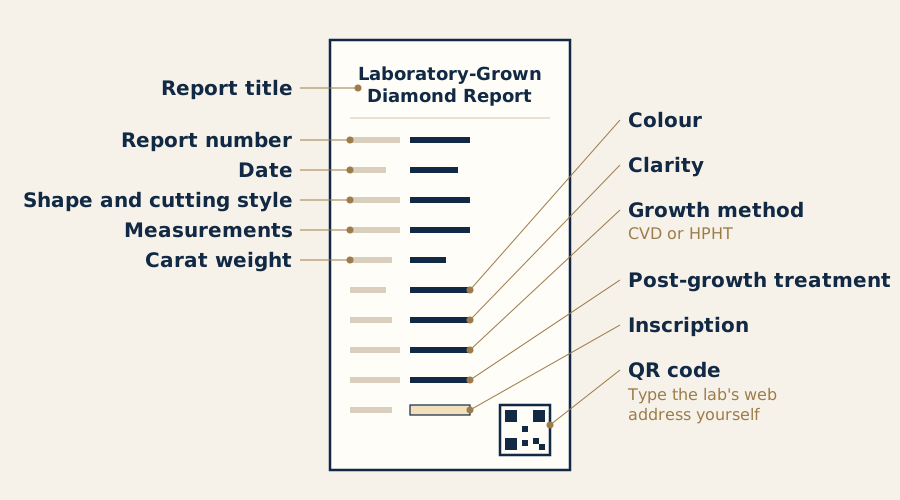
The shape and cutting style line uses standard trade names such as 'Cushion Modified Brilliant' or 'Emerald Cut'. If you are unsure what the wording means for your stone, our overview of diamond shapes and cutting styles shows each one, so you can confirm the outline on the report is the outline in front of you.
Two fields are specific to lab-grown stones. The growth method is either CVD (chemical vapour deposition, where carbon from a gas builds up layer by layer on a seed plate) or HPHT (high pressure, high temperature, which recreates the conditions deep in the earth). Our article on how CVD and HPHT diamonds are grown explains both. Many CVD diamonds are then heat-treated after growth to improve colour, and a good report says so.
For a field-by-field explanation using a real layout, see our line-by-line walkthrough of an IGI lab-grown report. Note too that GIA announced in 2025 that it would move its lab-grown reports away from the traditional D-to-Z colour and Flawless-to-Included clarity scales towards simpler descriptions, so a recent GIA lab-grown report may look different from an older one. Both can be genuine.
How do you verify a lab-grown diamond report online?
Every major lab keeps a free online database of the reports it issues. The lookup takes about a minute and is the single most useful check you can do.
- Type the lab's web address yourself. Go to igi.org, gia.edu or the relevant lab's site directly. Do not rely on a link, PDF or QR code supplied by the seller, because a fake document can point to a fake site.
- Enter the report number exactly. IGI lab-grown numbers are usually nine or ten digits; GIA numbers are usually ten. Leave off any 'LG' prefix unless the site asks for it.
- Read the result, not just whether one appears. Confirm it says laboratory-grown, then compare shape, measurements, carat, colour and clarity line by line with the paper or PDF you were given.
- Download the lab's own PDF. Where the site offers one, compare it with the seller's copy. Any difference in a single digit is a reason to stop and ask.
- Note the date and any comments. Treatment notes, inscription text and comments should match too.
| Lab | Where to verify | Common on lab-grown in Australia? | Inscription style (typical) |
|---|---|---|---|
| IGI | igi.org, Verify Your Report | Yes, the most common | 'LG' plus the report number |
| GIA | gia.edu, Report Check | Less common | 'LABORATORY-GROWN' plus the report number |
| GCAL | gcalusa.com report lookup | Occasional | Report number, sometimes with a logo |
| HRD Antwerp | hrdantwerp.com report check | Occasional | Report number with lab-grown wording |
The process for GIA numbers is set out in our guide to checking a GIA report number step by step. You may also come across older reports from other labs; our explainer on what AGS reports cover is useful if you are comparing paperwork across labs. If a report comes from a lab you cannot find online, or whose website has no lookup, treat it as a seller's description rather than independent grading.
How do you read a lab-grown diamond inscription?
The inscription is laser-etched into the girdle, the narrow band around the widest part of the stone. The characters are microscopic, far too small to read with the naked eye, and only a few microns deep, so they do not affect the diamond's appearance or grade. You need at least a 10× loupe (a jeweller's magnifier); a 20× to 40× microscope makes it much easier.
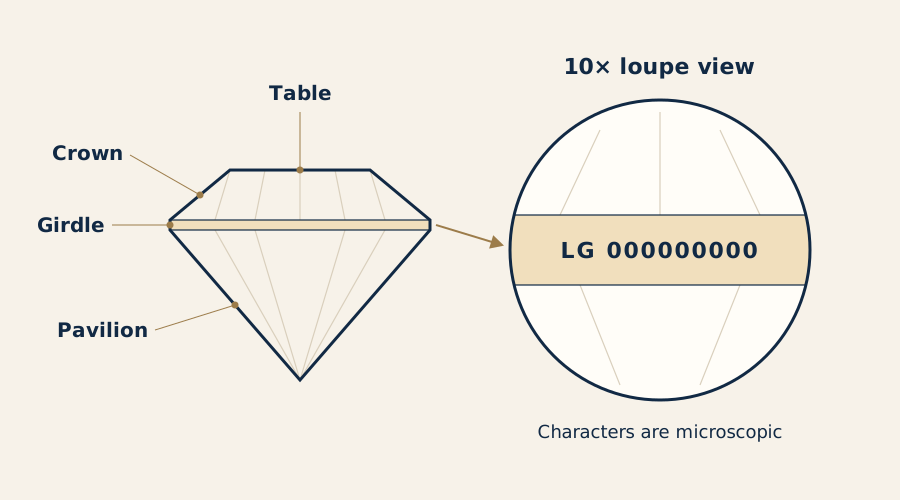
- Hold the stone side-on. In a ring, tilt it so you look along the girdle between the claws. A claw sometimes covers part of the number, so rotate slowly.
- Use soft, angled light. Direct light washes out the etching; light from one side makes the characters stand out.
- Read every character. Check the prefix ('LG' on most IGI lab-grown stones, 'LABORATORY-GROWN' on GIA) and every digit of the number.
- Compare with the report. The report lists the inscription text, which should match exactly, including any logo or extra words.
An inscription is strong evidence, but it is not proof on its own. A number can be polished off during re-cutting, and any laser can etch any number onto any diamond. That is why the measurement check in the next section matters. Our article on what a laser inscription can and cannot prove goes deeper into these limits.
Not sure which one is right?
Send us the stones you are looking at and our gemologist will tell you which to choose and why.
How do you match the diamond to its report?
The aim is to show that the physical stone fits the report so closely that it could not reasonably be another diamond. A jeweller or valuer can do all of these checks in a few minutes; some you can do yourself.
| Check | Tool | Acceptable match (approximate) |
|---|---|---|
| Carat weight | Calibrated carat scale (loose stones only) | Within 0.01 ct |
| Measurements | Digital or Leveridge gauge | Within about 0.02–0.03 mm per dimension |
| Shape and outline | Eye and loupe | Same shape and cutting style |
| Inclusions | 10× loupe or microscope, compared with the plot | Same type and position where a plot is shown |
| Inscription | 10× loupe or microscope | Every character identical |
| Lab-grown identity | Diamond screening device | Flags as lab-grown or 'refer for further testing' |
If the report names a less common cut, compare the outline against our reference to all 34 diamond cuts before assuming there is a mismatch; a 'cushion' on one report and a 'modified square' on another can describe very similar stones.
A mounted diamond cannot be weighed accurately, so the measurements and inclusions carry more weight. The plotting diagram (a map of inclusions on the report, where included) is useful here: inclusions are as individual as fingerprints. CVD diamonds may show tiny dark pinpoints or graphite specks, while HPHT diamonds can contain small metallic flux inclusions, a clue linked to growth methods that leave tell-tale inclusions.
Remember what the report does not cover: it says nothing about the setting, the claws, the metal or whether the stone has been chipped since grading. Our page on the things a grading report leaves out lists the gaps worth checking separately.
How can you tell if a lab-grown diamond certificate is fake?
Most reports are exactly what they say they are. Problems tend to follow a few recognisable patterns:
- No online record, or a record that only appears through a link the seller provided.
- A record that differs from the paper copy in any field: one grade higher, a different weight, different measurements.
- A natural diamond report attached to a lab-grown stone. This is the most serious risk, because of the price gap between the two.
- No inscription, or an inscription that is partly polished away, where the report lists one.
- A lab you cannot find or an in-house 'certificate' presented as independent grading.
- Blurry PDFs, odd fonts or missing security features such as holograms or microprint on printed reports.
- Missing growth method or treatment details on a report that normally includes them.
Natural diamonds have their own paperwork, and a stone sold with origin reports for natural diamonds should never turn out to be lab-grown. If the inscription has been removed or altered, ask for the stone to be re-graded by the lab, which issues a new report and usually a new inscription; our article on the limits of girdle inscriptions explains why re-cutting can remove one legitimately too.
What do Australian rules say about lab-grown diamond disclosure?
Australia has no single law written specifically for diamond reports, but the Australian Consumer Law applies to every jewellery sale. Section 18 prohibits misleading or deceptive conduct, and section 29 prohibits false or misleading representations about the standard, quality, composition or history of goods. Describing a lab-grown diamond as natural, or leaving out that it is lab-grown when that matters to the buyer, would fall foul of those rules. The ACCC (Australian Competition and Consumer Commission) enforces them.
In practice, the jewellery trade uses the terms laboratory-grown, lab-grown and synthetic for these diamonds, following international nomenclature such as CIBJO's guidelines. A seller should state it on the receipt or invoice, not just in conversation. Ask for an invoice that records the report number and says laboratory-grown in writing.
Why it matters so much: a 1 carat lab-grown round, G–H colour, VS clarity, retails in Australia for roughly AUD 800–3,000, while a comparable natural diamond is roughly AUD 7,000–15,000. A mix-up in either direction is a large amount of money, and for insurance you need the valuation and the report to agree. Our comparison of how natural and lab-grown reports differ shows what changes on the page.
Can a jeweller tell lab-grown from natural without the report?
Not with the basic tools. The handheld thermal and electrical testers many jewellers own confirm that a stone is diamond (rather than moissanite or cubic zirconia), but they cannot tell a natural diamond from a lab-grown one, because both are diamond.
Separating the two needs diamond screening devices that measure how the stone absorbs or fluoresces under ultraviolet light, and for difficult cases, a full laboratory with spectroscopy and imaging that reveals growth patterns. CVD diamonds tend to show layered growth, HPHT diamonds show geometric growth sectors, and natural diamonds show patterns neither process copies. This is the evidence behind the 'laboratory-grown' line on a report, which is one reason the chemistry that makes a lab-grown stone diamond does not change the need for paperwork.
| Natural diamond report | Lab-grown diamond report | |
|---|---|---|
| Title | Diamond Grading Report | Laboratory-Grown Diamond Report |
| Growth method | Not listed | CVD or HPHT |
| Post-growth treatment | Noted if detected (e.g. HPHT, irradiation) | Often listed; many CVD stones are treated |
| Inscription | Report number | 'LG' or 'LABORATORY-GROWN' plus number |
| Origin information | Sometimes, on origin reports | Not applicable |
| Typical labs in Australia | GIA, IGI, HRD | IGI most common, also GIA, GCAL |
Any lab-grown diamond you are considering should come with its report number, so you can run every check above before you decide. For background on prices, growth and grading in one place, our overview of lab-grown prices, growth and grading is the starting point.
Browse lab-grown diamonds
How to verify a lab-grown diamond report: step by step
- Get the report number in writing. Ask for it on the listing or invoice, along with the issuing lab's name.
- Look it up yourself. Type the lab's address into your browser and enter the number; ignore seller-supplied links and QR codes.
- Confirm 'laboratory-grown'. The online record should say it clearly, with the growth method and any treatment.
- Compare every field. Shape, measurements, carat, colour, clarity and inscription text should match the copy you were given exactly. Our guide to decoding each field on an IGI report helps here.
- Read the inscription. Clean the stone and use a 10× loupe or ask the jeweller to show you under a microscope.
- Match the measurements. Ask for a gauge reading (and a weight for loose stones) and compare with the report.
- Keep records. Save the lab's PDF, the invoice stating laboratory-grown and any valuation, and give copies to your insurer.
Free consultation
Talk to a gemologist
Compare stones in person or online with Raj Sood, Graduate Gemologist (GIA), AJP (GIA).
Book a consultationShop this shape
FAQ
Common questions
How do I check if my IGI lab-grown report is real?
Go to igi.org yourself, open Verify Your Report and enter the report number. The online record should match your copy in every field and state that the diamond is laboratory-grown.
Do all lab-grown diamonds have a laser inscription?
Most lab-grown diamonds graded by IGI and GIA are inscribed, but not every lab-grown diamond is graded or inscribed, particularly very small stones. If the report lists an inscription, the stone should carry it.
Can I read a diamond inscription without a loupe?
No. The characters are microscopic and need at least 10× magnification, and a 20× to 40× microscope is easier. Any jeweller can show it to you in a few minutes.
Does a matching inscription prove the diamond matches the report?
It is strong evidence but not proof on its own, because a number can be etched onto any stone. Matching measurements, weight and inclusions confirm it.
Can a normal diamond tester tell if a diamond is lab-grown?
No. Basic thermal and electrical testers only confirm that the stone is diamond. Separating lab-grown from natural needs specialised screening devices or a gem laboratory.
What should I do if the report does not match the diamond?
Stop and ask the seller for an explanation in writing. If it is not resolved, a gem lab can re-grade the stone, and under the Australian Consumer Law you have rights if goods were misdescribed.

Ask a gemologist
Not sure which diamond to choose?
Raj Sood is a Graduate Gemologist (GIA) and master jeweller. Bring the stones you are considering, or send the reports, and he will tell you honestly which one is better and why.
Keep learning
Related guides
 Lab-Grown DiamondsHow to Read an IGI Report for a Lab-Grown Diamond
 Certificates & ValuationsDiamond Laser Inscription: What It Does and Does Not Prove
 Certificates & ValuationsHow to Verify a GIA Report Number
 Certificates & ValuationsNatural vs Lab-Grown Diamond ReportsLab-Grown DiamondsLab-Grown Diamonds GuideCertificates & ValuationsDiamond Origin Reports ExplainedCertificates & ValuationsAGS Diamond Reports ExplainedLab-Grown DiamondsAre Lab-Grown Diamonds Real Diamonds
Explore more
More guides on this topic
Education