
- Education
- Diamond 4Cs & Grading
- Clarity Enhanced Diamonds: Laser Drilling and Fracture Filling Explained
Diamond 4Cs & Grading
Clarity Enhanced Diamonds: Laser Drilling and Fracture Filling Explained
Some diamonds look cleaner than their natural clarity because they have been treated. Here is how laser drilling and fracture filling work, how to spot them on a report, and what they mean for durability, care and price.
 Reviewed by Raj Sood, Graduate Gemologist (GIA), AJP (GIA)Master jeweller and Graduate Gemologist (GIA) · reviewed 4 November 2026
Quick answer
Clarity enhanced diamonds are natural diamonds treated to make inclusions less visible. Laser drilling burns a tiny channel to a dark inclusion and bleaches it; fracture filling injects glass into surface-reaching cracks. Drilling is permanent and graded by GIA. Filling is not permanent, can be damaged by heat, and GIA will not grade filled stones. Both must be disclosed.
What are clarity enhanced diamonds?
A clarity enhanced diamond is a diamond that has been treated to make its inclusions (internal features such as crystals and cracks) or blemishes (surface features such as scratches and nicks) less noticeable. Clarity is one of the four Cs that set a diamond's grade and price, and because one step on the clarity scale can move the price a long way, there is a commercial reason to make a stone look cleaner than nature left it.
Two treatments account for almost all clarity enhancement in diamond: laser drilling, which targets dark inclusions, and fracture filling, which hides cracks that reach the surface. They work very differently, labs report them differently and they hold up very differently over time, so it pays to treat them as two separate questions rather than one category.
Neither treatment changes what the stone is. A drilled or filled natural diamond is still natural diamond: 10 on the Mohs hardness scale, with a refractive index (how strongly it bends light) of about 2.42. What changes is how it looks, how it must be cared for and what it is worth. If any grading terms here are new, our guide to the FL to I3 clarity scale sets out each grade, and our glossary of jewellery terms defines the rest.
| Laser drilling | Fracture filling | |
|---|---|---|
| What it targets | Dark crystals and spots inside the stone | Feathers and cleavages that reach the surface |
| How it works | Laser channel to the inclusion, then acid bleaching | High refractive index glass forced into the crack |
| Permanent? | Yes | No; the filler can be damaged or lost |
| Graded by GIA? | Yes, the drill hole counts as an inclusion | No; GIA does not issue a grading report |
| Main giveaway under a loupe | Fine white tunnel running in from the surface | Coloured flash when the stone is tilted |
| Care and repair risk | Low | High: heat, ultrasonic cleaning, acids, repolishing |
How does laser drilling a diamond work?
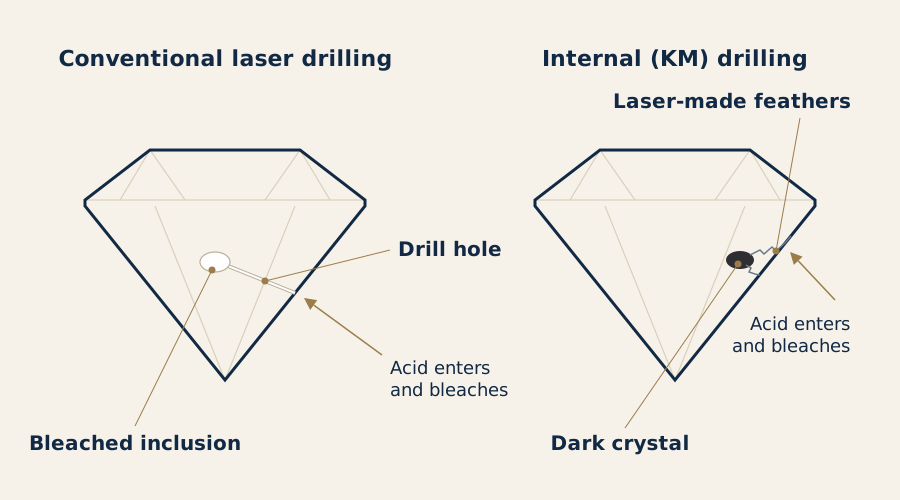
In conventional laser drilling, a focused laser beam burns a narrow channel from the surface of the diamond down to a dark inclusion, often a crystal of another mineral or a black spot of graphite. The channel is very fine, usually a small fraction of a millimetre across (figures of around 0.02 mm or less are often quoted), and from the side it looks like a thin white thread. Once the channel reaches the inclusion, the stone is boiled in strong acid. The acid travels down the tunnel and dissolves or bleaches the dark material, so the black spot turns white or nearly disappears. The technique has been in commercial use since about 1970.
A newer method, usually called internal laser drilling or KM drilling (from the Hebrew kiduah meyuhad, meaning special drilling), appeared in the late 1990s. Instead of boring a straight tunnel, the laser heats a dark inclusion close to the surface until it expands and creates or extends small feathers that run out to the surface. Acid then enters through those feathers and bleaches the inclusion. The result looks much like a natural feather, often with a stepped or worm-like pattern, which makes it harder to spot than a classic drill hole.
Drilling is mostly used on lower clarity stones where a single dark crystal is dragging the grade down, typically included I1 to I3 diamonds and SI2 stones with an obvious black spot. It rarely lifts a stone by more than about one grade, because the drill hole is itself an inclusion that counts against clarity. What it mainly improves is how the stone looks face-up: a white or pale inclusion is far less noticeable to the eye than a black one.
What is a fracture filled diamond?
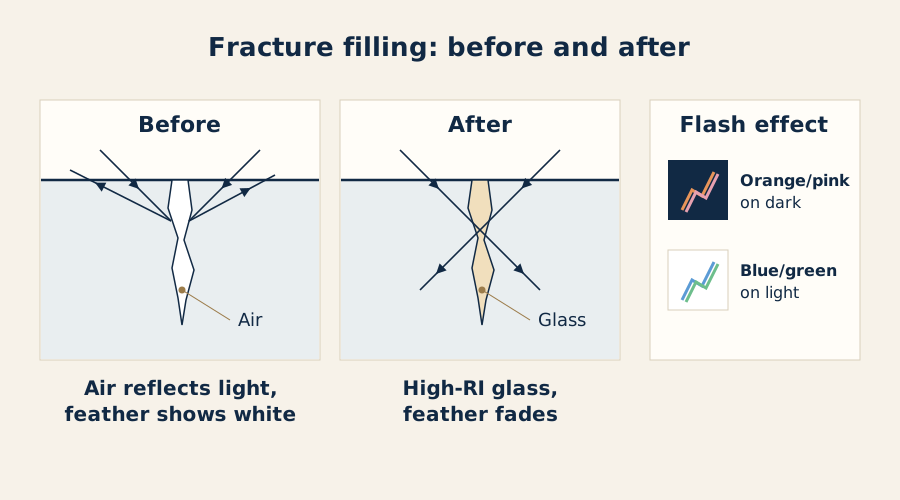
A fracture is a break inside the diamond. In grading language it is called a feather, or a cleavage if it runs along one of the crystal's natural planes of weakness. Air trapped in the break reflects light, so a feather usually looks white, grey or silvery. Fracture filling replaces that air with a glass, usually a lead-based glass with a high refractive index, pushed into the crack under heat and vacuum or pressure. Because the glass bends light in a similar way to diamond, the crack seems to fade away.
The process was developed commercially in Israel in the early 1980s and is often associated with Zvi Yehuda, which is why older trade references sometimes call filled stones Yehuda diamonds. Only fractures that reach the surface can be filled, since the glass needs a way in; open laser drill holes are sometimes filled at the same time. On a heavily included stone, filling can make the diamond look noticeably cleaner, sometimes by two clarity grades or more, which is exactly why it must be disclosed.
The weakness is simple: the filler is glass, not diamond. It is much softer, it melts at a far lower temperature and it can react with chemicals that diamond ignores. The original crack is still there underneath, and the filling does nothing to make the stone stronger.
Coloured stones are treated in a similar spirit. Our guide to how emeralds are oiled and resin-filled covers that side. The key difference is that clarity treatment of emerald is close to routine, while fracture filling in diamond is a minority treatment with a much larger effect on value.
Related guideEmerald Inclusions and Clarity EnhancementHow does a grading report show a laser drill hole or filling?
Laser drilled diamonds are graded normally by GIA and most other major labs. The drill hole is treated as an inclusion: it is drawn on the clarity plot (the diagram of the stone that maps its inclusions, with internal features in red) and listed as a laser drill hole in the key to symbols. The clarity grade you see already includes the effect of the hole. For internal (KM) drilling, the feathers created are plotted and a comment such as "internal laser drilling present" is added.
Fracture filled diamonds are a different story. GIA does not issue a grading report on a filled diamond, because the grade could change if the filler is damaged; it will identify the stone as clarity enhanced instead. Some other labs will describe a filled stone and note the treatment, but any clarity grade given then applies to the stone as enhanced, not its natural state. Always read the comments section, not just the grade.
| Treatment | Graded by GIA? | How it appears on the report | On the clarity plot |
|---|---|---|---|
| Untreated | Yes | No treatment comment | Normal inclusion symbols only |
| Conventional laser drilling | Yes | Laser drill hole listed in key to symbols | Red line running from the surface to the inclusion |
| Internal (KM) laser drilling | Yes | Comment noting internal laser drilling | Plotted as feathers, in red |
| Fracture filling | No | Identified as clarity enhanced; not graded | Not issued as a graded plot |
One point of confusion: a laser inscription is not laser drilling. Many labs inscribe the report number on the girdle (the thin outer edge) with a laser, which leaves the clarity untouched. Our guide to what a girdle inscription can and cannot prove explains why the number links a stone to a report but does not, on its own, confirm the stone is untreated.
Not sure which one is right?
Send us the stones you are looking at and our gemologist will tell you which to choose and why.
How can you tell if a diamond is laser drilled or fracture filled?
A report from a major lab is the reliable answer, but there are signs you or your jeweller can check with a 10× loupe (the standard grading magnifier). For drilling, look at the stone from the side and from slight angles: a conventional drill hole shows as a perfectly straight, fine white line running in from a facet, sometimes with a tiny opening visible on the surface. Natural inclusions are almost never that straight. KM drilling is harder, and usually needs a trained eye or a lab.
For filling, the classic giveaway is the flash effect. Tilt the stone and watch the feather: against a dark background (darkfield lighting), a filled fracture flashes orange, pink or purple; against a bright background (brightfield), it flashes blue, green or yellow. Other signs include tiny trapped bubbles, flow lines or a crackled texture inside the feather, and a faint yellow or brown tint where the glass is thick.
- Straight white tunnels running in from the surface suggest a laser drill hole.
- Coloured flashes in a feather as the stone moves suggest fracture filling.
- Bubbles or flow marks inside a feather suggest glass filler.
- A grade that seems too clean for the price deserves a closer look at the report comments.
Are clarity enhanced stones eye-clean? Often they look close to it face-up, which is the point of the treatment. But they start from low clarity, and a bleached crystal or a filled feather can still show as a pale area, especially in a large stone. A genuinely eye-clean VS2 diamond or a stone at the VS1 grade starts with small inclusions that need no help. Shape matters too: step cuts such as the Asscher have large open facets that show inclusions and treatment more plainly than brilliant cuts.
Are clarity enhanced diamonds durable? Risks and care
Laser drilled diamonds are about as durable as an untreated stone of the same clarity. The treatment is permanent: there is nothing to wear out or leach away. The open channel can collect dirt over time, and the original inclusion is still inside the stone, so a large crystal close to the girdle remains a weak spot just as it would in an undrilled diamond. KM drilling extends feathers, so it can add a small amount of risk if those feathers are near an edge.
Fracture filled diamonds need real care, because the glass is far more vulnerable than diamond. The usual causes of damage are:
- A jeweller's torch during resizing, retipping claws or repairs near the stone. The heat can boil, crack or cloud the filler.
- Ultrasonic and steam cleaners, which can loosen or etch the filler over time.
- Repolishing a chipped or worn stone, which can expose and damage the filling.
- Strong acids, such as the pickling solutions used after soldering.
- Extreme heat, for example in a house fire.
When a filling fails, the feather reappears, sometimes looking worse than before because the glass has clouded or partly drained. Some stones can be refilled, but the result is never certain. This is our gemmologist risk rating for each type:
| Diamond type | Everyday wear risk | Cleaning and repair risk | Our risk rating |
|---|---|---|---|
| Untreated, eye-clean | Low | Low | Low |
| Conventional laser drilled | Low | Low | Low |
| Internal (KM) laser drilled | Low to moderate | Low | Low to moderate |
| Fracture filled | Moderate | High (heat, ultrasonic, acids) | High |
For a filled diamond, the safe routine is warm water, a mild detergent and a soft brush. Tell any jeweller about the treatment before work begins, so the stone can be removed or protected before heat is applied, and make sure your insurer knows the stone is treated.
Are clarity enhanced diamonds worth it? Price and value
Treatment lowers value because the market prices untreated diamonds higher, and because a filled stone carries care limits. A laser drilled diamond usually costs somewhat less than an untreated stone of the same grade. A fracture filled diamond usually costs much less than an untreated stone that looks similar, because what you are really buying is a lower clarity stone made to look cleaner. The ranges below are broad and for comparison only.
| 1 ct round, G–I colour | What you get | Approximate price range (AUD) |
|---|---|---|
| Natural, untreated SI2 | Graded clarity, no care limits | about $4,000–$8,000 |
| Natural, laser drilled SI2 | Graded clarity including the drill hole | about $3,000–$6,500 |
| Natural, fracture filled (looks SI, natural I1–I2) | Not graded by GIA; care limits | about $1,500–$4,000 |
| Lab-grown, untreated VS | Graded clarity, no care limits | about $800–$2,500 |
So is a clarity enhanced diamond worth it? A fully disclosed laser drilled stone, priced as drilled, can be a sensible way to get more size for the money, especially in a protective setting. A filled diamond can suit someone who wants a large look on a tight budget and accepts the care rules, but it is a poor choice if you expect to resize often, or want a stone that will pass to the next generation without special handling. Resale is also harder for filled stones.
If you would rather put the money into natural clarity, compare what each step buys you: the near-invisible inclusions of VVS1 diamonds and VVS2 diamonds, or the rare top of the scale in flawless and internally flawless stones. Our guides on whether VVS is worth the extra cost and how to split your budget between colour and clarity help weigh that up.
Browse natural and lab-grown diamonds
Are lab-grown diamonds ever clarity enhanced?
Clarity treatment of lab-grown diamonds is uncommon. Laboratory-grown diamonds, made by the CVD (chemical vapour deposition) or HPHT (high pressure, high temperature) methods, are real diamond with the same hardness and refractive index as natural, and most reach the market in clean grades such as VS or better. Because a cleaner lab-grown stone is already affordable, there is little reason to drill or fill one.
The post-growth treatment you are more likely to see in lab-grown diamonds is for colour, such as HPHT annealing of CVD stones to remove a brown tint. A report from a lab such as GIA or IGI will state that the diamond is laboratory-grown and note any post-growth treatment. Our guide to what clarity to expect in lab-grown diamonds covers the inclusions each growth method tends to leave.
How to check a diamond for clarity treatment: step by step
Clarity choices also depend on shape, since some cuts hide inclusions far better than others; see our colour and clarity pairings for each diamond shape. Whatever you choose, these checks will tell you whether a stone has been treated.
- Ask for the report. Confirm it comes from an independent lab and that the number on the report matches the girdle inscription, if there is one.
- Read the comments section. Look for wording such as laser drill hole, internal laser drilling or clarity enhanced, and check whether the stone is natural or lab-grown.
- Check the clarity plot. A straight red line from the surface to an inclusion marks a drill hole.
- Ask the seller directly. Ask in writing whether the diamond has been drilled, filled or otherwise treated.
- Look under a loupe. Tilt the stone against dark and light backgrounds and watch any feathers for coloured flash.
- Plan care and repairs. If the stone is filled, note it on your insurance and tell any jeweller before resizing or claw work.
Free consultation
Talk to a gemologist
Compare stones in person or online with Raj Sood, Graduate Gemologist (GIA), AJP (GIA).
Book a consultationShop this shape
FAQ
Common questions
Is a laser drilled diamond a real diamond?
Yes. A laser drilled diamond is still natural diamond; only a tiny channel has been made to bleach a dark inclusion. The drill hole counts as an inclusion and is included in the clarity grade.
Does fracture filling wear off?
It does not usually wear off in normal wear, but it is not permanent. Heat from a jeweller's torch, ultrasonic or steam cleaning, acids and repolishing can damage the filler and make the crack reappear.
Does GIA grade clarity enhanced diamonds?
GIA grades laser drilled diamonds and notes the drilling on the report. It does not issue grading reports on fracture filled diamonds and identifies them as clarity enhanced instead.
Do sellers have to tell you if a diamond is fracture filled?
Yes. Under Australian Consumer Law a seller must not mislead you, and a treatment that affects value and care, such as fracture filling, should be disclosed clearly before you buy.
Are clarity enhanced diamonds cheaper?
Yes. Laser drilled diamonds usually cost somewhat less than untreated stones of the same grade, and fracture filled diamonds cost much less than untreated stones that look similar.
Can a fracture filled diamond be resized or repaired?
Often, but the stone should be removed from the ring or carefully protected from heat first. Always tell the jeweller the diamond is filled before any work starts.

Ask a gemologist
Not sure which diamond to choose?
Raj Sood is a Graduate Gemologist (GIA) and master jeweller. Bring the stones you are considering, or send the reports, and he will tell you honestly which one is better and why.
Keep learning
Related guides
 Diamond 4Cs & GradingUnderstanding Diamond Clarity Grades: FL to I3 Explained
 Certificates & ValuationsDiamond Laser Inscription: What It Does and Does Not Prove
 Diamond 4Cs & GradingI1 to I3 Clarity Diamonds
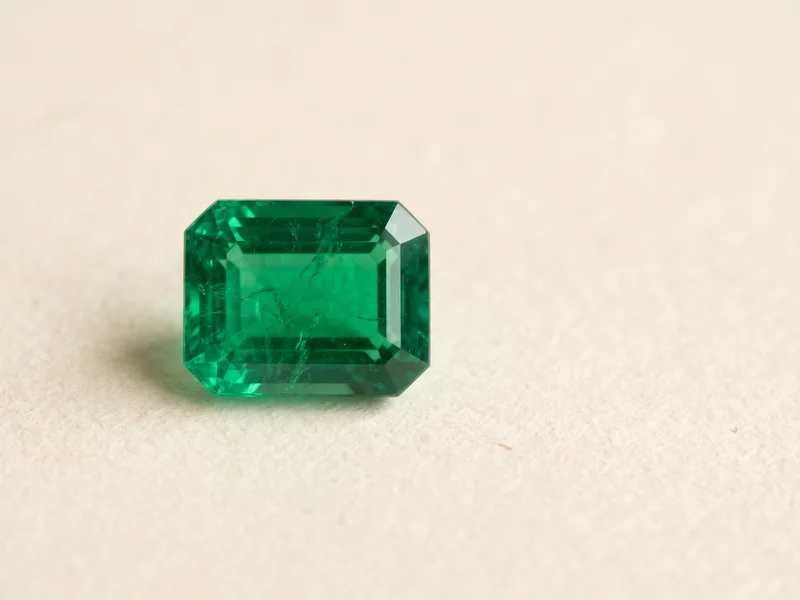 Diamond 4Cs & GradingEmerald Inclusions and Clarity EnhancementDiamond 4Cs & GradingDiamond 4Cs
 Diamond 4Cs & GradingVS2 Clarity Diamonds
 Diamond 4Cs & GradingVS1 Clarity DiamondsDiamond 4Cs & GradingVVS2 Clarity Diamonds
Explore more
More guides on this topic
Education