
- Education
- Diamond 4Cs & Grading
- Laser Drill Holes in Diamonds: What They Are, How to Spot Them and What They Mean
Diamond 4Cs & Grading
Laser Drill Holes in Diamonds: What They Are, How to Spot Them and What They Mean
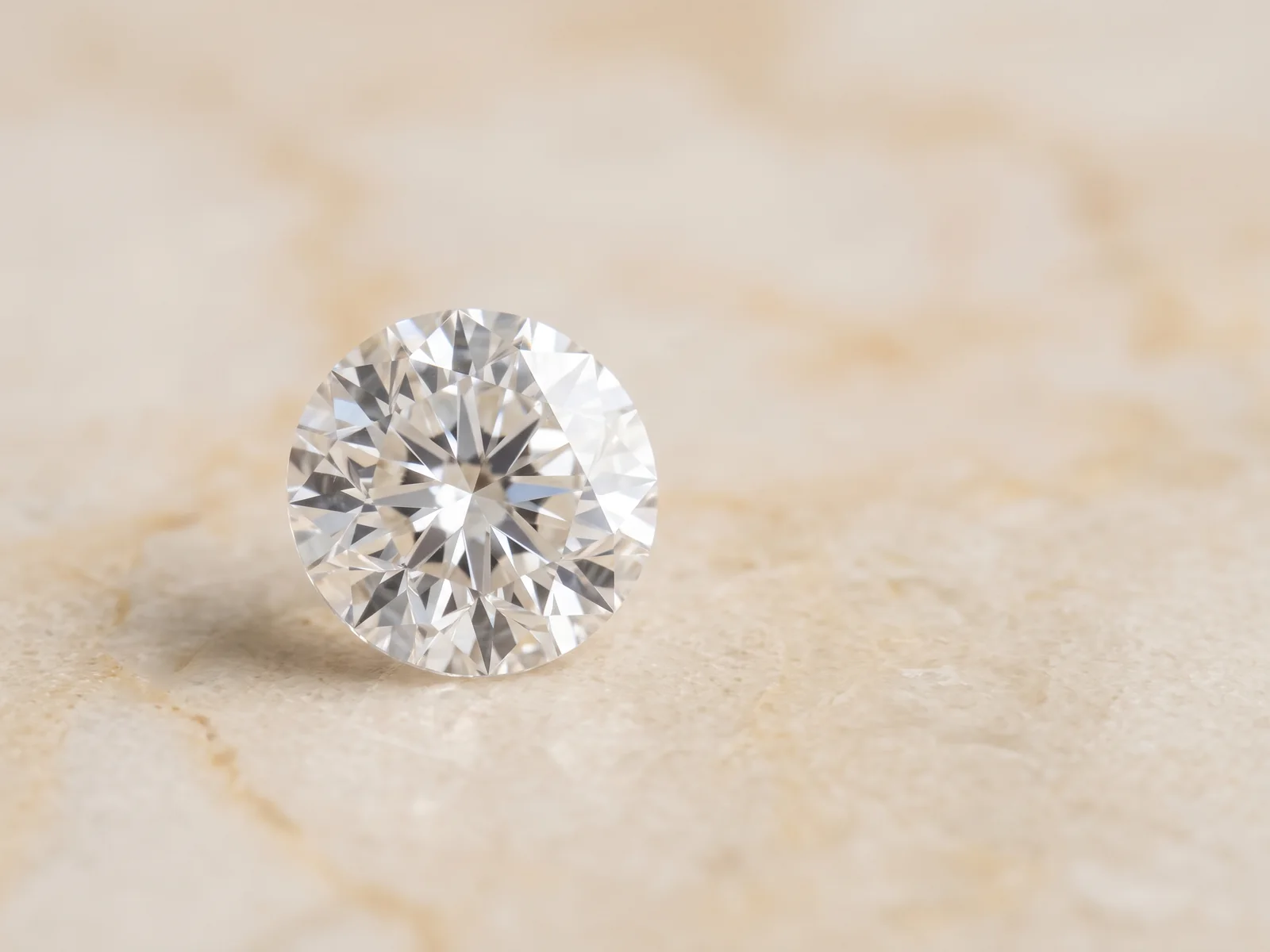
Laser drill holes in diamonds are one of the few clarity features made by people, not nature. Knowing how to spot one, and what it means for durability and price, stops a treated stone being mistaken for an untreated one.
 Reviewed by Raj Sood, Graduate Gemologist (GIA), AJP (GIA)Master jeweller and Graduate Gemologist (GIA) · reviewed 4 November 2026
Quick answer
Laser drill holes are tiny tunnels burned into a natural diamond with a laser to reach a dark inclusion, which is then bleached with acid so it looks lighter. They are a permanent clarity treatment, must be disclosed, and are plotted and named on grading reports. They rarely threaten durability but lower the value.
What are laser drill holes in diamonds?
A laser drill hole is a tiny tunnel burned into a diamond with a focused laser beam. Its only job is to reach a dark inclusion (a crystal or other feature trapped inside the stone) so that the inclusion can be bleached or dissolved and become far less noticeable. Drilling is a clarity treatment: it changes how clean a diamond looks, and clarity is one of the four Cs used to grade every diamond.
Almost everything a gemmologist sees inside a diamond formed naturally, deep in the earth, long before the stone was mined. Laser drill holes are different. They are made by people, after the diamond has been cut, and they are permanent: the tunnel cannot be closed again. That is why laser drilling must always be disclosed when the stone is sold. It sits alongside fracture filling as one of the two main ways clarity is enhanced, and our guide to laser drilling and fracture filling side by side covers both treatments.
Diamond is 10 on the Mohs hardness scale, with a refractive index (how strongly it bends light) of about 2.42. A drill hole does nothing to that hardness, and it does not change the diamond's colour or carat weight in any meaningful way. What it changes is the stone's clarity appearance, its clarity grade and, importantly, its price. Any unfamiliar word on this page is also defined in the GemTrove jewellery glossary.
How is a diamond laser drilled?
Laser drilling has been used commercially since about the early 1970s. The aim is always the same: a stone with an obvious black or dark grey inclusion, usually near the centre where it is easy to see through the table (the large flat top facet), is made to look cleaner. The process runs in four stages:
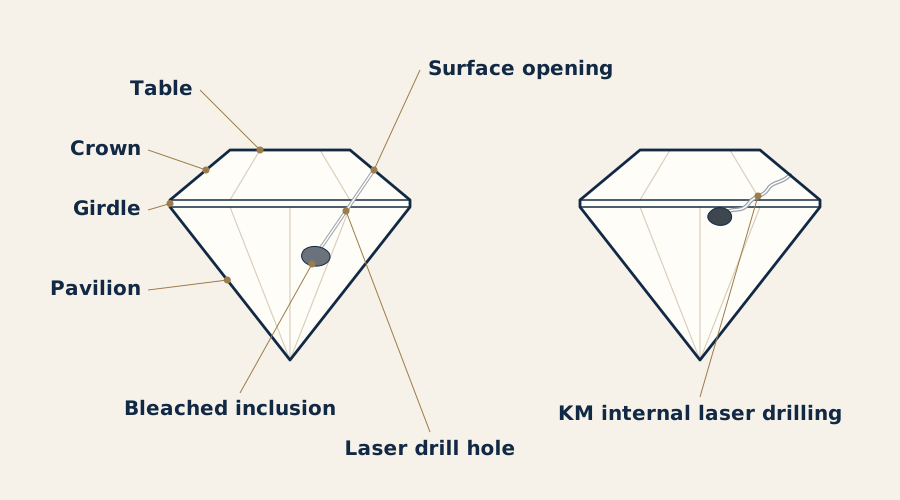
- Aim: the operator picks the shortest, least visible path from the surface to the dark inclusion, often entering through the crown or pavilion at an angle so the opening is hidden among facet reflections.
- Drill: an infrared laser heats a tiny spot until the diamond converts to graphite and burns away, pulse by pulse, leaving a narrow tunnel typically well under 0.2 mm across.
- Bleach: the stone is boiled in strong acid, which travels down the tunnel, cleans out the graphite and dissolves or bleaches the dark inclusion so it looks white or colourless.
- Fill (sometimes): the hole may be filled with a high-refractive-index glass to make the tunnel harder to see. A filled stone is no longer just drilled; it is also clarity enhanced by filling, and many labs will not give it a clarity grade.
Since about the late 1990s a second method has been in use, often called KM drilling, from the Hebrew kiduah meyuhad, meaning special drilling. Instead of boring a straight tunnel, the laser heats an inclusion lying close to the surface until a small crack (a feather) opens from the inclusion to the outside. Acid then reaches the inclusion through that crack. The result looks much more like a natural feather, with an irregular, worm-like or stepped outline, which makes KM drilling harder to recognise. Grading reports usually describe it as internal laser drilling.
Both methods only make sense on stones where the dark inclusion is the main thing holding the grade and appearance back. A diamond with a scattered cloud or many small crystals gains little from drilling, so most drilled stones started life with one or two obvious dark spots.
How are laser drill holes shown on a grading report?
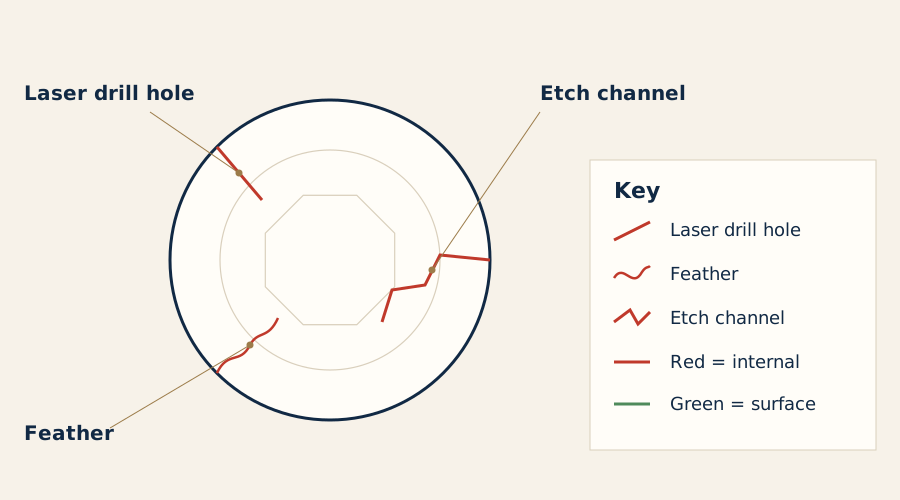
A diamond grading report includes a plotting diagram: an outline of the stone, face-up and face-down, with each clarity characteristic drawn where it sits. Internal features are drawn in red and surface features in green. A laser drill hole is drawn in red as a short, straight line running in from the surface, and the key beside the diagram names it as a laser drill hole. GIA and IGI both grade laser-drilled diamonds, because the treatment is permanent and stable, and the drill hole counts towards the clarity grade like any other feature.
| Report wording | Where you see it | What it means |
|---|---|---|
| Laser drill hole | Plot key and list of clarity characteristics | A straight tunnel was drilled to a dark inclusion |
| Internal laser drilling | Usually in the comments | KM-style drilling: a feather was opened to the surface by laser |
| Clarity enhanced / filled | Report heading or comments; some labs will not grade the stone | The stone, or its drill hole, contains a glass filler |
| Laser inscription | Inscription line on the report | Not a treatment: text such as the report number written on the girdle |
That last row trips people up. A laser inscription is a tiny line of text written on the girdle (the thin outer edge). It is shallow, it sits on the surface and it has nothing to do with clarity. Our article on what a girdle inscription can and cannot prove explains how to use it to match a stone to its paperwork. The report will also list fluorescence (a glow under ultraviolet light), which is likewise unrelated to drilling; see how fluorescence is graded from None to Very Strong.
Related guideClarity-Enhanced Diamonds: Laser Drilling and Fracture FillingLaser drill hole vs etch channel: how can you tell them apart?
Several natural features can look like a drill hole under a loupe (a 10× hand magnifier). The most confusing is the etch channel, a natural tunnel dissolved into the diamond by hot fluids while it was still in the earth. Our guide to naturally formed etch channels shows them in detail. The table sets out the main differences.
| Feature | Made by | Shape under 10× | Reaches surface? | Treatment? |
|---|---|---|---|---|
| Laser drill hole | People (laser) | Dead-straight tube of even width, ending at a bleached inclusion | Yes, a tiny round opening | Yes |
| KM drilling | People (laser) | Irregular, worm-like or stepped feather leading to a bleached inclusion | Yes | Yes |
| Etch channel | Nature (dissolution) | Straight or angular, often square in section, can change direction | Yes | No |
| Feather | Nature (stress) | Flat, wispy crack that can look white | Sometimes | No |
| Twinning wisp | Nature (crystal growth) | Twisted ribbon of pinpoints and clouds | No | No |
| Pit | Nature or polishing | Small cavity on the surface only, no tunnel | Surface only | No |
Other natural features sometimes mistaken for treatment include twinning wisps along a twin plane, knots, crystals that reach the surface and graining lines left by uneven growth. Around the edge, the hair-like bearding left when the girdle is shaped can also look like tiny tunnels. On the surface, small pits and extra facets and polishing burn marks and lizard skin are blemishes, not treatments.
Not sure which one is right?
Send us the stones you are looking at and our gemologist will tell you which to choose and why.
Are laser drill holes visible to the naked eye?
Usually not face-up. A drill hole is very narrow, and once the inclusion is bleached the tunnel appears as a fine white or colourless line. Seen from above through the table, it is often lost among the reflections of the facets. Viewed from the side, or with the stone tilted, a longer hole can show as a faint white thread.
Whether a drilled stone is eye-clean (no features visible without magnification at a normal viewing distance of about 25–30 cm) depends on three things: how big the original inclusion was, how well it bleached, and how many holes were needed. Some stones need two or three holes to reach one large crystal. The bleached inclusion often remains as a white or slightly grey patch, which can still be visible even when the hole itself is not.
Drilled diamonds mostly fall in the SI (slightly included) and I (included) clarity grades, because drilling is only worth doing on stones that had an obvious dark inclusion. Size matters as well: a drill hole is easier to hide in smaller diamonds from 0.25 to 0.4 carat, where everything is seen at a smaller scale, than in a 2 carat centre stone.
Dirt is the other issue. An unfilled drill hole is open to the air, so skin oil, soap and grime can seep in over months of wear and turn the white line grey or dark again. A professional clean usually brings it back.
Do laser drill holes in diamonds affect durability?
A single, straight, unfilled drill hole removes only a minute amount of diamond and is not, on its own, a real threat to a stone's strength. It does not spread and it does not grow. The risk comes from what sits around it: KM drilling deliberately opens a feather to the surface, glass fillers can be damaged, and holes close to a thin edge leave less material where a knock lands. This is how a gemmologist would rate the risk for everyday wear:
| Situation | Risk rating | Why |
|---|---|---|
| One straight hole, unfilled, away from the girdle | Low | Tiny tunnel; the diamond around it is intact |
| Several holes to one inclusion | Low to moderate | More channels, and a bleached inclusion that may sit in a stressed area |
| KM internal laser drilling | Moderate | A feather has been opened to the surface on purpose and can extend with a hard knock |
| Drill hole filled with glass | Moderate | Filler can cloud or crack with heat, acids or harsh cleaning |
| Hole or KM feather near the girdle, a point or under a claw | Moderate to higher | Thin areas take the impacts, and claws add pressure |
Care is straightforward. An unfilled drilled diamond can be cleaned like any other diamond. If the hole is filled, avoid ultrasonic and steam cleaners and keep it away from strong heat. Either way, tell your jeweller the stone is drilled before any repair, resizing or re-tipping that uses a torch, so they can protect it or remove it first.
Are lab-grown diamonds ever laser drilled?
Laser drilling is almost entirely a natural-diamond treatment. Laboratory-grown diamonds can contain dark inclusions too, such as metallic flux in HPHT-grown stones or dark non-diamond carbon in CVD-grown stones, but lab-grown diamonds are now produced in such volume and at such prices that drilling an included one rarely makes commercial sense. Many lab-grown diamonds sold for jewellery grade VS or better.
Lab-grown diamonds are often treated in other ways, mostly after growth to improve colour, and that should also be stated on the report. Whatever the origin, the report should say clearly whether the stone is natural or lab-grown and whether it has been treated.
If clarity matters to you and budget is tight, a lab-grown diamond of higher clarity and an untreated natural diamond of lower clarity are both alternatives to a drilled natural stone. Each is genuine diamond; what differs is origin, rarity and price.
Browse diamonds: natural and lab-grown
How do laser drill holes in diamonds affect price?
A laser-drilled diamond sells for noticeably less than an untreated natural diamond with the same colour, clarity grade and carat, because the market places a higher value on untreated stones. How much less varies with how visible the hole and the bleached inclusion are, and with how many holes there are. Our page on the factors that set a diamond's value explains where treatment sits among cut, colour, clarity and carat.
| 1 ct round, G–H colour | Approximate price range (AUD) |
|---|---|
| Untreated, SI2 | about $5,000–$9,000 |
| Laser-drilled, SI2–I1 | about $3,000–$6,000 |
| Lab-grown, VS (for comparison) | about $800–$2,500 |
These are broad ranges only; prices move with the market and with the exact grades and cut. A drilled diamond can be a reasonable choice if you understand what you are getting and the price reflects the treatment. It suits someone who wants a natural diamond and is comfortable with an SI or I stone that looks clean face-up. It is less suitable if you specifically want an untreated stone.
There are other ways to get more visual size for the budget, from shape choice to halos; our tips on making a diamond look larger on the hand cover them. In multi-stone pieces, small drilled diamonds can sit among untreated ones, so check how the weight is described; the difference between ct, ctw and tcw explains the abbreviations.
How do you check a diamond for laser drilling? Step by step
- Read the report. Confirm whether the stone is natural or lab-grown and read the comments for any mention of laser drilling, internal laser drilling or clarity enhancement.
- Study the plot. Look in the key for a laser drill hole and find the straight red line on the diagram.
- Use a 10× loupe. Follow any fine line to the surface; a drill hole is straight, even in width and ends at a small round opening.
- Ask about filling. If the stone is drilled, ask whether the hole has been filled with glass, because that changes care and repairs.
- Judge it by eye. At about 25–30 cm, face-up, check whether the hole or the bleached inclusion is visible.
- Compare the price. Set it against untreated stones of the same colour, clarity and carat so the treatment is reflected in what you pay.
- Plan the setting. Keep drill holes and KM feathers away from claws and thin edges where possible.
Free consultation
Talk to a gemologist
Compare stones in person or online with Raj Sood, Graduate Gemologist (GIA), AJP (GIA).
Book a consultationShop this shape
FAQ
Common questions
Is a laser drilled diamond a real diamond?
Yes. Laser drilling only adds a tiny tunnel to reach an inclusion; the stone is still natural diamond with the same hardness and sparkle. It is a treated diamond, so the treatment must be disclosed.
Is a laser drilled diamond bad?
Not necessarily. A single unfilled drill hole is stable and low risk for everyday wear, but the stone is worth less than an untreated one of the same grades, so the price should reflect that.
Does GIA grade laser drilled diamonds?
Yes. GIA grades laser-drilled diamonds because the treatment is permanent, and the drill hole is plotted and counted in the clarity grade. GIA does not give clarity grades to fracture-filled diamonds.
Can you see laser drill holes without magnification?
Usually not face-up, because the hole is very narrow and hides among facet reflections. A bleached inclusion or a long hole viewed from the side can sometimes be seen.
What is KM laser drilling?
KM drilling uses a laser to heat an inclusion near the surface until a small feather opens to the outside, letting acid reach and bleach it. It looks like a natural feather and is usually reported as internal laser drilling.
Can a laser drill hole be removed?
No. The tunnel is permanent, and only recutting the stone could remove it, which would cost weight and rarely makes sense.

Ask a gemologist
Not sure which diamond to choose?
Raj Sood is a Graduate Gemologist (GIA) and master jeweller. Bring the stones you are considering, or send the reports, and he will tell you honestly which one is better and why.
Keep learning
Related guides
 Diamond 4Cs & GradingClarity-Enhanced Diamonds: Laser Drilling and Fracture Filling
 Diamond 4Cs & GradingEtch Channels in Diamonds
 Certificates & ValuationsDiamond Laser Inscription: What It Does and Does Not Prove
 Diamond 4Cs & GradingPits and Extra Facets on DiamondsDiamond 4Cs & GradingDiamond 4CsDiamond 4Cs & GradingDiamond Fluorescence Strengths: None to Very StrongDiamond 4Cs & GradingTwinning Wisps in DiamondsDiamond 4Cs & GradingKnot Inclusions in Diamonds
Explore more
More guides on this topic
Education