
- Education
- Care, Repairs & Remodelling
- Travelling With Fine Jewellery: Practical Ways to Reduce the Risk
Care, Repairs & Remodelling
Travelling With Fine Jewellery: Practical Ways to Reduce the Risk
Most jewellery lost on holiday is not stolen. It slips off a cold finger, goes down a hotel drain or disappears from a checked bag. Here is how to travel with fine jewellery and bring every piece home in the same condition it left.
 Reviewed by Raj Sood, Graduate Gemologist (GIA), AJP (GIA)Master jeweller and Graduate Gemologist (GIA) · reviewed 4 November 2026
Quick answer
Travelling with jewellery is low-risk if you plan. Take only pieces you wear daily, have claws and settings checked a few weeks before you go, pack everything in carry-on or on your body, never in checked luggage, use the room safe, take rings off for beach, pool and snow, and check your insurance covers jewellery away from home.
What are the real risks of travelling with jewellery?
After years of repairing pieces that came back from holidays, the pattern is clear: theft is the risk people worry about, but loss and damage are what actually happen. The common stories are a ring that slid off in the ocean, an earring back that came loose on a long-haul flight, a claw (one of the small metal prongs that hold a stone) snagged on a backpack strap, or a chain left beside a hotel basin.
- Loss: fingers shrink in cold water, air-conditioning and snow, so a ring that fits at home can slide off. Earring backs and bracelet clasps work loose with constant movement.
- Damage: knocks against luggage, rock and railings bend claws and chip exposed edges. Sand, sunscreen and chlorine wear metal and dull stones.
- Theft: most often from unattended bags, beach towels, pool loungers and checked luggage, rather than from people wearing jewellery.
- Paperwork gaps: no photos, no valuation and no proof of ownership make an insurance claim or a customs question much harder.
Almost all of these are preventable with a little preparation, and most of that preparation is simply good habit. If you already follow an everyday jewellery care routine, travel just raises the stakes: you are far from your jeweller, in unfamiliar water and weather, and moving through airports where bags are opened, scanned and handled by strangers.
Should you take your engagement ring on holiday or leave it at home?
The simplest risk reduction is to take less. A good rule is to pack only what you would be sorry to lose but genuinely want to wear, and to leave heirlooms, one-off pieces and anything you would only wear once at home. For most people that means an engagement ring and wedding band, one pair of everyday earrings and perhaps one necklace.
Plenty of people do travel with their engagement ring, and that is fine with the right setting and habits. A low-set solitaire, a bezel (a rim of metal around the stone) or a band with flush-set stones copes with travel far better than a tall six-claw setting or a delicate pavé band, where many tiny stones sit in small beads of metal. Our guide to looking after an engagement ring day to day explains which designs need extra caution.
The shape of the stone matters as much as the setting. Diamonds with fine points, such as the marquise, with a point at each end or the pear, with its single fine tip, are the most likely to chip if a point takes a knock on a railing or a suitcase handle. If yours is pointed, check that each tip sits inside a V-claw or bezel; our examples of protective V-claw and bezel settings for pointed stones show what a well-guarded point looks like.
Some couples bring a simple travel band instead: a plain gold or platinum band, a silicone ring for adventure trips, or a lower-value ring set with a lab-grown diamond or a lab-created sapphire. That is a practical choice, not a downgrade. The stone matters too, because gems differ widely in how they handle knocks, water and heat. See how each gemstone handles water, heat and chemicals before you pack anything coloured.
| Stone | Mohs hardness | Travel suitability | Main travel risk |
|---|---|---|---|
| Diamond (natural or lab-grown) | 10 | Very good | Chipping on a hard knock, loose claws |
| Sapphire and ruby | 9 | Very good | Loose claws more than the stone itself |
| Emerald | 7.5–8 | Take care | Brittle; often oil-treated, dislikes heat and solvents |
| Tanzanite | 6–7 | Take care | Scratches and cleaves on knocks |
| Opal (solid, doublet, triplet) | 5.5–6.5 | Take care | Scratches; doublets and triplets dislike soaking |
| Pearl | 2.5–4.5 | Pack carefully | Sunscreen, chlorine, perfume and sweat |
How do you check a ring before you travel?
Book a check with your jeweller two to four weeks before you leave. That gives time for small repairs, such as re-tipping a worn claw or re-sizing, without a last-minute rush. At home, you can do a quick check yourself first:
- Look at the claws under a bright light, ideally with a 10× loupe (a small jeweller's magnifier). Tips should be rounded and sitting over the stone, not flattened, thin or lifted.
- The tap test: hold the ring near your ear and gently tap it. A rattle or click means a stone is moving.
- The snag test: run the ring lightly over a fine cloth or pair of stockings. If it catches, a claw is lifting.
- Check the band: look at the underside of the shank (the part that goes around the finger). If it has worn thin, flat or cracked, it needs attention before a trip.
- Check clasps and earring backs: chains should close firmly and butterfly backs should grip, not slide.
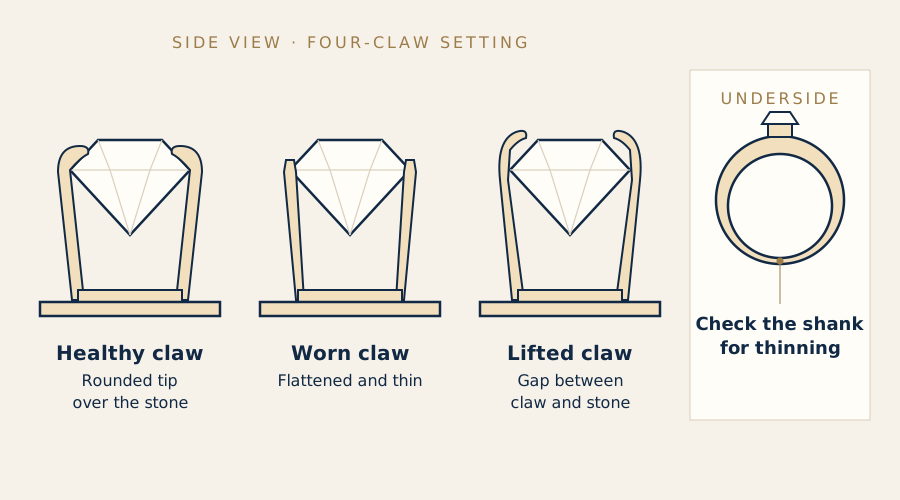
A thin band is a common finding on rings worn daily for ten years or more. Depending on how much metal is left, the fix may be re-shanking a thin ring band by replacing the lower section, or a new band altogether; our page on whether to repair or replace a worn band sets out how a jeweller decides. If any term here is new, look it up in our glossary of jewellery terms.
While the ring is in for a check, ask for it to be cleaned and photographed. A clean stone makes it easier to see damage later, and a dated photo is useful evidence for insurance.
Jewellery repairs service
How should you pack jewellery for a flight?
Jewellery damages jewellery. A diamond (Mohs 10) will scratch gold, silver, pearls and every other gem it rubs against, and chains knot within minutes in a loose pouch. Packing is about keeping pieces apart and keeping them with you.
- Use a travel jewellery case with separate padded compartments, ring rolls and earring holes, or small individual soft pouches.
- Thread fine chains through a drinking straw and fasten the clasp on the outside, so they cannot tangle.
- Push earrings through a piece of card or felt with the backs on, so the backs do not go missing.
- Wrap pearls separately in soft cloth and keep them flat, away from anything hard.
- Keep the case small and plain, and pack it in the bag that stays under the seat in front of you, not in the overhead locker.
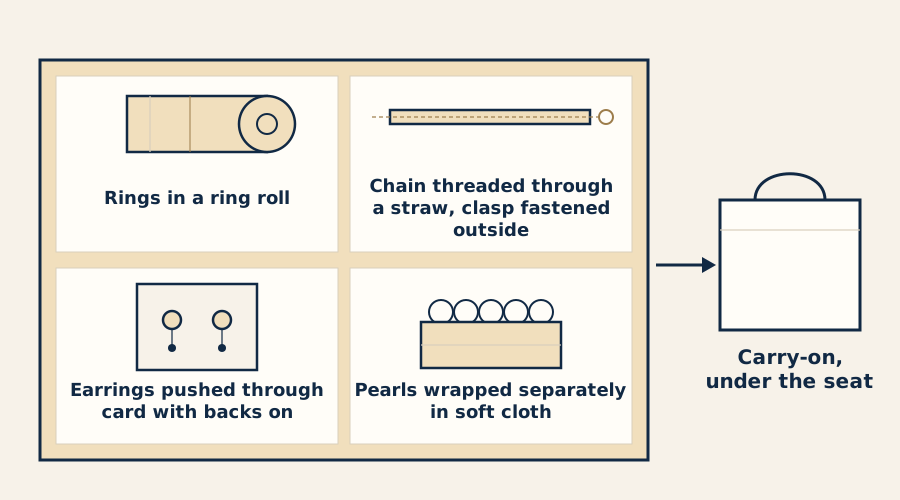
These are the same principles as storing jewellery so pieces don't scratch each other at home, just made compact. If you are wearing pieces on the flight, keep it simple: one ring, studs and a short chain are easy to wear through security and comfortable to sleep in.
Not sure which one is right?
Send us the stones you are looking at and our gemologist will tell you which to choose and why.
Is travelling with jewellery safer in carry-on or checked luggage?
Carry-on, every time. Checked bags are handled, opened for inspection and sometimes delayed or lost. Most airlines' conditions of carriage exclude jewellery and other valuables from their liability for checked baggage, and even where they do pay, international compensation is capped at a modest amount under the Montreal Convention. The safest place for fine jewellery is on your body or in a bag that never leaves your sight.
| Where it is | Theft risk | Damage risk | Usually covered if lost? | Verdict |
|---|---|---|---|---|
| Worn on your body | Low | Low to moderate | Often, if your policy covers portable valuables | Good for everyday pieces |
| Carry-on, under the seat | Low | Low | Often, if not left unattended | Good for everything else |
| Overhead locker | Moderate | Low | Sometimes | Acceptable, but keep valuables lower |
| Checked luggage | Higher | Moderate | Rarely; airlines and insurers usually exclude it | Avoid |
At airport security in Australia and overseas, most fine jewellery passes through metal detectors without trouble, though chunky bracelets and large pieces may set them off. If you are asked to remove items, place them inside a zipped pouch rather than loose in the tray, and watch the tray go through the scanner. Retrieve the pouch before you collect your laptop and shoes, because the busy moment at the end of the belt is when small items are left behind.
On long flights, fingers swell with cabin pressure, salty food and sitting still, then shrink again in cold air when you land. A ring that is snug on board can be loose at the destination. If you take rings off to sleep or exercise on the trip, the advice in wearing a ring while sleeping or exercising applies: put it in one fixed place, every time, never on a tray table or seat pocket.
Are hotel safes safe for jewellery?
An in-room safe stops opportunistic theft, which is most of what happens in hotels. It is not a vault: staff can open it for guests who forget their code, and many hotels limit their liability for its contents. For higher-value pieces, ask reception whether they have a front-desk safe deposit box and what their stated liability is, and keep any receipt they give you.
- Use the room safe whenever jewellery is not being worn, including during breakfast and at the pool.
- Set your own code and avoid obvious ones such as 1234 or your birth year.
- Never leave jewellery beside the basin, on a bedside table or wrapped in a tissue, which is easily thrown away when the room is cleaned.
- Check the safe before checkout. Put something you cannot leave without, such as your passport, in the safe with the jewellery.
- In holiday rentals without a safe, keep jewellery in a closed case inside a locked suitcase, out of sight.
Basins are a particular hazard. A ring set on the edge of a hotel sink can slide straight into the drain. Use a small dish or close the plug first, and apply the same safe storage habits you use at home every evening.
Can you wear jewellery at the beach, pool or in the snow?
This is where most holiday damage happens. Water, temperature and grit all work against jewellery, often in combination, and the safest choice for most activities is to take rings off and lock them away.
| Activity | Main risk | What to do |
|---|---|---|
| Beach and surf | Cold water shrinks fingers; sand (quartz, Mohs 7) scratches metal and softer gems | Leave rings in the safe; rinse anything worn in fresh water |
| Pool and spa | Chlorine can weaken gold alloys and dull pearls and opals | Remove all jewellery before swimming |
| Hot springs and onsen | Sulphur blackens silver and can discolour lower-carat gold | Remove everything before you get in |
| Snow and skiing | Fingers shrink in the cold; gloves pull rings off | Leave rings at the lodge or wear a silicone band |
| Hiking and climbing | Knocks against rock; claws snag on straps and ropes | Remove rings; wear simple studs only |
| Sunscreen and lotion | Films dull stones and build up under settings | Put jewellery on after sunscreen has dried; clean on return |
Chlorine deserves special mention. Repeated exposure can cause stress corrosion in gold alloys, where tiny cracks form, often at claws and solder joints, and a claw can fail weeks after the holiday. Our guide to what sunscreen and pool chlorine do to gold and gems explains why, and what to do if you forgot.
Related guideSunscreen, Chlorine and Your JewelleryHumid, tropical air also speeds up tarnish on sterling silver, especially near sulphur-rich water or volcanic areas. It is cosmetic and reversible; cleaning tarnished silver at home brings most pieces back. Opal doublets and triplets (thin slices of opal glued to a backing, sometimes with a clear cap) should never be soaked, because water can get between the layers and cloud or lift them.
Does travel insurance cover jewellery, and do you declare it at customs?
Check this before you book, not after something goes missing. Many Australian travel insurance policies cap any single item, including jewellery, at somewhere around AUD 500 to 1,500 unless you pay to list it, and most exclude items left unattended, packed in checked luggage or left in a car. Read the product disclosure statement (PDS) for the exact limits and exclusions.
- Home and contents insurance can include portable valuables or specified items cover, which may follow your jewellery overseas. Ask your insurer whether it applies outside Australia and for how long.
- Specified items need a recent valuation. Many insurers expect one within the last two to five years; prices of gold and gems change.
- Keep copies of valuations, grading reports and receipts in cloud storage or email, not only in the suitcase.
- Record identifiers: grading report numbers and any laser inscription (a tiny number engraved on a diamond's girdle, readable under magnification).
Customs is simpler than people fear. Jewellery you own and take out of Australia is personal effects, and you do not pay duty to bring it back. Carrying a valuation, receipts or photos helps if a Border Force officer asks whether a piece was bought overseas. Jewellery bought overseas is different: it counts towards your duty-free concession, currently AUD 900 per adult traveller (AUD 450 under 18), and goods above that may attract duty and GST. Some destination countries also ask travellers to declare high-value jewellery on arrival, so check the Smartraveller page and the destination's customs site before you go.
What should you do if jewellery is lost or damaged overseas?
Act quickly, because most insurers and airlines have short reporting deadlines.
- Lost or stolen: report it to local police within 24 hours and get a written report or reference number. Notify the hotel or airline in writing as well. Then contact your insurer.
- Stone loose or a claw bent: take the piece off straight away and put it in a sealed pouch. Do not keep wearing it until you get home.
- Stone lost from a setting: keep the empty mount. It helps a jeweller match and reset a replacement.
- Overseas repairs: for anything beyond a simple clasp, it is usually wiser to wait until you are home and use a jeweller who knows the piece.
When you get back, give everything you wore a gentle clean and a once-over, even if nothing seems wrong. Salt, sand and sunscreen collect under settings. Follow the gem-by-gem cleaning advice so you do not use the wrong method on emerald, opal or pearl, and return to your full care and maintenance guide for regular checks.
Travelling with jewellery: a step-by-step checklist
- Choose what to take three to four weeks out. Leave heirlooms and one-off pieces at home.
- Book a setting check two to four weeks before you fly, so claws, clasps and bands can be repaired in time.
- Photograph every piece on a plain background and save copies of valuations, receipts and report numbers online.
- Check your insurance PDS for single-item limits, overseas cover and exclusions, and list high-value pieces if needed.
- Pack a compartment case: rings in a roll, chains through straws, earrings on card, pearls wrapped on their own.
- Carry it on board in the bag under your seat; never in checked luggage.
- Use the safe at your accommodation and choose one fixed place for rings when they are off.
- Remove jewellery for the beach, pool, spa, snow and hiking.
- Clean and inspect everything when you get home, and book a check if anything rattles or snags. Our engagement ring care checklist covers the ongoing routine.
Free consultation
Talk to a gemologist
Compare stones in person or online with Raj Sood, Graduate Gemologist (GIA), AJP (GIA).
Book a consultationShop this shape
FAQ
Common questions
Can I take my jewellery in my carry-on luggage?
Yes, and you should. Fine jewellery belongs in your carry-on or on your body, because airlines and most insurers exclude valuables packed in checked bags.
Do I need to declare my own jewellery when leaving or returning to Australia?
Jewellery you owned before the trip is personal effects and is not subject to duty when you return. Carry receipts, valuations or photos in case you are asked; jewellery bought overseas counts towards your AUD 900 duty-free concession.
Will my engagement ring set off airport metal detectors?
Usually not. Most rings, studs and fine chains pass through without trouble, though large or heavy pieces may trigger an alarm and need to go through the scanner in a tray.
Does travel insurance cover lost jewellery?
Often only up to a single-item limit, and usually not if it was left unattended or in checked luggage. Check the product disclosure statement, and consider listing valuable pieces on a home and contents policy that covers you overseas.
Should I wear my rings swimming on holiday?
It is safer not to. Cold water shrinks fingers so rings can slip off, and chlorine can weaken gold alloys over time, so leave rings in the safe while you swim.
Is a hotel safe secure enough for jewellery?
An in-room safe deters opportunistic theft but staff can open it. For higher-value pieces, ask about a front-desk safe deposit box and the hotel's stated liability.

Ask a gemologist
Not sure which diamond to choose?
Raj Sood is a Graduate Gemologist (GIA) and master jeweller. Bring the stones you are considering, or send the reports, and he will tell you honestly which one is better and why.
Keep learning
Related guides
 Care, Repairs & RemodellingSunscreen, Chlorine and Your JewelleryCare, Repairs & RemodellingEngagement Ring Care GuideCare, Repairs & RemodellingHow to Store Jewellery
 Care, Repairs & RemodellingHow to Clean Silver JewelleryCare, Repairs & RemodellingCan You Sleep or Work Out in Your Ring?Care, Repairs & RemodellingCleaning Gemstones by Type
 Care, Repairs & RemodellingWhen to Repair vs Replace a Band
Explore more
More guides on this topic
Education