
- Education
- Care, Repairs & Remodelling
- Sunscreen, Chlorine and Your Jewellery: What Causes Damage and How to Prevent It
Care, Repairs & Remodelling
Sunscreen, Chlorine and Your Jewellery: What Causes Damage and How to Prevent It
An Australian summer puts sunscreen, chlorine, salt water and sand on your jewellery almost every day. Here is what each one does to gold, silver, platinum and gemstones, the damage jewellers see, and how to prevent and clean it.
 Reviewed by Raj Sood, Graduate Gemologist (GIA), AJP (GIA)Master jeweller and Graduate Gemologist (GIA) · reviewed 4 November 2026
Quick answer
Sunscreen won't eat gold or diamonds, but its oils and zinc oxide coat stones and pack into settings, dulling sparkle and trapping sand. Chlorine and salt water are the bigger risk: they tarnish silver, strip plating, harm pearls and opal doublets, and can crack 9 and 14 carat gold claws. Take jewellery off before swimming, then rinse.
How do sunscreen, chlorine and salt water affect jewellery?
Summer in Australia means sunscreen most days, a swim in the pool or the surf, and for many people a gym session before work. None of that ruins jewellery in one go. The trouble is repetition. A ring worn every day through summer might see hundreds of sunscreen applications and dozens of swims, and small chemical and physical effects add up over months. For the everyday basics, our complete jewellery care and maintenance guide is the place to start; this page focuses on the four summer culprits.
- Sunscreen: mostly a physical problem. It coats stones and clogs settings, and it holds grit against the metal.
- Chlorine: a chemical problem. Pools, spas and household bleach attack silver, plating and lower-carat gold alloys.
- Salt water: both. Chloride in sea water tarnishes and corrodes, and cold water shrinks fingers so rings slip off.
- Sand: a physical problem. Beach sand is mostly quartz, hard enough to scratch every precious metal.
The jewellery most at risk is anything soft, porous, plated or made from a lower-carat alloy (a metal mixed with other metals for strength and colour). Diamond, platinum and 18 carat gold cope with summer far better than pearls, opal doublets, sterling silver or gold-plated pieces. Any unfamiliar term here, such as rhodium or gallery, is explained in our plain-English jewellery glossary.
Does sunscreen damage jewellery or a diamond ring?
Sunscreen rarely harms metal or diamond chemically. Its problem is that it is designed to stick. Most sunscreens sold in Australia are regulated by the TGA (Therapeutic Goods Administration), and many are labelled water resistant for up to 4 hours. To resist water and sweat they contain oils, silicones and film-forming ingredients, and that same film coats your jewellery and resists a quick rinse.
Mineral sunscreens use zinc oxide or titanium dioxide, fine white powders that leave a pale paste. Chemical sunscreens use organic UV filters such as octocrylene or avobenzone in an oily base. Either way, the residue settles where a finger can't wipe: under the claws, inside the gallery (the open metalwork beneath a centre stone), between pavé stones and in the gap under a halo.
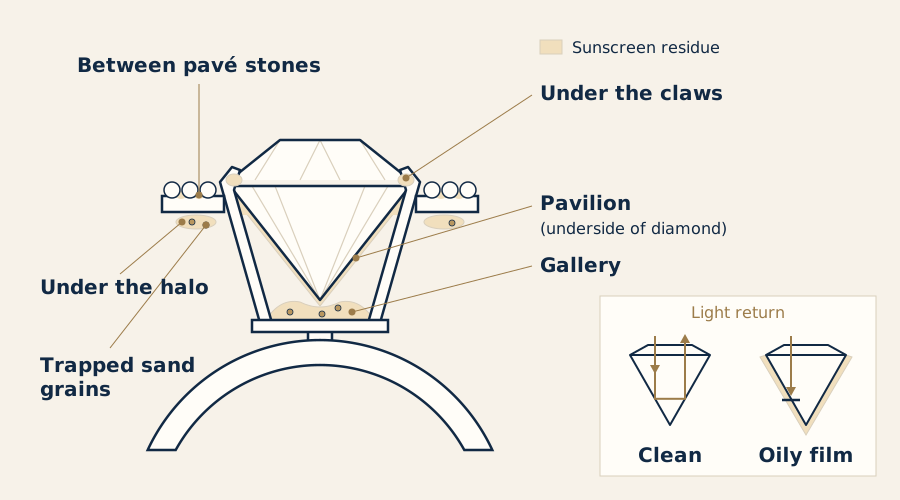
Diamond is lipophilic, meaning it attracts oil and grease. A thin film on the pavilion (the pointed underside of the stone) stops light entering and leaving cleanly, so even a high-colour diamond looks greyish and flat. That is why a sunscreen-coated diamond ring can look tired by February and bright again after a proper degreasing. Our guide to cleaning a diamond ring at home shows how to cut through the film safely.
The second problem is grit. A sticky layer holds sand and dust against the metal, and every time you rub sunscreen into your hands you are effectively polishing the ring with a mild abrasive paste. Over a summer that softens crisp edges, wears away milgrain (the fine beaded edging on some rings) and thins claw tips. Porous gems are the exception to 'mostly harmless': turquoise, pearls, opal and oil-treated emeralds can absorb oils, which slowly changes their colour or lustre.
Does chlorine damage gold, silver and platinum?
Some of them, yes, and this is where most real summer damage happens. Pool chlorine is usually added as sodium or calcium hypochlorite, and outdoor pools typically hold about 1–3 parts per million (ppm) of free chlorine. That is weak, but jewellery is exposed again and again, and chlorine and chloride are good at finding the weakest metal in an alloy.
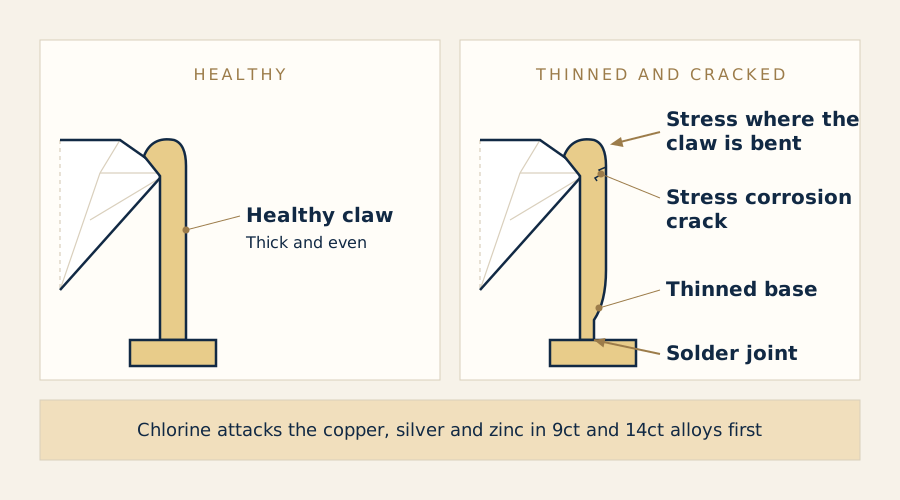
Gold jewellery is pure gold mixed with silver, copper, zinc, nickel or palladium. 9 carat gold is 37.5% gold, 14 carat is 58.5% and 18 carat is 75%. The lower the gold content, the more of those other metals are exposed at the surface. Chlorine attacks them, especially where the metal is under stress: claws bent over a stone, a shank that has been resized, and solder joints. The result is stress corrosion cracking, fine cracks that start at the surface and grow slowly inward, and can let a claw snap without any warning.
| Metal | Chlorine (pool, spa) | Salt water | Sand | Practical advice |
|---|---|---|---|---|
| 9ct gold (37.5%) | Can discolour; most prone to stress cracks | Moderate risk | Scratches | Take off for every swim |
| 14ct gold (58.5%) | Some risk at claws and solder joints | Moderate risk | Scratches | Take off for swims |
| 18ct gold (75%) | Lower risk, can still dull | Low to moderate | Scratches | Remove for regular swimming |
| White gold (rhodium plated) | Plating resists well; alloy beneath can discolour once plating wears | Low to moderate | Wears the plating | Remove; replate as needed |
| Platinum (950) | Very resistant at pool strength | Very resistant | Scratches (Mohs 4–4.5) | Chemically safe; loss is the main risk |
| Sterling silver (92.5%) | Tarnishes grey to black quickly | Tarnishes | Scratches easily | Keep out of pools and the sea |
| Gold-plated and vermeil | Plating can dull and strip | Plating can strip | Wears through | Keep dry |
| Titanium and stainless steel | Generally resistant | Generally resistant | Scratches | Usually fine to swim in |
White gold behaves differently. Most white gold is rhodium plated: a very thin layer of rhodium, a bright white metal in the platinum family, over an alloy that is slightly yellow or grey. Rhodium resists chlorine well, but it is usually well under a micron thick and wears away with friction from sand, gym equipment and daily wear. Once it thins, chlorine and sweat reach the alloy underneath and the ring starts to look patchy and warm. Our guide to how often white gold needs replating sets out the usual intervals.
Sterling silver (92.5% silver, usually with copper) reacts fastest. Chlorine and chloride form a grey film of silver chloride, and the copper darkens too, so a silver chain can look dull after a single afternoon in the pool. It can usually be brought back; see removing tarnish from sterling silver. Platinum is the clear exception among precious metals: at pool strength it is essentially unaffected, though it still scratches and still slides off wet fingers. Remember too that household bleach is far stronger than pool water, so cleaning the bathroom in a gold ring is one of the quickest ways to damage it.
Is salt water and sand bad for jewellery at the beach?
Sea water is about 3.5% salt, mostly sodium chloride. For gold it is generally less aggressive than chlorinated pool water, but chloride still tarnishes silver, attacks plating and creeps into tight joints, where it dries and concentrates. If you did swim in your jewellery, rinse it in fresh water afterwards and dry it properly rather than letting salt crystals dry inside the setting.
Sand is the bigger mechanical risk. Most beach sand is largely quartz, about 7 on the Mohs scale (a 1–10 scale of scratch resistance, with diamond at 10). Gold sits at about 2.5–3, silver about 2.5–3 and platinum about 4–4.5, so sand scratches every precious metal. It also scratches gems softer than 7, including pearls, opal, turquoise and tanzanite, and sand packed behind a stone grinds against the claws each time the ring moves.
The biggest beach risk isn't chemistry at all; it's loss. Cold water makes fingers shrink, sunscreen makes them slippery, and a wave does the rest. A ring that feels secure on land can slide straight off in the surf. If your ring spins or slides when your hands are cool, sizing beads and bars that stop a ring slipping are worth a look. For a situation-by-situation answer, see whether a ring can go in the shower, pool or surf.
Not sure which one is right?
Send us the stones you are looking at and our gemologist will tell you which to choose and why.
Which gemstone jewellery is most at risk from sunscreen and chlorine?
Diamond (Mohs 10), sapphire and ruby (Mohs 9) are chemically very stable and are not harmed by sunscreen or pool water; the risk to them is their setting. Softer, porous and treated gems are a different story.
| Gem | Mohs hardness | Main summer risk | Advice |
|---|---|---|---|
| Diamond | 10 | Oily film dulls sparkle; fracture-filled diamonds need gentler care | Remove for swims to protect the setting; degrease regularly |
| Sapphire and ruby | 9 | Very stable; lead-glass filled rubies are sensitive to chemicals | Untreated or heated: low risk. Filled: keep away from chemicals |
| Emerald | 7.5–8 | Usually oil or resin treated; detergents, heat and ultrasonic can draw out the filler | No pools, no ultrasonic cleaning |
| Tanzanite | 6–6.5 | Scratched by sand; can chip | Off at the beach |
| Solid opal | 5.5–6.5 | Scratched by sand; dislikes chemicals and sudden heat | Off for swims; wipe sunscreen away |
| Opal doublet or triplet | 5.5–6.5 | Water can seep into the glue layer, clouding or lifting it | Never soak |
| Turquoise | 5–6 | Porous; absorbs oils and can turn greenish | Put on after sunscreen has soaked in |
| Pearl | 2.5–4.5 | Nacre dulled by chlorine, sweat and sunscreen; silk thread weakens | Last on, first off |
Opal deserves a special mention in Australia. Many opals sold here are doublets (a thin slice of opal glued to a dark backing) or triplets (the same with a clear quartz or glass cap on top). The glue is the weak point: repeated soaking in pool or sea water can let moisture creep in, and the opal turns grey or foggy in a way that won't clean away. Solid opal tolerates a quick splash but still dislikes chemicals and sudden temperature changes. Our cleaning guide for each gemstone type lists the safe methods stone by stone.
Pearls are made of nacre, thin layers of calcium carbonate that are soft and react with acids and chlorine. Sunscreen, perfume and sweat slowly strip their lustre, and wet silk thread stretches and weakens. The old jeweller's rule is that pearls are last on, first off: put them on after sunscreen, perfume and hairspray, and take them off before the pool.
Can you wear jewellery in a spa, hot tub or at the gym?
Spas and hot tubs are harder on jewellery than pools. They are usually kept at a higher sanitiser level, some use bromine instead of chlorine, and heat speeds up chemical reactions. Stress cracking that might take years in a cool pool can develop faster in hot water, so take everything off before you get in.
The gym is mostly a physical risk. Gripping a barbell or kettlebell squeezes the shank (the band) against the bar, which can bend it out of round, flatten its profile and push claws away from the stone. Knurled bars (the textured grip) scratch metal and can chip a stone that sits high. Lifting chalk (magnesium carbonate) packs into settings along with sweat, which is salty and mildly acidic. Our guide to wearing rings to the gym or to bed covers silicone bands and other options.
- Spa or hot tub: everything off.
- Weights, rowing, climbing, boxing: rings off.
- Running, walking, yoga: usually fine, but rinse the sweat off afterwards.
- Cleaning with bleach or pool chemicals: rings off and gloves on.
What damage do jewellers see after an Australian summer?
Most summer damage doesn't happen in a day. It shows up at the bench as a pattern after the warmer months. These are the kinds of problems jewellers see most often:
- Cracked or thinned claws on 9ct and 14ct rings that are regularly worn swimming, sometimes with the stone loose or already missing.
- White gold rings that look patchy and yellowish, because sand and gym wear removed the rhodium and chlorine reached the alloy beneath.
- Sterling silver chains and charms turned grey or black after a beach holiday.
- Pearls that have lost their lustre, and strands with stretched, discoloured silk.
- Opal doublets and triplets that have clouded or started to lift at the edge.
- Halo and pavé rings packed with white sunscreen paste, with diamonds that look grey until cleaned.
- Rings lost at the beach or pool, very often a ring that was already slightly loose.
Most of this is fixable. Thin claws can be re-tipped or rebuilt and a loose stone can be secured; see checking and tightening loose stones. A shank worn thin at the base can be replaced, and our guide to replacing a worn ring shank explains how. If the wear is widespread, deciding whether to repair or replace a band helps you weigh it up, and where a piece is too far gone, the stones and often the metal can go into something new: see which parts of damaged jewellery can be reused.
Jewellery repairs: claw checks, re-tipping and cleaning
How do you protect jewellery at the beach, pool and gym?
Prevention is mostly about timing and habit. The table below sets out the common summer situations and the simple rule for each.
| Situation | Main risk | What to do |
|---|---|---|
| Applying sunscreen | Film and residue in settings | Rings off, apply, let it soak in, wash and dry hands, rings back on |
| Outdoor pool | Chlorine, loss | Take jewellery off before swimming |
| Spa or hot tub | Heat and strong sanitiser | Everything off |
| Surf beach | Loss, sand, salt | Leave fine jewellery at home or in a zipped pouch |
| Gym | Bending, scratching, chalk | Rings off, or a silicone band |
| Cleaning the house | Bleach and strong chemicals | Rings off, gloves on |
| Shower | Soap film | Usually fine for diamond, gold and platinum; remove pearls and opal |
- Keep a small zipped pouch in your beach bag and always use the same pocket. Rings put down on a towel, in a shoe or wrapped in a tissue are the ones that disappear.
- Put rings back on only when your hands are dry and the sunscreen has soaked in.
- On beach days, wear simpler pieces, or none, and leave heirlooms and engagement rings in a safe place.
- Rinse anything that did go in the water as soon as you can, before chlorine or salt dries on it.
On holiday the risks multiply: hotel pools, new routines and jewellery taken off in unfamiliar rooms. Our tips on packing fine jewellery for a holiday help with that, and back home, storing pieces so they don't scratch each other keeps cleaned, dried jewellery in good shape. If something valuable does go missing, it helps to understand replacement value for insurance versus resale value before you make a claim.
How do you clean sunscreen and chlorine off jewellery?
For diamond, sapphire and ruby set in gold or platinum, a gentle home clean removes sunscreen film and pool residue. Plug the sink first.
- Rinse straight away. Run the piece under fresh, lukewarm water as soon as you can after a swim to wash off chlorine or salt.
- Soak. Leave it for 10–20 minutes in warm water with a few drops of mild dishwashing liquid, which breaks down the oils in sunscreen.
- Brush. Use a soft toothbrush behind the stone, under the claws, through the gallery and between pavé stones, where residue packs in.
- Rinse again. Use clean warm water so no soap film is left on the stone.
- Dry. Pat with a lint-free cloth, then let the setting air-dry so no water sits under the stone.
- Check. Look at each claw and hold the ring by your ear and tap it gently; a stone that rattles or moves needs attention.
- Silver only: finish with a silver polishing cloth to lift any grey tarnish.
Don't soak pearls, opals, turquoise or emeralds. Wipe them with a soft cloth dampened in plain water and dry them straight away. Avoid toothpaste and baking soda, which are abrasive, and never use bleach. Home ultrasonic cleaners are not suitable for those gems, for fracture-filled diamonds or for pieces with a loose stone.
If sunscreen paste has hardened under a halo, or the ring still looks dull after a soak, a jeweller's steam clean and inspection will reach what a toothbrush can't. Our comparison of when a professional clean beats a home clean explains what each one can and can't do.
Free consultation
Talk to a gemologist
Compare stones in person or online with Raj Sood, Graduate Gemologist (GIA), AJP (GIA).
Book a consultationShop this shape
FAQ
Common questions
Does chlorine damage diamonds?
No. Diamond itself is not affected by pool chlorine. The risk is to the metal holding it, especially 9ct and 14ct gold claws, which can develop stress cracks with repeated exposure.
Can I wear my gold ring in the pool?
An occasional dip is unlikely to cause harm, but regular swimming in chlorinated water can discolour gold and slowly crack claws and solder joints, particularly in 9ct and 14ct. Take it off before swimming, and always before a spa.
Will sunscreen ruin my engagement ring?
No, but it will make it look dull. Sunscreen oils and zinc oxide coat the diamond and pack into the setting, so put your ring on after the sunscreen has soaked in and clean it regularly.
Can sterling silver go in the ocean or a pool?
It can, but it will tarnish quickly. Chlorine and salt water turn silver grey or black; rinse it in fresh water, dry it and use a polishing cloth, or better, take it off before swimming.
Is platinum safe to swim in?
Chemically, yes. Platinum is essentially unaffected by chlorine and salt water at normal concentrations. It still scratches from sand, and the bigger risk is the ring sliding off cold, wet fingers.
Can you swim with opal jewellery?
It is better not to. Opal doublets and triplets are glued, and water can seep in and cloud them, while solid opal is soft enough to scratch from sand and dislikes chemicals.
How do I get sunscreen out of my ring?
Soak it for 10–20 minutes in warm water with a little mild dishwashing liquid, brush gently under the stone with a soft toothbrush, rinse and dry. If the residue has hardened under a halo, a professional steam clean will shift it.

Ask a gemologist
Not sure which diamond to choose?
Raj Sood is a Graduate Gemologist (GIA) and master jeweller. Bring the stones you are considering, or send the reports, and he will tell you honestly which one is better and why.
Keep learning
Related guides
 Care, Repairs & RemodellingCan You Wear Your Ring in the Shower, Pool or at the Beach?Care, Repairs & RemodellingJewellery Care and MaintenanceCare, Repairs & RemodellingHow to Clean a Diamond Ring at Home
 Care, Repairs & RemodellingCleaning Gemstones by Type
 Care, Repairs & RemodellingHow to Store Jewellery
 Care, Repairs & RemodellingJewellery Remodelling: What Can Be Reused Safely?Care, Repairs & RemodellingHow to Clean Silver JewelleryCare, Repairs & RemodellingRe-Shanking a Ring
Explore more
More guides on this topic
Education