
- Education
- Care, Repairs & Remodelling
- How to Store Jewellery: Keep Every Piece Safe, Untangled and Tarnish-Free
Care, Repairs & Remodelling
How to Store Jewellery: Keep Every Piece Safe, Untangled and Tarnish-Free
Most of the scratches, kinks and loose stones we see at the repair bench happen in a drawer, not on the hand. Learning how to store jewellery properly costs very little and saves pieces you can never replace.
 Reviewed by Raj Sood, Graduate Gemologist (GIA), AJP (GIA)Master jeweller and Graduate Gemologist (GIA) · reviewed 4 November 2026
Quick answer
To store jewellery well, keep each piece separate in a soft-lined compartment or pouch so harder gems cannot scratch softer ones, fasten chains so they don't tangle, and keep everything cool, dry and out of direct sun. Seal silver with anti-tarnish strips, let pearls breathe, avoid bathrooms, and have a jeweller check claws and clasps once a year.
How to store jewellery: what actually causes the damage?
Jewellery is tough on the hand and surprisingly fragile in storage. When pieces come in for repair, the same four causes turn up again and again, and good storage deals with every one of them.
- Scratching and chipping: harder materials rubbing against softer ones. A diamond loose in a dish with a pearl strand will mark the pearls within weeks.
- Tangling and kinking: fine chains knot around each other, and pulling them apart stretches or kinks the links until they snap.
- Chemical reaction: silver tarnishes in air, and residue from sunscreen, perfume and hand cream left on a piece keeps working on metal and porous gems while it sits in the box.
- Heat, light and dryness: some gems fade in strong sun, and pearls, opals and emeralds do not like heat or very dry air.
So the first rule is to put pieces away clean. Skin oils and lotions build up behind stones and dull them, and chlorine and sunscreen residue can be harsh on some alloys and soft gems; our page on how sunscreen and chlorine affect metals and stones explains why. A quick wipe with a soft, lint-free cloth before a piece goes away is enough for most days. For everything else about cleaning and daily wear, start with our complete jewellery care and maintenance guide.
Related guideSunscreen, Chlorine and Your JewelleryWhich gems and metals scratch each other in storage?
The Mohs scale ranks how well a material resists scratching, from 1 (talc) to 10 (diamond). The rule is simple: anything higher on the scale can scratch anything lower. It is a ranking, not an even measure, so the gap between 9 and 10 is far larger than the gap between 6 and 7.
| Material | Approx. Mohs hardness | Main storage risk |
|---|---|---|
| Diamond (natural or lab-grown) | 10 | Scratches everything, including the facet edges of other diamonds |
| Sapphire and ruby (natural or lab-created) | 9 | Scratches most other gems and all precious metals |
| Tungsten carbide | about 8.5–9 | Scratches gold, platinum and softer gems it touches |
| Topaz | 8 | Can chip along cleavage if knocked |
| Emerald and aquamarine | 7.5–8 | Emerald is brittle and often oil-treated |
| Quartz: amethyst, citrine | 7 | Some colours fade in strong light |
| Peridot | 6.5–7 | Scratched by dust and harder gems |
| Opal | 5.5–6.5 | Heat and sudden temperature change |
| Turquoise | 5–6 | Porous; absorbs oils and cosmetics |
| Platinum | about 4–4.5 | Scratches, but the metal is moved rather than lost |
| Pearl | 2.5–4.5 | Scratched by almost everything |
| Gold and sterling silver alloys | about 2.5–4 | Scratches easily; silver tarnishes |
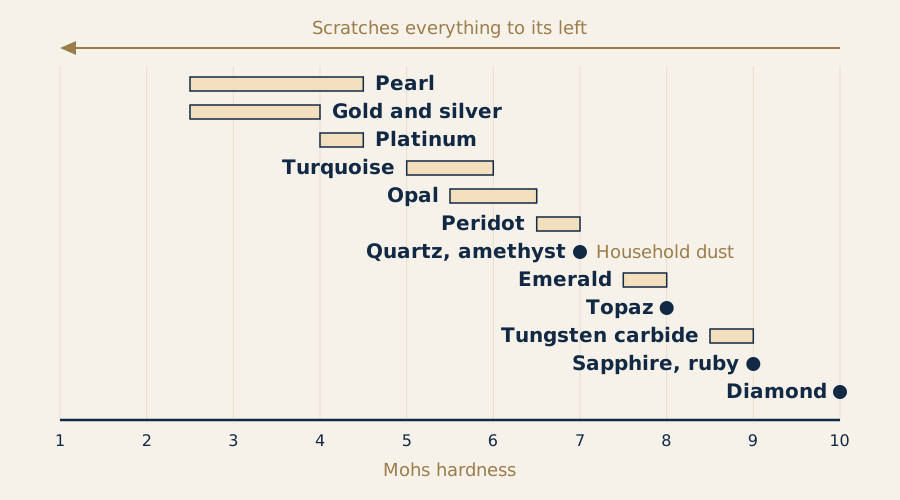
Two things surprise most people. First, household dust contains fine quartz grit, which sits at 7 on the scale. That is harder than pearl, opal, turquoise, peridot and every precious metal, so an open dish on a dresser slowly sandblasts the softer pieces in it, and wiping a dusty pearl with a dry cloth grinds that grit across its surface. Closed boxes and pouches solve this.
Second, diamonds can damage each other. Lab-grown and natural diamonds are the same material with the same hardness, and two diamond rings jumbled together can wear or chip each other's facet junctions (the sharp edges where facets meet). The same goes for tungsten carbide rings, which are hard enough to mark gold bands and softer gems, and for gentler stones such as peridot, a softer green gem, which loses its polish quickly if it rubs against harder pieces.
How should you store gold, platinum, silver and gemstones?
Each material has its own weak spot. Here is how to store the common ones.
| Material | How to store it | What to watch for |
|---|---|---|
| Yellow and rose gold | Own compartment or pouch; chains fastened | Surface scratches; kinked chains |
| White gold | Own compartment, away from diamonds and sapphires | Rhodium plating (a bright white coating) scratches and wears through, showing a yellowish tint |
| Platinum | Own compartment or pouch | Fine scratches build up into a soft grey patina |
| Sterling silver | Sealed zip-lock bag with an anti-tarnish strip | Tarnish; scratches from harder pieces |
| Diamond rings and studs | Individual ring slot or pouch | Chipping other diamonds; loose claws |
| Emerald | Own pouch, away from heat and sun | Oil treatment drying out; chips |
| Pearls | Flat in a soft, breathable pouch | Scratches, dryness, stretched thread |
| Opal | Padded pouch, away from heat | Crazing (fine surface cracks) |
| Amethyst, kunzite | Closed box, out of direct light | Colour fading |
Metal choice changes the advice a little. Platinum, which scratches but rarely loses metal, develops a matte patina that some people like and a jeweller can polish away. White gold looks bright because of its rhodium plating, and that coating is thin, so storing it next to harder gems speeds up the day it needs replating.
Mixed collections need the most thought. Birthstone pieces, which combine many different gem types, can put a garnet at 7 next to a pearl at 2.5 or an opal at 6, so give each one its own place rather than one shared tray.
How do you store silver jewellery to prevent tarnish?
Tarnish is a chemical reaction, not dirt. Silver reacts with sulphur compounds in the air, mainly hydrogen sulphide, to form a thin layer of silver sulphide that starts golden and darkens to brown and black. Warmth and humidity speed it up. Sterling silver is 92.5% silver and usually 7.5% copper, and the copper can add its own discolouration. If you want the background, our page on what sterling silver is and why it tarnishes covers the alloy in detail.
The way to store silver jewellery is to cut off its air supply:
- Dry it first. Any moisture sealed in the bag speeds up tarnish.
- Seal it. Use a small zip-lock bag and press the air out before closing.
- Add an anti-tarnish strip. These absorb sulphur compounds; replace them roughly every 6–12 months, or when they change colour.
- Keep it away from sulphur sources: rubber bands, latex, some wool and felt, newspaper, cardboard and certain paints can all release sulphur.
- Add a silica gel sachet in humid weather, but keep that box away from your pearls.
Silver stored this way can sit for months with little or no tarnish. If a piece has already darkened, see our guide to removing tarnish from silver safely before you put it away. Avoid harsh dips on gem-set silver, oxidised (deliberately darkened) designs or gold-plated silver.
Not sure which one is right?
Send us the stones you are looking at and our gemologist will tell you which to choose and why.
How do you store pearls, opals and other delicate gems?
Pearls are organic. Their lustre comes from nacre, thin layers of calcium carbonate laid down by the mollusc, and nacre is soft, sensitive to acids and dislikes being dried out. To store pearls well, lay strands flat in a soft silk or cotton pouch, on their own. Don't hang a strand, because its weight stretches the silk thread. Don't keep pearls sealed in an airtight plastic bag or next to silica gel for long periods, because very dry air can dull and eventually crack the nacre. A strand you wear often usually needs restringing every one to two years; if you see gaps between the knots, it is time.
Opal contains a small amount of water locked in its structure, roughly 3–10%. Prolonged heat or sudden temperature changes can cause crazing, a network of fine cracks, so never store opal in a hot car, on a sunny windowsill or beside a heater. Most Australian solid opal is stable in normal room conditions, and there is no need to keep it in water or oil. Opal doublets and triplets (thin slices of opal glued to a backing, with a clear cap on a triplet) should never be soaked, because water can lift the glue and cloud the stone.
Emeralds are usually treated with oil or resin to fill tiny surface-reaching fractures. Heat and dryness can draw that filler out and make the fractures more visible, so keep emeralds cool and in their own pouch. Amethyst and kunzite can lose colour with long exposure to strong light; our guide to why amethyst can fade in strong sunlight explains the risk. Turquoise, coral and amber are porous, so store them well away from perfume and cosmetics.
Jewellery box, pouch or safe: which storage suits what?
There is no single right container. Most collections end up using two or three of these jewellery storage ideas together.
| Storage option | Good for | Watch out for |
|---|---|---|
| Lined jewellery box with separate compartments | Everyday rings, earrings, bracelets | Pieces doubling up in one slot; cheap linings that shed fibres |
| Ring roll or slotted ring tray | Diamond and gem-set rings, kept upright and apart | Rings too loose in the slot can still knock together |
| Individual soft pouches (microfibre, cotton, silk) | Pearls, opals, travel, anything delicate | Easy to lose; label or keep them in one box |
| Sealed zip-lock bag with anti-tarnish strip | Sterling silver | Not for pearls or opals long-term |
| Necklace stand or hanging organiser | Chains and pendants you wear often | Dust and light; not for pearl strands |
| Home safe | Valuable pieces and anything you rarely wear | Damp inside some safes; add a sachet or dehumidifier |
| Bank safe deposit box | High-value heirlooms stored for years | Access hours; check whether contents are insured |
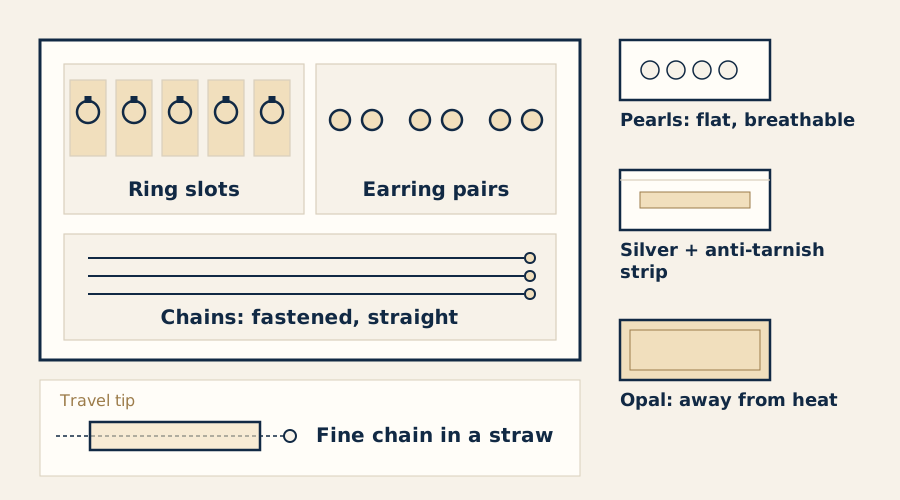
For how to store necklaces without tangling, fasten every clasp first, then either hang the chain from its own hook or lay it out straight in a long compartment. For travel or a crowded drawer, thread a fine chain through a drinking straw and fasten the clasp outside it. Chains under about 1 mm thick kink easily, and a kink is a weak point that can snap later.
What should you never do when storing jewellery?
- Don't store jewellery in the bathroom. Steam and humidity speed up tarnish, and sinks and drains are where most rings go missing.
- Don't pile pieces loose in a dish, drawer or handbag pocket. This is the main cause of scratched pearls and chipped stones.
- Don't leave jewellery in heat or sun: hot cars, windowsills and the top of the fridge are all risky for opal, emerald, pearls and fade-prone gems.
- Don't put pieces away dirty. Sunscreen, salt and chlorine left on a ring keep working on it. Our page on whether a ring is safe in the shower, pool or surf covers what to rinse off.
- Don't wrap jewellery in tissue or a napkin. It gets thrown out, and it does nothing to stop scratching.
- Don't use rubber bands or newspaper near silver.
- Don't hang pearl strands or seal them in airtight plastic for long periods.
- Don't yank tangled chains apart. Lay the knot flat, add a drop of baby oil if needed, and tease it out with two pins.
How do you store jewellery safely when travelling or at home?
For trips, a padded travel roll or a small hard case with separate sections keeps pieces apart; a weekly pill organiser works well for earrings. Carry valuable jewellery in your hand luggage, never in checked bags, and take less than you think you need. Our guide to practical tips for travelling with fine jewellery goes through hotel safes, flights and beach holidays.
At home, bedroom drawers and jewellery boxes on a dresser are the first places a burglar looks. Storing jewellery in a safe that is bolted down is the usual answer for valuable pieces. Many home and contents policies cap cover for jewellery that isn't individually listed, and some require a safe above a certain value, so read your policy wording rather than assuming.
Storage and insurance go together. Keep clear photos of each piece and a current valuation in a separate place from the jewellery itself. Our pages explain how often a valuation should be updated, the difference between replacement and resale value and what a jewellery valuation covers compared with a diamond certificate. If you are storing pieces inherited from a family member, see valuations for estates and family law matters.
If a piece has sat in a box for years because it no longer suits you, it may be worth a second life. Our guide to which stones and metal can be reused in a remodel explains what a jeweller can safely recover from an old setting.
How often should stored jewellery be checked by a jeweller?
Check your own pieces at home about once a month, and have a jeweller look at anything you wear regularly about once a year; rings worn every day benefit from a check every six months. Storage is also the moment problems are easiest to spot, because the piece is off your hand and under a light. Look for:
- A stone that moves or rattles when you tap the setting gently.
- A claw that catches on fabric or looks flatter or thinner than the others.
- A stone sitting higher or at a slight angle compared with before.
- A ring shank (the band) worn thin at the back, or a small crack where it joins the head.
- A clasp that doesn't snap firmly shut, or a kinked or stretched chain.
- Gaps between the knots on a pearl strand, or fine cracks appearing in an opal.
A jeweller can retip worn claws, tighten stones, replate white gold, re-solder a thin shank and restring pearls, often in a few days. A professional clean at the same visit removes build-up under stones that home cleaning can't reach; see when a professional clean does more than home cleaning. If you are wondering how a ring bought online will be serviced later, our page on buying an engagement ring online versus in a store covers aftercare.
Jewellery repairs service
How to store jewellery at home: step by step
- Clean and dry each piece. Wipe off skin oils, lotion and sunscreen with a soft cloth; let anything washed dry fully.
- Inspect it. Check claws, clasps and chains, and set aside anything that needs a jeweller.
- Sort by material and hardness. Keep diamonds, sapphires and tungsten apart from gold, silver, pearls and opals.
- Fasten every chain and hang it, lay it straight or thread it through a straw.
- Give each piece its own place: a ring slot, a compartment or a soft pouch.
- Seal silver in a zip-lock bag with an anti-tarnish strip, air pressed out.
- Keep pearls and opals breathable in soft pouches, away from silica gel, heat and sun.
- Choose a cool, dry, dark spot away from the bathroom and windows; use a safe for valuable pieces.
- Photograph and record what you have, and keep valuations somewhere separate.
- Diarise a check: monthly at home, yearly with a jeweller.
Any unfamiliar word on this page, from nacre to rhodium, is explained in our jewellery glossary of terms.
Free consultation
Talk to a gemologist
Compare stones in person or online with Raj Sood, Graduate Gemologist (GIA), AJP (GIA).
Book a consultationShop this shape
FAQ
Common questions
Is it bad to store jewellery in the bathroom?
Yes. Steam and humidity speed up silver tarnish and can affect pearls and glued opal doublets, and rings left by the basin are easily knocked down the drain. A bedroom drawer or wardrobe is a better spot.
Should you store jewellery in plastic bags?
Sterling silver stores well in a sealed zip-lock bag with an anti-tarnish strip. Pearls and opals should not be sealed in airtight plastic for long periods, because they do better in a soft, breathable pouch.
Can you store diamonds together?
It is safer not to. Diamond is the hardest material, so two diamond pieces rubbing together can wear or chip each other's facet edges. Natural and lab-grown diamonds have the same hardness, so the same rule applies to both.
How do you store necklaces without tangling?
Fasten the clasp, then hang each necklace on its own hook or lay it straight in a long compartment. For travel, thread fine chains through a drinking straw and fasten the clasp outside it.
Does silica gel stop jewellery tarnishing?
Silica gel absorbs moisture, which slows tarnish, but it does not absorb sulphur, so pair it with an anti-tarnish strip for silver. Keep silica gel away from pearls and opals, which don't like very dry air.
How often should jewellery be checked by a jeweller?
About once a year for pieces you wear regularly, and every six months for rings worn every day. Bring a piece in sooner if a stone moves, a claw catches or a clasp feels loose.

Ask a gemologist
Not sure which diamond to choose?
Raj Sood is a Graduate Gemologist (GIA) and master jeweller. Bring the stones you are considering, or send the reports, and he will tell you honestly which one is better and why.
Keep learning
Related guides
 Care, Repairs & RemodellingHow to Clean Silver Jewellery
 Care, Repairs & RemodellingTravelling With Fine Jewellery: Practical Risk-Reduction TipsCare, Repairs & RemodellingCan You Wear Your Ring in the Shower, Pool or at the Beach?
 Buying Knowledge & Custom ProcessBuying an Engagement Ring Online vs In-Store
 Care, Repairs & RemodellingJewellery Remodelling: What Can Be Reused Safely?
 Care, Repairs & RemodellingSunscreen, Chlorine and Your Jewellery
 MetalsSterling Silver Jewellery
Explore more
More guides on this topic
Education