
- Education
- Care, Repairs & Remodelling
- When to Repair or Replace a Wedding Band: A Jeweller's Guide
Care, Repairs & Remodelling
When to Repair or Replace a Wedding Band: A Jeweller's Guide
A wedding band is the ring you wear most and think about least, so it wears quietly for years. Knowing whether to repair or replace a wedding band comes down to how much metal is left, what it is made of and what has gone wrong.
 Reviewed by Raj Sood, Graduate Gemologist (GIA), AJP (GIA)Master jeweller and Graduate Gemologist (GIA) · reviewed 4 November 2026
Quick answer
Repair a wedding band when the metal is still about 1 mm thick or more and the damage is local, such as a small crack, a lost stone, a size change or worn polish. Replace it when the shank is thin all round, cracks keep returning, or it is tungsten, ceramic or another unworkable metal.
How do you know whether to repair or replace a wedding band?
A band rubs against its partner ring, knocks on benchtops, steering wheels and gym bars, and loses a tiny amount of metal every year. Most gold, platinum and silver bands can be repaired many times over a lifetime. Replacement makes sense in three situations: there is too little metal left to hold a repair, the metal cannot be worked at all, or fixing it would cost close to what a new band costs.
From the workbench, the question is rarely 'is it broken?' and more often 'how much life is left in it?'. A jeweller looks at the shank (the band itself, especially the palm side), any solder joins (the seams where metal has been joined before), the stones if there are any, and whether the ring is still round.
| Problem | Usually repair | Usually replace |
|---|---|---|
| Wrong size | Plain or lightly patterned gold, platinum or silver | Full eternity bands, tungsten, ceramic, most titanium |
| Thin palm side | Still about 1 mm or more, or a half reshank is possible | Thin all the way round, not just at the bottom |
| Crack | Single crack at an old join, solid metal around it | Repeated cracks, porous metal, cracks in several places |
| Lost stones | One or two stones, settings sound | Many settings worn flat or the channel walls thin |
| Scratches and dullness | Almost always: polish or re-plate | Never needed for this alone |
| Bent or out of round | Reshaped on a mandrel if no crack | Bent with a crack in thin metal |
Day-to-day habits make a big difference to how long a band lasts, so our guide to everyday jewellery care and maintenance is worth reading alongside this one. Any workshop term here that is new to you is explained in our plain-English jewellery glossary.
How thin is too thin for a ring band?
Thickness is measured from the inside surface of the ring to the outside surface, not across the width of the band. A new plain band is typically 1.5–2.0 mm thick, and comfort-fit or heavier men's bands can be 2.0–2.5 mm. The palm side wears fastest, because it presses against whatever you grip, so that is where a jeweller measures first with a pair of callipers.
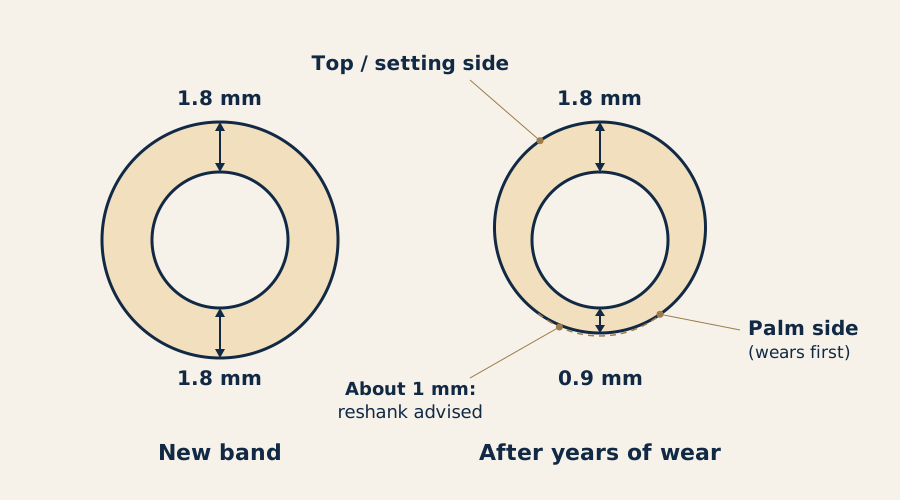
| Thickness at the thinnest point | What it means | Usual action |
|---|---|---|
| 1.5 mm or more | Healthy for daily wear | Clean and polish as needed |
| 1.2–1.5 mm | Normal wear | Check every 6–12 months |
| 1.0–1.2 mm | Getting thin; may flex under pressure | Plan a reshank in the next year or two |
| Below about 1.0 mm | Can bend, go oval or crack | Reshank now, or replace if thin all over |
| Visible crack or split | Structural failure | Repair straight away if metal allows; otherwise replace |
Width matters as much as thickness. A narrow band under about 2 mm wide has less metal to lose, and it can feel sharp or bend once it thins. If you are choosing a new band, our guide to choosing a band width that will last explains the trade-off between a delicate look and durability.
Shaped bands wear in their own way. Tapered bands that narrow towards the centre stone keep most of their metal at the back, so they usually wear well. Reverse taper designs are wider at the top and narrowest at the back, which is exactly where daily wear happens, so their palm side deserves a closer look at every check.
What band repairs can a jeweller do?
Most band problems have a standard workshop fix. These are the repairs we see most often:
- Resizing: cutting the band and removing a section to go smaller, or adding a piece of matching metal to go larger, then soldering and polishing so the join disappears.
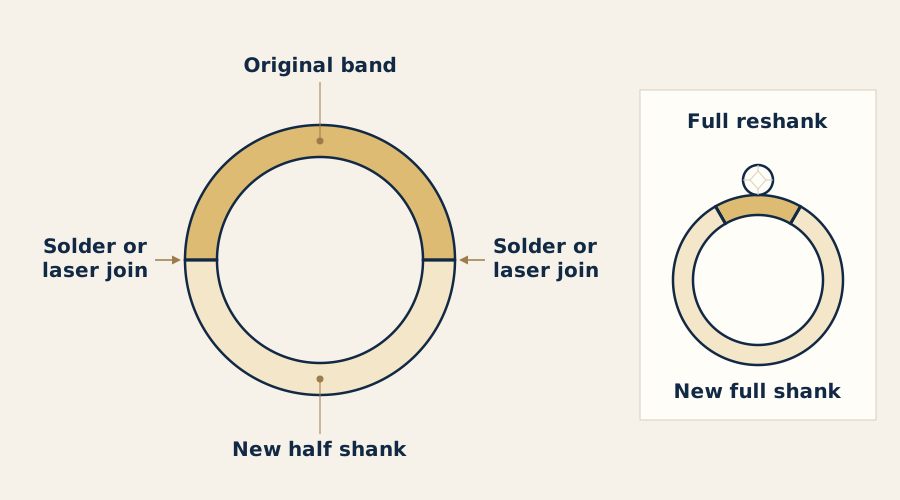
- Reshanking: replacing the worn bottom section of the band with new metal. A half shank replaces the palm half; a full shank replaces everything below the setting.
- Crack repair: filling and joining a split with solder or a laser weld, which melts a tiny spot of metal with very little heat spreading to nearby stones.
- Reshaping: pushing an oval or dented band back to round on a steel mandrel (a tapered rod).
- Polishing and refinishing: removing scratches, or restoring a brushed, satin or hammered finish.
- Rhodium plating: a thin coat of rhodium, a bright white platinum-group metal, over white gold, which wears off over time.
- Pattern work: re-cutting worn milgrain (a row of tiny metal beads along the edge) or re-engraving faded lettering inside the band.
Polishing removes a little metal each time, so it is not a free fix. A thin band that is machine-polished every few months loses thickness faster than one polished every couple of years. Crisp profiles such as knife-edge profiles are especially sensitive, because heavy polishing rounds off the ridge that gives them their look.
How many times can a ring be resized?
There is no fixed number. Each resize adds or reopens a solder join, and a join that has been heated many times can develop porosity (tiny holes in the metal) and become a weak point. A well-made plain gold or platinum band can usually be resized several times over its life without problems, especially if the jeweller moves the join or replaces the section rather than reheating the same spot again and again.
Some general limits jewellers work to:
- Stretching: a plain band can be stretched about half a size, sometimes up to one, but stretching thins the metal, so it is avoided on worn bands.
- Adding metal: roughly 1–2 sizes up is routine; much larger changes often mean a new shank.
- Going down: usually straightforward, because metal is removed rather than added.
- Full eternity bands: stones run all the way round, so there is no plain section to cut. These are usually remade in the new size.
- Half eternity bands: can normally be resized through the plain back.
Patterns complicate things. Twisted and rope-style bands carry a repeating pattern that is hard to cut into without breaking the rhythm, so a large size change may show. Engraving that runs all the way round has the same problem.
If your band is shaped to sit against an engagement ring, resizing it can change how the two rings meet. Fitted and curved wedding bands should be resized together with the engagement ring on the mandrel, and it is worth checking how much gap to leave between the two rings once the work is done.
Not sure which one is right?
Send us the stones you are looking at and our gemologist will tell you which to choose and why.
Can every metal band be repaired?
No. Precious metals can be cut, soldered and polished. Several modern alternative metals are chosen precisely because they are hard, and that same hardness or brittleness means they cannot be worked once they are made. This table is a practical guide:
| Metal | Resizable? | Crack repair? | What to expect |
|---|---|---|---|
| 18ct yellow or rose gold (75% gold) | Yes | Yes | Wears slowly; repairs very well |
| 18ct white gold | Yes | Yes | Needs rhodium re-plating; nickel alloys can crack with age |
| 9ct gold (37.5% gold) | Yes | Yes | Can be prone to stress cracking, especially in chlorine |
| Platinum 950 | Yes | Yes | Metal moves more than it wears away; develops a soft grey patina |
| Palladium | Yes, specialist | Yes, specialist | Repairable, but fewer workshops handle it |
| Sterling silver | Yes | Yes | Soft; thins and bends faster than gold |
| Titanium | Rarely, very small changes | No | Usually replaced |
| Tungsten carbide | No | No | Very hard but brittle; can shatter if struck |
| Ceramic | No | No | Cannot be resized or repaired; replace |
| Cobalt chrome | No | No | Usually replaced |
Platinum behaves differently from gold. When it is scratched, most of the metal is pushed aside rather than removed, so platinum bands tend to lose weight more slowly, although they still thin over decades. White gold is a gold alloy with a slightly warm grey or yellowish colour underneath its rhodium plating; once the plating wears through, the band is not damaged, it just needs re-plating.
If you are replacing a band because the old metal did not suit your life, our page comparing wedding band metals for wear sets out how each one ages. Tradies, mechanics and anyone who grips tools all day should also read about men's bands for hands-on work, where thickness and profile matter more than usual.
What if diamonds are missing from a wedding band?
A single lost stone in a diamond band is a common, repairable problem. The jeweller replaces the diamond with one matched for size and colour, then tightens the neighbouring settings, because a stone rarely falls out on its own: the metal holding it has usually worn or been knocked.
- Claw-set bands: worn claws can be rebuilt (retipped) with new metal before a stone is lost.
- Channel-set bands: stones sit in a groove between two metal walls. If the walls have worn thin, the channel loosens along its length and several stones may need resetting at once.
- Bezel-set bands: each stone has its own rim of metal, which is very secure; a worn rim can be reshaped and tightened.
- Pavé and micro-pavé: tiny beads of metal hold each small diamond; worn beads can be re-raised, but this is fine, time-consuming work.
Replacement becomes the sensible choice when most settings in the band are worn at the same time, or when the metal walls of a channel are too thin to hold stones securely after tightening. If you like the security of a rim, bezel-set diamond bands hold stones in a way that wears very slowly.
Checking claws regularly is the cheapest way to avoid losing stones in the first place. Our guide explains the signs that claws need retipping, and the same checks apply to claw-set wedding bands.
Related guideWhen Do Ring Claws Need Retipping?Is it cheaper to repair or replace a wedding band?
In most cases repairing a precious metal band costs less than replacing it, often much less. The calculation changes when a band needs several jobs at once, such as a full reshank, stone replacement and re-plating, or when it is a full eternity band that has to be remade in a new size anyway.
| Job | Approximate price range (AUD) |
|---|---|
| Clean and polish | about $30–$90 |
| Rhodium re-plating (white gold) | about $50–$130 |
| Resize, plain gold band | about $60–$200 |
| Resize, platinum band | about $100–$300 |
| Crack repair or laser weld | about $50–$200 |
| Half reshank, gold | about $200–$600 |
| Replace one small diamond (to about 0.05 ct) | about $80–$250 |
| New plain 18ct gold band | about $800–$2,500 |
| New plain platinum band | about $1,200–$3,500 |
These are broad ranges only. Anything that uses new metal moves with the price of gold and platinum, and heavier, wider or patterned bands cost more. A written quote after the jeweller has measured the band is the only reliable figure.
Sentiment matters too. Many people keep a thin family band going with a reshank because it is the original ring, even when a new one would cost a similar amount. Others retire the worn band and have a new band made around an heirloom ring. If the band is the piece you want to keep and the engagement ring is the one being replaced, see designing an engagement ring to suit an existing band.
Jewellery repairs service
How do you stop a wedding band wearing out? What not to do
Wear cannot be stopped, but it can be slowed a great deal. These are the habits that cause most of the damage we repair:
- Don't swim in chlorinated pools or spas wearing gold: chlorine can cause stress corrosion cracking in white gold and lower-carat gold, often at old solder joins.
- Don't wear the band for heavy work: gym weights, tools, gardening and moving furniture crush and thin the palm side.
- Don't use abrasive cleaners or toothpaste: they scratch the surface and wear plating faster.
- Don't let rings grind against each other unchecked: two hard metals rubbing all day wear both rings.
- Don't try to resize or bend a band yourself: squeezing a ring smaller or forcing it over a knuckle can crack a thin shank.
- Don't cut off a tungsten or ceramic band with a ring cutter: these metals have to be cracked off with special tools, so go to a jeweller or emergency department.
Friction between your engagement ring and band is a slow, constant cause of wear. Read whether a spacer band helps if your rings sit tightly together and you can see shiny rub marks where they touch.
For a daily-wear ring, a professional check every 6–12 months is a sensible rhythm: the jeweller looks at thickness, joins and settings, and cleans it ultrasonically if the stones allow. White gold usually needs re-plating somewhere between every 6 and 18 months depending on wear. Gentle cleaning at home in between is covered in our full ring cleaning routine.
How do you decide to repair or replace a wedding band? Step by step
- Know the metal. Check the stamp inside the band (750 or 18K for 18ct gold, 375 or 9K for 9ct, PT950 for platinum). If it is tungsten, ceramic or cobalt chrome, repair is not an option.
- Look at the palm side. Compare the thickness at the bottom with the top. A visibly flatter or thinner bottom means a reshank may be due.
- Check for cracks. Look closely at any old solder join and inside the band. Hairline lines that catch the light are a warning sign.
- Count the stones. Note any missing or loose diamonds, and whether claws or channel walls look worn.
- Have it measured. Ask a jeweller to measure the thinnest point with callipers and to tell you whether a half reshank, full reshank or new band is sensible.
- Compare written quotes. Add up every job the band needs and compare the total with a new band in a metal that suits your life.
- Decide what matters to you. Weigh cost and durability against the value of keeping the original ring, then plan care so the repaired or new band lasts.
Free consultation
Talk to a gemologist
Compare stones in person or online with Raj Sood, Graduate Gemologist (GIA), AJP (GIA).
Book a consultationShop this shape
FAQ
Common questions
Can a cracked wedding ring be repaired?
Usually, if it is gold, platinum, palladium or silver and the metal around the crack is still solid. The jeweller solders or laser welds the split and polishes it. Repeated cracks in the same band often point to thin or porous metal, and then a reshank or new band is safer.
How thin is too thin for a wedding band?
Most jewellers suggest reshanking once the thinnest point drops to about 1 mm. Below that the band can bend, go oval or crack under everyday pressure.
Is reshanking a ring worth it?
For a precious metal band with a sound top and worn bottom, a half reshank usually costs far less than a new band and keeps the original ring. It is less worthwhile if the whole band is thin or many stones also need replacing.
Can tungsten or ceramic rings be resized?
No. Tungsten carbide and ceramic cannot be cut and soldered, so a band that no longer fits has to be replaced. Some sellers offer exchange programs, so check what came with your ring.
Why does my white gold band look yellow?
White gold is usually rhodium plated, and the plating wears off over months of wear to show the slightly warm metal underneath. Re-plating restores the bright white colour and does not damage the band.
How often should a wedding band be checked by a jeweller?
Every 6–12 months for a ring worn every day, and straight away if it feels loose, oval or has lost a stone. Regular checks catch thin metal and worn settings while they are still simple to fix.

Ask a gemologist
Not sure which diamond to choose?
Raj Sood is a Graduate Gemologist (GIA) and master jeweller. Bring the stones you are considering, or send the reports, and he will tell you honestly which one is better and why.
Keep learning
Related guides
 Care, Repairs & RemodellingWhen Do Ring Claws Need Retipping?
 MetalsBest Metal for Wedding Bands
 Wedding Bands & EternityHow to Choose a Men’s Wedding Band for Hands-On Work
 Engagement Rings & SettingsTapered Bands
 Engagement Rings & SettingsTwisted BandsEngagement Rings & SettingsWhat Engagement Ring Band Width Should You Choose?Wedding Bands & EternityDo You Need a Spacer Band Between Rings?
Explore more
More guides on this topic
Education