
- Education
- Engagement Rings & Settings
- Best Settings for a Heart Cut Diamond: Claws, Halos and Bands
Engagement Rings & Settings
Best Settings for a Heart Cut Diamond: Claws, Halos and Bands
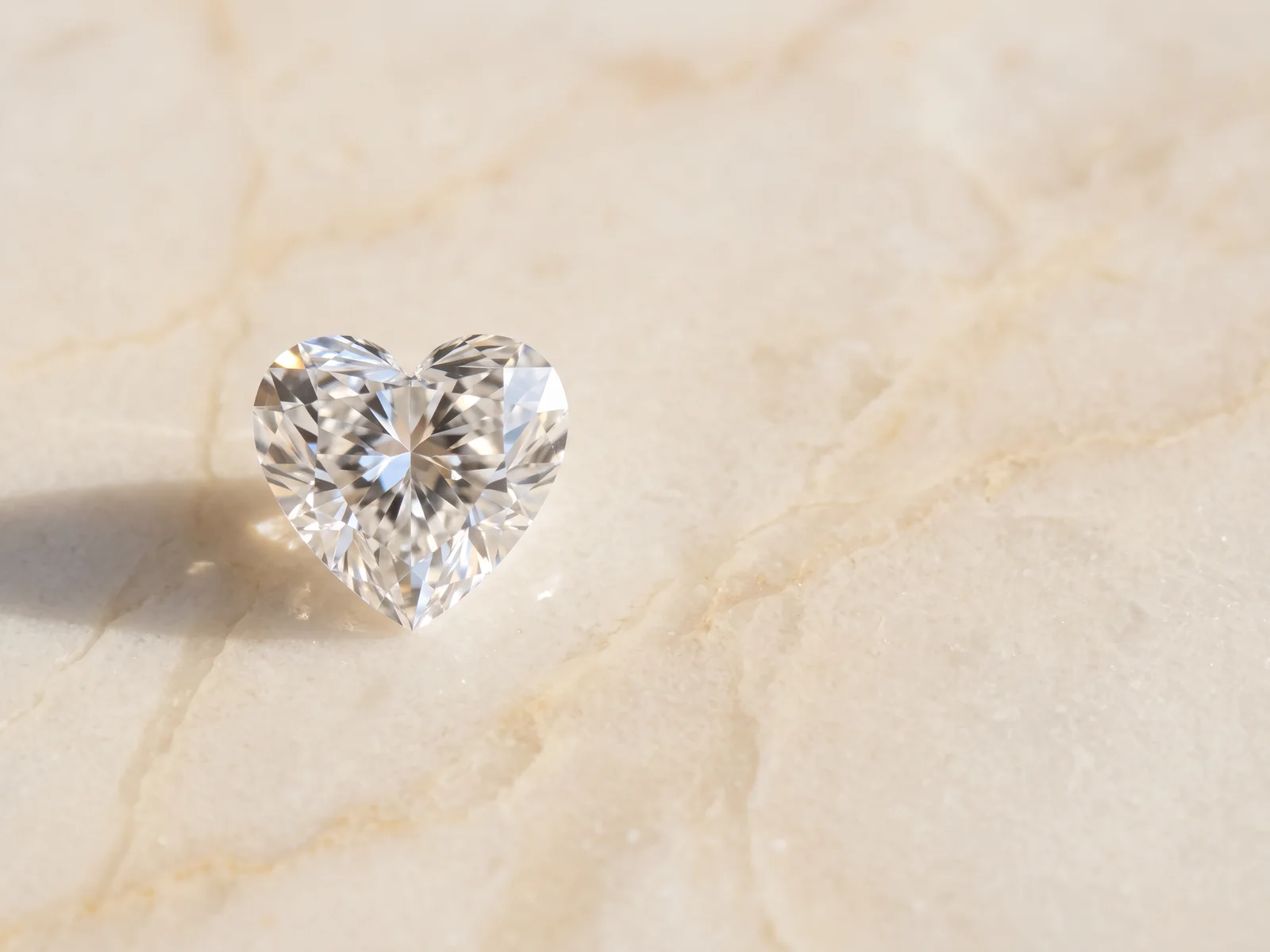
A heart cut diamond has a fine point and a notched cleft, and both need protecting. The setting decides whether your heart stays safe and still looks like a heart on the hand.
 Reviewed by Raj Sood, Graduate Gemologist (GIA), AJP (GIA)Master jeweller and Graduate Gemologist (GIA) · reviewed 4 November 2026
Quick answer
The best setting for a heart cut diamond protects its point and frames its lobes. A five-claw setting, with a V-claw on the point and claws at each lobe and either side of the cleft, is the most common choice. Bezels suit active hands, halos add size, and a contoured band sits flush beside it.
What makes a heart cut diamond hard to set?
A heart cut diamond is a modified brilliant: it uses brilliant-style triangular and kite-shaped facets, arranged around a heart outline instead of a circle. A typical 56–58 facet heart diamond (59 if the cutter adds a culet, a tiny flat facet at the bottom) has two rounded lobes, a cleft between them, curved wings down each side and a pointed tip. If you are still choosing the stone itself, start with our full heart shaped diamond guide for ratio, colour and clarity. This page assumes you have a heart in mind and want to know what should hold it.
Diamond sits at 10 on the Mohs hardness scale, but hardness only measures resistance to scratching. Toughness, the resistance to knocks, is a different property. Diamond has four directions of cleavage (planes along which it can split cleanly), so a sharp blow on a thin edge is what causes chips. A heart has two thin areas: the point, where the girdle (the narrow outer rim of the stone) tapers to a fine tip, and the cleft, where the girdle turns sharply inward.
So every setting for a heart has four jobs:
- Protect the point: the most exposed edge on the stone and the most common place for a chip.
- Guard the cleft: a deep or thin cleft can catch on knits and door frames.
- Hold the lobes evenly: uneven grip lets the stone tilt, which makes the halves look mismatched.
- Keep the outline readable: too much metal in the wrong place blurs the shape that you chose the stone for.
Words like girdle, culet and cleavage are all explained in our plain-English jewellery glossary if you want to look anything up as you go.
Where should the claws go on a heart cut diamond?
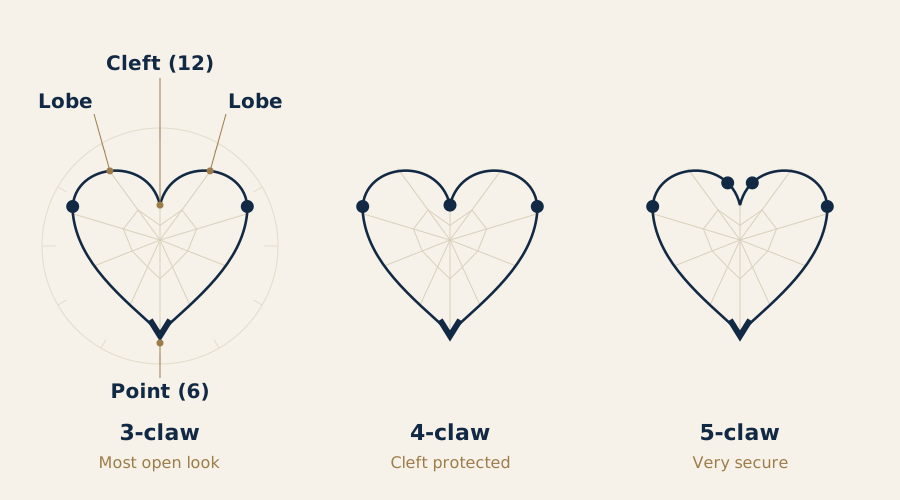
Claws (also called prongs) are small metal posts that rise from the setting and fold over the girdle to hold the stone. A heart needs at least three. Picture the stone point-down like a clock face, with the cleft at 12 and the point at 6. The lobe claws usually sit near the widest part of each lobe, somewhere between 9 and 10 o'clock on the left and between 2 and 3 o'clock on the right. Placed too high, they press into the curve of the lobe and flatten it; too low, and the lobes are not held firmly.
| Layout | Where the claws sit | Strengths | Watch for |
|---|---|---|---|
| 3 claws | V-claw on the point, one on each lobe | Most open look; shows the most outline | Cleft is unguarded; each lobe relies on one claw |
| 4 claws | V-claw on the point, one on each lobe, one in the cleft | Cleft protected; neat and symmetrical | A heavy cleft claw can fill the dip and soften the heart |
| 5 claws | V-claw on the point, one on each lobe, one either side of the cleft | Very secure; the most common layout from about 0.75 ct | More metal across the top of the stone |
| 6 claws | V-claw, one on each lobe, one either side of the cleft, one on each wing | Extra hold for larger stones, often 2 ct and up | Can look busy on smaller hearts |
Claw placement can also hide or highlight small differences between the two halves. If one lobe is a touch fuller than the other, a skilled setter can shift the lobe claws slightly to balance what you see face-up. That only works if the stone is close to symmetrical in the first place, so run through our heart symmetry checklist before you commit to a stone.
What is a V-claw and why does a heart need one?
A V-claw (sometimes called a chevron claw) is a small V-shaped piece of metal that wraps around both sides of the point, covering the last millimetre or so of the tip. It takes the knocks instead of the diamond, and it also hides the tip if the cutter left it slightly blunt or uneven. For a heart, a pear or a marquise, it is the standard way to protect a point. These are the main claw styles you will see on heart shape diamond engagement rings:
- V-claw: wraps the point completely. The usual choice for the tip of any heart, whatever the rest of the setting.
- Round claw: a rounded bead of metal over the girdle. Ideal on the lobes, but on its own at the point it can leave the tip exposed on either side.
- Double claws: two thin claws side by side instead of one. They spread the grip and give a lighter look on the lobes.
- Eagle or talon claws: long, tapered claws with a pointed tip. Decorative, but they catch more easily on clothing.
- Tab or flat claws: flat, flared claws, often used in vintage-style or bold modern designs.
Claw thickness matters as much as shape. On a 1 carat heart, claws are often around 0.8–1.2 mm at the tip. Thinner claws show more diamond but wear down sooner. Platinum claws tend to wear more slowly, and both platinum and gold claws can be re-tipped (built back up with new metal) when they thin. Whatever the metal, have the claws checked every 6–12 months. Our overview of engagement ring setting styles compares claw, bezel, tension and channel settings across all shapes.
Is a bezel setting good for a heart cut diamond?
A bezel is a thin rim of metal that runs around the girdle instead of claws. For a heart, it is the most protective option there is: the point, the cleft and both lobes are all wrapped in metal, and nothing sticks up to snag. A bezel set heart diamond suits nurses, gardeners, tradespeople and anyone who uses their hands hard; see our guide to settings for people who work with their hands for more options.
- Full bezel: metal all the way round. Maximum protection and a clean, modern line.
- Half-bezel: metal on the sides or ends only, leaving parts of the girdle open. A balance between protection and light.
- Point bezel: a claw setting with a small bezel cup around the tip only. Similar in effect to a V-claw but more solid.
The trade-off is size and outline. A bezel usually covers a fraction of a millimetre of the stone's edge all the way round, so the heart looks a little smaller than in claws. The metal edge also traces the outline, which can make a shallow cleft look shallower. White metal (platinum or white gold) keeps the rim quiet against a colourless stone; yellow or rose gold makes the outline bolder and adds warmth to the diamond.
Not sure which one is right?
Send us the stones you are looking at and our gemologist will tell you which to choose and why.
Should a heart shaped engagement ring have a halo?
A halo is a ring of small diamonds, usually about 1.0–1.5 mm each, set around the centre stone. A single row adds about 2–3 mm to the face-up width of the ring. That makes a heart diamond halo setting popular for stones under about 0.75 carat, where the outline can otherwise look like a rounded triangle. Our page on the minimum size for a heart to read clearly explains where that tipping point sits.
- Classic halo: follows the heart outline exactly, including a crisp dip at the cleft and a fine point at the tip. A good halo is the easiest way to make the shape obvious from across a room.
- Hidden halo: a row of small diamonds under the girdle, visible from the side only. It adds sparkle in profile without changing the face-up shape.
- Double halo: two rows, for a bigger, more vintage look. It can overwhelm a small heart.
- No halo (solitaire): the stone alone, which shows the heart's own outline most honestly.
Two things to check. First, the halo must dip into the cleft: a halo that simply rounds over the top turns the whole ring into a teardrop. Second, a halo means dozens of small stones, each held by tiny beads of metal, so it needs a check every year or so and more care around hard surfaces. The halo also takes knocks before the centre stone does, which is a genuine plus for the point.
Which side stones suit heart shape diamond engagement rings?
Side stones change the character of the ring more than any other choice. Because a heart is roughly as wide as it is long, side stones need to be in proportion so the centre still looks like the main event. Common pairings for heart cut diamond engagement rings:
- Plain solitaire band: a slim band of about 1.8–2.5 mm lets the heart stand alone.
- Pavé band: small diamonds set into the band, held by tiny beads of metal. Adds sparkle without competing with the outline.
- Three-stone with pears: pear side stones either point inward toward the heart or outward toward the band. Pears echo the heart's point and keep the soft, curved theme.
- Trillions: triangular side stones. Their straight edges contrast with the heart's curves and make it look wider.
- Tapered baguettes: step-cut side stones that narrow toward the band, giving clean lines that lead the eye to the centre.
- Toi et moi: two centre stones side by side, often a heart and a pear. Our guide to how heart and pear shapes differ helps if you are weighing up the two.
With any side stone, the point of the heart sits right where the side stones begin, so the setter needs room to fit a V-claw without crowding. Ask for a side view of the design, not just the top view, to make sure the stones are not jammed against the tip.
How do heart settings compare with other diamond shapes?
The table compares the main heart shaped engagement ring settings on what matters most for this shape: point protection and how clearly the heart reads.
| Setting | Protects point and cleft | Shows the outline | Looks larger | Upkeep | Suits |
|---|---|---|---|---|---|
| 3-claw solitaire | Point only | Very clearly | No | Claw checks every 6–12 months | Careful wearers, smaller stones |
| 5-claw solitaire | Point and cleft | Clearly | No | Claw checks every 6–12 months | Most everyday wearers |
| Half-bezel | Point and sides | Mostly | No | Low | Active hands wanting some openness |
| Full bezel | Everything | Slightly softened | Slightly smaller | Very low | Hard daily wear |
| Halo | Point and edge shielded | Very clearly | Yes, about 2–3 mm wider | Check small stones yearly | Hearts under about 0.75 ct |
| Three-stone | Depends on centre claws | Clearly | Yes, wider overall | Moderate | A fuller, more formal look |
Each diamond shape has its own weak spots, so the right setting is never one-size-fits-all. The heart's closest relative is the pear, and how pear diamonds are set covers the same V-claw thinking for a single point. Protecting a marquise's two points doubles that challenge, while princess cut corner protection deals with four sharp corners instead of one tip.
By contrast, settings for round brilliants and cushion cut setting ideas have no points at all, so they can use simpler four or six-claw heads. For step cuts and older stones, see Asscher cut settings and settings for antique old mine cuts, and for longer stones generally, settings for elongated shapes.
What metal and wedding band suit a heart cut diamond ring?
Platinum (usually 950, meaning 95% platinum) is dense and hard-wearing, which makes it a popular choice for claws on a point. 18ct white gold is usually rhodium plated for a bright white finish, and the plating needs renewing every year or two. 18ct yellow and rose gold warm the look of the diamond, so a slightly warmer colour grade can look white in them. A common combination is a yellow or rose gold band with a white metal head, so the claws next to a colourless heart do not tint it.
Orientation is a choice too. Most hearts are set with the point toward the fingertip, which reads as a heart to the person looking at your hand. Some people prefer the point toward the wrist, so the heart looks right side up to them. Either is fine; just decide before the head is made, because the claws are built around it.
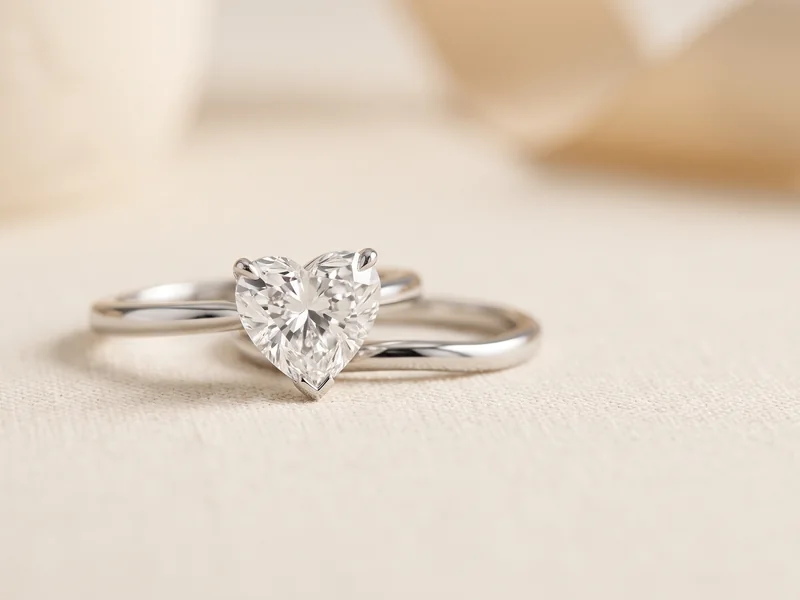
Plan the wedding band at the same time as the engagement ring. A heart is widest across the lobes and narrowest at the point, and a straight band can either leave a gap near the tip or press against the V-claw. The usual answers are a contoured band curved to follow the stone, a notched band with a small cut-out for the point, or a setting raised high enough that a straight band slides underneath. Our guide to wedding bands that sit flush against a heart shows each option.
How much does a heart cut diamond engagement ring cost?
The total is the stone plus the setting. Heart diamonds are cut from both natural and laboratory-grown diamond. Lab-grown diamonds are real diamond with the same hardness and refractive index (about 2.42), grown in a laboratory rather than mined; they cost much less than natural stones of the same size and grade. Either way, the stone should come with an independent grading report that states clearly whether it is natural or lab-grown.
| Component | Approximate price range (AUD) |
|---|---|
| 18ct gold solitaire setting | about $1,500–$3,500 |
| Platinum solitaire setting | about $2,500–$5,000 |
| Halo or three-stone setting (small diamonds included) | about $2,500–$6,000 |
| 1 ct lab-grown heart, G–H, VS | about $1,000–$3,000 |
| 1 ct natural heart, G–H, VS | about $7,000–$16,000 |
These are broad ranges only; prices move with the metal market, the design and the exact grades. For the stone, carat, colour, clarity and the evenness of the outline move the price most, and how colour and clarity move a heart's price explains each in detail. For the setting, metal weight, the number of small diamonds and handwork such as a custom halo matter most.
Shop heart diamonds: natural and lab-grown
How do you choose a setting for a heart cut diamond? Step by step
- Start with the stone. Note its measurements, ratio and any inclusions near the point or cleft from the grading report.
- Check the halves. Use these symmetry checks for the lobes, cleft and point so you know whether claws need to balance anything.
- Decide how hard you wear rings. Careful wearers can choose three or five claws; hard daily use points toward a half or full bezel.
- Protect the point. Whatever the style, insist on a V-claw, point bezel or halo at the tip.
- Choose solitaire or halo. Under about 0.75 ct, consider a halo so the shape reads clearly; above that, a solitaire shows the outline well.
- Pick metal and orientation. Platinum or gold, and point toward the fingertip or the wrist.
- Plan the band now. Confirm whether a straight, contoured or notched band will sit flush.
- Review a CAD render. Check claw positions on your actual stone, top view and side view, before casting.
Free consultation
Talk to a gemologist
Compare stones in person or online with Raj Sood, Graduate Gemologist (GIA), AJP (GIA).
Book a consultationFAQ
Common questions
How many claws should a heart cut diamond have?
At least three: a V-claw on the point and one on each lobe. Five claws, adding one either side of the cleft, is the most common choice for everyday engagement rings from about 0.75 carat.
Why do heart diamonds need a V-claw?
The point is the thinnest edge on the stone and the most likely place to chip. A V-claw wraps both sides of the tip so knocks land on metal instead of diamond.
Is a halo a good idea for a heart shaped diamond?
It is a good option for hearts under about 0.75 carat, because it adds around 2–3 mm of width and makes the outline easier to read. A well-made halo must dip into the cleft, or the ring will look like a teardrop.
Which way should the point of a heart diamond face?
Most hearts are set with the point toward the fingertip, so the heart looks upright to people facing you. Setting it toward the wrist is equally valid if you would rather see it upright yourself.
Will a straight wedding band sit next to a heart engagement ring?
Only if the setting is raised high enough for the band to slide underneath. Otherwise a contoured or notched band is usually needed to sit flush beside the point.
Are bezel settings safe for heart cut diamonds?
Yes, a full bezel is the most protective setting for a heart, covering the point, cleft and lobes. The trade-off is that the stone looks slightly smaller and the outline a little softer.

Ask a gemologist
Not sure which diamond to choose?
Raj Sood is a Graduate Gemologist (GIA) and master jeweller. Bring the stones you are considering, or send the reports, and he will tell you honestly which one is better and why.
Keep learning
Related guides
 Diamond ShapesHeart-Shaped Diamonds
 Wedding Bands & EternityBest Wedding Band for Heart Engagement Rings
 Diamond ShapesHeart-Shaped Diamond Symmetry Guide
 Engagement Rings & SettingsBest Settings for Pear DiamondsEngagement Rings & SettingsEngagement Ring Setting Styles Guide
 Diamond ShapesHeart vs Pear Shaped DiamondsDiamond ShapesHow Big Should a Heart-Shaped Diamond Be to Show Its Shape?
 Engagement Rings & SettingsBest Settings for Princess Diamonds
Explore more
More guides on this topic
Education