
- Education
- Lab-Grown Diamonds
- HPHT Blue Nuance in Lab-Grown Diamonds: Causes, Grading and What to Check
Lab-Grown Diamonds
HPHT Blue Nuance in Lab-Grown Diamonds: Causes, Grading and What to Check
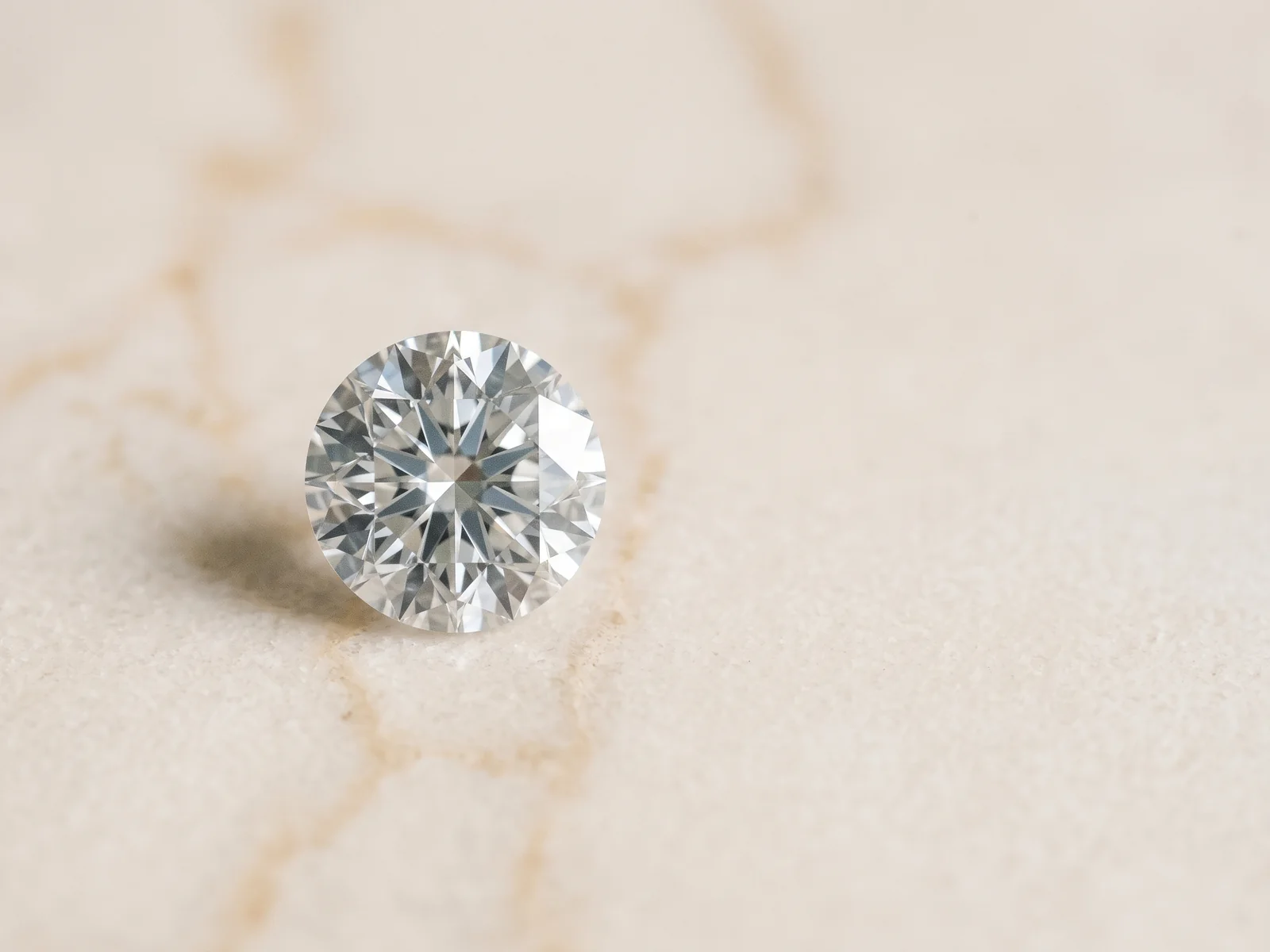
HPHT blue nuance is the faint cool tint some lab-grown diamonds show in daylight, and most reports barely mention it. Here is what causes it, how to spot it and when it matters.
 Reviewed by Raj Sood, Graduate Gemologist (GIA), AJP (GIA)Master jeweller and Graduate Gemologist (GIA) · reviewed 4 November 2026
Quick answer
HPHT blue nuance is a faint grey-blue tint seen in some colourless HPHT lab-grown diamonds. It comes from traces of boron that enter the crystal during growth. It is not a flaw or a treatment, and many people never notice it, but it can make a D–F stone look cooler; check it face-down, in daylight, beside a neutral stone.
What is HPHT blue nuance in a lab-grown diamond?
In the diamond trade, nuance means a secondary tint that sits on top of a stone's colour grade. The familiar D-to-Z colour scale measures how much yellow or brown a diamond shows, from none at D to a light tint at Z. A stone can grade E or F and still look faintly brown, grey, green, milky or blue in real life, because the letter grade does not fully capture those hues. HPHT blue nuance is the blue version, and it turns up mostly in lab-grown diamonds grown by the high-pressure, high-temperature (HPHT) method.
Lab-grown diamonds are real diamond: carbon atoms in the same cubic crystal structure as a mined stone, 10 on the Mohs hardness scale, with a refractive index of about 2.42. Our explainer on why lab-grown diamonds are real diamond covers the science. Blue nuance does not change any of that. It is purely a question of appearance: a cool, steely or slightly grey-blue look that is most visible in larger stones, in daylight, against white.
This page focuses on lab-grown stones. For the same idea across every colourless-looking diamond, natural included, see our guide to brown, grey and blue nuance in colourless-looking diamonds. If you are new to lab-grown altogether, start with our complete lab-grown diamonds guide.
Why do HPHT lab-grown diamonds have a blue tint?
The HPHT method recreates, in a press, the conditions deep in the Earth where natural diamond forms: roughly 5–6 gigapascals of pressure (about 50,000–60,000 times the air pressure around you) and about 1,300–1,600 °C. Carbon dissolves in a molten metal solvent, usually iron, nickel or cobalt, and crystallises slowly onto a small diamond seed. Our page on how lab-grown diamonds are made, from seed to polished stone walks through each stage.
The main impurity in diamond is nitrogen, and nitrogen makes diamond yellow. To grow colourless stones, HPHT growers add nitrogen getters, metals such as titanium, aluminium or zirconium that grab nitrogen before it can enter the crystal. That works well, but it has a side effect. Traces of boron are very hard to keep out completely; they can come from the raw carbon, the metal solvent or parts of the growth cell.
Boron absorbs light at the red end of the spectrum, so a boron-bearing diamond looks blue. In a nitrogen-rich diamond, nitrogen cancels boron's effect (nitrogen gives up an electron and boron takes it, so they neutralise each other). Remove the nitrogen and there is nothing left to mask the boron, so even a fraction of one part per million can tint the stone. A diamond whose main impurity is boron is called Type IIb, the same type as natural blue diamonds.
- Type Ia: nitrogen in clusters; most natural diamonds, often faintly yellow.
- Type Ib: single scattered nitrogen atoms; rare in nature, common in older yellow HPHT stones.
- Type IIa: almost no nitrogen or boron; very pure, typical of colourless lab-grown.
- Type IIb: trace boron, no meaningful nitrogen; blue to grey-blue, and able to conduct electricity.
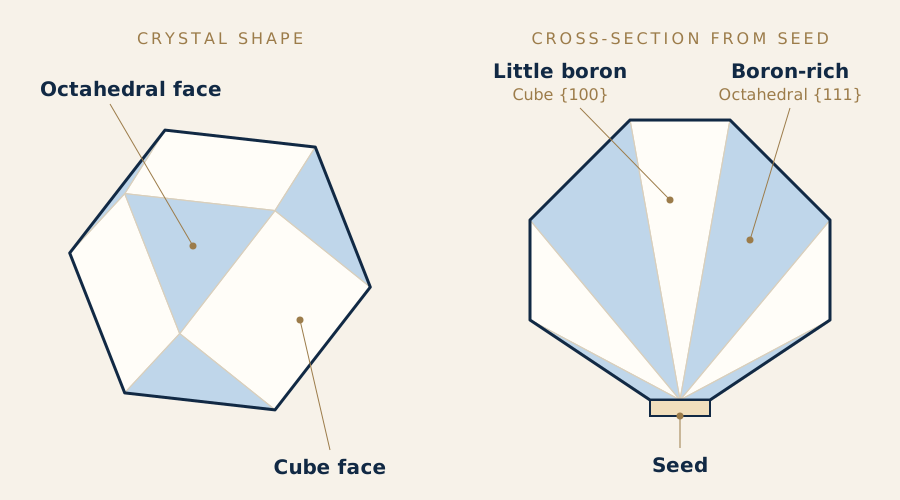
HPHT crystals grow as cuboctahedra, a shape with square cube faces and triangular octahedral faces. Each face builds its own wedge of crystal, called a growth sector, and the octahedral sectors take up much more boron than the others. So the blue is often uneven, concentrated in zones you cannot see with the eye but that labs image under ultraviolet light as a cross or hourglass pattern. The same growth process can also trap tiny pieces of the solvent, which our guide to metal flux inclusions in HPHT stones explains.
Do CVD lab-grown diamonds show blue nuance too?
Much less often. The other main growth method, chemical vapour deposition (CVD), builds diamond layer by layer from a methane and hydrogen gas plasma at low pressure and roughly 700–1,200 °C. There is no metal solvent, and boron is not usually present unless it is added on purpose. The typical nuance in CVD stones is brown or grey, from strain and defects in the crystal, which many growers reduce with a post-growth HPHT heat treatment.
| HPHT lab-grown | CVD lab-grown | |
|---|---|---|
| How it grows | Metal solvent, about 5–6 GPa and 1,300–1,600 °C | Gas plasma, low pressure, about 700–1,200 °C |
| Usual nuance | Blue or grey-blue (boron) | Brown or grey (growth defects) |
| Usual diamond type | Type IIa, often with trace boron (IIb) | Type IIa |
| Post-growth treatment | Usually sold as grown | Often HPHT-annealed to remove brown |
| Typical inclusions | Metallic flux, sometimes magnetic | Dark graphite-like specks |
| Short-wave UV | Often greenish-blue glow and phosphorescence | Often orange or red; varies |
Neither method is better in itself; a well-chosen stone from either can face up white and bright. If you are weighing the two, our full comparison of HPHT and CVD growth goes further into colour, clarity and how labs tell them apart.
Related guideHPHT vs CVD Lab-Grown DiamondsHow can you tell if a lab-grown diamond has a blue nuance?
A faint blue nuance is hard to see once the stone is set and moving on a hand. It shows most clearly in a few situations:
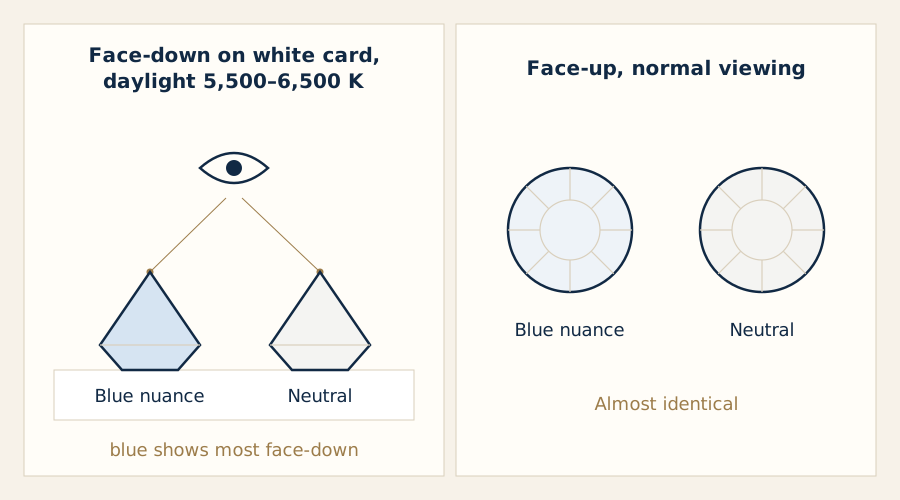
- Face-down on white: looking through the side of the stone (the pavilion) on a white card concentrates the body colour.
- Daylight or daylight-balanced light: roughly 5,500–6,500 K. Warm indoor lighting tends to hide it.
- Side by side: next to a neutral D–F stone of similar size, the blue one looks cooler or slightly steely.
- Larger stones: above about 1.5 carat, light travels further through the diamond and picks up more colour.
- In dim light: a blue tint with a grey component can make the stone look a little darker or less lively.
Shape plays a part as well. Fancy shapes tend to show body colour more than a round brilliant, because colour gathers in their ends and narrow areas. A slight cool tint is often easier to notice in oval cut diamonds or pear shaped diamonds than in a round of the same grade. Our overview of how each diamond shape handles light and colour compares the main outlines.
Ultraviolet light gives more clues. Many HPHT lab-grown diamonds are inert or very weak under long-wave UV but glow greenish-blue under short-wave UV, and then keep glowing for several seconds to a minute after the lamp is switched off. That afterglow is called phosphorescence, and boron is a major cause of it. Natural diamonds usually react the other way, glowing more strongly under long-wave UV. Do not confuse the two ideas: blue fluorescence is a glow under UV and is common in natural diamonds, while blue nuance is the stone's actual body colour in ordinary light.
Labs use further tests you cannot do at home. Boron makes Type IIb diamond a semiconductor, so it conducts electricity, and infrared spectroscopy shows boron's signature directly. A strong magnet can also lift some HPHT stones, as explained in our page on why a strong magnet can pick up some HPHT stones. Any unfamiliar term here is defined in our glossary of jewellery and gem terms.
Not sure which one is right?
Send us the stones you are looking at and our gemologist will tell you which to choose and why.
How do grading reports describe blue nuance?
Most reports for colourless lab-grown diamonds do not use the word nuance at all. The D-to-Z grade is built around the absence of yellow and brown, so a stone with a faint blue tint and no yellow can still receive a high grade. Where the blue is stronger, a lab may add a comment, or grade the stone on the fancy colour scale instead (for example Faint Blue, Very Light Blue or Fancy Light Blue). Wording differs between labs and changes over time, so read what is actually printed rather than assuming.
| What you may see on the report | What it tells you |
|---|---|
| Laboratory-Grown / Lab-Grown, plus a laser inscription on the girdle | The stone is lab-grown; this must always be disclosed |
| Growth method: HPHT (or CVD) | Which process grew it; blue nuance is mainly an HPHT issue |
| As grown / no indication of post-growth treatment | Colour has not been altered after growth |
| Colour: D, E or F | High grade on the yellow scale; blue can still be present |
| Comment mentioning Type IIb or a blue tint | The lab found boron or a visible blue component |
| Colour graded as Faint or Light Blue | The blue is strong enough to count as a fancy colour |
The report is your starting point, but it is not the whole picture. Two E-colour HPHT stones can look different side by side, one neutral and one cool, and only your eyes or a trusted video in daylight will tell you. Our guide to how reports separate HPHT and CVD growth shows where the growth method appears on common report layouts.
In Australia, the Australian Consumer Law prohibits misleading descriptions of goods. In practice, that means a lab-grown diamond should be clearly identified as lab-grown (or laboratory-grown) on the label, the receipt and the report, and a seller should not describe a visibly blue stone as neutral white. If anything is unclear, ask for the report number and check it on the lab's own website.
Is HPHT blue nuance bad, and does it affect sparkle?
It is not a defect in the sense of a crack or a cloud. Boron has no effect on hardness or durability, and sparkle comes mainly from the cut: how well the facets return light to your eye. A well-cut round with a faint blue nuance will still sparkle like any other well-cut round.
Whether it matters to you comes down to taste and strength of tint. Many people like a faint blue; it reads as icy and crisp, especially in white gold or platinum. A stronger blue with a grey component is different. It can make the stone look steely, and in dim indoor light slightly darker and less lively than a neutral stone of the same grade.
- Likely fine: faint blue you only see face-down, stones under about 1.5 carat, white-metal settings, people who like a cool white.
- Worth a closer look: stones over 2 carats, D–F grades where no yellow balances the blue, and anyone who wants a warm or perfectly neutral white.
- Watch for grey: in G–H stones, leftover yellow can mix with blue and look more grey than white.
Metal colour changes the effect too. White metals reinforce a cool look, while yellow or rose gold reflects warmth into the stone and can soften a slight blue. To see how blue nuance compares with brown and grey tints in practice, read our page on how blue nuance compares with brown and grey tints.
How is blue nuance different from a blue diamond?
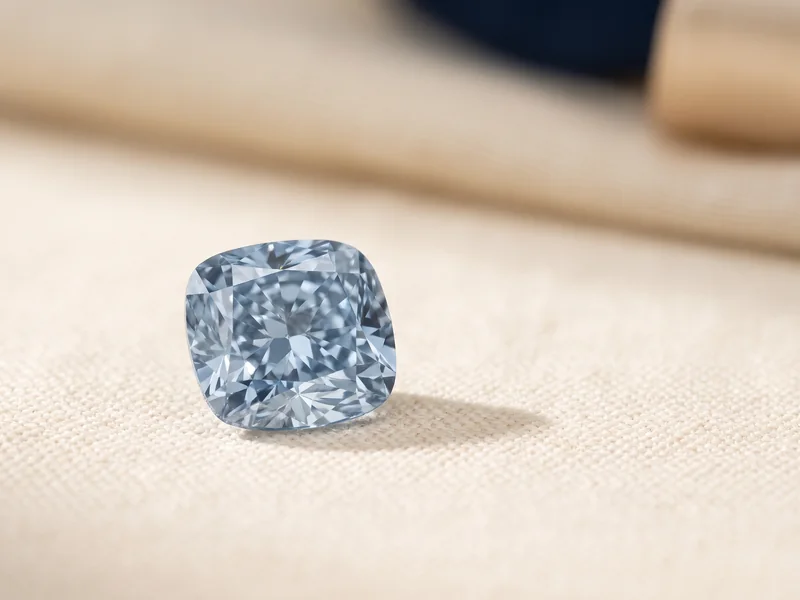
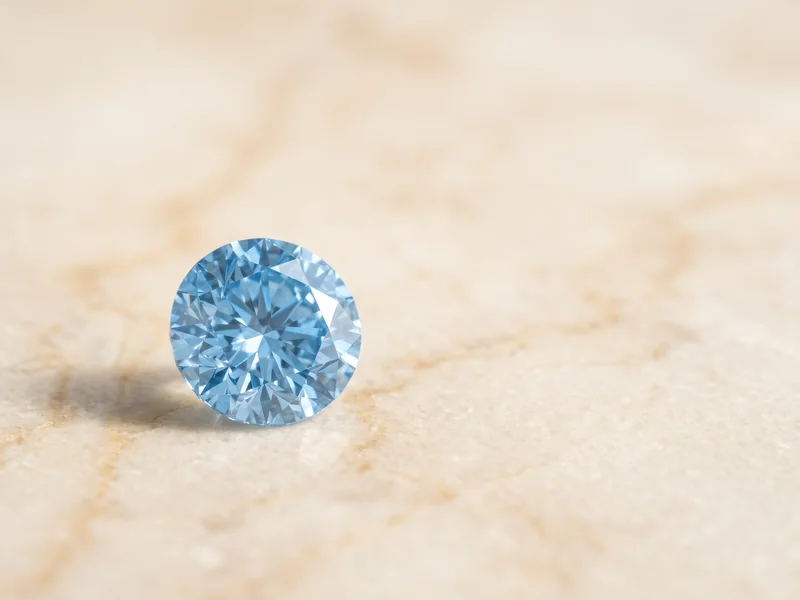
Blue nuance and a true blue diamond have the same cause, boron, in very different amounts. A nuance is a hint of colour in a stone sold as colourless; a blue diamond has enough boron to be graded and sold for its colour. Blue can also be created by treatment, which works quite differently.
| Blue nuance (HPHT lab-grown) | Fancy blue lab-grown | Natural blue | Treated blue | |
|---|---|---|---|---|
| Cause | Trace boron, unintended | Boron added on purpose | Natural boron (Type IIb) | Irradiation creates colour centres |
| Graded as | D–Z colourless, sometimes with a comment | Fancy colour scale | Fancy colour scale | Fancy colour, disclosed as treated |
| Conducts electricity | Often, weakly | Yes | Yes | No |
| Rarity | Common in HPHT growth | Readily available | Very rare | Available |
| Approximate price | Similar to neutral lab-grown | Above colourless lab-grown | Often tens of thousands of dollars per carat or more | Well below natural blue |
Natural blue diamonds are among the rarest of all; the 45.52 carat Hope diamond is the famous example, and South Africa's Cullinan mine is a well-known source. Our page on natural blue diamonds and how their colour is graded covers the intensity scale and the rarity of the type IIb blues found in nature.
Treated blues are usually made by irradiation, which knocks carbon atoms out of place and creates a colour centre that absorbs red light. They do not conduct electricity, which is one way labs separate them from boron blues. Our guide to irradiated and HPHT-treated colour diamonds explains the process and the disclosure rules. Do not confuse HPHT growth with HPHT treatment, either: the same press can be used to change the colour of a mined stone, as described in our page on natural diamonds whose colour was altered by HPHT.
Does blue nuance affect lab-grown diamond price in Australia?
Usually only a little, if at all. Lab-grown prices are driven by carat, cut, colour grade and clarity, and a faint blue nuance that does not appear on the report rarely changes the listed price. Some dealers who sort stones by eye list a noticeably blue or steely stone a little lower than a neutral one of the same grade. Fancy blue lab-grown diamonds, where boron is added deliberately, cost more than colourless lab-grown because the colour is the point.
| Round brilliant, VS clarity | Approximate price range (AUD) |
|---|---|
| 1 ct lab-grown, D–F, neutral or faint blue | about $700–$2,000 |
| 2 ct lab-grown, D–F, neutral or faint blue | about $1,500–$4,500 |
| 1 ct lab-grown fancy blue | about $2,000–$6,000 |
| 1 ct natural fancy blue | often tens of thousands of dollars or more |
These are broad ranges only, and lab-grown prices in particular have fallen quickly over recent years. Lab-grown diamonds cost much less than natural diamonds of the same size and grade, and their resale value is low, so choose one because you like how it looks rather than as a store of value. For everything else to weigh up, see what to compare when buying lab-grown in Australia.
Browse lab-grown diamonds
How to check an HPHT lab-grown diamond for blue nuance: step by step
- Read the report. Confirm it says lab-grown, note the growth method (HPHT or CVD) and look for any comment about Type IIb or a blue tint.
- Note the colour grade. Blue shows most in D–F; in G–H it may mix with yellow and look grey.
- Ask for daylight viewing. Use daylight or a daylight-balanced lamp of about 5,500–6,500 K, not warm shop lighting.
- Compare face-down. Place the stone face-down on a white card beside a neutral stone of similar size.
- Check face-up. Look at it from normal viewing distance; if the blue only shows face-down, it is unlikely to matter in wear.
- Look in dim light. A steely, grey-blue stone can darken more than a neutral one indoors.
- Think about the metal. White metals emphasise a cool tint; yellow or rose gold softens it.
Free consultation
Talk to a gemologist
Compare stones in person or online with Raj Sood, Graduate Gemologist (GIA), AJP (GIA).
Book a consultationShop this shape
FAQ
Common questions
Why do some lab-grown diamonds look blue?
Most blue-looking colourless lab-grown diamonds were grown by HPHT and contain traces of boron. Growers remove nitrogen to avoid yellow, which leaves nothing to mask the boron, so a faint blue tint can appear.
Is blue nuance a sign of a fake diamond?
No. A lab-grown diamond with a blue nuance is still real diamond with the same hardness and refractive index as a natural one. The tint simply reflects a trace element in the crystal.
Will a grading report tell me if a diamond has blue nuance?
Not always. Reports usually state the growth method and colour grade, and some add a comment about Type IIb or a blue tint, but a faint nuance may not be mentioned, so view the stone in daylight too.
Do CVD diamonds have blue nuance?
Rarely. CVD stones are more likely to show a brown or grey nuance, which is often reduced by post-growth treatment; blue in a CVD stone usually means boron was added deliberately.
Is a blue nuance lab-grown diamond cheaper?
A faint blue rarely changes the listed price. Some sellers price a clearly blue or steely stone a little lower than a neutral one of the same grade, while deliberately grown fancy blue stones cost more.
Can blue nuance be removed?
Not in practice for a finished stone. Boron is part of the crystal, so the tint is permanent and stable; it will not fade or change with wear or cleaning.
Terms in this guide

Ask a gemologist
Not sure which diamond to choose?
Raj Sood is a Graduate Gemologist (GIA) and master jeweller. Bring the stones you are considering, or send the reports, and he will tell you honestly which one is better and why.
Keep learning
Related guides
 Lab-Grown DiamondsHPHT vs CVD Lab-Grown DiamondsDiamond 4Cs & GradingBrown, Grey and Blue Nuance in Colourless-Looking Diamonds
 Lab-Grown DiamondsMetallic Inclusions in HPHT Lab-Grown Diamonds
 Fancy Colour DiamondsBlue DiamondsLab-Grown DiamondsLab-Grown Diamonds Guide
 Natural DiamondsHPHT Natural Diamonds
 Fancy Colour DiamondsTreated Colour Diamonds (HPHT and Irradiation)
 Lab-Grown DiamondsAre Lab-Grown Diamonds Real Diamonds
Explore more
More guides on this topic
Education