
- Education
- Diamond 4Cs & Grading
- Diamond Tint Guide: Brown, Grey and Blue Nuance in Colourless-Looking Diamonds
Diamond 4Cs & Grading
Diamond Tint Guide: Brown, Grey and Blue Nuance in Colourless-Looking Diamonds
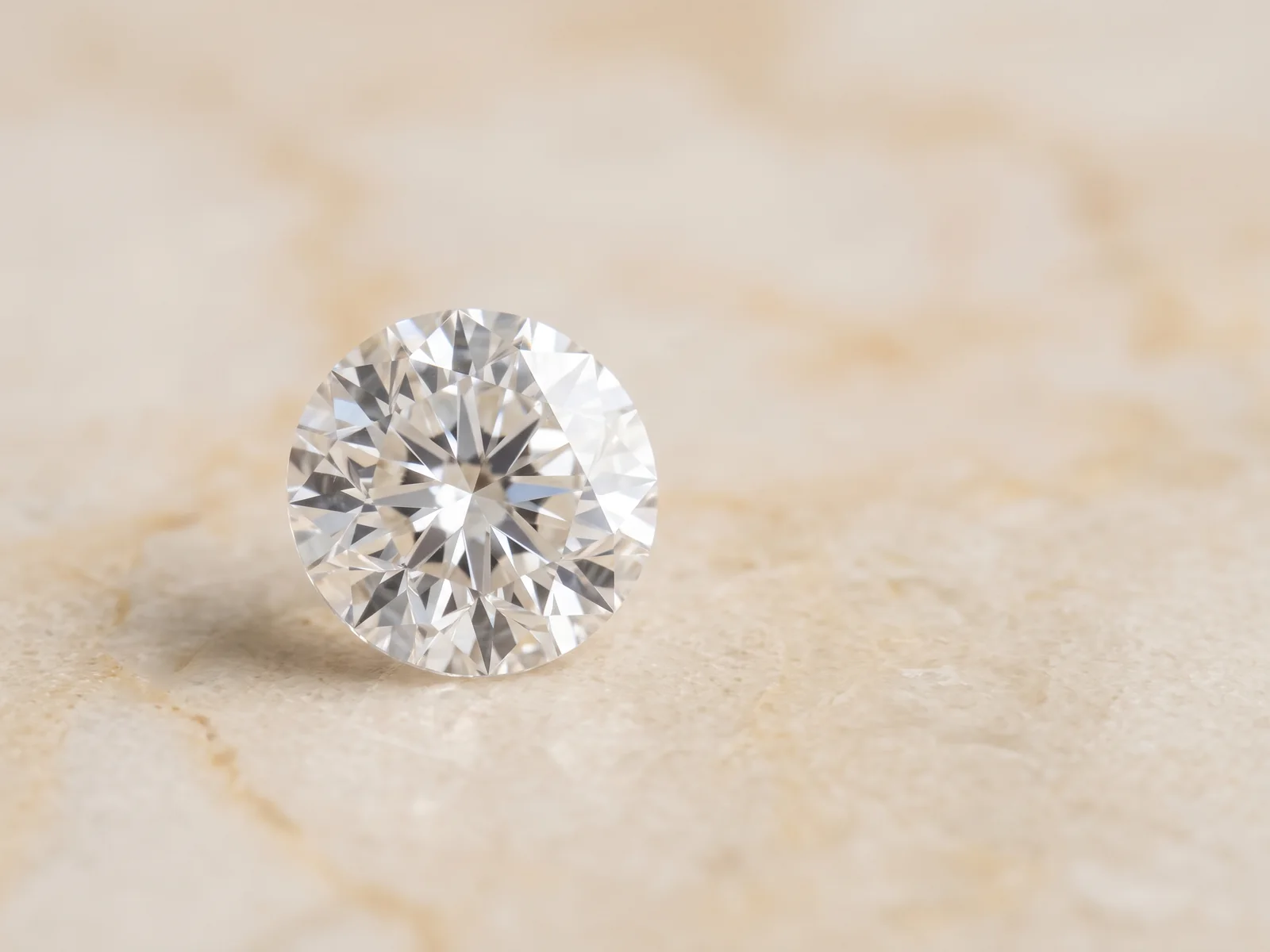
Two diamonds can carry the same colour grade and still look different side by side, because the grade measures how much colour is there, not which colour. Understanding diamond tint helps you read past the letter and choose a stone that looks right to you.
 Reviewed by Raj Sood, Graduate Gemologist (GIA), AJP (GIA)Master jeweller and Graduate Gemologist (GIA) · reviewed 4 November 2026
Quick answer
A diamond tint, or nuance, is a faint hue such as brown, grey or blue in a stone graded on the D–Z scale. The letter grade shows how much colour is present, not which colour. At the same grade, brown usually looks warmer and trades lower, grey looks cooler and flatter, and faint blue often reads icy white.
What is a diamond tint or colour nuance?
Almost every diamond that looks colourless has a trace of body colour. In most natural stones that colour is yellow, caused by nitrogen atoms in the crystal. A tint or nuance (the trade uses both words) is when the faint colour leans another way: towards brown, grey, blue or, less often, green. The stone still sits in the normal colourless-to-light range, but its character changes.
Colour is one of the four Cs of diamond grading, and it is the one most people misread. A grade such as G or H tells you the depth of colour compared with a set of reference stones. It does not tell you the hue. So a G with a whisper of brown and a G with a whisper of yellow share a letter, yet one may look slightly coffee-warm and the other slightly creamy.
Hue is the actual colour you see (yellow, brown, grey, blue). Tone is how light or dark it is. Saturation is how strong it is. In colourless-looking diamonds all three are very low, which is why nuance is subtle and why it often only shows when stones sit next to each other. Any of these terms you have not met before are also in our glossary of jewellery terms.
How does the D–Z colour scale handle brown, grey and blue?
The GIA colour scale runs from D (colourless) to Z (light yellow or brown), 23 letter grades in all. Graders view the diamond face-down (table down, point up) on a white tray, under daylight-equivalent light, and compare it with master stones (reference diamonds of known grade). Looking through the side of the stone removes most of the sparkle, so the body colour is easier to judge.
| Grade range | GIA description | What a tint looks like here |
|---|---|---|
| D–F | Colourless | Nuance is very hard to see, even side by side; faint blue occasionally noticed in lab-grown stones |
| G–J | Near colourless | Brown or grey can be seen by a trained eye next to a pure-yellow stone; most people see it only in comparison |
| K–M | Faint | Brown reads as warm or tea-coloured; grey as steely; a report may add a description such as Faint brown |
| N–R | Very light | Hue is visible face-up to most people |
| S–Z | Light | Clear yellow or brown colour; beyond Z a stone becomes a fancy colour |
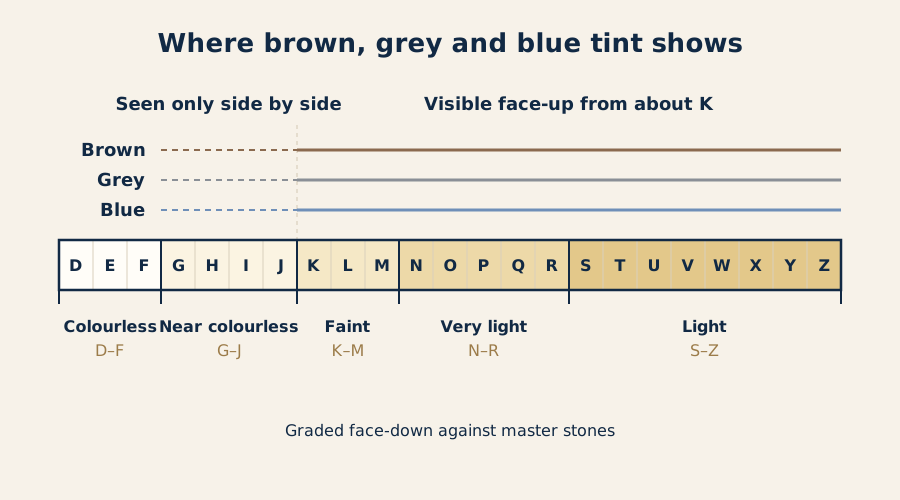
In the D–J range, a grading report usually gives only the letter. The hue is not always stated, so a brown-leaning H and a yellow-leaning H can carry identical paperwork. At lower grades some labs add a word to the colour description, but the practice differs between labs. To see how colour sits alongside cut, clarity and carat when you compare stones, keep the whole grade in view rather than one letter.
Related guideDiamond 4CsIn wholesale listings you will often see No BGM. BGM stands for brown, green, milky. A no BGM diamond is one the supplier says shows no brown or green tint and no milky haze. It is a trade description, not a lab grade, so treat it as a helpful filter and still look at the stone or a good video yourself.
What causes a brown tint in a diamond?
Brown in a natural diamond usually comes from plastic deformation: the crystal was squeezed and slightly bent deep in the earth, which created clusters of missing atoms (vacancy clusters) that absorb light across the spectrum. Under magnification you can sometimes see this as graining, faint parallel lines or bands of brownish colour. Australia's former Argyle mine was known for strongly brown diamonds formed this way, and its rare pinks come from a related kind of deformation.
In a near-colourless stone, a brown tint looks warmer and a little earthier than yellow. Many people describe it as coffee, tea or muddy rather than creamy. At G to H it is usually invisible face-up on its own. From about I downwards it can make a diamond look slightly less bright, because brown absorbs a little light rather than just adding colour.
- Where it shows: in the pavilion facets and along the girdle (the thin edge), seen best from the side.
- When it matters: in white gold or platinum, next to stones with pure-yellow body colour, or in a matched pair of earrings.
- Treatment: some brown natural diamonds are treated with high pressure and high temperature (HPHT) to remove the brown. This must be disclosed, and a lab report will state it.
Lab-grown diamonds can also show brown, for a different reason. Stones grown by chemical vapour deposition (CVD) often come out of the reactor brownish and are then treated to lighten them. Our guide on why CVD-grown stones can show brown explains the process in detail.
What causes a grey tint in a diamond?
A grey tint is cooler and flatter than brown. It looks steely or slightly smoky, and in a well-cut stone it can read almost white in daylight, then a touch sleepy under warm indoor light. Grey is common in some natural diamonds and is caused by several things:
- Hydrogen-related defects in the crystal, found in some natural diamonds from particular sources.
- Tiny dark inclusions, such as clouds of minute particles, that together lower the stone's brightness and give a grey cast. This overlaps with clarity rather than true body colour.
- Very low boron in some type IIb diamonds, which can give grey-blue rather than a clear blue.
- Residual defects in lab-grown stones after growth and post-growth treatment.
Grey is harder to judge than brown because it does not add warmth; it removes vividness. A grey-leaning F may face up just as white as a yellow-leaning F, but with a little less snap. In a lab-grown stone, the cause is usually tied to how it was grown and treated, covered in our article on the grey cast in CVD lab-grown diamonds.
Do not confuse a grey tint with a milky or hazy look. Milkiness is usually caused by fine clouds or, occasionally, by very strong fluorescence, and it softens the whole stone. Grey tint is a colour; milkiness is a loss of transparency. Both reduce brightness, which is why suppliers group milky with brown and green in the BGM shorthand.
Not sure which one is right?
Send us the stones you are looking at and our gemologist will tell you which to choose and why.
Is a blue nuance in a diamond a good thing?
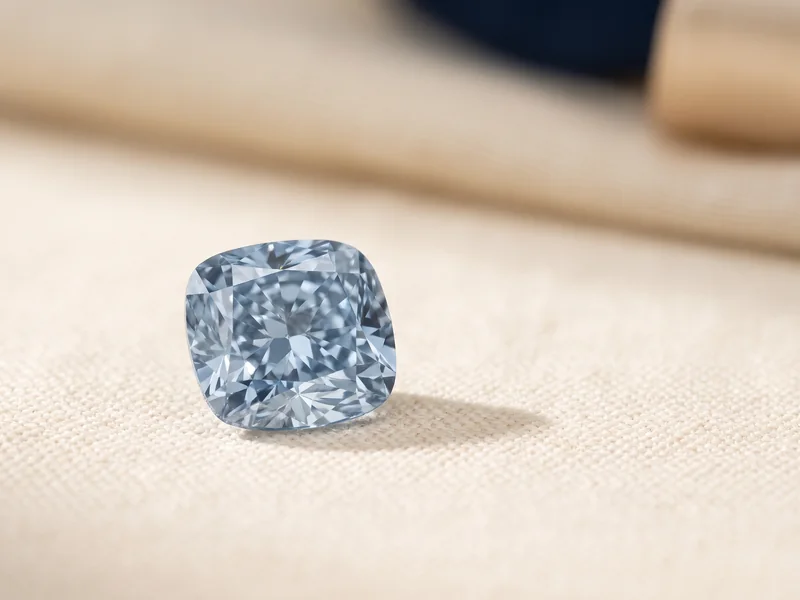
A true blue nuance comes from boron. Even a few atoms of boron per million carbon atoms absorb red light, which shifts the stone's colour towards blue. Diamonds with measurable boron are called type IIb. When there is plenty of it, you get fancy blue diamonds. When there is only a trace, the stone sits in the colourless range with a faint cool edge.
Many people find a faint blue nuance attractive because it pushes a diamond away from warmth and makes it look icy white, especially in platinum or white gold. Others see the same stone as slightly steely, closer to grey. It is a matter of taste, not quality. In natural diamonds a blue nuance in the D–J range is uncommon. In lab-grown diamonds it is much more common, especially in stones grown by HPHT, where traces of boron are hard to keep out entirely. Our page on boron and the blue cast in HPHT lab-grown stones goes into the chemistry.
Blue fluorescence vs blue tint is the most common mix-up. Fluorescence is a glow the diamond gives off under ultraviolet light, reported separately as None, Faint, Medium, Strong or Very Strong. It is not body colour. Under normal daylight, medium to strong blue fluorescence can make a faintly yellow stone (around H to K) look a little whiter. In a small number of stones, very strong fluorescence makes the diamond look hazy or oily. A blue body tint, by contrast, is visible in any light.
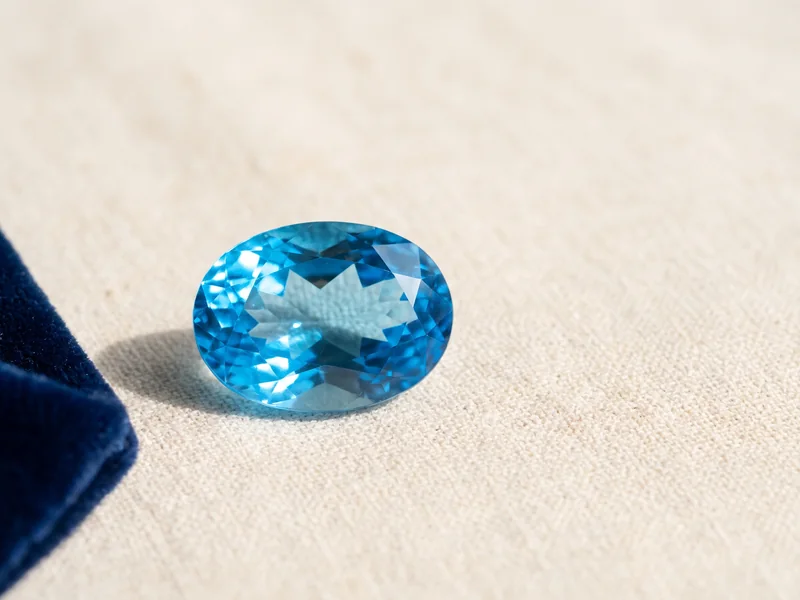
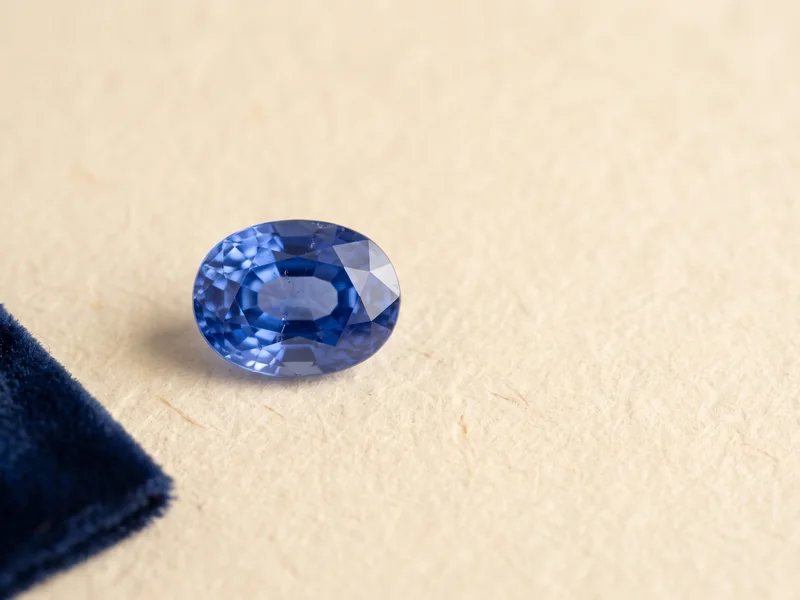
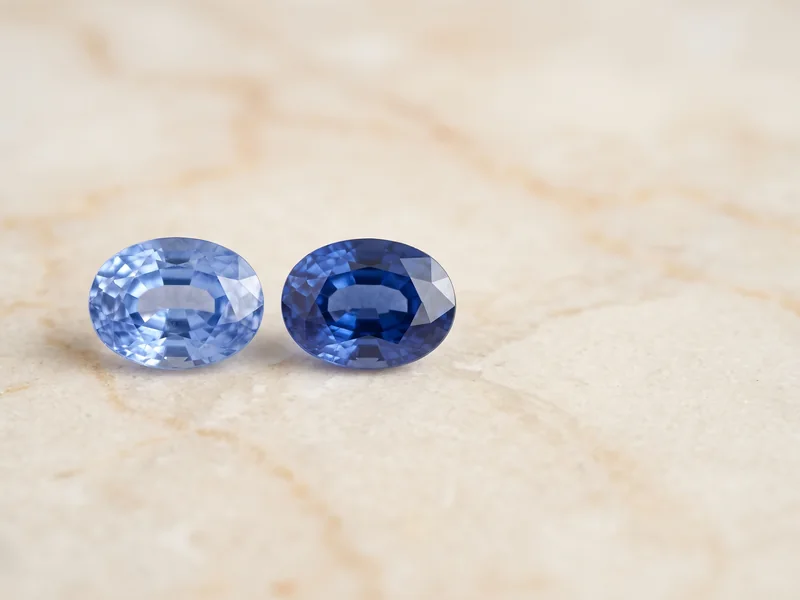
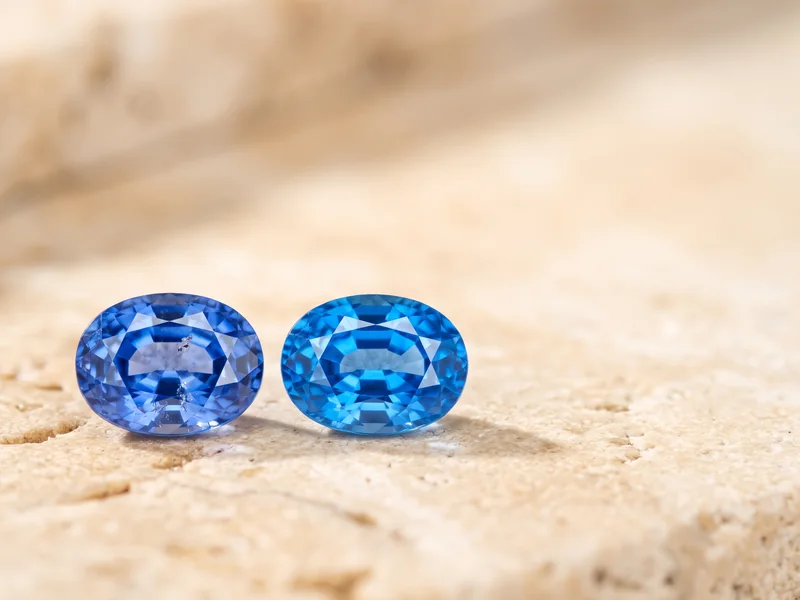
If what you actually want is blue colour you can see, a diamond is only one option. Sapphire (9 on the Mohs scale) is the classic choice; our guide to judging blue sapphire colour and quality explains hue, tone and saturation, and the comparison of teal and blue sapphire engagement rings covers the green-blue end. Lighter options include blue topaz, with a hardness of 8, and aquamarine at 7.5–8; see aquamarine versus blue topaz and how blue topaz is treated and cared for.
Brown vs grey vs blue tint: how do they compare?
| Yellow (standard) | Brown | Grey | Blue | |
|---|---|---|---|---|
| Main cause | Nitrogen | Plastic deformation, vacancy clusters | Hydrogen, fine inclusions, low boron | Boron (type IIb) |
| Look face-up | Creamy, warm | Coffee or tea warmth | Steely, smoky, slightly flat | Icy, cool edge |
| Effect on brightness | Little in D–J | Can dull a little from about I | Can soften sparkle | Usually little |
| Common in | Most natural diamonds | Natural (e.g. Argyle), CVD lab-grown | Some natural, some lab-grown | HPHT lab-grown; rare in natural |
| Typical market effect | Baseline for each grade | Usually priced below yellow at the same grade | Usually priced below yellow at the same grade | Rarely discounted; depends on buyer taste |
| Metal it suits | Yellow and rose gold in lower grades | Yellow and rose gold | White gold, platinum | White gold, platinum |
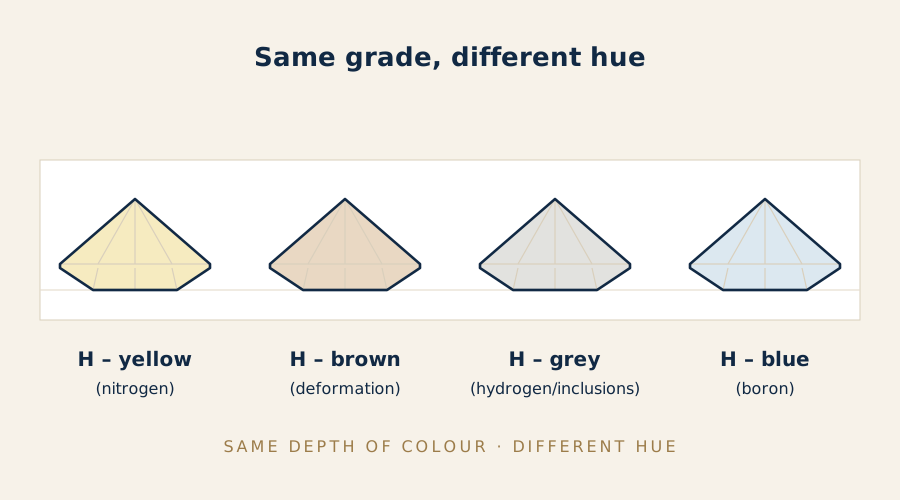
The pattern to remember: the grade sets how much colour; the nuance decides what kind. A brown or grey nuance a grade or two above your usual limit can look very similar to a yellow stone at your limit. A faint blue nuance can look whiter than its letter suggests. Naturally blue type IIb diamonds are the far end of the same boron story.
Do lab-grown diamonds have brown, grey or blue tints?
Yes, and more often than natural diamonds in the near-colourless range, because the growing method leaves its own fingerprints. Lab-grown diamonds are real diamond, with the same hardness (10 on the Mohs scale) and refractive index (about 2.42) as natural stones. Their tints simply come from different causes.
- CVD (chemical vapour deposition): carbon from a gas such as methane is deposited layer by layer on a diamond seed plate. Many CVD stones grow with a brownish colour and are then given post-growth treatment, often HPHT annealing, to lighten them. A trace of brown or grey can remain, which is the subject of our guide to brown and grey tints in CVD growth.
- HPHT (high pressure, high temperature): diamond crystallises from carbon in a molten metal under conditions similar to the earth's mantle. Small amounts of boron can get in, giving a faint blue or blue-grey nuance, often in stones graded D to F. Read about HPHT lab-grown diamonds with a faint blue nuance.
- Reports: labs such as IGI and GIA state that the stone is laboratory-grown, and reports commonly note the growth method or that post-growth treatment was applied.
For a lab-grown diamond, the practical question is the same as for natural: does the stone look clean and bright to you, in the metal you plan to use? Because lab-grown stones cost much less than natural, it is usually easy to choose a grade or two higher if a tint bothers you.
Compare natural and lab-grown diamonds
Does diamond tint affect price, and which metal suits it?
Tint affects price mainly through demand. Most buyers look for a clean yellow-based grade, so brown or grey nuance in a natural diamond usually sells below a yellow stone at the same letter, with a bigger gap the stronger and more visible the tint. Faint blue is rarely discounted. In lab-grown diamonds the price is driven far more by size, cut and the overall market, and tint makes a smaller difference.
| 1 ct round, G–H, VS, excellent cut | Approximate price range (AUD) |
|---|---|
| Lab-grown, clean colour | about $800–$2,500 |
| Natural, yellow-based colour | about $7,000–$14,000 |
| Natural, faint brown or grey nuance | usually towards or below the lower end of the natural range |
These are broad ranges only; prices move with the market and with every grade. The smart way to use nuance is as a trade-off: a natural G with a faint brown nuance in yellow gold can look the same on the hand as a dearer stone, while a faint blue lab-grown E in platinum may look whiter than its paperwork.
Shape changes how much tint you see. A round brilliant hides body colour well because its faceting returns so much light. Fancy shapes such as ovals, pears and radiants tend to gather colour at their ends and corners, so a faint brown or grey shows sooner. Our overview of how each diamond shape shows colour and the full list of 34 diamond cuts side by side help you allow for this, and the price per carat across different shapes page shows where a fancy shape can offset a higher colour grade.
Metal matters as much as the tint. Yellow and rose gold warm everything around them, so a faint brown nuance often disappears. White gold and platinum are cool and neutral, which suits a blue or grey nuance but makes brown easier to spot. Claw settings show more of the stone's side, where tint gathers; a bezel or halo hides more of it.
How do you check a diamond for tint before you buy?
- Read the full report. Note the colour grade, fluorescence, any comments about colour, and whether the diamond is natural or lab-grown and treated.
- Ask about hue directly. Ask whether the stone has any brown, grey, green or blue nuance, or whether it is no BGM. A good jeweller will tell you what they see.
- Compare side by side. View the stone next to the grades either side of it, ideally one with a plain yellow-based colour.
- Check face-up and side-on. Look from above, then from the side on a white card, where body colour concentrates.
- Change the light. Look in daylight, under warm indoor light and, if possible, under a UV torch to see fluorescence.
- Match the metal. Hold the stone against the metal you plan to use before you decide.
- Weigh the trade-off. Decide whether a nuance you cannot see on the hand is worth the price difference; our full guide to diamond grading helps balance colour against the other Cs.
Free consultation
Talk to a gemologist
Compare stones in person or online with Raj Sood, Graduate Gemologist (GIA), AJP (GIA).
Book a consultationShop this shape
FAQ
Common questions
Is a brown tint diamond bad?
Not necessarily. A faint brown tint in a G or H stone is usually invisible on its own, and it often costs less than a yellow-based stone at the same grade. It is more noticeable from about I downwards and in white metal.
What does no BGM mean on a diamond listing?
No BGM means the supplier says the stone shows no brown, no green and no milky haze. It is a trade description rather than a lab grade, so it is still worth checking a video or the stone in person.
Is blue fluorescence the same as a blue tint?
No. Fluorescence is a glow under ultraviolet light and is reported separately from colour. A blue tint is body colour caused by boron and is visible in ordinary light.
Why do lab-grown diamonds sometimes look slightly blue or grey?
HPHT lab-grown diamonds can pick up traces of boron, which gives a faint blue or blue-grey nuance. CVD lab-grown diamonds can keep a little brown or grey after post-growth treatment.
Does a grading report show diamond tint?
Usually not in the D–J range, where reports generally give only the letter grade. Some labs add a colour description at lower grades, so ask the jeweller what hue they see.
Which metal hides a brown tint in a diamond?
Yellow and rose gold hide brown well because they warm the whole look of the stone. White gold and platinum show brown more readily but suit blue or grey nuance.

Ask a gemologist
Not sure which diamond to choose?
Raj Sood is a Graduate Gemologist (GIA) and master jeweller. Bring the stones you are considering, or send the reports, and he will tell you honestly which one is better and why.
Keep learning
Related guides
 Lab-Grown DiamondsBrown or Grey Tint in CVD Lab-Grown Diamonds
 Lab-Grown DiamondsBlue Nuance in HPHT Lab-Grown DiamondsDiamond 4Cs & GradingDiamond 4Cs
 Fancy Colour DiamondsBlue Diamonds
 GemstonesBlue Topaz
 GemstonesHow to Judge Blue Sapphire Quality
 GemstonesTeal Sapphire vs Blue Sapphire Engagement Rings
 GemstonesAquamarine vs Blue Topaz
Explore more
More guides on this topic
Education