
- Education
- Lab-Grown Diamonds
- Lab-Grown Diamond Clarity: What's Typical and What to Check
Lab-Grown Diamonds
Lab-Grown Diamond Clarity: What's Typical and What to Check
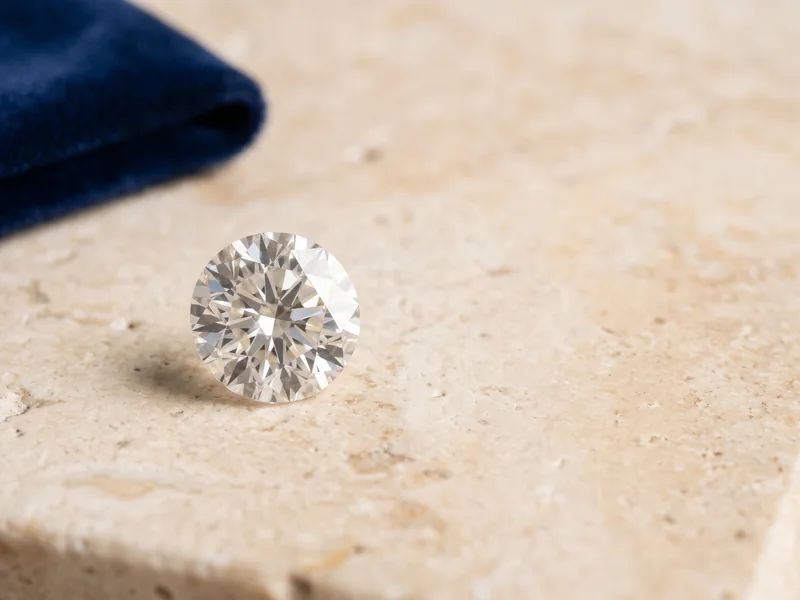
Lab-grown diamond clarity is often higher than people expect, but the grade on the report is only part of the story. Here is what is typical, what the inclusions look like and how to read the report honestly.
 Reviewed by Raj Sood, Graduate Gemologist (GIA), AJP (GIA)Master jeweller and Graduate Gemologist (GIA) · reviewed 4 November 2026
Quick answer
Most lab-grown diamonds sold today grade VS2 or better on the clarity scale, and VVS grades are common, because growers control the conditions. Typical inclusions differ from natural: metallic flux in HPHT stones, dark pinpoints and graining in CVD stones. For a ring, an eye-clean VS2 or VS1 lab-grown diamond looks the same as a VVS to the naked eye.
What clarity is typical for a lab-grown diamond?
Clarity describes how many internal features (called inclusions) and surface marks (called blemishes) a diamond has, how big they are, where they sit and how easy they are to see under 10× magnification. It is one of the four Cs, alongside colour, cut and carat weight.
Across the lab-grown diamonds offered for sale in Australia, most grade VS2 or better, and a large share sit in the VVS (very, very slightly included) range. Stones grading SI1 and SI2 exist but are offered less often, and lab-grown stones in the I (included) grades are uncommon in retail jewellery. That is very different from natural diamonds, where the SI and VS grades make up much of what you see in jewellery stores, and VVS and Flawless stones are genuinely scarce.
The reason is simple. A laboratory-grown diamond is real diamond, the same carbon crystal with the same hardness (10 on the Mohs scale) and refractive index (about 2.42) as a mined one, as our page on why lab-grown diamonds are real diamond explains. But it grows in weeks under controlled conditions rather than forming deep in the earth a billion or more years ago. Growers can tune temperature, pressure and gas mix, and rough that comes out heavily included is often cut into smaller stones or not sold as gem quality at all. If you are new to the topic, start with our complete guide to lab-grown diamonds.
So a high clarity grade is normal for lab-grown and is not by itself a sign of an unusually special stone. What matters more is whether the diamond is eye-clean, where any inclusions sit, and whether you are paying extra for a grade you cannot see.
How is lab-grown diamond clarity graded?
Lab-grown diamond clarity is graded on the same 11-grade scale used for natural diamonds. A trained grader examines the stone face-up and from the side under 10× magnification, then assigns a grade based on the size, number, position, nature and relief (how much it stands out) of each feature. Our explainer on the full FL to I3 clarity scale goes into each grade in depth.
| Grade | Meaning | What you see |
|---|---|---|
| FL | Flawless: no inclusions or blemishes at 10× | Nothing, even under magnification |
| IF | Internally Flawless: tiny surface blemishes only | Nothing to the eye |
| VVS1 / VVS2 | Very, very slightly included | Minute features, very hard to find at 10× |
| VS1 / VS2 | Very slightly included | Minor features, visible at 10× with some effort; almost always eye-clean |
| SI1 / SI2 | Slightly included | Noticeable at 10×; SI1 often eye-clean, SI2 sometimes visible |
| I1 / I2 / I3 | Included | Obvious at 10×, often visible to the eye; can affect durability |
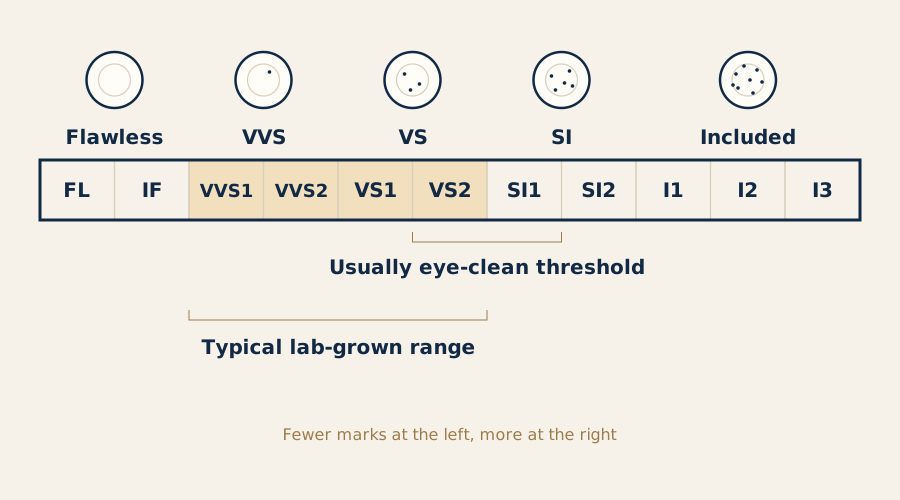
At the very top, Flawless and Internally Flawless grades are far easier to find in lab-grown than in natural, and they cost much less too. At the bottom, the included I1 to I3 grades are rare in lab-grown jewellery, because there is little reason to sell a heavily included lab stone when cleaner ones are plentiful.
One wrinkle on reports: IGI, which grades a large share of lab-grown diamonds, uses the full FL to I3 scale. GIA graded lab-grown stones on the same scale for several years but has announced a move to broader descriptive categories for laboratory-grown diamonds rather than individual clarity grades. Check which version of the report you are looking at. If a term on the report is unfamiliar, our plain-English jewellery glossary explains it.
What inclusions do lab-grown diamonds have?
Lab-grown diamonds are not perfect just because they are made in a laboratory. They have inclusions too, but the kinds of inclusion depend on how the stone was grown. There are two main methods: HPHT (high pressure, high temperature), which recreates the conditions deep in the earth inside a press, and CVD (chemical vapour deposition), which builds diamond layer by layer from a carbon-rich gas onto a thin diamond seed plate. Our page on how HPHT and CVD growth work covers the process step by step.
| HPHT lab-grown | CVD lab-grown | Natural | |
|---|---|---|---|
| Typical inclusions | Metallic flux inclusions (iron, nickel, cobalt), pinpoints | Dark pinpoints of non-diamond carbon (graphite), graining, clouds | Mineral crystals (garnet, olivine, diopside, diamond), feathers, clouds, needles |
| Look under 10× | Black or grey, sometimes shiny like metal in reflected light | Small dark specks, sometimes lined up in planes parallel to the growth layers | Varied shapes and colours; often crystals with natural outlines |
| Odd behaviour | Stones with larger metallic inclusions can be attracted to a strong magnet | Strain patterns show under crossed polarising filters | Inclusion types point to where in the earth the crystal formed |
| Can it be a feather? | Yes, especially from cutting stress | Yes | Yes, very common |
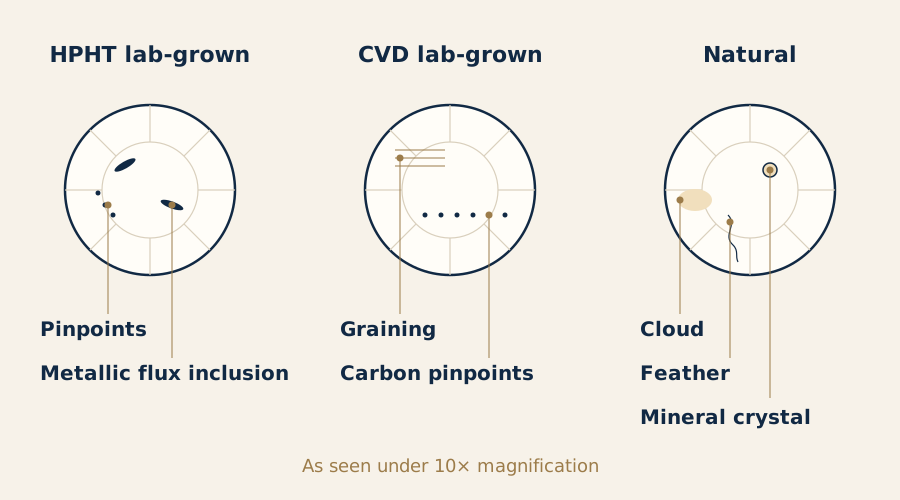
HPHT diamond inclusions are mostly trapped bits of the metal solvent the diamond grows in. They tend to be dark and opaque, and because they block light completely, even a small one can be noticeable if it sits under the table (the large flat top facet). CVD diamond clarity is affected mainly by tiny dark specks of carbon that did not form diamond, and by graining, faint internal lines left where growth layers met. CVD stones are also often given a post-growth HPHT treatment to improve their colour, which the report should mention.
Both types can also have feathers (small internal cracks), and both pick up ordinary cutting blemishes such as polish lines, nicks or extra facets. None of these features make a lab-grown diamond any less real; they simply count towards its clarity grade in the same way they would for a mined stone.
Is lab-grown diamond clarity better than natural?
On average, yes: the typical lab-grown diamond on sale grades higher for clarity than the typical natural diamond on sale. But that comparison needs some care, because the grades mean exactly the same thing on both. A VS2 lab-grown diamond and a VS2 natural diamond have similar amounts of inclusion; one is not secretly cleaner than the other.
| Lab-grown | Natural | |
|---|---|---|
| Grades most often sold | VVS1 to VS2 | VS1 to SI2 |
| How common is FL/IF? | Readily available | Rare |
| Price jump for higher clarity | Small | Large |
| Typical inclusion types | Metallic flux (HPHT), carbon pinpoints and graining (CVD) | Mineral crystals, feathers, clouds, needles |
| Same 10× grading standard? | Yes, on IGI reports and older GIA reports | Yes |
The bigger practical difference is price. In natural diamonds, stepping from VS2 to VVS1 can add thousands of dollars to a 1 carat stone. In lab-grown, the same step usually adds a few hundred. That is why many buyers choose a higher clarity in lab-grown than they would in natural, and why we see far more VVS lab-grown engagement rings than VVS natural ones.
At GemTrove we sell both natural and laboratory-grown diamonds, and our honest view is that neither is better. Natural diamonds are rare and formed over geological time; lab-grown diamonds are real diamond made recently in a laboratory, at much lower cost. Clarity is just one part of that choice, not a reason on its own to pick one over the other.
Not sure which one is right?
Send us the stones you are looking at and our gemologist will tell you which to choose and why.
What should you check on a lab-grown diamond report?
A grading report is the independent description of the stone. For a lab-grown diamond, these are the lines that matter most for clarity and disclosure:
- Origin: the report title and description should say Laboratory-Grown Diamond (or similar). If the word lab-grown or laboratory-grown is missing, stop and ask.
- Growth method: many reports state whether the stone was grown by HPHT or CVD.
- Treatment comment: look for wording such as "as grown" or a note that post-growth treatment may be present. This usually relates to colour, not clarity, but it should be disclosed.
- Clarity grade: the grade itself, for example VS1.
- Clarity plot: a diagram of the stone, face-up and from below, with symbols marking each inclusion and its type (crystal, pinpoint, cloud, feather).
- Key to symbols: the list of inclusion types the grader recorded, usually in order of importance.
- Laser inscription: most lab-grown diamonds carry a microscopic inscription on the girdle (the thin outer edge) with the report number and often "LG" or "Lab-Grown". It should match the report.
Here is how that might read on a typical IGI-style report for a ring stone: Laboratory-Grown Diamond, Round Brilliant, 1.02 carat, G colour, VS1 clarity, CVD growth process, inscription LG followed by the report number, with a plot showing a small cloud and two pinpoints near the girdle. That stone would almost certainly be eye-clean, and the inclusions sit where a claw could cover them.
Keep a copy of the report with your paperwork. It is what an insurer or valuer will ask for, as covered in our page on insuring a lab-grown diamond.
What does honest lab-grown wording look like in Australia?
Australia has no separate diamond law, but the Australian Consumer Law applies to every jewellery sale. It bans misleading or deceptive conduct and false or misleading claims about the quality, grade, composition or origin of goods, and the ACCC (Australian Competition and Consumer Commission) enforces it. For lab-grown diamonds and clarity, honest wording in practice looks like this:
- Say what it is, every time. "Lab-grown diamond", "laboratory-grown diamond" or "laboratory-created diamond", not just "diamond" in a heading with the disclosure hidden in small print.
- Use grades from the report. A seller should not describe a stone as "VVS quality" or "flawless" unless an independent report says so.
- Separate opinion from grade. "Eye-clean" is a useful description, but it is the seller's judgement, not a lab grade.
- Do not confuse lab-grown with simulants. Moissanite and cubic zirconia are different materials, not diamond. They have their own scales; see how moissanite is graded for colour and clarity.
- Disclose treatments. If the report notes post-growth treatment, the seller should pass that on.
- No "fake" and no "investment" talk. Lab-grown is real diamond; natural is a purchase you love, not a financial product.
If a listing leaves you unsure whether a stone is natural or lab-grown, ask for the report number and check it on the grading lab's website yourself.
What clarity should you choose for a lab-grown diamond?
For most rings and earrings, the goal is an eye-clean stone: one with no inclusions you can see without magnification at a normal viewing distance of about 25–30 cm. In lab-grown diamonds, that is easy to achieve. Here is how the common grades compare in practice:
- VVS1 and VVS2: inclusions are tiny even under 10×. Worth it if you value knowing the stone is technically very clean; read about VVS1 diamonds and what VVS2 looks like up close.
- VS1: eye-clean in almost every case, though very large step cuts are still worth checking. See VS1 clarity explained.
- VS2: usually eye-clean in round and other brilliant cuts up to about 2 carats. Our page on why VS2 is so often eye-clean shows examples. A VS2 lab-grown diamond is the grade many buyers settle on.
- SI1 and SI2: can be eye-clean, but must be checked stone by stone. Dark HPHT flux inclusions are more visible than white clouds. Read the risks and rewards of SI2 before choosing one.
Shape matters too. Step cuts such as emerald and Asscher cuts have long, open facets that show inclusions more easily, so in those shapes VS1 or better is the safer choice. Brilliant cuts (round, oval, pear, cushion) scatter light and hide small features well, so VS2 is usually plenty. Larger stones also show inclusions more, because everything is bigger.
Related guideUnderstanding Diamond Clarity Grades: FL to I3 ExplainedHow much does clarity change lab-grown diamond prices?
Less than you might think. In lab-grown diamonds, carat weight, cut quality and colour usually move the price more than clarity does, and the gap between neighbouring clarity grades is small. Our page on what really sets lab-grown prices breaks down each factor.
| 1 ct round, G colour, excellent cut | Approximate price range (AUD) |
|---|---|
| Lab-grown VVS1 | about $1,200–$2,800 |
| Lab-grown VS1 | about $1,000–$2,400 |
| Lab-grown VS2 | about $900–$2,200 |
| Lab-grown SI1 | about $800–$1,900 |
| Natural VS2, for comparison | about $7,000–$14,000 |
These are broad ranges only. Lab-grown prices have been falling for several years and move with the market, the grading lab and the exact stone. The pattern is what matters: in lab-grown, going from VS2 to VVS1 costs a modest amount, so a higher clarity is often affordable. In natural, the same step costs much more, which is why natural buyers more often stop at VS2 or SI1.
Browse lab-grown diamonds by clarity grade
How do you check a lab-grown diamond's clarity? Step by step
- Confirm it is lab-grown. The report should say laboratory-grown and name the lab, for example IGI or GIA.
- Match the inscription. Check the girdle inscription under a loupe or on the video matches the report number.
- Read the grade and the plot. Note the clarity grade, then look at where each inclusion sits and what type it is.
- Check the growth and treatment comments. Note whether the stone is HPHT or CVD and whether post-growth treatment is mentioned.
- Look at 10× or in a high-definition video. Pay attention to anything dark under the table, the most visible spot.
- Judge it face-up at normal distance. Hold it about 25–30 cm away; if you cannot see anything, it is eye-clean for you.
- Compare the price of the next grade up and down. Decide whether the difference buys something you can actually see.
Once it is set, a lab-grown diamond needs exactly the same cleaning and checks as a natural one; our guide to caring for a lab-grown diamond covers the routine. Clean stones show their clarity best, because grease and soap film dull the sparkle far more than a VS2 inclusion ever will.
Free consultation
Talk to a gemologist
Compare stones in person or online with Raj Sood, Graduate Gemologist (GIA), AJP (GIA).
Book a consultationShop this shape
FAQ
Common questions
What clarity are most lab-grown diamonds?
Most lab-grown diamonds offered for sale grade VS2 or better, and VVS grades are common. Lower SI and I grades exist but are offered much less often in jewellery.
Do lab-grown diamonds have inclusions?
Yes. HPHT lab-grown diamonds can contain metallic flux inclusions, and CVD stones can show dark carbon pinpoints and graining. Both can also have feathers and cutting blemishes.
Is VS2 good enough for a lab-grown diamond?
For most brilliant cuts, yes. A VS2 lab-grown diamond is usually eye-clean, though step cuts such as emerald cuts and very large stones are safer at VS1 or better.
Is lab-grown diamond clarity graded the same as natural?
IGI uses the same FL to I3 scale and the same 10× standard for both. GIA has announced broader descriptive categories for lab-grown reports, so check which format your report uses.
Can you tell a lab-grown diamond by its inclusions?
Sometimes a gemmologist can spot clues such as metallic flux or CVD growth patterns, but you cannot reliably tell by eye. Confirming origin needs a grading report or laboratory testing equipment.
Are flawless lab-grown diamonds worth it?
They look the same to the eye as a VS1 or VS2, so you are paying for the knowledge that the stone is technically clean. Because the price step is small in lab-grown, some buyers decide it is worth it for peace of mind.
Terms in this guide

Ask a gemologist
Not sure which diamond to choose?
Raj Sood is a Graduate Gemologist (GIA) and master jeweller. Bring the stones you are considering, or send the reports, and he will tell you honestly which one is better and why.
Keep learning
Related guides
 Diamond 4Cs & GradingUnderstanding Diamond Clarity Grades: FL to I3 Explained
 Lab-Grown DiamondsHow Are Lab-Grown Diamonds Manufactured?
 Lab-Grown DiamondsWhat Actually Drives Lab-Grown Diamond Prices?
 Diamond 4Cs & GradingVS2 Clarity DiamondsDiamond 4Cs & GradingVS1 Clarity Diamonds
 Diamond 4Cs & GradingVVS2 Clarity DiamondsDiamond 4Cs & GradingVVS1 Clarity Diamonds
Explore more
More guides on this topic
Education