
- Education
- Lab-Grown Diamonds
- Lab-Grown Diamond Colour Grades: What D to K Really Mean
Lab-Grown Diamonds
Lab-Grown Diamond Colour Grades: What D to K Really Mean
Lab-grown diamond colour grades use the same D-to-Z letters as natural diamonds, but the tints, the price steps and the report wording are different. Here is how to read the grade and choose one that looks white in your setting.
 Reviewed by Raj Sood, Graduate Gemologist (GIA), AJP (GIA)Master jeweller and Graduate Gemologist (GIA) · reviewed 4 November 2026
Quick answer
Lab-grown diamond colour grades use the same D–Z scale as natural diamonds: D is colourless, Z has a noticeable yellow or brown tint. Most lab-grown diamonds sold are D–H, because growers can control colour. For a white look, G–H suits platinum or white gold and H–J suits yellow gold and G–I rose gold. Check the report for post-growth treatment.
What are lab-grown diamond colour grades?
A colour grade describes how much body colour a diamond has, judged against a set of reference stones called master stones. For diamonds in the colourless range, the scale runs from D, which shows no colour at all, to Z, which has a light yellow or brown tint. Lab-grown diamonds are graded on the same letters as natural ones because they are the same material: crystallised carbon, 10 on the Mohs hardness scale, with a refractive index (how strongly it bends light) of about 2.42. Our explainer on whether lab-grown diamonds are real diamond covers the science, and the complete lab-grown diamond guide puts colour alongside cut, clarity and carat.
What differs is the pattern behind the letter. Natural diamonds get most of their colour from nitrogen atoms trapped in the crystal, which produces a yellow tint. Most lab-grown diamonds are grown almost free of nitrogen (gemmologists call this Type IIa), so when they do show colour it is more often a faint brown, grey or, occasionally, blue. The grade on the report is the same kind of letter, but the tint it describes can look a little different, which is why it pays to look at the stone and not only at the paperwork.
GemTrove sells both natural and laboratory-grown diamonds, so the aim of this page is a straight explanation rather than a push either way. Any term you have not met before is explained in our plain-English jewellery glossary.
How does the lab-grown diamond colour chart work?
Graders judge colour with the diamond face-down on a white tray, looking through the side of the stone under controlled, daylight-balanced light. Viewing it upside down takes the sparkle out of the picture, so only the body colour is left. The stone is placed between master stones of known grade and given the letter it matches most closely.
| Grade group | Grades | What you see | Typical use |
|---|---|---|---|
| Colourless | D, E, F | No colour visible face-up or, for D, even face-down to a trained eye | Platinum and white gold, icy-white looks |
| Near colourless | G, H, I, J | Little or no colour face-up; a slight tint face-down, more visible in I–J | The most popular range for engagement rings |
| Faint | K, L, M | A warm tint visible face-up, especially in larger stones | Yellow gold, vintage-style rings |
| Very light | N to R | Clear yellow, brown or grey tint | Rarely offered in lab-grown |
| Light | S to Z | Obvious tint, approaching fancy colour | Almost never offered in lab-grown |
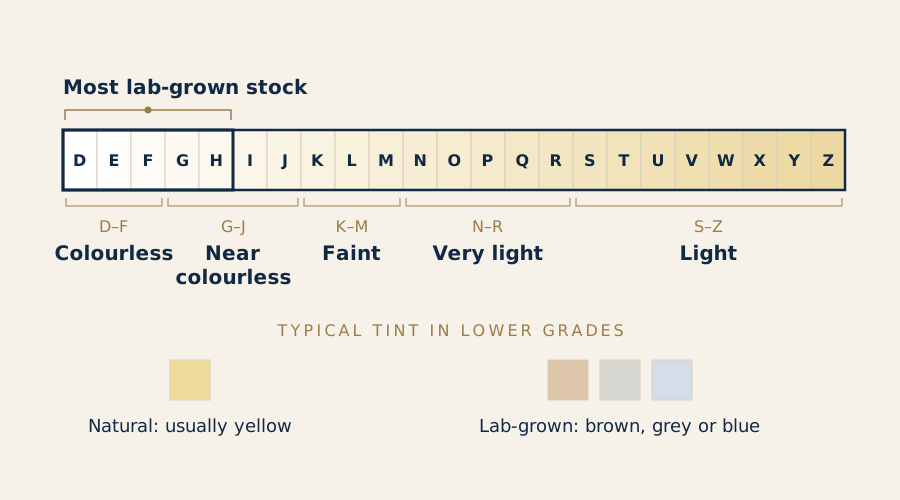
Each step on the scale is small. Once a diamond is set and you are looking at it face-up, a single grade (G against H, for example) is very hard to see without a side-by-side comparison. Two or three grades are easier to spot, particularly in fancy shapes and larger stones, where there is more depth of crystal for light to travel through and pick up colour.
Beyond Z, a diamond is no longer graded as a white diamond. Strong, attractive colour such as pink, blue or yellow is graded on a separate fancy colour scale instead; our guide to pink, blue and yellow lab-grown fancy colours explains how those are graded and produced.
Why do some lab-grown diamonds look brown, grey or blue?
The tint a laboratory-grown diamond shows depends mostly on how it was grown. There are two main methods, explained step by step in our article on how CVD and HPHT diamonds are made:
- CVD (chemical vapour deposition): a diamond seed plate sits in a vacuum chamber filled with a carbon-rich gas such as methane mixed with hydrogen. The gas is energised into a plasma and carbon builds up on the seed layer by layer over several weeks. CVD diamonds are usually nitrogen-free, but tiny defects in the growing crystal can give a brown or greyish tint.
- HPHT (high pressure, high temperature): carbon is dissolved in molten metal at roughly 5–6 gigapascals and 1,300–1,600 °C, recreating the conditions deep in the earth. Growers add materials that soak up nitrogen to keep the colour white. Traces of boron can leave a faint blue or grey tint, and leftover nitrogen a yellow one.
- Post-growth treatment: many CVD diamonds are heated under pressure after growth to reduce brown and lift the colour by several grades. This is a normal, permanent process, but it must be disclosed.
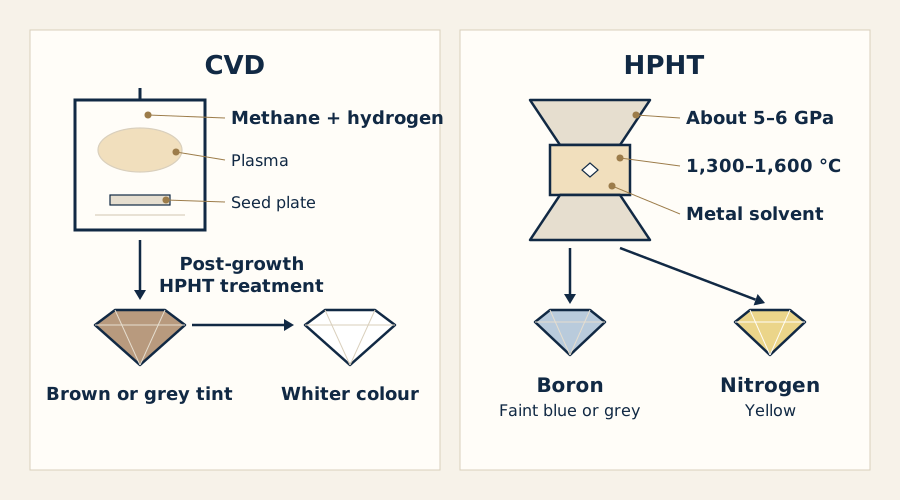
A CVD diamond brown tint is the reason so many CVD stones are treated before cutting. A treated diamond is still a real lab-grown diamond with a fairly earned colour grade; the point is that you know about it. Our page on post-growth treatment and how reports disclose it explains the process and the report wording in more detail.
Because these tints are brown, grey or blue rather than the yellow of most natural diamonds, two stones with the same letter can look slightly different side by side. A grey-leaning H can look a touch flat or steely; a yellow-leaning H looks warm. Neither is wrong, but it is worth seeing which you prefer.
How do lab-grown diamond colour grades compare with natural diamonds?
The letters are the same, but the way colour behaves in the market is quite different. This comparison of lab-grown vs natural diamond colour sets out the main points:
| Lab-grown diamond | Natural diamond | |
|---|---|---|
| Colour scale | D–Z (IGI; GIA's format has changed over the years) | D–Z (GIA, IGI and other labs) |
| Main cause of tint | Growth defects, traces of boron or nitrogen | Nitrogen in the crystal |
| Typical tint colour | Brown, grey, occasionally blue | Yellow, sometimes brown |
| Grades most often sold | Mostly D–H | Widely spread, commonly F–K |
| Colour treatment | Common in CVD stones, disclosed on the report | Uncommon in the colourless range, disclosed if present |
| Fluorescence under UV | Usually none or weak, sometimes unusual colours | About a quarter to a third show some, mostly blue |
| Price step between grades | Relatively small | Large, especially from D to G |
The big practical difference is choice. In natural diamonds, a D or E colour carries a steep premium, so most buyers settle in the G–J range. In lab-grown diamonds, growers can produce high colours consistently, so D–F stones are common and the extra cost for them is modest. Our full side-by-side comparison of lab-grown and natural diamonds covers price, rarity and resale as well.
You cannot tell the two apart by colour, or by eye at all. Standard handheld diamond testers also read both as diamond; separating them takes specialised screening equipment, as our guide to how lab-grown diamonds behave on a diamond tester explains. That is why the report and the girdle inscription matter so much.
Not sure which one is right?
Send us the stones you are looking at and our gemologist will tell you which to choose and why.
What should you check on a lab-grown diamond report?
Every lab-grown diamond of a meaningful size should come with a report from an independent laboratory, most often IGI (International Gemological Institute) or GIA (Gemological Institute of America). When you read an IGI lab-grown diamond colour grade or any other report, check these points:
- Origin: the report should clearly say Laboratory-Grown Diamond or similar, not just 'diamond'.
- Growth method: CVD or HPHT, which tells you what kind of tint to look for.
- Treatment statement: IGI reports usually say 'As Grown' if there is no sign of post-growth treatment, or note indications of post-growth treatment if there are.
- Colour grade and format: D–Z letters on most reports. GIA has changed its lab-grown report format more than once, and in 2025 announced a move away from D–Z grades towards broader descriptions, so check the date and wording on any GIA report.
- Fluorescence: usually 'None' or 'Faint' on lab-grown reports.
- Girdle inscription: most lab-grown diamonds are laser-inscribed with the report number and a lab-grown marking such as 'LG', visible under magnification.
- Verification: look the report number up on the lab's website and make sure it matches the stone's measurements.
Remember that a colour grade is a judgement by trained people, and laboratories do not always land on the same letter for the same stone. A grade from one lab can sit a step away from another lab's view, which is why our guide to comparing grades from different laboratories suggests comparing stones, not just letters. Seeing diamonds in person helps here, and our article on choosing lab-grown online or in a showroom sets out what each approach can and cannot show you.
Related guideLab-Grown Diamonds vs Natural DiamondsWhat is the best colour for a lab-grown diamond?
There is no single best colour; the right grade depends on the metal, the shape and how sensitive your eye is to warmth. Metal colour reflects into the diamond, so a white metal shows tint more and a yellow metal hides it.
| Setting | Suggested colour range | Why |
|---|---|---|
| Round in platinum or white gold | F–H | Round brilliants hide colour well; G–H face up white to most people |
| Oval, pear, emerald or radiant in white metal | E–G | Elongated and step cuts show more body colour at the ends and through large facets |
| Any shape in yellow gold | H–J | Yellow metal warms the stone anyway, so higher grades add little |
| Any shape in rose gold | G–I | Rose gold flatters near colourless stones; grey tints can look slightly dull against pink |
| Pavé or halo accents | Matched to the centre, usually F–H | Small stones show little colour, but a mismatch with the centre can be noticed |
Lab-grown diamond colour G vs H is the most common question we hear. Face-up and set in white metal, most people cannot tell them apart without a side-by-side view, and the price gap is usually small. D colour lab-grown diamonds are widely available, and some people simply like knowing the stone is at the top of the scale; that is a reasonable choice as long as it is not at the expense of cut. A well-cut G will look brighter and whiter than a poorly cut D, because good cutting returns more white light; see our guide to how cut quality shapes a lab-grown diamond's look.
For pairs and clusters, colour consistency matters more than the grade itself. Earring studs should sit within one colour grade of each other and ideally share a growth method, so the tints match; our article on pairing lab-grown diamonds for studs explains the checks. The same thinking applies to small stones around a centre diamond, covered in lab-grown melee in pavé and halo work.
How much does colour affect lab-grown diamond prices in Australia?
Colour moves the price of a lab-grown diamond less than it moves a natural one. As a rough guide for a 1 carat round brilliant with an excellent cut and VS clarity, the ranges below show the pattern. These are broad Australian retail ranges only; lab-grown prices have fallen quickly over recent years and keep changing.
| 1 ct round, excellent cut, VS clarity | Approximate price range (AUD) |
|---|---|
| Lab-grown, D–F | about $1,000–$2,500 |
| Lab-grown, G–H | about $800–$2,000 |
| Lab-grown, I–J | about $600–$1,500 |
| Natural, G–H (for comparison) | about $7,000–$13,000 |
In practice, carat weight, cut quality and the overall supply of lab-grown stones shift the price far more than a single colour grade does. Our breakdown of the real factors behind lab-grown pricing goes through each one. If you are working out cover for a ring, the colour grade is one of the details an insurer or valuer will ask for, and our page on insuring a lab-grown diamond ring explains how replacement value is usually set.
Browse lab-grown diamonds by colour grade
How should lab-grown diamonds be described in Australia?
Australia does not have a separate law just for lab-grown diamonds, but the Australian Consumer Law applies to every sale. Section 18 bans misleading or deceptive conduct, and section 29 bans false or misleading claims about what a product is or where it came from. For lab-grown diamonds, that means the origin must be clear every time the stone is described, including in the colour grade and report details.
- Clear terms: 'lab-grown', 'laboratory-grown' and 'laboratory-created' all describe origin plainly. 'Synthetic diamond' is technically accurate and used by gemmologists.
- Not acceptable: calling a lab-grown stone simply 'a diamond', or using a grade such as 'D colour' without saying it is laboratory-grown.
- Careful with extra claims: environmental or ethical claims need evidence. Our guide on using the term conflict-free with care explains why vague claims can mislead.
- Accurate both ways: a lab-grown diamond is real diamond, not 'fake'; a natural diamond is a rare natural material, but neither should be promised to hold or grow in value.
It also helps to know what is not diamond at all. Moissanite (silicon carbide, Mohs 9.25, refractive index about 2.65–2.69) and cubic zirconia (Mohs about 8–8.5, refractive index about 2.15) are diamond simulants with their own grading habits. See our lab-grown diamond and moissanite comparison, the guide to how lab-grown diamond differs from cubic zirconia and the separate scale explained in moissanite colour and clarity grading. A moissanite 'D–E–F equivalent' is not the same thing as a diamond colour grade.
How do you check the colour of a lab-grown diamond? Step by step
- Confirm the origin first. Make sure the report says laboratory-grown and matches the stone's inscription and measurements.
- Note the growth method and treatment. CVD or HPHT, and 'As Grown' or post-growth treatment, so you know which tints to look for.
- Set your range by metal and shape. Roughly F–H for a round in white metal, E–G for elongated shapes, H–J in yellow gold.
- View it face-down. On a white card in daylight, look through the side for any brown, grey or blue tint.
- Compare face-up next to another stone. Judge the grade you can actually see in normal light, not just the letter.
- Check cut before colour. If two stones are close, choose the brighter, better-cut one over a higher colour letter.
Once you have it, a lab-grown diamond keeps its colour. Everyday wear does not fade or yellow it, and it needs the same cleaning as a natural diamond, as our page on caring for lab-grown diamond jewellery explains. A regular soak in warm water with a drop of detergent keeps oil and soap film from dulling the stone and making it look warmer than its grade.
Free consultation
Talk to a gemologist
Compare stones in person or online with Raj Sood, Graduate Gemologist (GIA), AJP (GIA).
Book a consultationShop this shape
FAQ
Common questions
Is G colour good for a lab-grown diamond?
Yes. G is near colourless and, face-up in white gold or platinum, looks white to most people. It is one of the most popular grades for lab-grown engagement rings.
Do lab-grown diamonds turn yellow over time?
No. A diamond's colour does not fade or yellow with everyday wear, and post-growth treatment used to improve colour is considered permanent. A dull, warm look is usually just dirt on the pavilion.
Why are most lab-grown diamonds D to H colour?
Growers can keep nitrogen out of the crystal and many CVD stones are treated after growth to remove brown. Higher grades are also what most buyers want, so producers aim for them.
Is a D colour lab-grown diamond worth paying extra for?
It depends on you. The price step from G to D is usually small in lab-grown, but the visible difference once set is also small, so many people put the money into cut or size instead.
Are IGI colour grades the same as GIA colour grades?
Both use letters from the same D–Z system, but grading is a human judgement and labs do not always agree on the same stone. GIA has also changed its lab-grown report format, so compare the actual stones where you can.
Can a lab-grown diamond be blue or grey in the colourless range?
Yes. Traces of boron in some HPHT stones can add a faint blue or grey tint, and CVD stones can lean brown or grey. The colour grade still applies, but the tint may look different from the yellow of a natural diamond.

Ask a gemologist
Not sure which diamond to choose?
Raj Sood is a Graduate Gemologist (GIA) and master jeweller. Bring the stones you are considering, or send the reports, and he will tell you honestly which one is better and why.
Keep learning
Related guides
 Lab-Grown DiamondsLab-Grown Diamonds vs Natural Diamonds
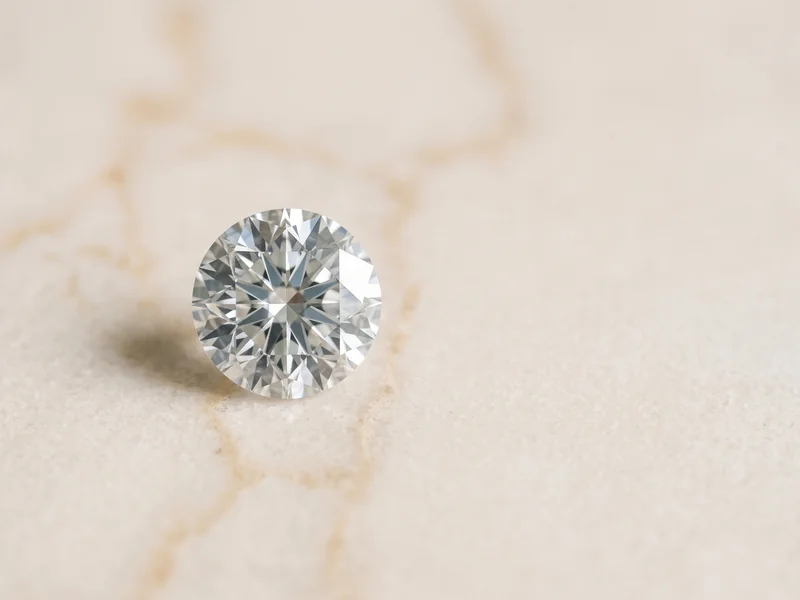 Lab-Grown DiamondsWhat Is Post-Growth Treatment in a Lab-Grown Diamond?
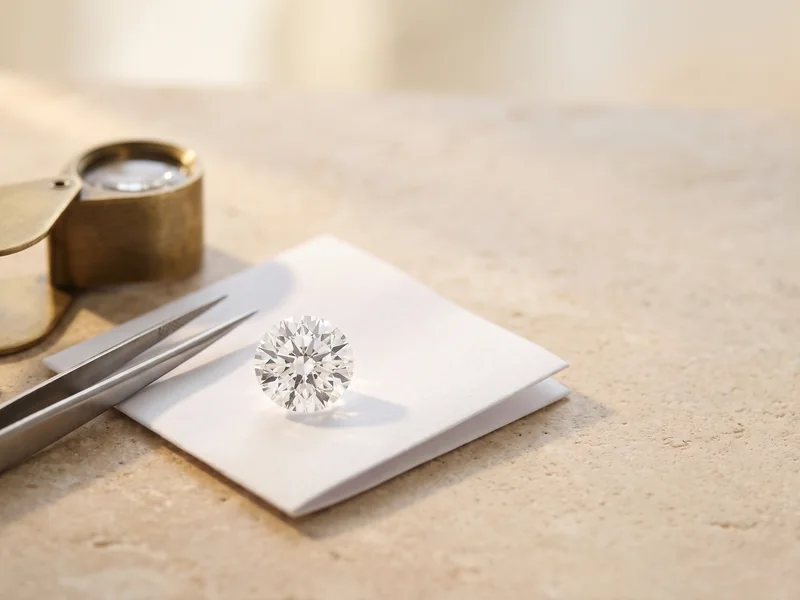 Certificates & ValuationsCan You Compare Diamond Grades From Different Laboratories Directly?
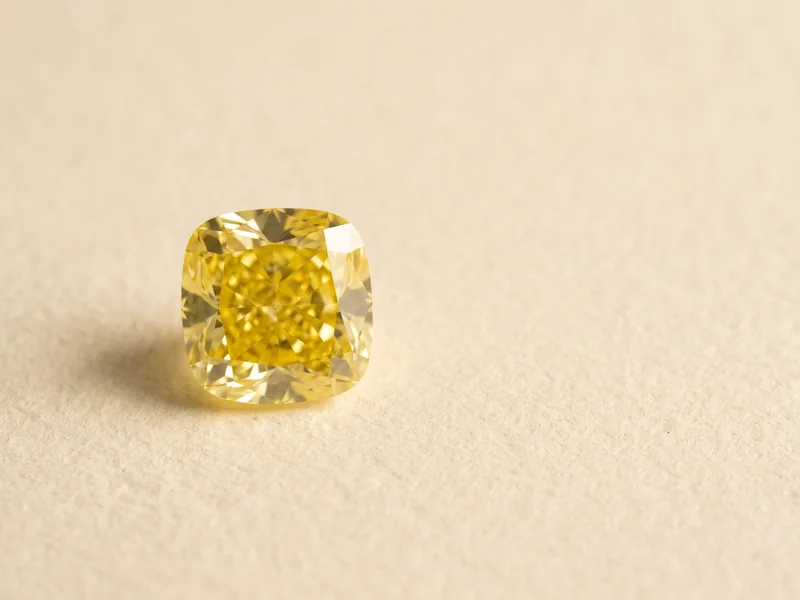 Lab-Grown DiamondsLab-Grown Fancy Colour Diamonds
 Lab-Grown DiamondsShould a Lab-Grown Diamond Be Insured?
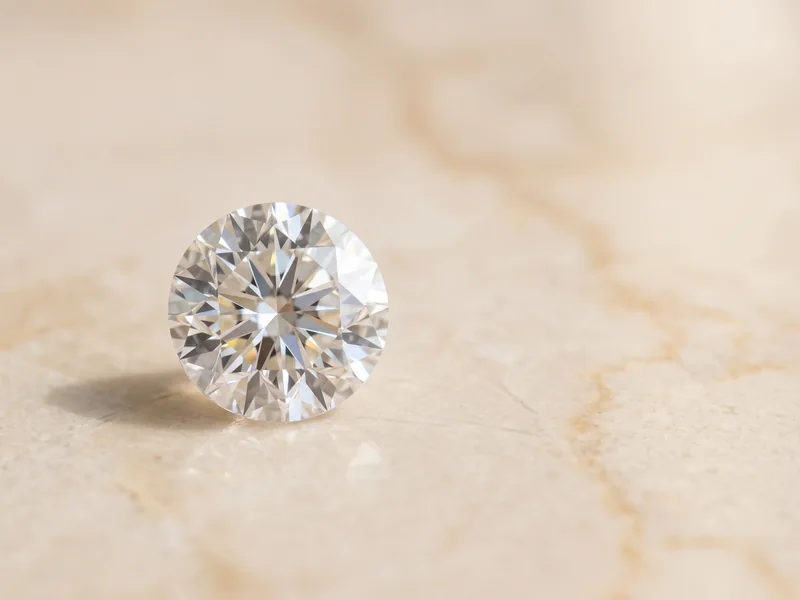 Lab-Grown DiamondsMoissanite Colour and Clarity GradesLab-Grown DiamondsHow Are Lab-Grown Diamonds Manufactured?
Explore more
More guides on this topic
Education