
- Education
- Lab-Grown Diamonds
- Metallic Inclusions in HPHT Diamonds: What They Are and Whether They Matter
Lab-Grown Diamonds
Metallic Inclusions in HPHT Diamonds: What They Are and Whether They Matter
Metallic inclusions in HPHT diamonds are the one inclusion type that points almost straight to how a lab-grown diamond was made. Knowing what they look like, how they are graded and when they matter helps you read a report with confidence.
 Reviewed by Raj Sood, Graduate Gemologist (GIA), AJP (GIA)Master jeweller and Graduate Gemologist (GIA) · reviewed 4 November 2026
Quick answer
Metallic inclusions in HPHT lab-grown diamonds are tiny pieces of the molten iron, nickel or cobalt flux used to grow the crystal, trapped as it formed. They look black and opaque, shine like metal in reflected light, and can make a stone respond to a strong magnet. They are graded like other inclusions, and an eye-clean stone is unaffected.
What are metallic inclusions in HPHT diamonds?
HPHT stands for high pressure, high temperature. It is one of the two main ways of growing a laboratory-grown diamond, and it copies the crushing heat and pressure deep inside the Earth where natural diamonds form. If you are new to the topic, our complete guide to lab-grown diamonds covers the basics first.
A metallic inclusion is a small piece of metal trapped inside the diamond while it grows. In an HPHT press, carbon does not turn into diamond on its own fast enough, so growers dissolve it in a bath of molten metal, usually an alloy of iron, nickel and cobalt. That metal bath is called the flux or solvent-catalyst. When a little of it is caught by the growing crystal, it freezes in place as a metallic flux inclusion.
Inclusions are simply internal features, and every diamond, natural or lab-grown, can have them. Our overview of the full range of diamond inclusion types explains the others. What makes metallic inclusions different is that they are almost unknown in natural diamonds, so a gemmologist treats one as a strong clue that the stone was grown by HPHT. Any unfamiliar term on this page is also defined in our plain-English jewellery glossary.
A metallic inclusion does not make a diamond less real. An HPHT lab-grown diamond is still diamond: 10 on the Mohs hardness scale, a refractive index of about 2.42 and the same crystal structure as a mined stone. The inclusion only affects clarity, and sometimes durability if it is large.
Why do HPHT lab-grown diamonds have metallic inclusions?
Most HPHT growth uses the temperature gradient method. A small diamond seed sits at the cooler bottom of a growth cell. Above it is the metal flux, and above that a carbon source such as graphite or diamond powder. The press squeezes the cell to about 5–6 gigapascals (roughly 50,000–60,000 times the air pressure around you) and heats it to around 1,300–1,600 °C. Carbon dissolves in the hot metal, drifts down towards the cooler seed and comes out of solution as diamond, layer by layer.
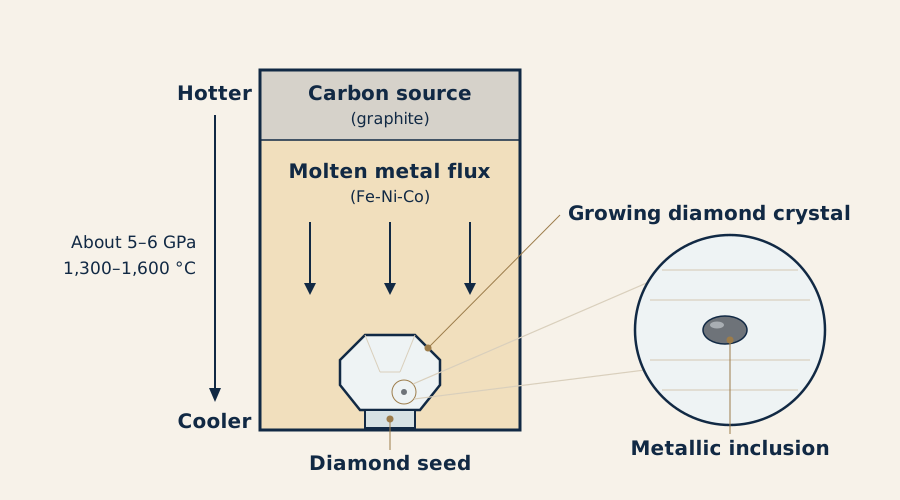
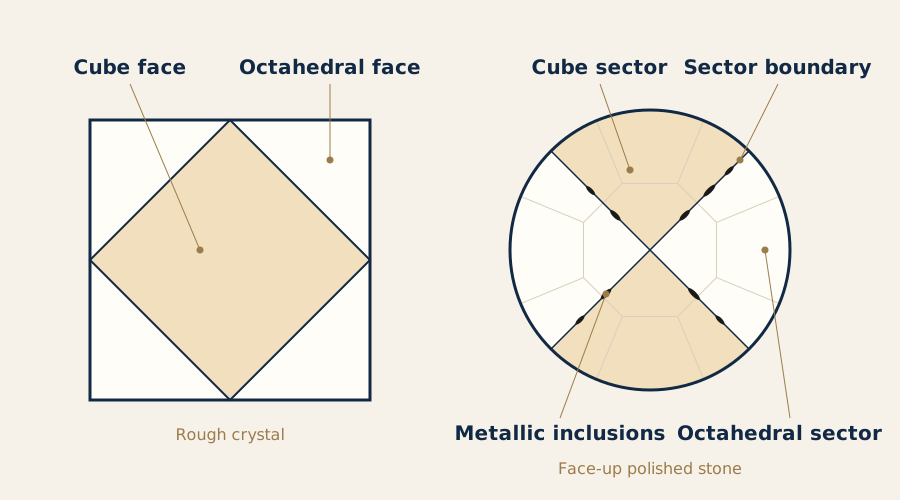
Because the crystal grows while it is bathed in liquid metal, tiny droplets or threads of that metal can be enclosed by the growing faces. This is more likely when growth is fast or the temperature wobbles, and it is often concentrated near the seed, where growth starts, or along the boundaries between growth sectors. Modern presses and better process control have reduced flux inclusions a great deal, which is why many HPHT stones on the market now grade VS or better, but they have not disappeared.
Growers also add nitrogen getters, such as titanium or aluminium, which lock away nitrogen so the diamond grows colourless. Traces of boron can slip in as well and give some HPHT stones a faint grey-blue cast, covered in our article on why some HPHT stones show a faint blue tint. The other main growth method, CVD, uses no molten metal at all, so it produces a different set of inclusions; see how HPHT and CVD growth differ.
What do metallic inclusions look like in a diamond?
Under a 10× loupe, metallic inclusions are opaque and black in transmitted light, meaning light shining through the stone cannot pass through them. Tilt the stone so light reflects off the inclusion and many show a bright, silvery or steely metallic lustre, like a tiny piece of polished metal. That shine is the giveaway that separates them from dark carbon spots.
- Rods and needles: elongated threads, sometimes lying parallel to the growth faces.
- Droplets: rounded or teardrop-shaped blobs, often near the seed area.
- Irregular platelets: flat, angular pieces that can flash when the stone moves.
- Clouds of particles: many tiny metallic specks that can look like a haze or a group of pinpoints.
They can be easy to confuse with other features, so it helps to know how they differ from the inclusions you will see in natural stones.
| Inclusion | Colour and look | Usually found in | Clue |
|---|---|---|---|
| Metallic flux inclusion | Black, opaque, metallic shine in reflected light | HPHT lab-grown | May respond to a strong magnet |
| Crystal (mineral) | Often white, clear or coloured; can be dark | Natural diamond | Shapes of minerals such as garnet or olivine |
| Pinpoint | Tiny white or dark dot | Natural and lab-grown | Too small to identify at 10× |
| Needle | Thin white or clear rod | Natural and lab-grown | No metallic lustre |
| Dark graphite spot | Black, matte, no mirror shine | CVD lab-grown and some natural | Non-diamond carbon |
| Sulphide with halo | Black to brassy, with a disc-shaped crack around it | Natural diamond | Rosette or halo fracture |
Natural diamonds have their own family of mineral crystal inclusions, and both natural and lab-grown stones can show tiny pinpoint inclusions or needle-shaped inclusions. A single dark dot is not proof of anything on its own; gemmologists look at the shape, the lustre and where the features sit within the crystal.
One practical point: black inclusions are usually easier to see than white ones of the same size, because they contrast with the bright facets around them. A brilliant cut can also reflect a single black inclusion several times, so one dot near the table can appear as a small cluster when you look face-up. Step cuts such as the emerald and Asscher, with their long open facets, show the interior even more plainly; our overview of how each diamond shape displays its interior compares them.
Are HPHT diamonds magnetic?
Diamond itself is not magnetic. But iron, nickel and cobalt are, so an HPHT lab-grown diamond with enough metallic inclusions can be attracted to a strong neodymium magnet. Natural diamonds almost never respond, which is why the magnet test became a popular quick screen in the trade.
The test is simple. A loose stone is placed on its table on a smooth, low-friction surface, or hung from a fine thread, and a strong magnet is brought close. If the stone moves towards the magnet, it very likely contains metallic flux and is very likely HPHT-grown.
The limits matter just as much:
- A negative result proves nothing. Many eye-clean HPHT diamonds contain too little metal to respond, and CVD diamonds contain none.
- It only works on loose stones. Once a diamond is set, the weight of the mounting (and any nickel in some white gold alloys) masks any effect.
- Rare natural exceptions exist. A natural diamond with unusual iron-bearing mineral inclusions can very occasionally respond weakly.
- It is not a grading tool. Labs identify growth method with spectroscopy and ultraviolet imaging, not magnets.
The magnet test also says nothing about natural diamonds that have been HPHT-treated. That process uses a press to change the colour of a finished natural stone, not to grow it, so it does not add metal inclusions.
Not sure which one is right?
Send us the stones you are looking at and our gemologist will tell you which to choose and why.
How do gemmologists tell HPHT from CVD and natural diamonds?
Metallic inclusions are one clue among several. Labs such as GIA and IGI combine them with growth patterns seen under deep ultraviolet light, fluorescence behaviour and spectroscopy (measuring how the diamond absorbs or emits particular wavelengths of light).
| Feature | HPHT lab-grown | CVD lab-grown | Natural |
|---|---|---|---|
| Typical inclusions | Metallic flux, pinpoints, clouds | Dark graphite spots, pinpoints | Mineral crystals, feathers, clouds |
| Magnetic response | Possible if metal is present | None | Almost never |
| Growth pattern | Cuboctahedral sectors (cross or hourglass shapes) | Layered growth striations | Octahedral growth, irregular zoning |
| Fluorescence | Often stronger under short-wave than long-wave UV | Often orange to red or weak | Often blue under long-wave UV, or none |
| Phosphorescence | Often a blue-green glow after UV is switched off | Less common | Uncommon |
| Strain under crossed polarisers | Very little | Often banded strain | Often irregular strain |
| Diamond type | Usually type IIa or IIb | Usually type IIa | About 98% type Ia (contains nitrogen) |
Phosphorescence is the glow that lingers after an ultraviolet lamp is switched off, and in HPHT diamonds it can last for many seconds. Type IIa means a diamond with almost no nitrogen, which is rare in nature but normal for colourless lab-grown stones. Neither fact alone settles the question, which is why reliable identification needs lab instruments.
Treated stones add another layer. Natural diamonds can be colour-treated, and lab-grown diamonds are often given a post-growth anneal; our guide to colour treatments such as HPHT and irradiation explains how labs disclose these. For the full side-by-side on growth methods, read telling HPHT and CVD stones apart.
Do metallic inclusions affect lab-grown diamond clarity and durability?
Yes, in the same way as any inclusion. Clarity is graded at 10× magnification on the standard scale: FL (flawless), IF, VVS1–VVS2, VS1–VS2, SI1–SI2 and I1–I3. The grader weighs the size, number, position, nature and contrast of the inclusions. Because metallic flux is dark and high in contrast, a metallic inclusion can pull a stone down further than a pale feature of similar size. Our page on how clarity grades are assigned goes into the five factors.
The cut style changes how much a dark inclusion shows, too. Brilliant-style faceting breaks it up and hides it better than a step cut does; you can compare faceting styles across the full list of 34 diamond cuts if you are still choosing a shape.
On the report, a metallic inclusion is usually plotted with a standard symbol such as crystal, pinpoint or cloud, since grading symbols describe appearance rather than composition. Some reports add a comment, and the growth method (HPHT or CVD) is often stated separately. A typical lab-grown report might read: clarity VS2, characteristics crystal and pinpoint, with a comment noting HPHT growth. Always check that the words laboratory-grown appear on the report and match the laser inscription on the girdle.
Related guideHPHT vs CVD Lab-Grown DiamondsDurability. Small metallic inclusions do not weaken a diamond in everyday wear. Larger ones are a little different. Metal expands much more than diamond when heated, so a big inclusion close to the surface can, in rare cases, develop a stress crack if the stone is exposed to intense heat, for example a jeweller's torch during retipping or resizing. A large inclusion that reaches the surface can also leave a small cavity when the stone is polished.
- Pinpoint-sized flux: no practical effect beyond the clarity grade.
- Eye-visible rods or droplets: mainly a looks issue; a lower grade and lower price.
- Large inclusions near the girdle or a point: worth avoiding in a ring worn daily, and worth mentioning to any jeweller before repairs.
Is an HPHT lab-grown diamond with metallic inclusions worth buying?
It can be, if the inclusion is small and the stone is eye-clean. Eye-clean means you cannot see any inclusion without magnification at a normal viewing distance of about 25–30 cm. In practice, many people looking at HPHT stones aim for VS2 or a carefully checked SI1, because black inclusions are less forgiving than white ones. Lab-grown diamonds already cost much less than natural, so the saving from dropping a clarity grade is small in dollar terms.
| 1 ct round, F–G colour | Approximate price range (AUD) |
|---|---|
| HPHT lab-grown, VVS–VS, eye-clean | about $900–$2,000 |
| HPHT lab-grown, SI1–SI2 | about $700–$1,500 |
| HPHT lab-grown, I1 with visible black inclusions | about $400–$900 |
| Natural, VS2 | about $7,000–$14,000 |
These are broad ranges only; lab-grown prices in particular have moved quickly over recent years and depend on cut quality, colour and the grading lab. Shape moves the price as well, and our page on price differences between round and fancy shapes sets out the pattern. A natural diamond is rarer and priced accordingly, but it should be chosen because you value its origin, not as an investment. A lab-grown diamond is real diamond made in a laboratory, and it is neither fake nor second-rate. More on comparing the two is in our article on lab-grown pricing and value.
Australian rules. Under the Australian Consumer Law, sellers must not mislead buyers about what they are selling, and the ACCC has made clear that lab-grown diamonds must be disclosed as lab-grown. In plain terms, you should always be told whether a diamond is natural or laboratory-grown, and the clarity grade and report should honestly reflect its inclusions. There is no separate requirement to describe an inclusion as metallic, so ask to see photos if that matters to you. At GemTrove we sell both natural and lab-grown diamonds, and we show the report and images for each.
Browse lab-grown diamonds
How to check an HPHT diamond for metallic inclusions: step by step
- Read the report. Confirm it says laboratory-grown, note the growth method if stated, and check the clarity grade and any comments.
- Match the inscription. Check that the report number laser-inscribed on the girdle matches the paper or digital report.
- Study the plotting diagram. Look for marks in the centre under the table, where a black inclusion is most visible.
- Ask for a 10× image in reflected light. A silvery or steely shine on a dark inclusion suggests metallic flux.
- Judge it face-up at arm's length. At about 25–30 cm, decide whether you can see anything without magnification.
- Think about the setting. An inclusion near the girdle can often sit under a claw; one in the middle cannot be hidden.
- Keep a note for later. If the ring ever needs resizing or retipping, tell the jeweller the stone is HPHT-grown with metallic inclusions so they can limit heat.
If any of the report wording is unclear, our definitions of every grading term are a quick reference to keep open beside it.
Free consultation
Talk to a gemologist
Compare stones in person or online with Raj Sood, Graduate Gemologist (GIA), AJP (GIA).
Book a consultationShop this shape
FAQ
Common questions
Do all HPHT diamonds have metallic inclusions?
No. Many HPHT lab-grown diamonds have none visible at 10×, and higher clarity grades are common now that growth is better controlled. Metallic inclusions are simply the inclusion type most closely linked to the HPHT method.
Are HPHT diamonds magnetic?
Diamond itself is not magnetic, but an HPHT stone with enough iron, nickel or cobalt flux inside can be pulled by a strong neodymium magnet. Many eye-clean HPHT stones do not respond, so a failed magnet test does not mean a diamond is natural.
Can natural diamonds have metallic inclusions?
Native metal inclusions in natural diamonds are extremely rare. Natural stones more often have dark graphite or sulphide inclusions, which can look similar but lack the bright metallic lustre and, in sulphides, usually show a disc-shaped halo crack.
Do CVD lab-grown diamonds have metallic inclusions?
No. CVD diamonds grow from a carbon-rich gas with no molten metal, so their dark inclusions are usually non-diamond carbon such as graphite. That is one way labs separate the two growth methods.
Will a metallic inclusion make my diamond break?
Small ones will not. A large inclusion near the surface can, rarely, crack under intense heat from a jeweller's torch, so mention it before any repair work.
Does the report say if an inclusion is metallic?
Not always. Inclusions are usually plotted by appearance, such as crystal or pinpoint, so ask for a magnified photo in reflected light if you want to know.

Ask a gemologist
Not sure which diamond to choose?
Raj Sood is a Graduate Gemologist (GIA) and master jeweller. Bring the stones you are considering, or send the reports, and he will tell you honestly which one is better and why.
Keep learning
Related guides
 Lab-Grown DiamondsHPHT vs CVD Lab-Grown Diamonds
 Diamond 4Cs & GradingDiamond Inclusions Guide
 Lab-Grown DiamondsBlue Nuance in HPHT Lab-Grown DiamondsLab-Grown DiamondsLab-Grown Diamonds GuideNatural DiamondsHPHT Natural Diamonds
 Fancy Colour DiamondsTreated Colour Diamonds (HPHT and Irradiation)
 Diamond 4Cs & GradingCrystal Inclusions in Diamonds
 Diamond 4Cs & GradingPinpoint Inclusions in Diamonds
Explore more
More guides on this topic
Education