
- Education
- Diamond 4Cs & Grading
- D vs E vs F Diamond Colour: What Each Grade Means and Which to Choose
Diamond 4Cs & Grading
D vs E vs F Diamond Colour: What Each Grade Means and Which to Choose
D vs E vs F diamond colour is the choice at the very top of the colour scale, and the price steps between them are real even when the visible difference is tiny. Here is what each grade means, who can actually see it, and when paying for a higher letter makes sense.
 Reviewed by Raj Sood, Graduate Gemologist (GIA), AJP (GIA)Master jeweller and Graduate Gemologist (GIA) · reviewed 4 November 2026
Quick answer
D, E and F are the three colourless grades on the GIA diamond colour scale. D is the most colourless, E and F show tiny traces only a grader sees face-down beside master stones. Once set and viewed face-up, most people cannot tell them apart. The differences are price and rarity, so F is often the sensible choice.
What do D, E and F mean in diamond colour?
Diamond colour is one of the four Cs of diamond grading, alongside cut, clarity and carat. For white diamonds, the colour grade measures how little colour a stone has. The GIA scale runs in 23 letters from D (no detectable colour) to Z (a light yellow or brown tint). It starts at D rather than A because older trade systems already used A, AA and AAA loosely, and GIA wanted a clean break.
The letters are grouped into bands. D, E and F are the colourless grades. G to J are near colourless, K to M faint, N to R very light and S to Z light. Our page on how diamond colour is graded from D to Z covers the whole scale; this page zooms in on the top three letters.
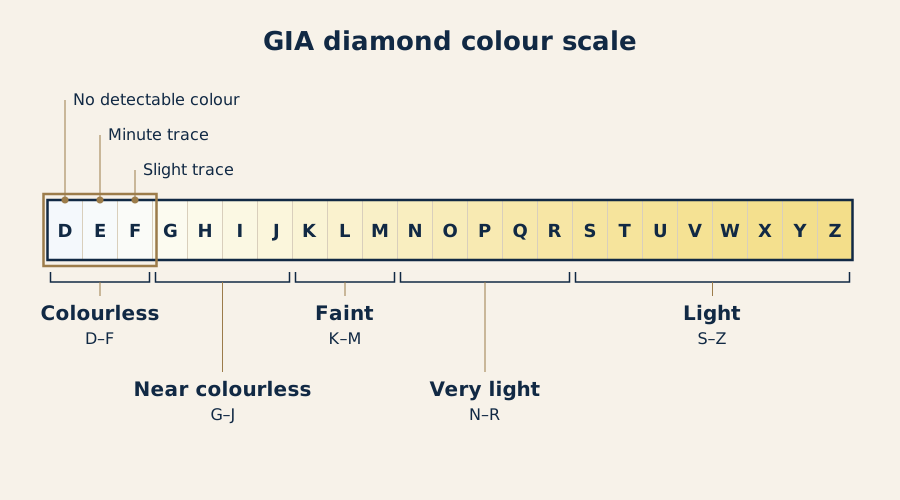
- D colour: no detectable colour, even to a trained grader comparing against master stones. See our D colour diamond guide for more on this grade.
- E colour: a minute trace of colour that only an experienced grader can detect face-down. Read what makes an E colour diamond for the detail.
- F colour: a slight trace, still detectable only by a grader under controlled conditions. It is still classed as colourless. Our page on F colour diamonds in detail goes further.
In most natural diamonds, the faint yellow tint comes from nitrogen atoms trapped in the crystal as it grew. The fewer nitrogen atoms, the higher the colour grade. Diamonds with almost no nitrogen are called type IIa; they make up only a small share of natural diamonds but a large share of D colour stones. You may also meet old European trade terms on some older paperwork: River roughly covered D and E, and Top Wesselton roughly F and G.
D vs E vs F diamond colour: can you actually see the difference?
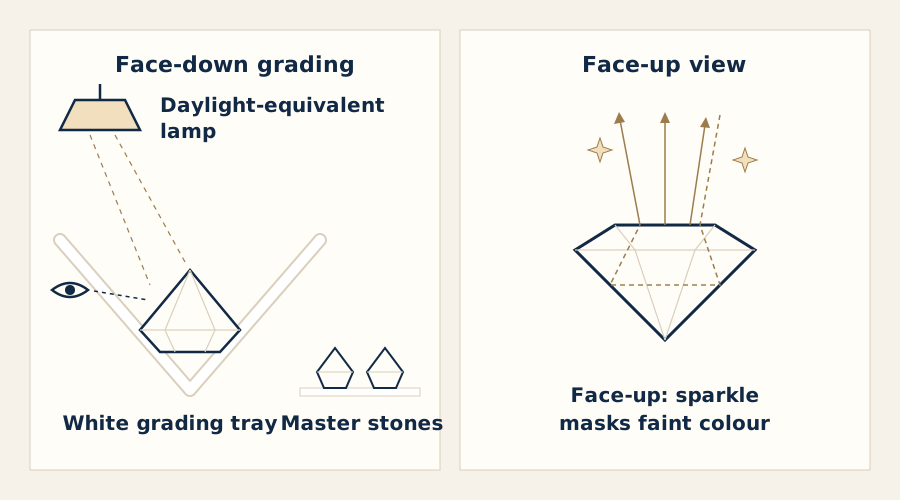
In normal life, almost never. A grader sees the difference between D, E and F by laying the diamond upside down on a white tray, looking through the side of the pavilion (the lower, pointed part) and comparing it with a set of master stones under a daylight-equivalent lamp. That view removes the sparkle and lets the body colour show through the thickest part of the stone.
Once a diamond is set and you look at it face-up (from the top, the way you see it on a hand), the facets send light back to your eye as white light and coloured flashes. That brilliance masks the tiny differences between colourless grades. Side by side on a white card, a trained eye may pick a D from an F. On a finger, in a café, under mixed light, it is not realistic.
What people do notice is the gap between colourless and the lower near-colourless grades in white metal, and the effect of poor cut. A badly proportioned D can look duller and greyer than a well-cut F, because light leaks out instead of coming back through the top.
How are D, E and F colour grades decided?
Colour grading is a comparison, not a measurement on a single instrument. At GIA, graders use a set of master stones: real diamonds of known colour that mark the boundaries between grades. Each grade is a range between two master stones, so one E can sit closer to D and another closer to F. Several graders usually assess the same diamond independently before a grade is issued. If any of these words are new, our plain-English jewellery glossary defines them.
- Position: face-down on a white grading tray, viewed through the pavilion.
- Light: a controlled daylight-equivalent lamp in a neutral grey environment, with no window light.
- Comparison: side by side with master stones, moving the diamond along the set until it fits between two.
- Loose stones only: a mounted diamond can only be given an estimated colour range, because the metal reflects into it.
IGI uses the D to Z letters for both natural and lab-grown diamonds. GIA uses D to Z for natural diamonds, but for lab-grown diamonds it has moved to broader descriptive terms instead of individual letter grades. Some other labs use their own names alongside the letters, so always check which lab issued the report and how its grading conditions are described.
How do D, E and F compare with G and H?
Most buyers comparing D, E and F are also looking one or two grades down. Here is how the top of the scale lines up.
| Grade | GIA band | Face-down (grader) | Face-up when set | Rarity and price |
|---|---|---|---|---|
| D | Colourless | No detectable colour | Icy white | Rarest natural; highest price per carat |
| E | Colourless | Minute trace | Looks the same as D | Very rare; a step below D |
| F | Colourless | Slight trace | Looks the same as D or E | Rare; a further step down |
| G | Near colourless | Faint trace | White to almost everyone | Common choice; lower again |
| H | Near colourless | Faint trace, a little more | White in most settings; very faint warmth in large stones | Widely chosen for value |
The jump from F to G is the boundary between the colourless and near-colourless bands, and it often carries a noticeable price step for natural diamonds. Yet many people cannot tell an F from G colour, the top of near colourless, once both are set. Further down, H colour diamonds remain a very popular choice in white gold, and I colour, where warmth can start to show in white metal is where the trade-off becomes more personal.
Not sure which one is right?
Send us the stones you are looking at and our gemologist will tell you which to choose and why.
Which metal, shape and size suit a D, E or F diamond?
The setting decides whether you keep the benefit of a colourless grade. Metal reflects into a diamond, so the stone picks up some of its colour.
| Metal | Effect on a D–F diamond | Worth paying for colourless? |
|---|---|---|
| Platinum | Bright white, no tint added | Yes, the colourless look is kept |
| 18ct white gold (rhodium plated) | White while the plating is fresh; can warm slightly as it wears | Yes; replate every year or two |
| 18ct yellow gold | Reflects warm colour into the stone | Usually not; a lower grade looks similar |
| 18ct rose gold | Reflects a pink-peach warmth | Usually not |
If you love yellow or rose gold but want the centre to look icy, ask for white claws or a white head on a coloured band. In fully yellow settings, many people choose a grade as low as K colour, with its faint warm tint, because the metal hides the difference.
Shape: round brilliants hide colour best. Fancy shapes such as oval diamonds, pear cut diamonds and radiants tend to show a little more colour at their ends, where the stone is longer; our guide to elongated diamond cuts explains why. Step cuts such as emeralds and Asschers have large open facets that show body colour more clearly. D to F stones look white in every shape, but if you choose a step cut, the case for a colourless grade is a little stronger. To compare every outline, see our overview of the main diamond shapes.
Size: colour is easier to see in bigger stones because light travels further through them. Under about 0.50 carat, the difference between D and G is very hard to see at all. From about 2 carats upwards, colourless grades become more noticeable against near-colourless ones, especially in step cuts.
How much does D vs E vs F diamond colour cost in Australia?
For natural diamonds, each step up the colourless band adds to the price, and the step to D is usually the largest. The diamond looks the same on the hand; you are paying for rarity and the grade on the report. For lab-grown diamonds, the gap between D, E and F is small, because high colours are common in modern lab growth.
| 1 ct round, VS1, excellent cut | Natural (approx. AUD) | Lab-grown (approx. AUD) |
|---|---|---|
| D colour | about $12,000–$20,000 | about $800–$2,200 |
| E colour | about $10,000–$16,000 | about $750–$2,000 |
| F colour | about $9,000–$14,000 | about $700–$1,900 |
| G colour (for comparison) | about $8,000–$12,000 | about $650–$1,800 |
These are broad ranges only; prices move with the market and with every other grade, especially cut and fluorescence. If you are weighing whether a D is worth the premium, compare stones that match on everything else. Our page on E colour price and appearance shows where E tends to sit between the two.
Fluorescence also matters most at this end of the scale. Fluorescence is a glow, usually blue, that some diamonds give off under ultraviolet light. GIA describes it as None, Faint, Medium, Strong or Very Strong. In D to F stones, medium to strong blue fluorescence usually sells at a discount, because in rare cases it can make a stone look slightly hazy. Most fluorescent diamonds look completely normal, so it is worth seeing the stone in daylight before ruling one out.
Are lab-grown diamonds usually D, E or F colour?
Many are. Lab-grown diamonds are real diamond, with the same hardness (10 on the Mohs scale) and refractive index (about 2.42) as natural diamond, but they are grown in a laboratory rather than mined. Most CVD (chemical vapour deposition) diamonds are type IIa, with very little nitrogen, so they often reach the colourless grades.
Many lab-grown diamonds are given a post-growth HPHT treatment (high pressure, high temperature) to remove a brownish tint and lift the colour into D to F. This is a standard part of production and the report should say so. Some natural diamonds are treated the same way, which must also be disclosed; GIA laser-inscribes HPHT-processed natural stones it identifies.
Because a lab-grown D costs only a little more than a lab-grown F, more buyers choose D or E in lab-grown than in natural. Natural D to F stones are far rarer, and that rarity is what you are paying for. Neither choice is wrong; they are simply different products, and the report will always state whether a diamond is natural or laboratory-grown.
Browse D, E and F colour diamonds: natural and lab-grown
Is a D colour diamond worth it, or is F the smart pick?
It depends on what you value. A D colour diamond is worth it if knowing the stone sits at the very top of the scale matters to you, if you are choosing a large step cut in platinum, or if you are buying lab-grown, where the D premium is small. If you mainly care about how the ring looks, an F gives the same face-up appearance for less.
Related guideF Colour Diamonds- Choose D for a lab-grown stone, a large emerald or Asscher cut in platinum, or when the top grade itself is the point.
- Choose E if you want colourless with a little headroom above F, and an E is priced close to the F you are considering.
- Choose F for the colourless band at a lower natural price. This is why F is often the value point for natural diamonds.
- Look at G if the budget is tight; the face-up difference from F is very small.
How do you choose between D, E and F? Step by step
- Decide the metal first. If the setting is platinum or white gold, colourless grades keep their look. In yellow or rose gold, consider a lower grade.
- Set the budget across all four Cs. Read how cut, clarity and carat trade off against colour before you spend on colour alone.
- Prioritise cut. Choose an excellent or ideal cut before moving up from F to E or D.
- Check the report. Confirm the lab, the colour grade, the fluorescence, whether the stone is natural or lab-grown, and any treatment such as HPHT.
- Compare like with like. Look at D, E and F stones with the same carat, clarity and cut, so the price step you see is the colour step.
- View them face-up and side by side. If you cannot pick the higher grade in daylight, consider comparing an F with a G too.
- Check fluorescence in daylight. A fluorescent D to F stone may be good value if it looks clear in normal light.
Free consultation
Talk to a gemologist
Compare stones in person or online with Raj Sood, Graduate Gemologist (GIA), AJP (GIA).
Book a consultationFAQ
Common questions
Can you tell the difference between D and F colour diamonds?
Not face-up once they are set. A trained grader can separate them face-down on a white tray beside master stones, but in a ring the sparkle hides the tiny difference.
Is a D colour diamond worth the extra money?
For natural diamonds, a D costs noticeably more than an E or F for no visible difference on the hand. For lab-grown diamonds the D premium is small, so many buyers choose D.
Is E or F colour better for an engagement ring?
Both are colourless and look the same when set. E is a little rarer and costs a little more; F gives the colourless grade at a lower price, which is why it is a common choice.
Should I put a D, E or F diamond in yellow gold?
You can, but yellow gold reflects warmth into the stone, so much of the colourless benefit is lost. White claws help, or you can choose a lower colour grade for a yellow setting.
Are lab-grown D colour diamonds real diamonds?
Yes. They are real diamond, chemically and physically, grown in a laboratory rather than mined. Many are HPHT treated after growth to improve colour, and the report will say so.
Is F colour diamond better than G?
F sits in the colourless band and G at the top of near colourless, so F is rarer and costs more. Once set, very few people can see the difference.

Ask a gemologist
Not sure which diamond to choose?
Raj Sood is a Graduate Gemologist (GIA) and master jeweller. Bring the stones you are considering, or send the reports, and he will tell you honestly which one is better and why.
Keep learning
Related guides
 Diamond 4Cs & GradingD Colour Diamonds
 Diamond 4Cs & GradingE Colour DiamondsDiamond 4Cs & GradingF Colour Diamonds
 Diamond 4Cs & GradingDiamond Colour GradingDiamond 4Cs & GradingDiamond 4CsDiamond 4Cs & GradingI Colour DiamondsDiamond 4Cs & GradingH Colour DiamondsDiamond 4Cs & GradingG Colour Diamonds
Explore more
More guides on this topic
Education