
- Education
- Diamond Shapes
- Elongated Diamond Cuts: Oval, Pear, Marquise, Moval and More Compared
Diamond shapes
Elongated Diamond Cuts: Oval, Pear, Marquise, Moval and More Compared
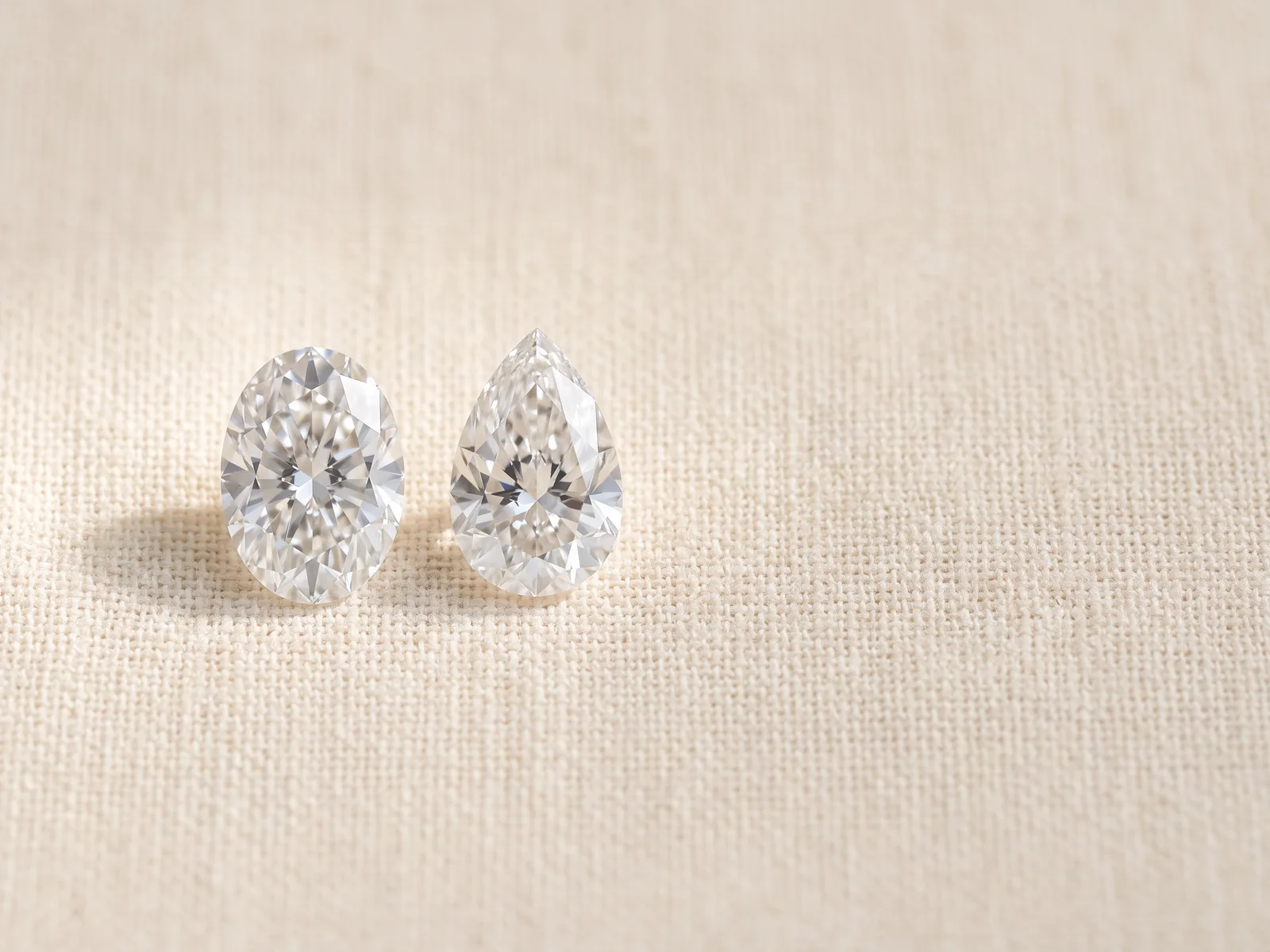
Elongated diamond cuts stretch the stone along the finger, and each one does it differently. This guide puts the whole family in one place so you can compare ratios, sparkle, durability and price before you narrow down to a single shape.
 Reviewed by Raj Sood, Graduate Gemologist (GIA), AJP (GIA)Master jeweller and Graduate Gemologist (GIA) · reviewed 4 November 2026
Quick answer
Elongated diamond cuts are shapes longer than they are wide, usually with a length-to-width ratio of about 1.20 or more. The family includes oval, pear, marquise, moval, elongated cushion, elongated radiant and emerald cuts. They make fingers look longer, face up larger than a round of the same carat, and cost less per carat, but can show a bow-tie.
What are elongated diamond cuts?
Elongated diamond cuts are any diamond shapes that are noticeably longer than they are wide. Gemmologists describe this with the length-to-width ratio: divide the stone's length by its width, both taken from the grading report. A round is 1.00. Once a stone passes about 1.20, most people see it as elongated rather than square or round.
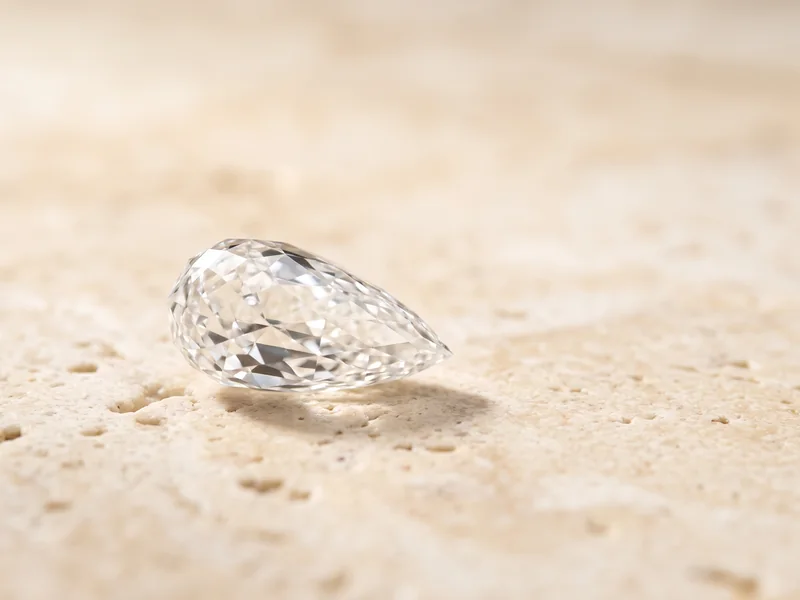
The family takes in seven main shapes: oval, pear, marquise, moval, elongated cushion, elongated radiant and emerald (including the extra-long elongated emerald). The faceted briolette drop is a close relative used mostly in earrings and pendants. Our guide to all 34 diamond cuts, shape by shape shows where these sit among the rest, and the introduction to how diamond shapes differ covers the basics if you are just starting out.
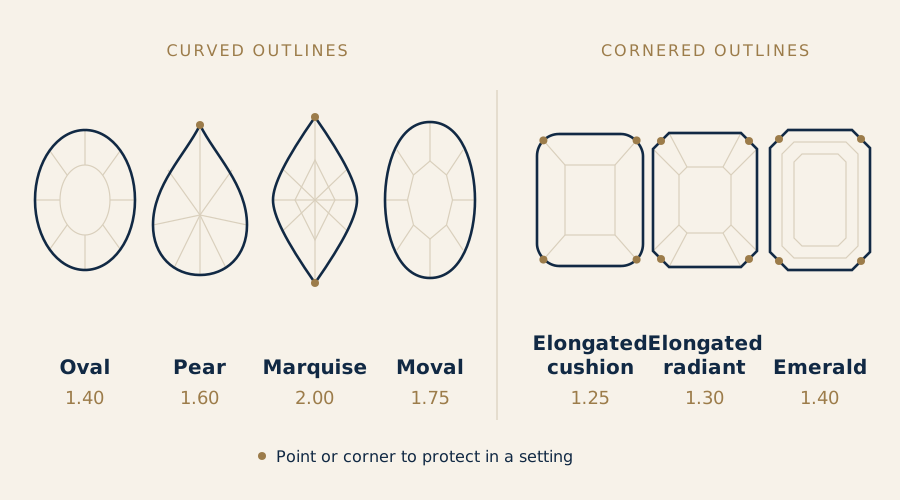
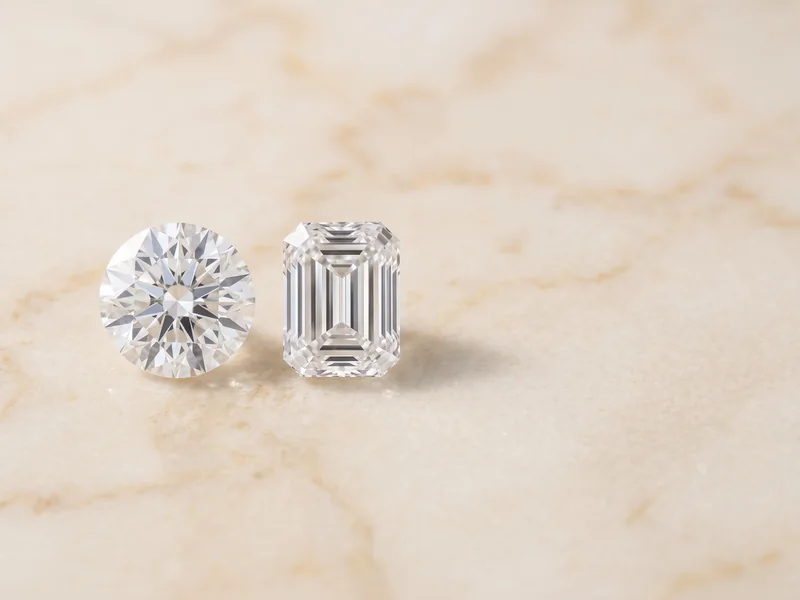
The family splits into two faceting styles. Brilliant cuts (oval, pear, marquise, moval, elongated cushion and elongated radiant) use many small triangular and kite-shaped facets to break light into sparkle. Step cuts (emerald and elongated emerald) use long, parallel rectangular facets, like steps, that give broad flashes of light and a calm, glassy look. The difference between step and brilliant faceting matters more than outline when you are deciding how lively you want the stone to look.
What do elongated diamond shapes have in common?
Whatever the outline, elongated stones share a handful of traits that set them apart from rounds and squares:
- They lengthen the finger. Set north–south (long axis along the finger), an elongated diamond draws the eye up and down the hand, which is why these are often called the diamond shapes that make fingers look longer.
- They spread wider for their weight. More of the stone's weight sits in its outline rather than its depth, so many elongated cuts look larger face-up (seen from above) than a round of the same carat.
- They can show a bow-tie. Brilliant-cut elongated shapes often have a dark band across the middle where light leaks out. More on this below.
- They show colour at the ends. Body colour (a faint yellow or brown tint) gathers where the stone is narrowest, at points and tips.
- They have no GIA cut grade. GIA grades cut only for round brilliants, so for fancy shapes you judge the cut from proportions, symmetry and your own eyes.
- They usually cost less per carat than rounds. Demand is lower and cutters can keep more of the rough crystal.
Diamond itself does not change between shapes: it is 10 on the Mohs hardness scale with a refractive index of about 2.42, whether natural or lab-grown. What changes is how the outline handles light and how exposed its edges are. Any unfamiliar term here is defined in our plain-English jewellery glossary.
How do elongated diamond cuts compare side by side?
This chart is the quickest way to compare the family. Ratios are the ranges most people choose, not fixed rules.
| Cut | Facet style | Typical ratio | Points to protect | Bow-tie | Overall look |
|---|---|---|---|---|---|
| Oval | Brilliant | 1.30–1.50 | None | Common | Soft, even sparkle, no corners |
| Pear | Brilliant | 1.45–1.75 | One | Common | Teardrop, round end and a point |
| Marquise | Brilliant | 1.85–2.10 | Two | Common | Long and dramatic, boat-shaped |
| Moval | Brilliant | about 1.60–1.90 | Two softened tips | Possible | Between oval and marquise |
| Elongated cushion | Brilliant (modified) | 1.15–1.35 | Rounded corners | Uncommon | Pillowy, vintage feel |
| Elongated radiant | Brilliant (modified) | 1.20–1.40 | Cut corners | Rare | Rectangle with crushed-ice sparkle |
| Emerald / elongated emerald | Step | 1.30–1.50 / 1.50+ | Cut corners | No | Clean lines, hall-of-mirrors effect |
Two patterns stand out. The longer and more pointed the shape, the more attention its points need in the setting. And the step-cut emerald is the only member with no bow-tie at all, but it is also the least forgiving of inclusions (internal features), because its open facets act like a window into the stone.
Oval vs pear vs marquise vs moval: which curved shape suits you?
The four curved brilliants are the core of the family. Each has its own detailed guide:
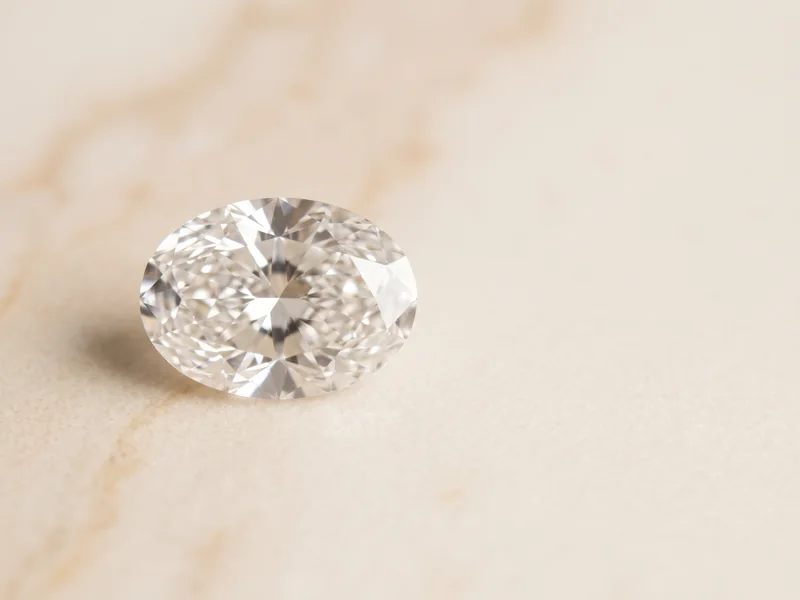
- Oval: the most popular elongated engagement ring shape and the easiest to wear, with no points to chip. See our oval diamond guide to ratio and bow-tie.
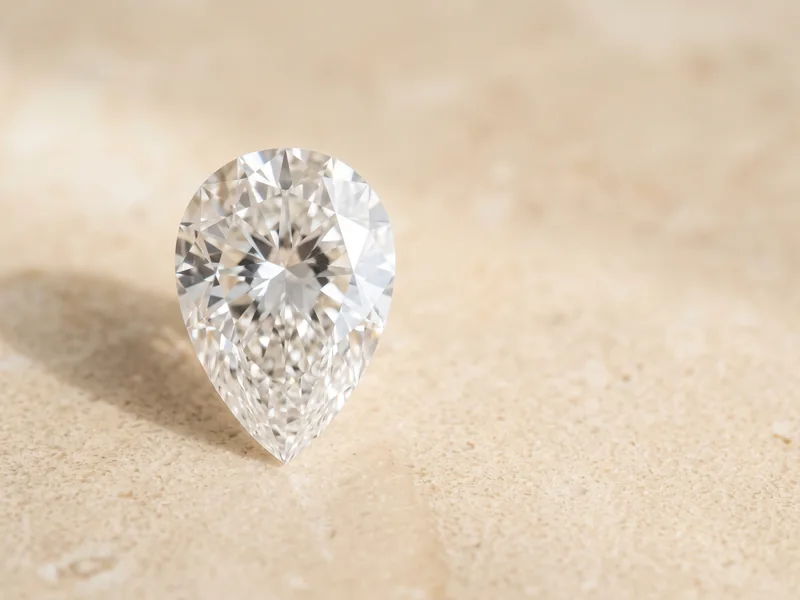
- Pear: a round end and a point, worn point-up on the finger or point-down as a pendant. Our pear cut guide covers shoulder shape and symmetry.
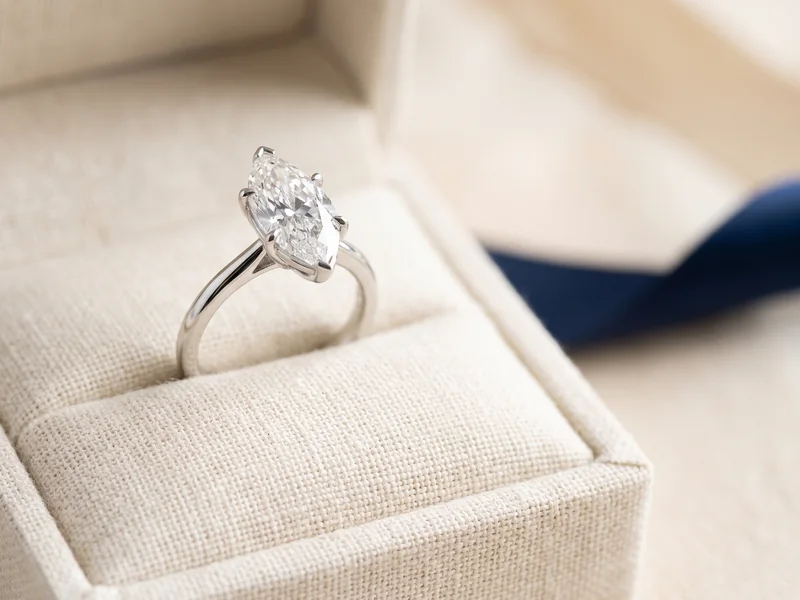
- Marquise: the longest of the group for its weight, with two points. Read the marquise cut diamond guide for ratio and setting advice.
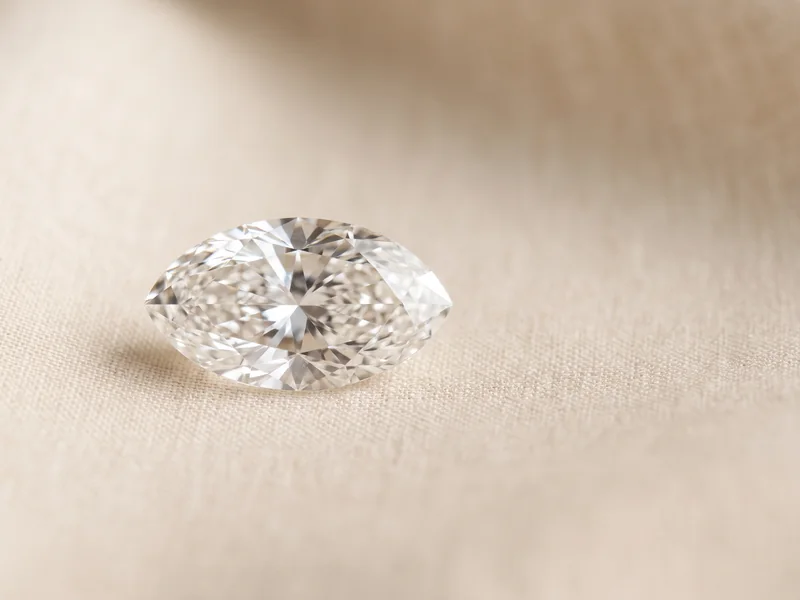
- Moval: a newer shape that blends marquise tips with oval curves. See the moval cut explained.
If you are torn between neighbours, the head-to-head guides help: oval versus moval, compared on sparkle and outline and how a moval differs from a marquise. For earrings and pendants, the faceted briolette, a drop with no table is an elongated option that hangs and moves with light rather than sitting flat.
A useful way to choose is by how much drama you want. An oval is the quietest, a pear adds one strong direction, a moval sharpens the ends without fully committing, and a marquise makes the boldest statement of all.
Not sure which one is right?
Send us the stones you are looking at and our gemologist will tell you which to choose and why.
What about elongated cushion, radiant and emerald cuts?
These three start from a square or rectangle and stretch it. They suit people who like length but prefer corners to curves.
- Elongated cushion: a rectangle with softly rounded corners and a pillow-like profile. Most sit around 1.15–1.35. See the elongated cushion cut guide.
- Elongated radiant: a rectangle with clipped corners and brilliant faceting, so it sparkles like an oval but has a crisper edge. Our guide to elongated radiant diamonds covers ratio and depth.
- Elongated emerald: a classic emerald stretched to 1.50 or more, giving very long step facets. The elongated emerald cut page explains why clarity matters more here.
The question most people ask is elongated cushion vs oval: the oval spreads wider and has a smoother outline, while the cushion sits a little deeper and has a softer, more vintage character. The oval and elongated cushion side-by-side guide walks through photos and measurements.
What is the right elongated diamond ratio?
Ratio decides how long and slim the stone looks, and the preferred range differs for each cut. A ratio at the low end looks fuller and wider; at the high end it looks slimmer and more elongated.
| Cut | Fuller look | Classic range | Slimmer look |
|---|---|---|---|
| Oval | Below 1.30 | 1.30–1.50 | Above 1.50 |
| Pear | Below 1.45 | 1.45–1.75 | Above 1.75 |
| Marquise | Below 1.85 | 1.85–2.10 | Above 2.10 |
| Elongated cushion | 1.10–1.15 | 1.15–1.35 | Above 1.35 |
| Elongated radiant | 1.15–1.20 | 1.20–1.40 | Above 1.40 |
| Emerald | Below 1.30 | 1.30–1.50 | 1.50+ (elongated emerald) |
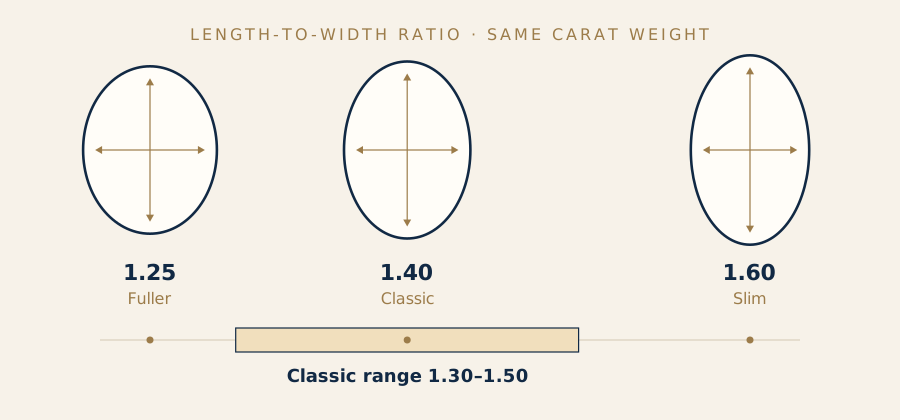
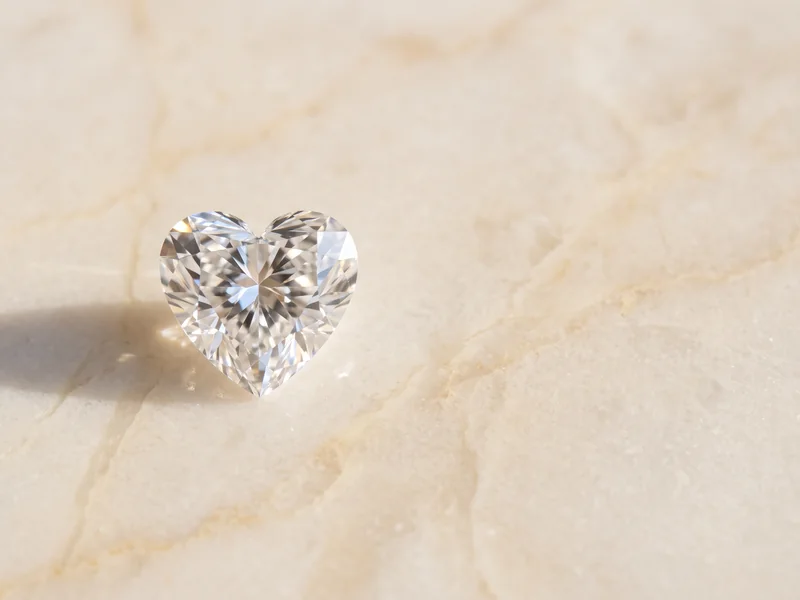
Your hand matters as much as the numbers. A slimmer ratio flatters shorter fingers by adding length, while wider fingers often suit a fuller stone so it does not look narrow across the hand. For comparison, a heart shaped diamond sits around 0.90–1.10, which is why it is grouped with fancy brilliants but not with the elongated family.
Do elongated diamonds have a bow-tie, and how do you avoid one?
A bow-tie is a dark, butterfly-shaped area across the centre of an oval, pear, marquise or moval. It happens because the long, curved outline makes it hard for every facet to return light at the same angle. A faint bow-tie that shifts and flickers as the stone moves is normal, and many people like the contrast. One that stays dark in every position is a sign of a shallow or poorly proportioned stone.
Most well-cut curved brilliants sit around 58–64% total depth (height divided by width) with a table (the large top facet) of about 53–63%. These ranges help screen stones, but they cannot tell you how the bow-tie looks. Only movement can.
Colour behaves differently too. Because tint collects at the points, many people choose one grade higher for a marquise or pear (around G–H in white metal) than they would for an oval. Step-cut emeralds have no bow-tie but show clarity plainly, so VS2 or better is a common choice there, compared with a carefully selected SI1 in an oval or radiant.
Do elongated diamond cuts look bigger, and what do they cost?
Yes, usually. Because more weight goes into the outline, elongated stones tend to face up larger than a round of the same carat. Typical 1 carat measurements:
| 1 ct shape | Typical size (length × width) | Compared with a 1 ct round (about 6.4 mm) |
|---|---|---|
| Oval | about 7.7 × 5.7 mm | Looks larger |
| Pear | about 8.5 × 5.6 mm | Looks larger |
| Marquise | about 10.0 × 5.0 mm | Looks noticeably longer |
| Moval | about 9.0 × 5.4 mm | Looks larger |
| Elongated radiant | about 7.0 × 5.3 mm | Similar to slightly larger |
| Elongated cushion | about 6.9 × 5.4 mm | Similar |
| Emerald | about 7.0 × 5.0 mm | Similar |
These depend on depth: a deeper stone hides weight underneath and faces up smaller. On price, every elongated shape is cut from both natural and laboratory-grown diamond, and the two look identical to the eye. Lab-grown diamonds are real diamond grown in a laboratory; they cost much less than natural. As a broad guide, a 1 ct oval around G–H, VS sits at about AUD $1,000–$3,000 lab-grown and about $7,000–$16,000 natural. Pears and marquises are often a little lower per carat than ovals; prices move with the market and the exact grades.
Browse oval, pear and marquise diamonds: natural and lab-grown
What settings protect elongated diamonds?
Elongated shapes are set mainly with points and corners in mind. The usual choices for an elongated engagement ring:
- Oval: four or six claws; no points, so almost any setting works.
- Pear: a V-claw (V-shaped claw) or bezel on the point, plus two or three claws around the round end.
- Marquise and moval: V-claws or bezel tips on both ends, with two claws at the sides. Our guide to keeping marquise points safe explains why.
- Cushion, radiant and emerald: four claws on the corners; double claws spread the load on longer stones.
- Halo or bezel: a rim of metal or small diamonds around the edge protects the whole outline.
Orientation is a design choice as well. North–south lengthens the finger; east–west (set sideways) reads modern and less traditional.
How do you choose an elongated diamond cut? Step by step
- Pick curves or corners. Oval, pear, marquise and moval are curved; cushion, radiant and emerald have corners.
- Choose your sparkle style. Brilliant for lively sparkle, step cut for clean flashes of light.
- Set a ratio range. Use the chart above and try fuller and slimmer stones against your hand.
- Read the report. Confirm measurements, colour, clarity, symmetry, and whether the stone is natural or lab-grown.
- Watch a 360° video. Check the bow-tie, tint at the ends and any inclusions near points.
- Compare face-up size. Use millimetres, not just carat weight.
- Plan the setting. Make sure every point and corner is protected before committing to the stone.
Free consultation
Talk to a gemologist
Compare stones in person or online with Raj Sood, Graduate Gemologist (GIA), AJP (GIA).
Book a consultationFAQ
Common questions
Which elongated diamond cut makes fingers look longest?
The marquise, because it has the highest ratio (about 1.85–2.10) and two points that lead the eye along the finger. A slim pear or moval comes close.
What ratio counts as an elongated diamond?
Most people see a stone as elongated from about 1.20. Each cut has its own preferred range, such as 1.30–1.50 for ovals and 1.45–1.75 for pears.
Do all elongated diamonds have a bow-tie?
No. Ovals, pears, marquises and movals often show one, elongated cushions and radiants show it less, and step-cut emeralds do not show one at all.
Is an elongated cushion or an oval better for everyday wear?
Both are durable because neither has a sharp point. The oval spreads a little wider face-up, while the cushion has a softer, vintage look; it comes down to taste.
Are lab-grown elongated diamonds real diamonds?
Yes. Lab-grown diamonds have the same hardness, refractive index and crystal structure as natural diamonds, and the grading report states clearly that the stone is laboratory-grown.
Are elongated diamonds cheaper than round diamonds?
Usually, per carat, at the same colour and clarity. Lower demand and better use of the rough crystal both keep prices below rounds.

Ask a gemologist
Not sure which diamond to choose?
Raj Sood is a Graduate Gemologist (GIA) and master jeweller. Bring the stones you are considering, or send the reports, and he will tell you honestly which one is better and why.
Keep learning
Related guides
 Diamond ShapesOval Diamonds
 Diamond ShapesPear Cut Diamonds
 Diamond ShapesMarquise Cut Diamonds Melbourne
 Diamond ShapesMoval Cut Diamonds
 Diamond ShapesHeart-Shaped Diamonds
 Diamond ShapesBriolette Cut Diamonds
 Diamond ShapesAll 34 Diamond Cuts: Every Shape Explained and ComparedDiamond ShapesUnderstanding Diamond Shapes
Explore more
More guides on this topic
Education