
- Education
- Diamond 4Cs & Grading
- F Colour Diamond Guide: What the Grade Means and When to Choose It
Diamond 4Cs & Grading
F Colour Diamond Guide: What the Grade Means and When to Choose It
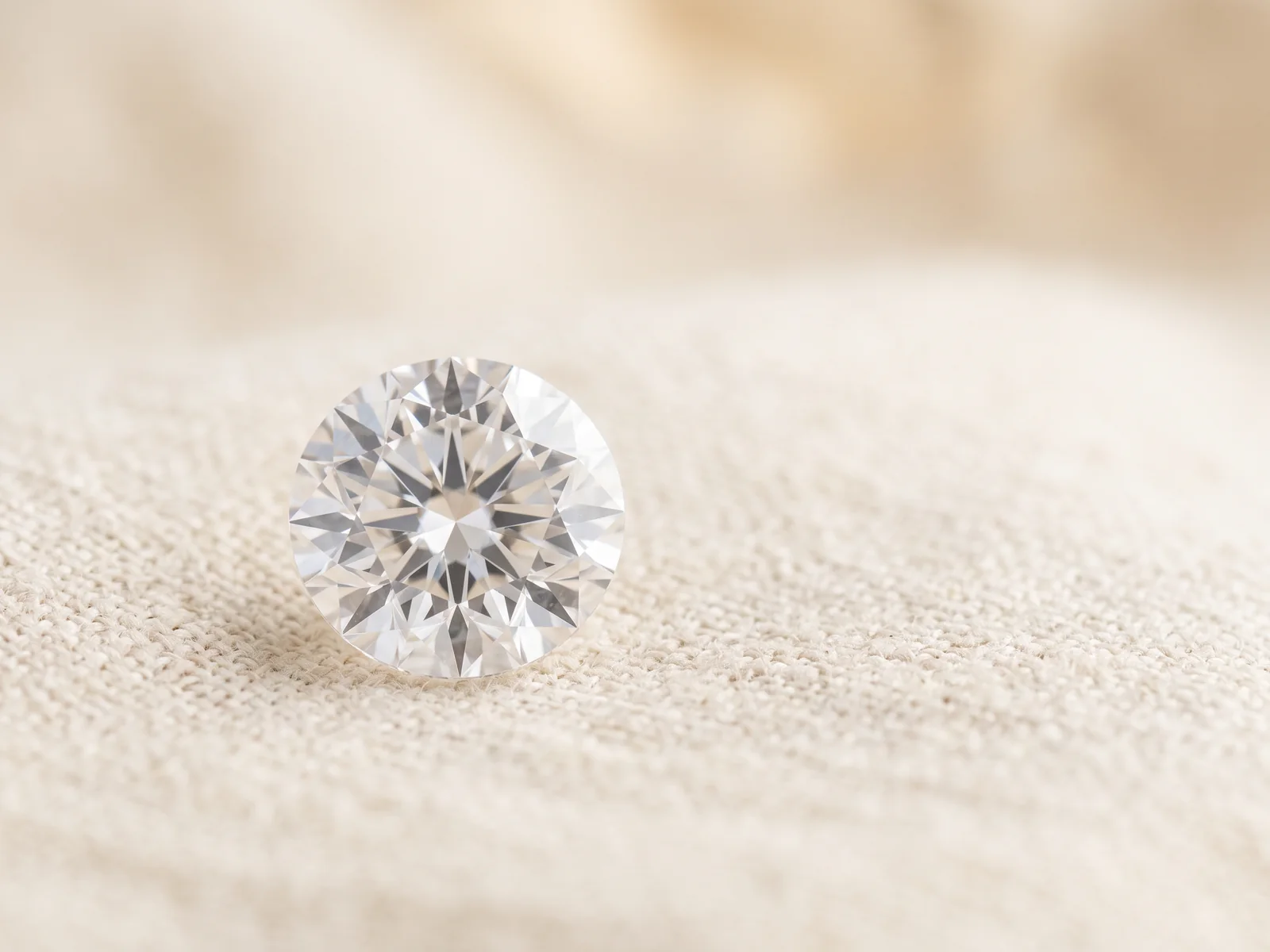
F is the last of the colourless grades, and for many buyers it is where colour stops being a compromise. Here is what an F colour diamond really looks like, what it costs next to its neighbours, and when the extra over G earns its place.
 Reviewed by Raj Sood, Graduate Gemologist (GIA), AJP (GIA)Master jeweller and Graduate Gemologist (GIA) · reviewed 4 November 2026
Quick answer
An F colour diamond is the lowest grade in GIA's colourless range (D–F), the third grade from the top of the D-to-Z scale. Face-up it looks icy white; only a trained grader comparing face-down against master stones can separate it from D or E. It costs noticeably less than D and suits platinum, white gold and any shape.
What is an F colour diamond?
An F colour diamond sits third from the top of the D-to-Z colour grading scale used by GIA and most other laboratories. It is the lowest of the three colourless grades, D, E and F. Colour is one of the four Cs of diamond quality, alongside cut, clarity and carat weight, and for white diamonds it measures an absence: how little yellow or brown tint the stone carries.
That tint is called body colour, the diamond's own underlying colour as opposed to the flashes of rainbow light it throws. Most white diamonds contain a trace of nitrogen, which absorbs blue light and leaves a faint yellow. The less of it there is, the higher the grade. An F has so little that, under GIA's description, it is colourless; the only difference from a D or E is a trace an experienced grader can pick up in a side-by-side comparison.
| Grades | GIA description | What it means in practice |
|---|---|---|
| D, E, F | Colourless | No colour visible face-up to the eye, in any metal |
| G, H, I, J | Near colourless | Looks white face-up; a trace of warmth may show in large or fancy shapes |
| K, L, M | Faint | A light warmth visible face-up, more so in white metal |
| N to R | Very light | Clearly tinted to most people |
| S to Z | Light | Obvious yellow or brown; beyond Z is a fancy colour |
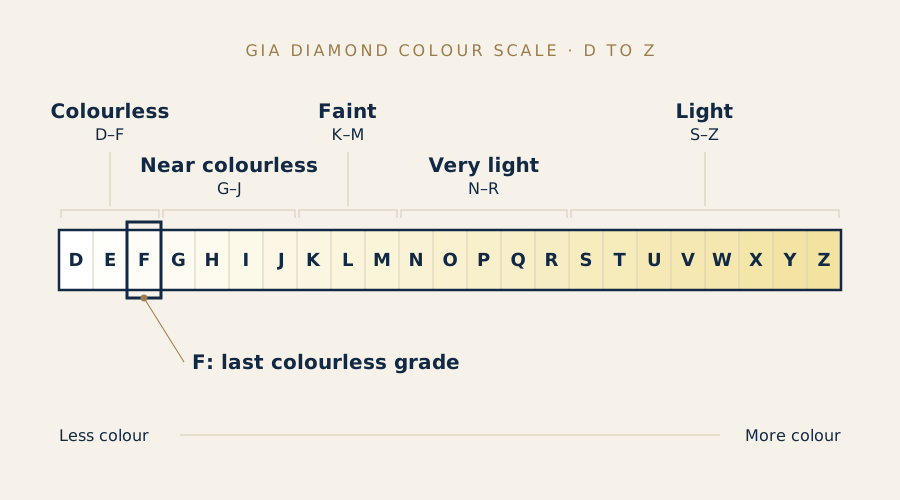
F sits between E colour diamonds above it and G, the first near-colourless grade below. Above E is D, the top of the scale. Each grade is a narrow band rather than a single point, so a high F and a low E can be closer together than a high F and a low F.
What does an F colour diamond look like face-up?
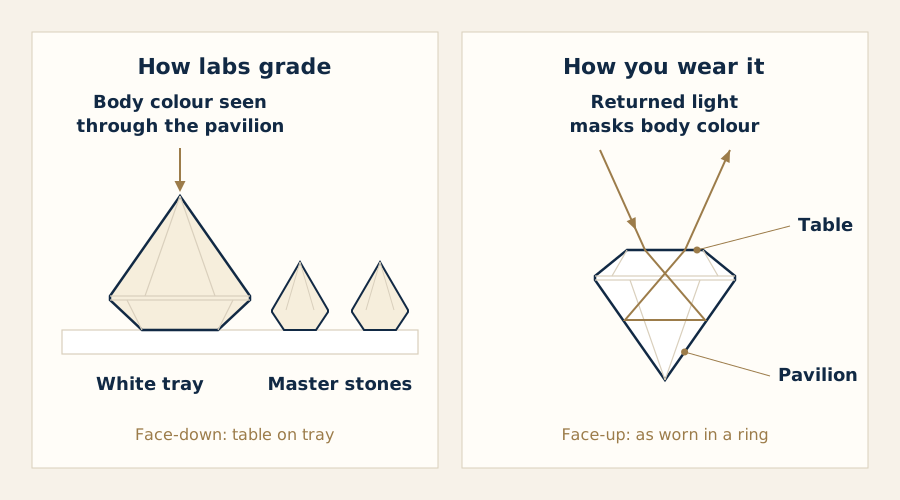
Laboratories grade colour with the diamond face-down: table on a white tray, pavilion (the pointed underside) facing up, under controlled daylight-equivalent lighting. The grader compares it with master stones, a set of diamonds of known colour, and gives it the grade of the master it matches. Face-down, the facets do less to scatter light, so you see the body colour through the stone's full depth.
You wear a diamond face-up, and that changes things. Face-up, a well-cut stone returns light from the pavilion back through the top, and the brightness and sparkle mask most of the body colour. That is why even trained eyes struggle to tell an F from an E face-up in a ring, and why many people cannot separate an F from a G at arm's length.
What an F does give you face-up:
- A crisp, cool white with no warmth in the corners or tips, even in fancy shapes.
- No colour contrast against platinum or white gold, so the stone and the metal read as one.
- Headroom in larger sizes: above about 2 carats, colour becomes easier to see, and an F stays white where a lower grade may start to warm.
- A clean match for side stones and halo diamonds, which are often graded in the F–G range.
Fluorescence is worth a look at this grade. It is the glow some diamonds give under ultraviolet light, usually blue. In lower colours, medium blue fluorescence can make a stone face up slightly whiter. In colourless grades there is no tint to counter, and in a small number of stones strong fluorescence can cause a hazy or oily look. Natural F stones with strong fluorescence are often priced lower; ask for a video in daylight to check for any haze.
F vs E vs G colour diamond: can you see the difference?
Side by side, face-down, on a white tray, a grader can. Set in a ring, on a hand, in normal light, most people cannot. Here is how F compares with the grades around it.
| D | E | F | G | H | |
|---|---|---|---|---|---|
| GIA range | Colourless | Colourless | Colourless | Near colourless | Near colourless |
| Visible tint face-up | None | None | None | None to most eyes | Very slight in large or fancy shapes |
| Separable by a grader | Top of scale | From D and F side by side | From E and G side by side | From F and H side by side | From G and I side by side |
| Natural price per carat | Highest | High | Below D and E | Below F | Below G |
| Suits yellow or rose gold | Yes, but the metal warms it | Same | Same | Yes | Yes |
The useful line is the one between F and G, because it is the border between colourless and near colourless. That label matters to some buyers and not at all to others. If you want the report to say colourless, F is the entry point. If you care only about what you see on the hand, G and even H colour stones often look the same in white metal at around 1 carat.
For a closer look at the top three grades, our comparison of D, E and F goes through when the step up matters. If you are weighing up the next tier down instead, the G versus H engagement ring guide covers that choice.
Related guideD vs E vs F Diamond ColourDoes diamond shape change how F colour looks?
Yes. Shape and faceting change how much body colour you see, even at the same grade. Round brilliants return the most light and hide colour best. Elongated shapes concentrate colour at their ends, and step cuts, with their long, open facets, show colour most honestly. Because an F has almost no colour to show, it looks colourless in every shape; the real question is how far below F you could go and still be happy.
| Shape | How much colour it shows | Is F worth it here? |
|---|---|---|
| Round brilliant | Least; faceting masks body colour | Only if you want colourless on paper; G–H look similar face-up |
| Princess | Low to moderate; corners can hold colour | Optional; G is usually enough under 1.5 ct |
| Oval, pear, marquise | Moderate; colour gathers at tips and ends | Worth considering above about 1.5 ct in white metal |
| Cushion, radiant | Moderate to high; mixed faceting holds colour | A sensible choice in larger sizes |
| Emerald, Asscher | Highest; open step facets show the body colour | Often the smartest place to choose F |
Size makes a difference too. A larger stone has a longer light path, so it shows more of its body colour. At 0.50 carat, the gap between F and H is very hard to see; at 3 carats in an emerald cut, many people can see it. Our colour and clarity pairings for every shape gives grade suggestions shape by shape.
Not sure which one is right?
Send us the stones you are looking at and our gemologist will tell you which to choose and why.
Which ring metal suits an F colour diamond?
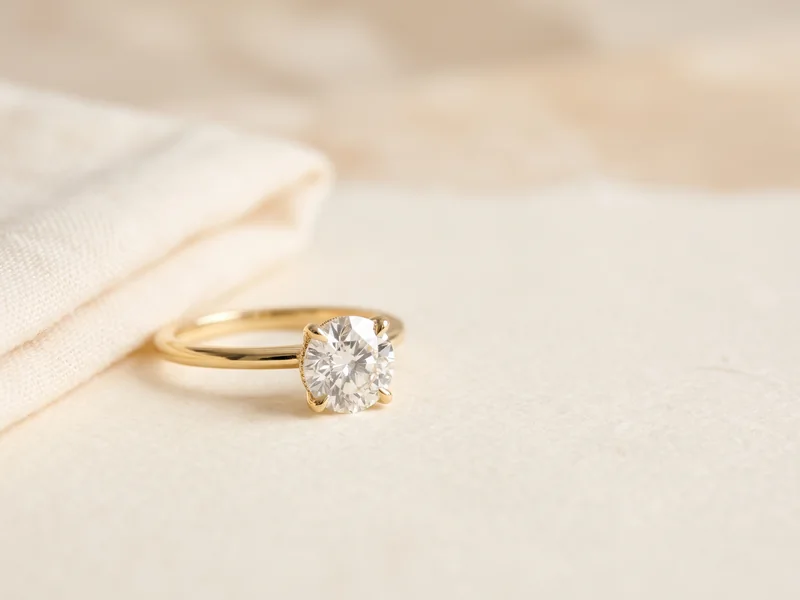
Metal colour reflects into a diamond and changes how warm or cool it looks. An F shows its full colourless effect in platinum or white gold. Most white gold is plated with rhodium, a bright white metal from the platinum family, which keeps the setting cool; platinum is naturally grey-white and needs no plating.
In yellow or rose gold, the metal warms everything around it, so the advantage of an F largely disappears. Many people pair yellow gold with near-colourless stones such as I colour or J colour diamonds, which look just as white against the warm metal. If you love yellow gold and still want an F, set it in white claws or a platinum head so the stone sits in white metal while the band stays yellow. Our guide to how metal colour affects a diamond shows each combination.
Halo and pavé settings add another consideration. Melee (the small accent diamonds) is commonly in the F–G or G–H range. An F centre stands out cleanly against them; a much lower centre can look warmer than the halo around it.
How much does an F colour diamond cost in Australia?
Colour is one of the biggest price drivers after carat weight. Each grade up costs more, and the steps get larger at the top of the scale and at larger sizes. The figures below are approximate AUD ranges for a natural round brilliant, 1.00 carat, VS2 clarity, excellent cut with a GIA report. Real prices move with the market, fluorescence, proportions and the exact stone.
| Colour | Approximate price range (AUD, natural 1.00 ct VS2) | Step from the grade below |
|---|---|---|
| D | about $14,000–$22,000 | Largest step on the scale |
| E | about $12,000–$19,000 | Moderate |
| F | about $11,000–$17,000 | Moderate |
| G | about $9,500–$15,000 | Moderate |
| H | about $8,000–$12,500 | Smaller |
| I | about $6,500–$10,500 | Smaller |
As a rough guide, each grade between D and H often changes the natural price by somewhere around 10–20% at 1 carat, with the gap widening in larger stones. Further down, K colour stones and faint yellow L and M diamonds drop much further, because the warmth becomes visible.
Lab-grown diamonds follow a very different curve. Laboratory-grown stones in high colours are common, so the step from G to F is small, and a 1 carat lab-grown F VS stone typically costs in the range of about AUD $900–$2,500. If you are balancing colour against inclusions, our article on whether to prioritise colour or clarity explains where the money shows most.
Natural and lab-grown F colour diamonds
F colour is found in both natural and laboratory-grown diamonds, and the two look identical to the eye. A natural F is a rare stone: only a small share of mined white diamonds grade in the colourless range. Lab-grown diamonds are real diamonds with the same crystal structure, hardness (10 on the Mohs scale) and refractive index (2.42), grown in a controlled process rather than formed in the earth.
Many lab-grown diamonds, especially those grown by CVD (chemical vapour deposition), receive a post-growth treatment to improve their colour. This is normal in the industry and should be noted on the grading report. Natural diamonds can also be colour-treated, though it is far less common and should always be disclosed. Whichever you choose, check the report for any treatment and for the words lab-grown or laboratory-grown, which are usually also inscribed (sometimes abbreviated, such as 'LG') on the girdle of graded lab-grown stones.
Shop F colour diamonds
Lab reports differ in how they describe lab-grown colour, so read the wording on the report itself. Natural stones are most often graded by GIA; lab-grown stones are commonly graded by IGI, which uses the D-to-Z letters for them. GIA has moved away from individual D-to-Z letters on its lab-grown reports, so a GIA lab-grown report may not show an 'F'.
Is an F colour diamond worth it?
It depends on the stone, the metal and what matters to you. F is a smart choice in some situations and an unnecessary spend in others.
- Choose F when you want a colourless grade on the report, the ring is platinum or white gold, the shape is a step cut or a large fancy, or you are matching a colourless halo or a pair of earrings.
- Choose F when you are buying lab-grown, where the price step from G or H is small enough that colourless costs little extra.
- Consider G or H instead when the stone is a round brilliant under about 1.5 carats, or you would rather put the difference into a better cut or a larger size.
- Skip F when the setting is yellow or rose gold; the metal masks the difference and a near-colourless stone looks the same.
If a term on the report is unfamiliar, our jewellery and diamond glossary explains it in plain English.
How to choose an F colour diamond: step by step
- Decide on the metal first. If the stone sits in platinum or white gold, F shows its value; in yellow or rose gold, compare it with a near-colourless stone.
- Check the report. Confirm the colour grade, the lab, whether the stone is natural or lab-grown, and any treatment.
- Look at fluorescence. None to faint is the simplest choice at F; with medium or strong, ask for a daylight video and check for haze.
- Keep the cut excellent. An F with a poor cut looks duller than a G with a great one, because cut controls brightness.
- Compare neighbours. Look at an E, an F and a G of similar size and clarity together, so the price step is clear before you commit.
- Choose clarity to match. Aim for an eye-clean stone, usually VS2 or a carefully chosen SI1 in brilliant cuts, and VS1 or better in step cuts.
Free consultation
Talk to a gemologist
Compare stones in person or online with Raj Sood, Graduate Gemologist (GIA), AJP (GIA).
Book a consultationShop this shape
FAQ
Common questions
What does F colour mean on a diamond report?
F is the third grade on the D-to-Z scale and the lowest of the colourless grades. It means the stone shows no body colour to the eye; only a trained grader comparing it face-down with master stones can separate it from D or E.
Can you tell the difference between F and G colour?
Face-up in a ring, most people cannot, especially in round brilliants around 1 carat. The difference becomes easier to see in larger stones, step cuts like emerald and Asscher, and side by side on a white background.
Is F colour good for an engagement ring?
Yes. An F looks fully white in platinum or white gold and in every shape. Whether it is worth the step up from G or H depends on the size, shape and metal you choose.
Is an F colour diamond worth it in yellow gold?
Usually not for the colour alone, because yellow gold reflects warmth into the stone and masks the difference. Many people choose an I or J for yellow gold, or set an F in white claws if they want it to stay colourless.
Is F colour VS2 a good combination?
It is a popular one. F gives a colourless grade and VS2 is usually eye-clean in brilliant cuts, so the stone looks white and clean without paying for flawless clarity or D colour.
Are lab-grown F colour diamonds common?
Yes. High colour grades are common in lab-grown diamonds, often after post-growth treatment, so the price difference between F and lower grades is much smaller than with natural stones.

Ask a gemologist
Not sure which diamond to choose?
Raj Sood is a Graduate Gemologist (GIA) and master jeweller. Bring the stones you are considering, or send the reports, and he will tell you honestly which one is better and why.
Keep learning
Related guides
 Diamond 4Cs & GradingD vs E vs F Diamond Colour
 Diamond 4Cs & GradingG Colour DiamondsDiamond 4Cs & GradingE Colour Diamonds
 Diamond 4Cs & GradingHow Ring Metal Changes the Way Diamond Colour LooksDiamond 4Cs & GradingDiamond 4CsDiamond 4Cs & GradingDiamond Colour GradingDiamond 4Cs & GradingI Colour Diamonds
 Diamond 4Cs & GradingD Colour Diamonds
Explore more
More guides on this topic
Education