
- Education
- Diamond 4Cs & Grading
- D Colour Diamond Guide: What the Top Grade Means and When It's Worth It
Diamond 4Cs & Grading
D Colour Diamond Guide: What the Top Grade Means and When It's Worth It
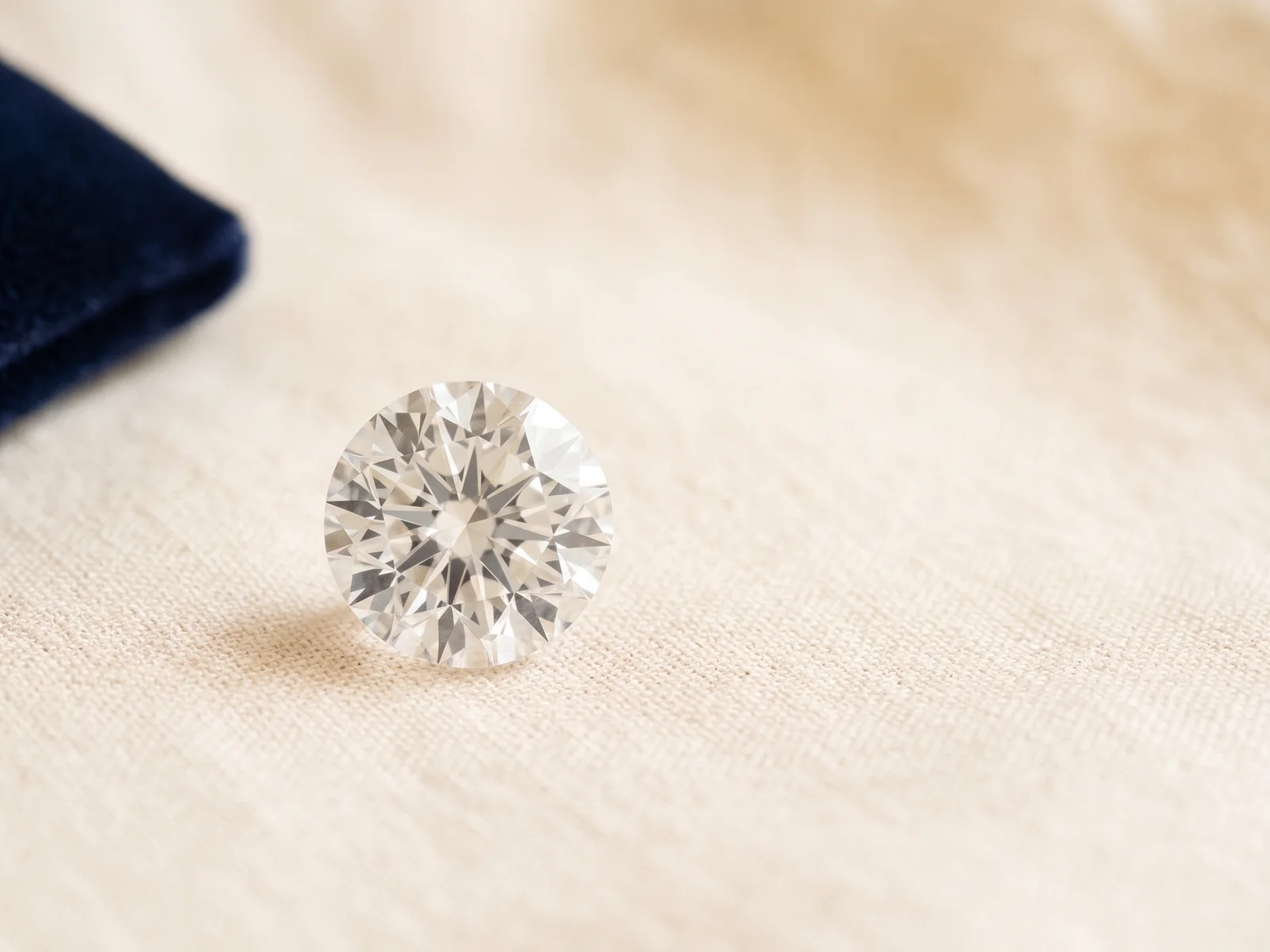
D is the top of the diamond colour scale, and the grade people most often pay for without ever seeing the difference. Here is what a D colour diamond actually looks like, how it compares with E and F, and when the extra money makes sense.
 Reviewed by Raj Sood, Graduate Gemologist (GIA), AJP (GIA)Master jeweller and Graduate Gemologist (GIA) · reviewed 4 November 2026
Quick answer
A D colour diamond is the highest grade on the GIA D-to-Z colour scale: a trained grader sees no body colour at all, even face-down beside master stones. Face-up, D looks almost identical to E and F. It shows its value best in larger step cuts set in platinum or white gold, and costs noticeably more than E or F.
What does D colour mean in a diamond?
Colour is one of the four Cs of diamond grading, and for white diamonds it really measures the absence of colour. Most natural diamonds contain traces of nitrogen, which absorbs some blue light and leaves a faint yellow or brown tint. The less tint, the higher the grade. D is the top grade: under standard grading conditions, a trained grader can see no body colour at all.
Body colour means the overall tint of the diamond itself. It is not the same as fire, the flashes of rainbow colour you see when light splits as it passes through the facets. A D colour diamond still shows plenty of fire. What it lacks is any underlying warmth. Our guide to how diamond colour grading works explains the full process, and any unfamiliar word on this page is defined in our plain-English jewellery glossary.
D is a colour grade only. It says nothing about clarity, cut or carat weight. A D diamond with a poor cut can look duller than a well-cut G, because cut controls brightness and sparkle far more than colour does. The famous D flawless diamond is simply a D colour stone that also grades Flawless for clarity, the top of both scales. In natural diamonds that combination is rare at any size, which is why it attracts so much attention.
Where does D sit on the diamond colour scale?
GIA (the Gemological Institute of America) introduced its D-to-Z colour scale in the 1950s. It deliberately started at D rather than A, so it would not be confused with the loose A, AA and AAA labels jewellers used at the time. Most labs, including IGI, now grade white diamonds on the same letters. The grades are grouped like this:
| Grades | Group | What you see |
|---|---|---|
| D, E, F | Colourless | No visible colour face-up; differences seen only face-down by a trained grader |
| G, H | Near colourless | Looks white face-up in most settings; a hint of warmth face-down |
| I, J | Near colourless | Faint warmth in larger or fancy shapes; looks white in yellow gold |
| K, L, M | Faint | Light warmth visible face-up |
| N–R | Very light | Yellow or brown clearly visible |
| S–Z | Light | Obvious yellow or brown; beyond Z is graded as fancy colour |
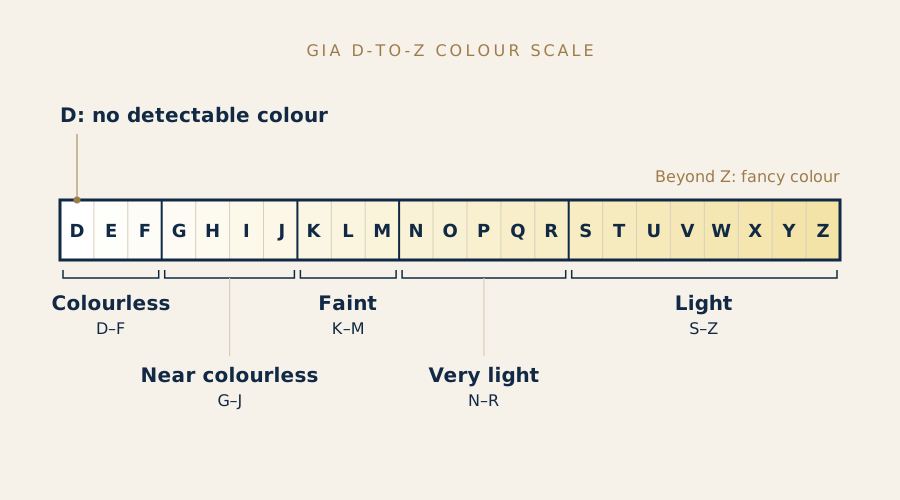
Within the colourless group, D sits just above E colour, one step down and F, the last of the colourless grades. Below them, G, the first near-colourless grade is where many Australian buyers settle. Further down, K colour, where faint warmth begins and faint yellow L and M stones show how gradual the change really is.
Each letter is a range, not a single point. A stone at the top of E and one just inside D can be extremely close, while a stone at the bottom of F may be nearer to G. That is one reason two diamonds with the same letter can look slightly different side by side.
Can you see the difference between D, E and F face-up?
Colour is graded face-down. The diamond is placed table-down (the large flat top facet against the surface) in a white grading tray and viewed side-on through the pavilion, the cone-shaped underside. The lighting is a controlled daylight-equivalent lamp, and the stone is compared with master stones, a set of reference diamonds of known colour. Looking through the pavilion removes most of the sparkle, so even tiny amounts of tint become visible.
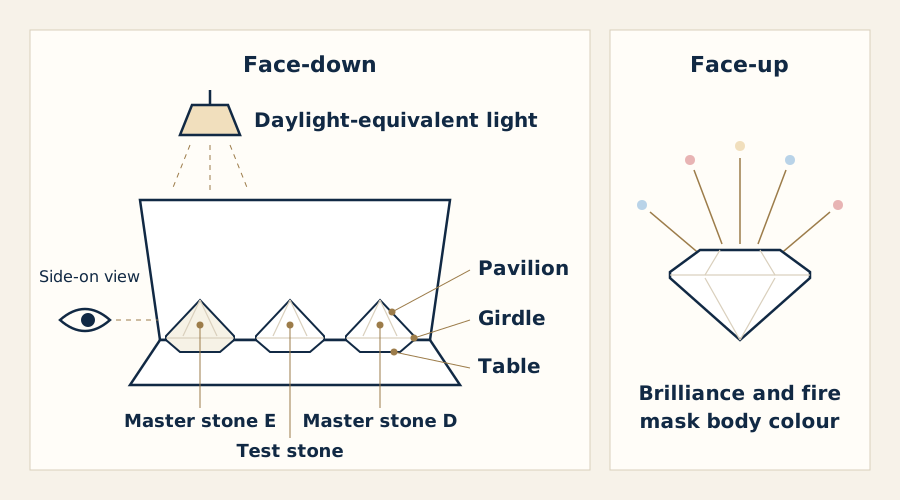
Face-up, it is a different story. Brightness, fire and reflections from the room all compete with body colour, and they mask it. Once the stones are set, most people, including many jewellers, cannot reliably tell D from E or F without a reference stone beside them. What a careful eye may pick up is a slightly icier, crisper look in a D when it sits directly next to an F under the same light. Separate the stones by a metre and that impression fades fast.
So the D vs E colour diamond question is mostly about the report and the price, not what you see across a dinner table. Our page with D, E and F compared side by side walks through the three grades in detail, including what each looks like in different lighting.
Related guideD vs E vs F Diamond ColourDoes a D colour diamond look different in each shape?
Yes. The shape and faceting decide how much body colour you can see, which decides how much a D actually shows its advantage. Round brilliants have many small facets that return a lot of white light, and that brilliance hides tint well. Step cuts, such as emerald and Asscher, have long, open facets arranged like steps. They act like windows into the stone, so colour shows much more clearly. Elongated brilliants such as ovals, pears and marquises tend to collect colour at the tips, where the stone is thinnest and the facets are crowded together.
| Shape | How much colour shows | Is D noticeable? |
|---|---|---|
| Round brilliant | Least | Very hard to tell D from F, even at 2 ct |
| Princess | Low | Hard; lower grades can hold a little warmth in the corners |
| Oval, pear, marquise | Moderate, at the tips | A slight advantage in larger sizes |
| Cushion, radiant | Moderate to high | Noticeable mainly over about 2 ct |
| Emerald, Asscher | Highest | The shapes where D is easiest to appreciate |
Size matters too. Light travels further through a larger stone, so it picks up more of any tint. A 0.50 carat round in F and D will look the same to almost anyone; a 3 carat emerald cut in the same two grades may not. As a rough guide, D's advantage starts to become visible to a careful eye in step cuts from around 1.5–2 carats, and in round brilliants hardly at all.
If you are weighing up colour against shape, our guide to the colour and clarity pairing that suits each shape sets out sensible grades for every common cut.
Not sure which one is right?
Send us the stones you are looking at and our gemologist will tell you which to choose and why.
Which metal suits a D colour diamond?
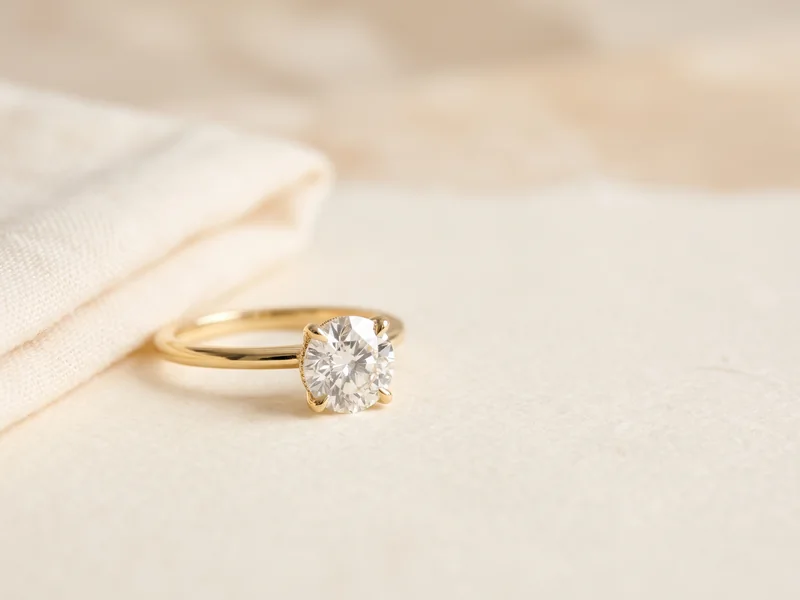
The metal around a diamond reflects into it. Yellow and rose gold bounce warm light into the stone, so a D colour diamond in yellow gold loses much of its icy look and ends up appearing about the same as a near-colourless stone. That is why many people choose I colour for a yellow gold ring or even J colour diamonds in warm metals: the gold makes everything look warm anyway, so the extra grades are hard to see.
Platinum is naturally white and keeps D looking as colourless as possible. White gold is gold alloyed with whiter metals and then usually coated in rhodium plating, a thin layer of a bright white metal. Underneath the plating, white gold is slightly warm or grey, and as the rhodium wears it can reflect a hint of that into a high-colour stone. Re-plating every year or two keeps it bright. Our guide to how your ring metal changes the colour you see shows the effect metal by metal.
If you love yellow gold but want to keep a D or E looking white, a common compromise is a two-tone ring: a yellow gold band with a platinum or white gold head (the part holding the stone), so only white metal touches the diamond.
Do fluorescence and treatments affect a D colour diamond?
Fluorescence is a glow some diamonds give off under ultraviolet (UV) light, usually blue. Roughly a quarter to a third of natural diamonds show some fluorescence. In lower colours, a medium blue glow can offset a little yellow and make the stone look whiter in daylight. In a D there is no yellow to offset, so strong blue fluorescence is usually treated as a drawback and priced at a discount. In a small number of stones, very strong fluorescence can make a diamond look slightly hazy or 'oily' in sunlight. Most fluorescent D diamonds look completely normal, so judge the stone in daylight rather than by the report line alone.
HPHT treatment (high pressure, high temperature) can remove brown colour from some natural diamonds and lift them into the colourless range, including D. It is a permanent treatment, but it must be disclosed. A GIA report on a treated natural stone states that it has been HPHT processed, and the girdle (the thin edge around the widest part) is usually laser-inscribed to say so.
Many natural D diamonds are Type IIa: diamonds with almost no nitrogen. They make up only a small share of natural diamonds, often quoted at under 2%, which is part of why natural D stones are scarce. Several of the world's famous large colourless diamonds are Type IIa.
Is a lab-grown D colour diamond the same as a natural one?
A lab-grown D colour diamond is real diamond, grown in a laboratory rather than mined. It has the same hardness (10 on the Mohs scale) and the same refractive index of about 2.42, so it shows the same brilliance and fire. Lab-grown diamonds are made by CVD (chemical vapour deposition, building carbon up layer by layer) or by HPHT growth, and many CVD stones are given a post-growth HPHT treatment to improve their colour.
Because growers can keep nitrogen out, high colours are common in laboratory-grown diamonds, and D, E and F make up a large part of what is available. In natural diamonds the opposite is true: D is scarce. That difference drives the price gap between the two far more than anything you can see.
Most lab-grown diamonds sold in Australia come with IGI reports that use the same D-to-Z letters. GIA has changed how it describes lab-grown diamonds in recent years, so check which lab graded the stone and what system the report uses. Every report, and usually a laser inscription on the girdle, should state clearly that the diamond is laboratory-grown.
Neither type should be bought as an investment. Retail prices for lab-grown diamonds have fallen steeply, and resale prices for natural diamonds are generally well below what you pay in a shop. Choose the grade for how it looks to you and what it means to you.
Browse D colour diamonds: natural and lab-grown
How much does a D colour diamond cost in Australia?
Colour has a steady effect on natural diamond prices, and the steps get steeper near the top of the scale because high colours are rarer. The table below gives broad ranges for a 1 carat round brilliant with an excellent cut and VS2 clarity. Treat them as rough guides only; prices move with the market, the exact stone and the report.
| Colour (1 ct round, excellent cut, VS2) | Natural, approx. AUD | Lab-grown, approx. AUD |
|---|---|---|
| D | $14,000–$24,000 | $900–$2,200 |
| E | $12,000–$20,000 | $850–$2,000 |
| F | $11,000–$18,000 | $800–$1,900 |
| G | $9,500–$15,000 | $750–$1,800 |
| H | $8,500–$13,000 | $700–$1,600 |
In natural diamonds, the step from E to D is often around 10–20%, and a D can cost roughly 30–50% more than a G of the same size, cut and clarity. The step grows with carat weight: at 2 carats and above, D commands a much larger premium in dollars. A couple of grades further down, H colour diamonds cost noticeably less again while still looking white face-up in most settings.
In lab-grown diamonds, the gap between D and G is usually small, often a few hundred dollars on a 1 carat stone. That changes the decision completely: in lab-grown, choosing D rarely means giving up cut or carat. Strong fluorescence in a natural D typically lowers the price, and an HPHT-treated natural D should cost less than an untreated one of the same grades.
Is a D colour diamond worth it?
It depends on the shape, size, metal and type of diamond. D tends to be the smart pick when:
- It is a step cut in white metal. An emerald or Asscher cut of about 1.5 carats or more, set in platinum or white gold, is where a D is easiest to appreciate.
- It is a large stone. At 2 carats and above, in any shape, tint is easier to see and the top colours stand out more.
- It is lab-grown. When the premium over G is small, D costs little extra for the peace of mind of the top grade.
- You are matching stones. Earrings, a pair of side stones, or a stone added to a piece that already holds D or E diamonds.
- The grade itself matters to you. Some people simply value knowing it is the top of the scale, and that is a fair reason as long as cut is not sacrificed.
D makes less sense in yellow or rose gold, in round brilliants under about 0.70 carat, or when paying for it forces you into a weaker cut or an inclusion you can see. If you are deciding whether to spend on colour or clarity, most gemmologists put cut first, then an eye-clean clarity, then colour. For many natural engagement rings, choosing between G and H for an engagement ring gives a stone that looks white face-up and frees budget for size or cut.
How do you choose a D colour diamond? Step by step
- Check the report. Confirm the lab, the D colour grade, and whether the diamond is natural or lab-grown, plus any treatment such as HPHT processing.
- Put cut first. For rounds, look for an excellent cut grade; for fancy shapes, check proportions and symmetry. A poorly cut D will not look its best.
- Read the fluorescence line. None to medium is usually fine. If it says strong or very strong, view the stone in daylight for any haze.
- Match the metal. Plan for platinum or white gold, or a white metal head on a yellow gold band.
- Compare it with E and F. View the stones face-up together in the setting metal, and weigh the price step against what you can see.
- Confirm clarity is eye-clean. A D with a visible inclusion defeats the purpose; VS2 or a well-placed SI1 is usually enough in brilliant cuts, VS1 or better in step cuts.
Free consultation
Talk to a gemologist
Compare stones in person or online with Raj Sood, Graduate Gemologist (GIA), AJP (GIA).
Book a consultationShop this shape
FAQ
Common questions
Is D the best colour for a diamond?
D is the highest colour grade on the D-to-Z scale, meaning no detectable body colour. It is not automatically the right choice, because face-up it looks almost the same as E and F and costs more, especially in natural diamonds.
Can you tell the difference between a D and an E colour diamond?
Usually not with the naked eye once the stone is set. Graders see the difference face-down beside master stones; face-up, a careful eye may notice a slightly icier look only when the two sit side by side.
Is a D colour diamond worth it in yellow gold?
Generally not. Yellow and rose gold reflect warm light into the diamond, so a D looks similar to an I or J colour stone in the same setting.
Are lab-grown D colour diamonds common?
Yes. Growers can keep nitrogen out, so D to F colours make up a large share of lab-grown diamonds, and the price step from G to D is usually small.
Does fluorescence lower the price of a D colour diamond?
Usually, yes. In a natural D, strong blue fluorescence is typically discounted because there is no yellow for it to offset, and very strong fluorescence can occasionally make a stone look slightly hazy in sunlight.
What is a D flawless diamond?
It is a diamond graded D for colour and Flawless for clarity, the top grade on both scales. In natural diamonds the combination is rare and priced accordingly; it is much more readily available in lab-grown diamonds.

Ask a gemologist
Not sure which diamond to choose?
Raj Sood is a Graduate Gemologist (GIA) and master jeweller. Bring the stones you are considering, or send the reports, and he will tell you honestly which one is better and why.
Keep learning
Related guides
 Diamond 4Cs & GradingD vs E vs F Diamond ColourDiamond 4Cs & GradingE Colour Diamonds
 Diamond 4Cs & GradingDiamond Colour Grading
 Diamond 4Cs & GradingHow Ring Metal Changes the Way Diamond Colour LooksDiamond 4Cs & GradingDiamond 4CsDiamond 4Cs & GradingI Colour DiamondsDiamond 4Cs & GradingF Colour DiamondsDiamond 4Cs & GradingH Colour Diamonds
Explore more
More guides on this topic
Education