
- Education
- Diamond 4Cs & Grading
- I Colour Diamond Guide: How It Looks, Prices and When It's the Smart Pick
Diamond 4Cs & Grading
I Colour Diamond Guide: How It Looks, Prices and When It's the Smart Pick
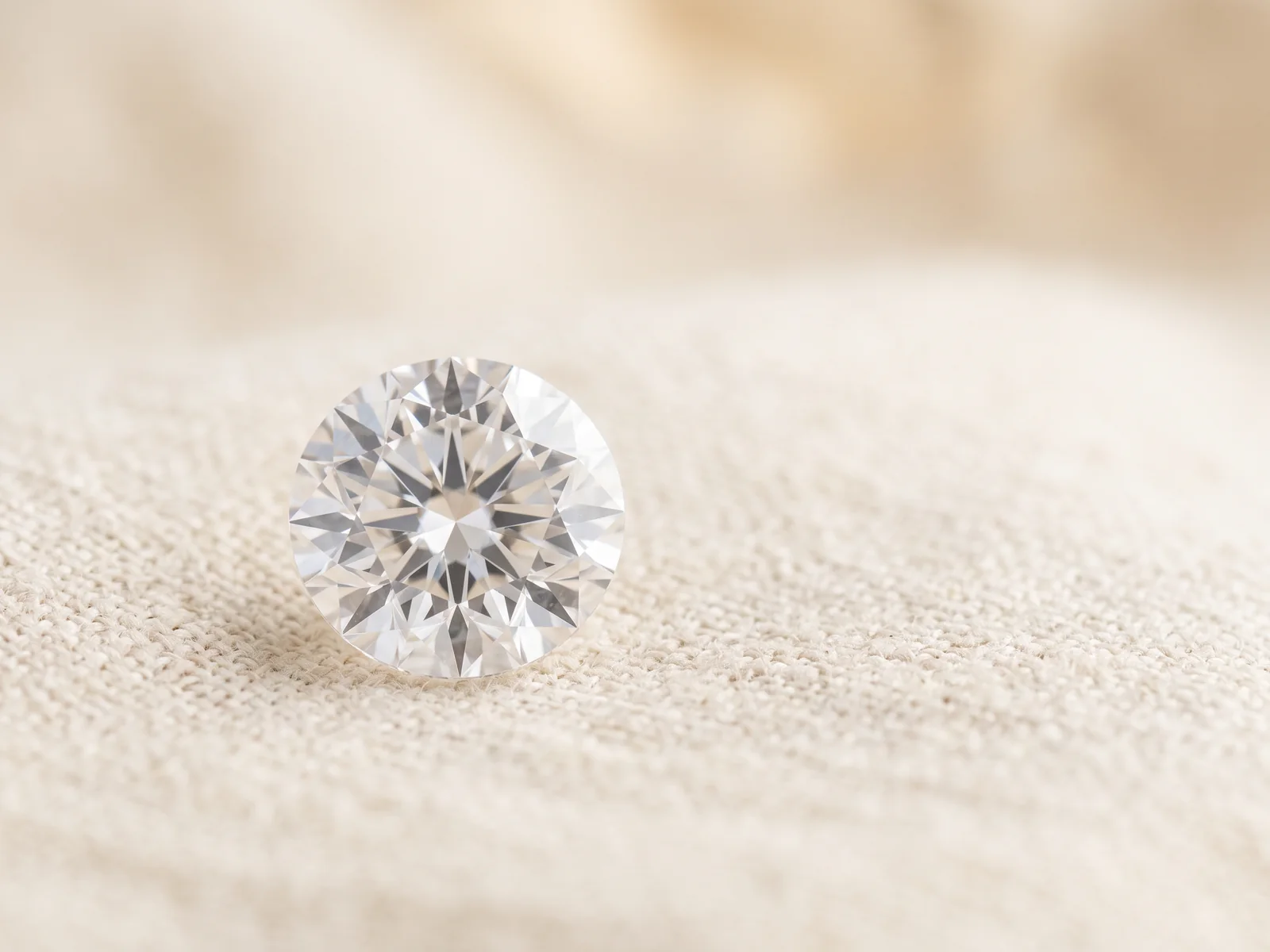
An I colour diamond sits at the warm end of the near colourless range, and for many rings it looks white while costing noticeably less than H or G. Here is how it really looks, by shape, size and metal, and when it is the right call.
 Reviewed by Raj Sood, Graduate Gemologist (GIA), AJP (GIA)Master jeweller and Graduate Gemologist (GIA) · reviewed 4 November 2026
Quick answer
An I colour diamond is graded in GIA's near colourless range (G–J). Face-up it looks white to most people, especially in round brilliants, stones under about 1.5 carats and yellow or rose gold settings. A faint warmth can show in step cuts and bright platinum. It usually costs less than H while looking almost identical.
What is an I colour diamond?
Diamond colour is graded on a scale that runs from D (colourless) to Z (light yellow or brown). An I colour diamond is the sixth grade along, inside the band GIA calls near colourless, which covers G, H, I and J. Colour is one of the four grading factors, alongside cut, clarity and carat; our guide to the four Cs of diamond quality shows how they fit together.
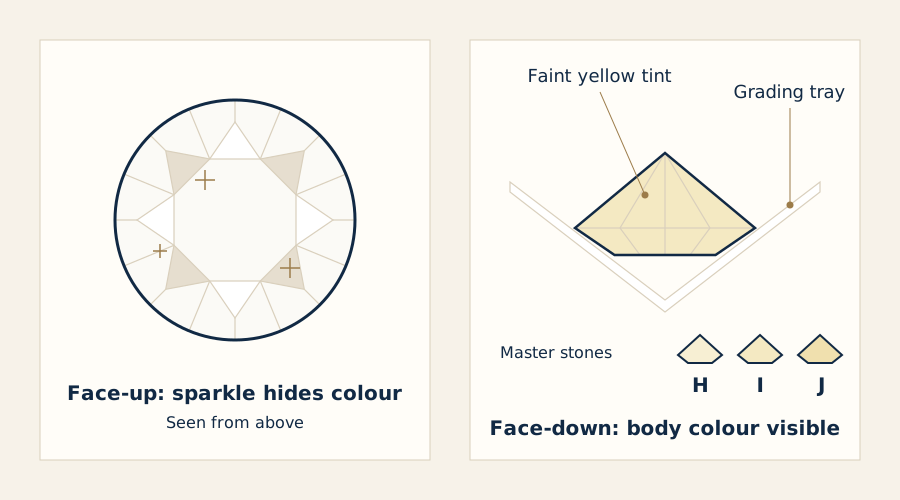
In a natural diamond, the faint yellow tint comes mostly from tiny amounts of nitrogen trapped in the crystal as it formed. The more nitrogen in the right arrangement, the more yellow light the stone absorbs and the warmer it looks. At I, that tint is very slight. Graders can see it clearly when the stone is face-down beside master stones; most people cannot see it at all once the diamond is face-up in a ring.
Graders judge colour with the diamond upside down on a white tray, under controlled daylight-balanced lighting, compared against a set of master stones (reference diamonds of known colour). Looking through the side of the pavilion strips away sparkle, so the body colour is easier to read. Our full page on how diamond colour grading works explains the process and why one grade apart is such a small step.
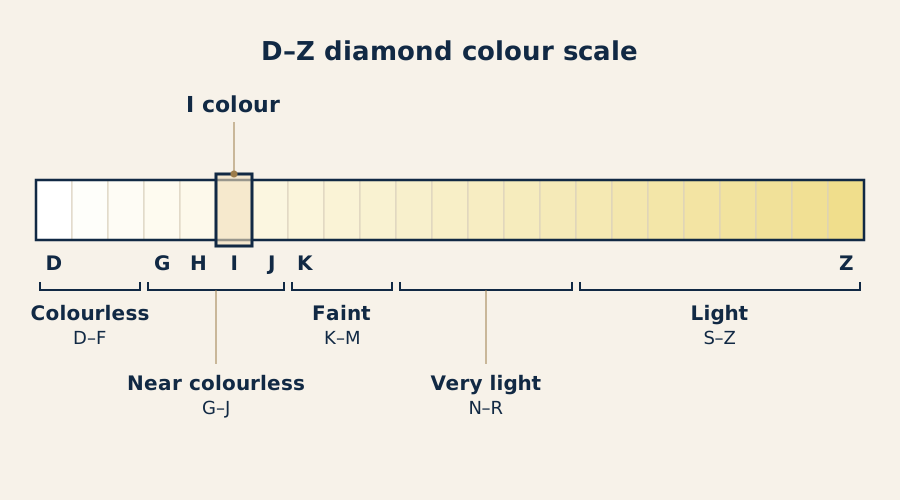
Natural and lab-grown diamonds are both graded on the D–Z scale by labs such as IGI, while GIA now uses broader descriptive colour terms on its lab-grown reports. Lab-grown diamonds are real diamond, grown in a laboratory rather than mined, and the report will always state which kind it is. Any unfamiliar term on this page is also explained in our plain-English jewellery glossary.
What does an I colour diamond look like face-up?
Face-up, meaning the way you see a diamond in a ring from above, sparkle and reflections do most of the work. In a well-cut stone they mask a lot of body colour. That is why the I colour diamond is often described as "white to the eye": on the hand, in normal light, most people see a bright, white stone.
Where the warmth can show is at the edges and points of the stone, where light travels a longer path through the diamond, and in very bright, cool lighting such as a jeweller's LED display. If you place an I directly beside a D or E, you will usually notice the I looks a touch softer or creamier. Beside an H, almost nobody can tell them apart face-up without practice.
- Face-up, on its own: reads white to most people in a round or other brilliant cut.
- Face-up, beside a much whiter stone: a faint creamy warmth becomes noticeable.
- Face-down on a white card: a faint yellow tint is visible through the pavilion.
- In yellow or rose gold: the metal's warmth hides the tint completely.
The jump from I to its neighbours is genuinely small. Our pages on H colour diamonds, one grade whiter and J colour diamonds, the last near colourless grade use the same approach, so you can compare all three like for like.
Which diamond shapes look whitest in I colour?
Shape changes how much body colour you notice. Brilliant cuts, with lots of small triangular and kite-shaped facets, scatter light and hide colour well. Step cuts, such as emerald and Asscher, have long parallel facets and a large open table (the flat top facet) that work like a window, so tint shows more. Elongated shapes tend to collect colour in their points.
| Shape | How it handles colour | I colour in white metal (about 1 ct) |
|---|---|---|
| Round brilliant | Hides colour best; maximum sparkle | Usually looks white |
| Princess | Good at hiding colour; slight warmth in corners | Usually looks white |
| Oval, pear, marquise | Colour gathers at the ends and points | White to most eyes; ends may look a touch warm |
| Cushion, radiant | Can hold colour, especially deeper cuts | Possible faint warmth; view before choosing |
| Heart | Warmth collects in lobes and point | Usually fine; check the point |
| Emerald, Asscher | Open step facets show body colour | Faint warmth likely; H or G often preferred |
These are general tendencies, not rules. A shallow, bright cushion can look whiter than a deep one of the same grade. For a shape-by-shape view that also weighs clarity, see our guide to matching colour and clarity to each diamond shape.
Does an I colour diamond look white in white gold or platinum?
Metal colour reflects into the diamond and sits right next to it, so it changes what your eye reads as white. This is one of the biggest factors in whether an I colour diamond is the right choice.
- Yellow gold: the warm metal makes an I look fully white, and many people say it looks the same as a G in yellow gold. You could even consider J or K here.
- Rose gold: similar to yellow; the pink warmth blends with any tint, so I looks white.
- White gold: most white gold is rhodium plated (coated in a thin layer of a bright, white platinum-group metal). Against that very white surface, an I can show a slight creamy edge, mostly noticeable in larger or step-cut stones.
- Platinum: naturally greyish white rather than bright white. An I usually looks white in platinum, though sharp-eyed people may see a faint warmth next to the claws.
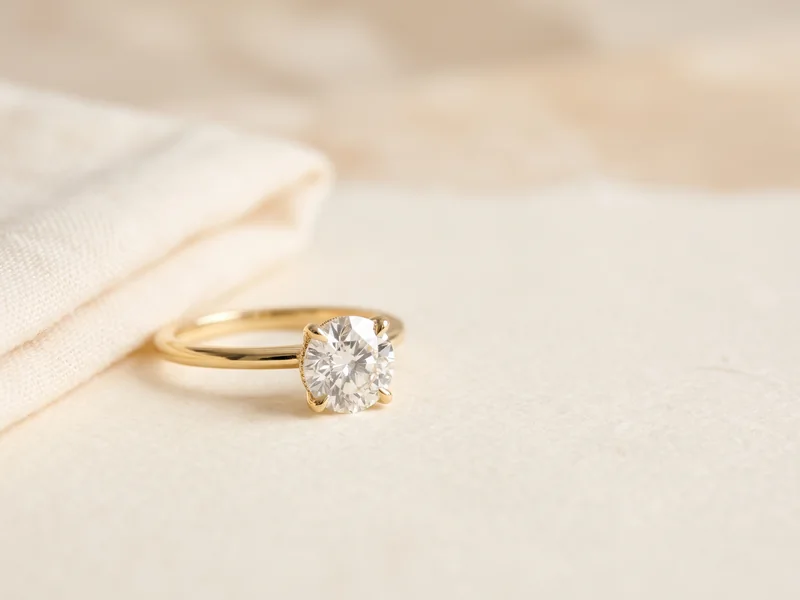
A popular middle path is a two-tone ring: a white gold or platinum band with yellow gold claws or a yellow gold bezel holding the centre stone. The yellow metal touches the diamond, so the I looks warm-white and even, while the band stays white. Our article on how the ring metal changes the way a diamond's colour looks goes through each metal with side-by-side examples.
Not sure which one is right?
Send us the stones you are looking at and our gemologist will tell you which to choose and why.
Do carat size and fluorescence change how I colour looks?
Size: a bigger diamond has a longer light path through it, so the same grade of colour looks stronger. Below about 0.50 carat, an I is very hard to tell from a G face-up in any metal, which makes it a sensible grade for small solitaires, studs and side stones. From about 1 to 1.5 carats it still looks white in most settings. Above about 2 carats, especially in a step cut or a white metal setting, the warmth becomes easier to see, and many buyers move to H or G.
Fluorescence: some diamonds glow, usually blue, under ultraviolet light, including the UV in daylight. The report grades it as None, Faint, Medium, Strong or Very Strong. In near colourless grades like I, medium to strong blue fluorescence can cancel out a little of the yellow and make the stone look slightly whiter in daylight. Very occasionally, very strong fluorescence can make a diamond look hazy or oily, so check the stone in person or on video in natural light.
Clarity interacts with all of this, because a stone with lots of visible inclusions draws the eye before colour does. If you are weighing where to spend, our guide to whether colour or clarity matters more sets out the trade-offs, and most rounds look their brightest when cut quality comes first.
How much does an I colour diamond cost compared with H and J?
Colour is one of the biggest price drivers in a natural diamond, and each step down the scale typically lowers the price per carat. Going from H to I usually saves a meaningful amount for very little visible difference, which is exactly why I is so popular. The step from I to J is usually a little smaller in natural stones.
| 1 ct round, VS2, excellent cut | Natural (approx. AUD) | Lab-grown (approx. AUD) |
|---|---|---|
| G colour | about $7,000–$11,500 | about $900–$2,000 |
| H colour | about $6,500–$10,000 | about $850–$1,900 |
| I colour | about $5,500–$8,500 | about $800–$1,800 |
| J colour | about $4,500–$7,500 | about $700–$1,600 |
| K colour | about $3,500–$6,000 | rarely offered |
These are broad ranges only; prices move with the market, the exact clarity and, above all, the cut. With lab-grown diamonds the picture is different: they cost much less than natural to begin with, and the gap between neighbouring colour grades is small, often only a few hundred dollars at 1 carat. Most lab-grown diamonds are also grown or treated to reach D–H, so lab-grown I colour stones are less common and the saving over H is modest. With natural diamonds, the I is where the value really shows.
Browse I colour diamonds: natural and lab-grown
How does I colour compare with G, H, J and K?
| Grade | GIA group | Face-up in white metal | Face-up in yellow or rose gold | Common use |
|---|---|---|---|---|
| G | Near colourless | White | White | Larger stones, platinum, step cuts |
| H | Near colourless | White; rarely any warmth | White | All-round choice in white metal |
| I | Near colourless | White to most; faint warmth possible in large or step cuts | White | Value pick for rounds and fancy brilliants |
| J | Near colourless | Slight warmth visible to some | White | Yellow and rose gold, smaller stones |
| K | Faint | Warmth often visible | Warm-white | Yellow gold, vintage looks |
At the top of the scale, D, E and F are the colourless grades, where differences are almost impossible to see face-up. If you are curious how they compare, read our pages on D colour, the highest grade, E colour diamonds and F colour, the last colourless grade, or the D vs E vs F colour comparison.
Closer to I, the G colour diamond guide covers the whitest near colourless grade, and our G vs H decision for engagement rings explains the step just above. Going the other way, K colour diamonds with a faint warmth and faint yellow L and M diamonds show where warmth becomes part of the look rather than something to hide.
Related guideH Colour DiamondsIs an I colour diamond good for an engagement ring?
For many engagement rings, yes. An I colour diamond engagement ring is a smart pick when most of these are true:
- The centre stone is a round brilliant or another brilliant-faceted shape such as oval, pear, princess or heart.
- It is under about 1.5 carats, or it is larger but set in yellow or rose gold.
- The setting is yellow or rose gold, or two-tone with yellow claws.
- You would rather put money into cut quality or a larger carat weight than a whiter grade you cannot see.
- The ring will be worn alone, not stacked next to bands of very white D–F diamonds.
It is a less obvious choice when the stone is a large emerald or Asscher cut in bright white gold, or when the ring has a halo of very white small diamonds that sit right against the centre and make comparison easy. In those cases H or G may look more even.
How do I choose an engagement ring with an I colour diamond?
If you are asking "how do I choose an engagement ring" and I colour is on your shortlist, work through it in this order:
- Choose the metal first. Yellow or rose gold makes I an easy yes; white gold or platinum means checking the stone more carefully.
- Pick the shape. Brilliant shapes hide warmth; for step cuts, compare an I against an H before deciding.
- Set your carat range. Under about 1.5 carats, I looks white in most settings; above 2 carats, view it in the metal you plan to use.
- Read the report. Confirm the colour grade, cut, clarity, fluorescence and whether the diamond is natural or lab-grown.
- Check fluorescence. Faint to medium blue is fine and can help; with strong or very strong, view the stone in daylight for haze.
- Compare face-up, not face-down. Look at the I beside an H and a J on a hand or in a ring mount, in normal light.
- Weigh the saving. Compare the price step from H to I, and decide whether to put the difference towards cut, size or the setting.
Free consultation
Talk to a gemologist
Compare stones in person or online with Raj Sood, Graduate Gemologist (GIA), AJP (GIA).
Book a consultationShop this shape
FAQ
Common questions
Is an I colour diamond good quality?
Yes. I is in GIA's near colourless range, and face-up it looks white to most people, particularly in round brilliants and yellow or rose gold. Cut quality matters far more to how it looks than the one grade between I and H.
Can you see the difference between H and I colour?
Face-up, usually not. The difference is easy for a grader to see face-down beside master stones, but in a ring, in normal light, most people cannot tell H and I apart.
Does an I colour diamond look yellow in white gold?
Generally not in a round or other brilliant cut under about 1.5 carats. Against bright rhodium-plated white gold, a larger or step-cut I can show a faint creamy edge, so yellow gold claws are a popular fix.
Is I or J colour better for a yellow gold ring?
Both look white in yellow gold, because the metal's warmth masks any tint. J usually costs less, so many people choose J for yellow gold and keep I for white or two-tone settings.
Are lab-grown I colour diamonds worth it?
They are real diamond and look the same as a natural I, but the saving over a lab-grown H is usually small. Most lab-grown diamonds are produced in D–H, so you often get a whiter lab-grown stone for only a little more.
What size I colour diamond still looks white?
In brilliant shapes, I looks white to most eyes up to about 1.5 carats in white metal and well beyond that in yellow or rose gold. Above about 2 carats in white metal, it is worth viewing the stone before you decide.

Ask a gemologist
Not sure which diamond to choose?
Raj Sood is a Graduate Gemologist (GIA) and master jeweller. Bring the stones you are considering, or send the reports, and he will tell you honestly which one is better and why.
Keep learning
Related guides
 Diamond 4Cs & GradingH Colour Diamonds
 Diamond 4Cs & GradingJ Colour DiamondsDiamond 4Cs & GradingDiamond Colour Grading
 Diamond 4Cs & GradingHow Ring Metal Changes the Way Diamond Colour LooksDiamond 4Cs & GradingDiamond 4CsDiamond 4Cs & GradingF Colour DiamondsDiamond 4Cs & GradingE Colour Diamonds
 Diamond 4Cs & GradingD Colour Diamonds
Explore more
More guides on this topic
Education