
- Education
- Diamond 4Cs & Grading
- G Colour Diamond: What the Grade Means and How It Looks
Diamond 4Cs & Grading
G Colour Diamond: What the Grade Means and How It Looks
G is the grade where most people stop being able to see colour and start saving money. Knowing exactly what a G colour diamond is, and is not, helps you spend where it shows.
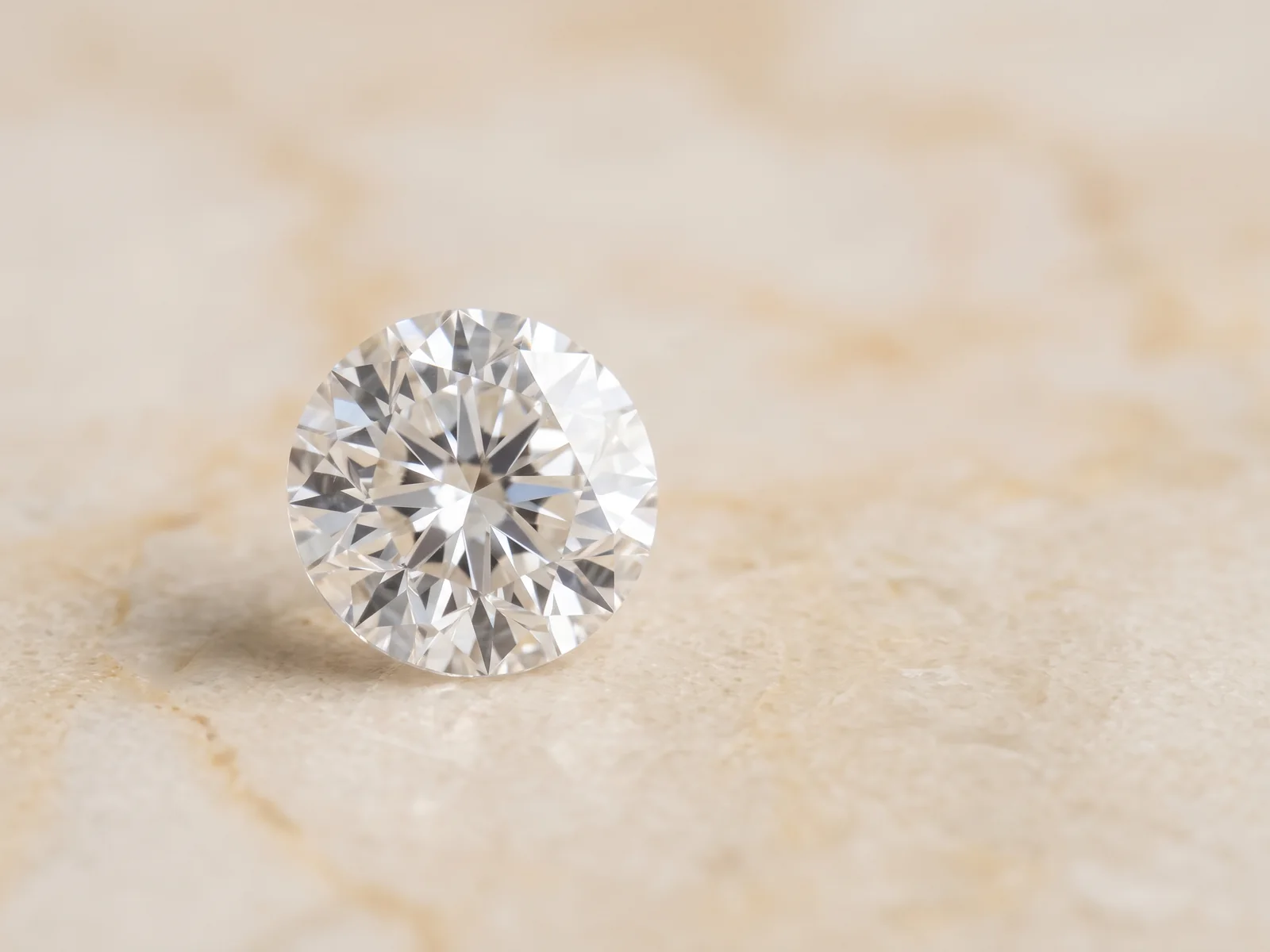
 Reviewed by Raj Sood, Graduate Gemologist (GIA), AJP (GIA)Master jeweller and Graduate Gemologist (GIA) · reviewed 4 November 2026
Quick answer
A G colour diamond sits at the top of GIA's near-colourless range (G–J), one grade below the colourless D–F group. Face-up, in a well-cut stone, almost nobody can see any warmth without a master stone beside it. It usually costs less than F and a little more than H, making it a common sweet spot in white metal.
What is a G colour diamond?
Colour is one of the 4Cs (cut, colour, clarity and carat). For white diamonds it measures how much faint yellow or brown body colour the stone has, meaning the colour of the diamond material itself rather than the light it throws back. The industry standard is GIA's D-to-Z scale, where D has no detectable colour and Z has a clear light yellow or brown tint. Beyond Z, diamonds are graded as fancy colours.
A G colour diamond is the fourth grade down and the first of the near-colourless group. Graders decide the grade by placing the loose stone upside down on a white tray, under controlled daylight-equivalent light, and comparing it with a set of master stones: diamonds of known colour kept as the reference. A stone graded G shows as much colour as the G master or slightly more, but less than the H master. Our guide to how diamond colour is graded covers the whole process.
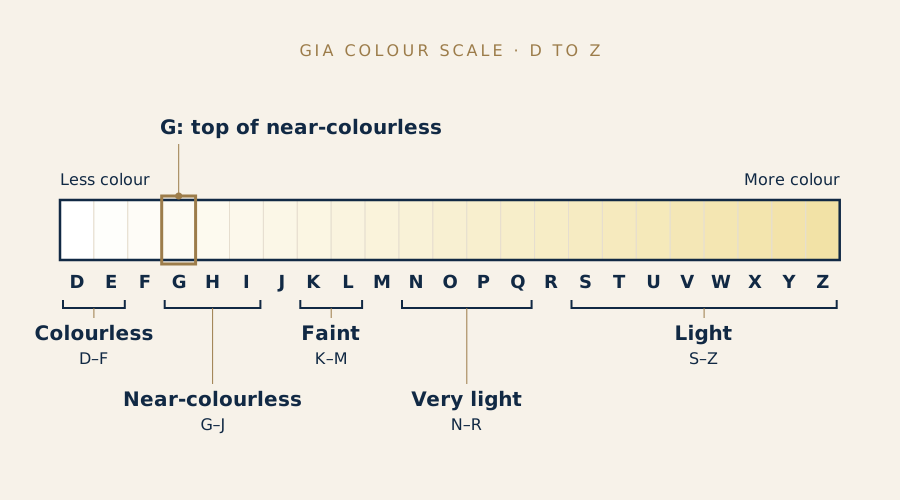
| Grades | GIA group | What a trained grader sees face-down |
|---|---|---|
| D, E, F | Colourless | No detectable colour |
| G, H, I, J | Near-colourless | Slight colour, visible only in comparison |
| K, L, M | Faint | A faint warm tint |
| N to R | Very light | Light yellow or brown |
| S to Z | Light | Clear yellow or brown |
Two things are worth knowing from the start. First, each letter is a range, so one G can sit close to F and another close to H. Second, the differences inside the near-colourless group are tiny. If any term here is new, our jewellery glossary explains it in plain English.
What does a G colour diamond look like face-up?
Grading is done face-down for a reason: looking through the side of the pavilion (the pointed underside), with no sparkle in the way, is the most sensitive way to see body colour. That is not how anyone sees a diamond on a hand. Face-up, the facets break the light into flashes of white and spectral colour, and that brightness hides most of the body colour.
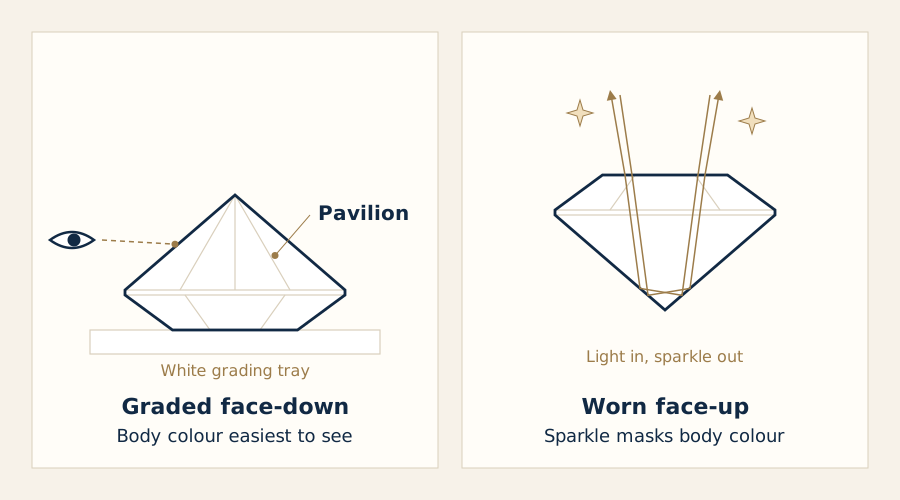
In practice, a well-cut G looks white to almost everyone in normal light. When a G is placed face-down on a white card next to an F and an H, a trained eye can usually rank them, though not always at first glance. Turn the same three stones face-up and most people cannot tell which is which. That is the honest summary of G: it is colourless to the eye, but it is not graded colourless.
Cut matters more than people expect here. A well-proportioned round returns so much light that a G and an H look much the same, while a shallow or deep stone leaks light and lets body colour show. A G with a poor cut can look warmer than a well-cut H.
G vs F and G vs H: can you see the difference?
G sits between two very popular grades. Above it, F colour stones are the lowest colourless grade; below it, H colour diamonds are the second near-colourless grade. Each step is one master-stone interval, the smallest difference the scale records.
| Grade | Group | Face-up to most people | Typical natural price vs G |
|---|---|---|---|
| E | Colourless | White | Noticeably more |
| F | Colourless | White | More, often by roughly 10–20% |
| G | Near-colourless | White | Reference point |
| H | Near-colourless | White in most settings | Less, often by roughly 5–15% |
| I | Near-colourless | Very slight warmth in large stones | Less again |
G vs F: F is technically colourless and G is not, which matters to some buyers on principle. Face-up, the difference is close to invisible. If you want the reassurance of the colourless group, it makes sense to compare F with the grades above it; comparing D, E and F explains what you gain at each step, and the pages on D colour and E colour diamonds go further.
G vs H: this is the decision most people actually face. H is the grade below and usually a little cheaper, and in many rings it looks the same. The gap shows most in larger stones, step cuts and white metal, which is where G earns its price.
Related guideG vs H Diamond Colour for Engagement RingsIs G colour good enough for every diamond shape?
Yes. G is white enough for any shape, but how much it matters changes with the cut. Brilliant cuts, with many small facets, scatter light and hide colour. Step cuts, with long parallel facets and a large open table, act like a window and show body colour more. Elongated shapes gather colour at their ends and points, where the stone is thinnest.
| Shape | How it shows colour | Is G worth it over H? |
|---|---|---|
| Round brilliant | Hides colour best | Rarely needed; H often looks identical |
| Princess | Hides colour well; corners can warm slightly | Optional |
| Oval, pear, marquise | Colour collects at the ends and point | Helpful from about 1 ct in white metal |
| Cushion | Larger, chunkier facets show more warmth | Helpful, especially in white metal |
| Radiant | Brilliant facets, but deep stones hold colour | Helpful in deeper stones |
| Emerald, Asscher | Open table shows body colour most | Often the sensible minimum in white metal |
For the full set of pairings, including the clarity grade that suits each cut, see colour and clarity pairings for each shape. As a rule, the more open the facet pattern, the more a step up to G pays off.
Not sure which one is right?
Send us the stones you are looking at and our gemologist will tell you which to choose and why.
Does a G colour diamond look different in white, yellow or rose gold?
The metal around a diamond reflects into it. White metal shows the stone's true colour; warm metal adds warmth of its own, which hides small differences in grade. Our guide to how ring metal changes diamond colour has side-by-side examples.
- Platinum and white gold: the cool, bright metal lets you see the diamond as it is. This is where G makes most sense, particularly above 1 carat. White gold is usually rhodium plated (a thin bright-white coating), which keeps it looking cool.
- Yellow gold: 18 carat yellow reflects warmth into the stone, so a G looks much like an H or an I. Many people choose H to J here and spend the difference elsewhere.
- Rose gold: the pink tone has a similar warming effect; G's advantage is mostly lost.
- Two-tone: a yellow or rose band with white claws or a white head lets a G or H stay white while you keep the warm band.
Does carat size change how G colour looks?
Yes. A larger diamond is a longer path for light, so body colour builds up as the stone gets bigger. A 0.30 carat G and a 0.30 carat I can be very hard to tell apart even face-down; at 2 carats the same pair is far easier to rank.
- Under 0.50 ct: colour differences across G to I are minimal face-up. Many people choose H or I here.
- 0.50 to 1.50 ct: G and H both look white in a good cut; G gives a little extra margin in white metal and fancy shapes.
- Over 1.50 ct: colour starts to show more, especially in step cuts and elongated shapes. G is a comfortable choice for white metal.
- Side stones and pavé: small melee diamonds are usually matched in a range such as G–H, so a G centre sits well beside them.
If budget is tight in a large stone, it is worth seeing what lower grades look like. I colour and J colour can face up white in yellow gold, K colour diamonds show a soft warmth some people prefer, and faint yellow L and M stones suit vintage and warm-metal designs.
Fluorescence is worth a mention. Some diamonds glow, usually blue, under ultraviolet light, including the UV in daylight. In a G stone, faint or medium blue fluorescence rarely makes any visible difference and can slightly offset warmth. Very strong fluorescence occasionally gives a hazy look, so view the stone in daylight if the report lists it as strong.
How much does a G colour diamond cost in Australia?
Price depends on all four Cs together, so a colour grade alone does not set a price. As a rough guide for a well-cut round with an independent report, approximate Australian retail ranges look like this. Treat them as a starting point, not a quote; prices move with the market and with each stone's details.
| Round, VS2 clarity, very good to excellent cut | Natural G (approx. AUD) | Lab-grown G (approx. AUD) |
|---|---|---|
| 0.50 ct | 2,000–4,000 | 400–1,200 |
| 1.00 ct | 8,000–14,000 | 900–2,500 |
| 1.50 ct | 15,000–26,000 | 1,500–3,500 |
| 2.00 ct | 25,000–45,000 | 2,000–5,000 |
For natural diamonds, each colour step usually changes price by a meaningful amount, with the jump from G up to F often larger than the step down to H. For lab-grown diamonds the steps are much smaller in dollar terms, so going up a grade costs less. If you are deciding where to spend, our guide on whether to put colour or clarity first works through real trade-offs.
Shop G colour diamonds
Are lab-grown G colour diamonds the same as natural?
Laboratory-grown diamonds are real diamond, with the same crystal structure, hardness (10 on the Mohs scale) and refractive index (about 2.42) as natural diamond. A lab-grown G and a natural G look the same to the eye. Lab-grown stones cost much less; natural stones are rarer, formed deep underground roughly one to three billion years ago.
There are a few colour differences worth knowing. Lab-grown diamonds made by CVD (chemical vapour deposition) are often given a post-growth heat treatment to improve their colour, and their remaining tint can lean slightly grey or brown rather than yellow. HPHT-grown stones can sometimes show a faint blue or grey tone. A good report states that the stone is laboratory-grown and notes any post-growth treatment. Most lab-grown stones in Australia are graded by IGI on the D–Z scale; GIA has moved to simpler descriptive terms on its lab-grown reports, so check which system a report uses.
When is a G colour diamond the smart pick?
G is not automatically the right grade. It earns its place in particular situations:
- White metal, 1 carat and above: platinum or white gold shows true colour, and size builds it up.
- Step cuts and fancy shapes: emerald, Asscher, cushion, oval and pear cuts show colour more than rounds.
- Matching side stones: pavé and halo diamonds are often G–H, and a G centre blends in.
- Peace of mind: if you would always wonder whether you can see warmth, G removes the question without the price of the colourless grades.
- Lab-grown stones: the price step to G is small, so it is often an easy upgrade.
How to choose a G colour diamond: step by step
- Choose the metal first. In platinum or white gold, G is a strong choice; in yellow or rose gold, compare it with H to J before you decide.
- Consider the shape. Step cuts and elongated shapes show colour more, so G gives more margin there than in a round.
- Check the report. Confirm the grading lab, the colour grade, the fluorescence and, for lab-grown stones, that it is described as laboratory-grown with any treatment noted.
- Put cut first. A well-cut stone hides body colour; a poorly cut G can look warmer than a well-cut H.
- Compare side by side. View a G next to an F and an H, face-up, in daylight and indoor light. If you cannot pick them, let price decide.
- Balance the 4Cs. Pair G with an eye-clean clarity, often VS2 or SI1, rather than overspending on clarity you cannot see.
Free consultation
Talk to a gemologist
Compare stones in person or online with Raj Sood, Graduate Gemologist (GIA), AJP (GIA).
Book a consultationShop this shape
FAQ
Common questions
Is G colour good for a diamond?
Yes. G is the top near-colourless grade and looks white to almost everyone face-up. It is a common choice for engagement rings, especially in platinum or white gold.
Can you see the difference between G and H colour?
Face-up in a well-cut stone, most people cannot. A trained grader can usually separate them face-down, and the difference becomes easier to see in larger stones, step cuts and white metal.
Is a G colour diamond worth it over F?
For most people, no visible difference justifies the extra cost of F, which is the lowest colourless grade. Choose F if being in the colourless group matters to you; otherwise G gives the same look for less.
Does a G colour diamond look yellow in yellow gold?
No. Yellow gold adds warmth to any diamond, so a G will look slightly warm like the metal, but no more than an H or I would. That is why many people choose a lower grade for yellow gold.
Are lab-grown G colour diamonds cheaper than natural?
Yes, lab-grown G diamonds cost much less than natural G diamonds of the same size and quality. They are real diamond and graded on the same D–Z scale by labs such as IGI.
Is G colour a good choice for an emerald cut?
Yes. Emerald and Asscher cuts have open tables that show body colour more than brilliant cuts, so G is a sensible minimum in white metal for many buyers.

Ask a gemologist
Not sure which diamond to choose?
Raj Sood is a Graduate Gemologist (GIA) and master jeweller. Bring the stones you are considering, or send the reports, and he will tell you honestly which one is better and why.
Keep learning
Related guides
 Diamond 4Cs & GradingG vs H Diamond Colour for Engagement Rings
 Diamond 4Cs & GradingF Colour Diamonds
 Diamond 4Cs & GradingH Colour Diamonds
 Diamond 4Cs & GradingHow Ring Metal Changes the Way Diamond Colour LooksDiamond 4Cs & GradingDiamond 4CsDiamond 4Cs & GradingDiamond Colour GradingDiamond 4Cs & GradingI Colour DiamondsDiamond 4Cs & GradingE Colour Diamonds
Explore more
More guides on this topic
Education