
- Education
- Diamond 4Cs & Grading
- G vs H Diamond Colour for Engagement Rings: Which Should You Choose?
Diamond 4Cs & Grading
G vs H Diamond Colour for Engagement Rings: Which Should You Choose?
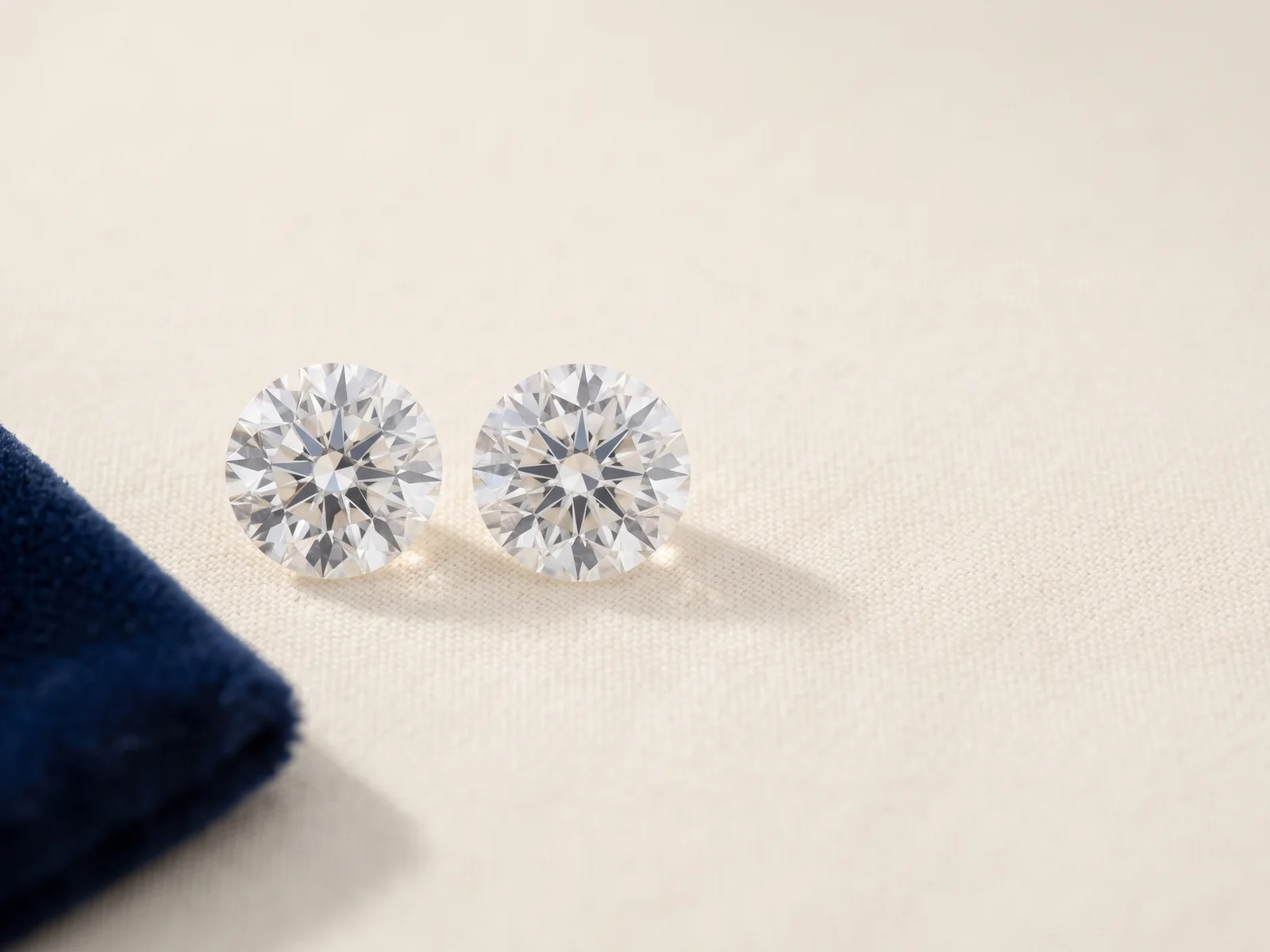
G vs H diamond colour is one of the most common choices in an engagement ring budget. The two grades sit one step apart, and knowing when that step matters can free up money for cut, size or the setting.
 Reviewed by Raj Sood, Graduate Gemologist (GIA), AJP (GIA)Master jeweller and Graduate Gemologist (GIA) · reviewed 4 November 2026
Quick answer
G and H are neighbouring near-colourless grades on the GIA D–Z scale. Face-up, almost nobody can tell them apart once set. Choose G for platinum or white gold, large stones and step cuts; choose H for round brilliants, yellow or rose gold, and to put the saving into carat or cut. A natural 1 carat H saves roughly $800–$1,800.
G vs H diamond colour: what is the actual difference?
G and H are neighbouring grades on the D–Z colour scale developed by the Gemological Institute of America (GIA) and used, with small differences in practice, by other labs such as IGI. The scale measures how much yellow or brown body colour (the faint tint in the diamond itself) a white diamond has. D has none. Each letter further down the alphabet has a little more. G and H both sit in the near-colourless band, G at the top of it and H just below. If you want the background first, start with how diamond colour is graded.
The gap between G and H is one grade, and one grade is a very small step. Graders decide it by placing the diamond upside down (face-down) on a white tray beside a set of master stones, which are reference diamonds of known colour, under controlled, daylight-balanced lighting. Looking through the side of the pavilion (the lower half of the stone) makes the tint easier to judge because sparkle is not getting in the way. Face-up, which is how you see a diamond in a ring, the same difference is far harder to spot.
Each grade is also a range rather than a single point. A high H and a low G can be closer to each other than two stones that both grade G. That is why colour is only one of the four Cs of diamond quality: cut, shape, size and the metal around the stone all change how much colour you actually notice. Any term on this page you have not met before is explained in our glossary of jewellery terms.
Where do G and H sit on the diamond colour scale?
The full scale runs from D to Z, but engagement ring diamonds are almost always chosen between D and K. Here is how the grades either side of G and H compare in everyday wear.
| Grade | GIA band | What you notice face-up | Commonly chosen for |
|---|---|---|---|
| D | Colourless | No tint, even to a trained grader | Buyers who want the top of the scale |
| E | Colourless | Indistinguishable from D outside a lab | Platinum solitaires, step cuts |
| F | Colourless | Last colourless grade; icy white | Large emerald and asscher cuts |
| G | Near-colourless | Looks white in almost every setting | Platinum, white gold, stones over 1.5 ct |
| H | Near-colourless | Looks white in most settings, especially rounds | Everyday engagement rings, 0.5–1.5 ct |
| I | Near-colourless | Slight warmth in big or step-cut stones | Yellow and rose gold, value-focused rounds |
| J | Near-colourless | Warmth visible to some people in white metal | Yellow gold settings |
| K | Faint | A gentle warm tint most people can see | Vintage-style rings in yellow gold |
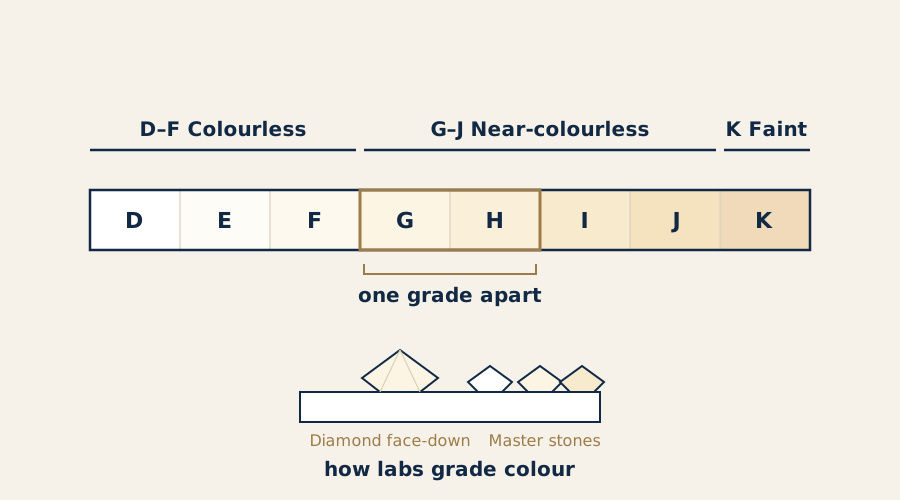
Above G you are paying for the colourless grades: D colour, the top of the scale, E colour diamonds and F colour, the last colourless grade. Each step up costs more for a difference that is mainly visible in a grading room. Our full G colour guide and the page covering everything about H colour go deeper into each grade on its own.
Below H, I colour, the value end of near-colourless is where many buyers in yellow gold land, and K colour and its faint warmth suits people who like an antique, candlelit look. G vs H is really the decision about where white starts to feel white enough for you.
Can you tell the difference between G and H colour?
In most real conditions, no. Shown two loose stones side by side, face-down on a white card, a trained eye can usually separate a G from an H. Shown one set diamond on its own, face-up, on a hand, almost nobody can name the grade. Colour is relative: you notice it when there is something whiter right beside it to compare against. That is also why labs grade colour face-down against master stones rather than face-up in a ring.
Whether you could ever notice the difference depends on six things:
- Size: under about 1 carat, a G and an H look the same face-up. From about 1.5–2 carats, there is more diamond for light to travel through, so body colour builds up and the gap becomes easier to see.
- Shape: round brilliants hide colour well; step cuts such as emerald and asscher show it most (more on this below).
- Metal: bright white platinum makes a warm tint easier to spot; yellow and rose gold hide it.
- Cut quality: a well-cut stone returns so much white light and sparkle that it masks a little body colour. A poorly cut G can look warmer than an excellent H.
- Lighting: warm indoor light and candlelight flatter both grades; cool daylight and shop LEDs are where small differences show.
- Fluorescence: a glow some diamonds give off under ultraviolet light, which can make an H look slightly whiter in daylight.
So the honest answer for a typical 0.70–1.20 carat round in a claw setting is that G and H will look identical to you, your partner and everyone who admires the ring.
Which diamond shapes show colour more: G or H for each?
Shape matters because it changes how deep the stone is and how light moves through it. Brilliant faceting breaks light into lots of small flashes that disguise tint. Step cuts, with their long parallel facets and large open table (the flat top facet), act more like a window, so you see straight into the body colour.
| Shape | How it handles colour | G or H? |
|---|---|---|
| Round brilliant | Hides colour better than any other shape | H looks white; G only for very large stones |
| Princess | Hides colour well; corners can hold a faint tint | H in most sizes |
| Oval, pear, marquise | Colour gathers at the ends and points | H under about 1.5 ct, G above |
| Cushion | Often shows more colour, especially crushed-ice styles | G in white metal, H in yellow gold |
| Radiant | Brilliant faceting, but colour can concentrate in the corners | G or H depending on size and metal |
| Emerald, asscher | Large open table shows body colour most | G, or F if you are sensitive to warmth |
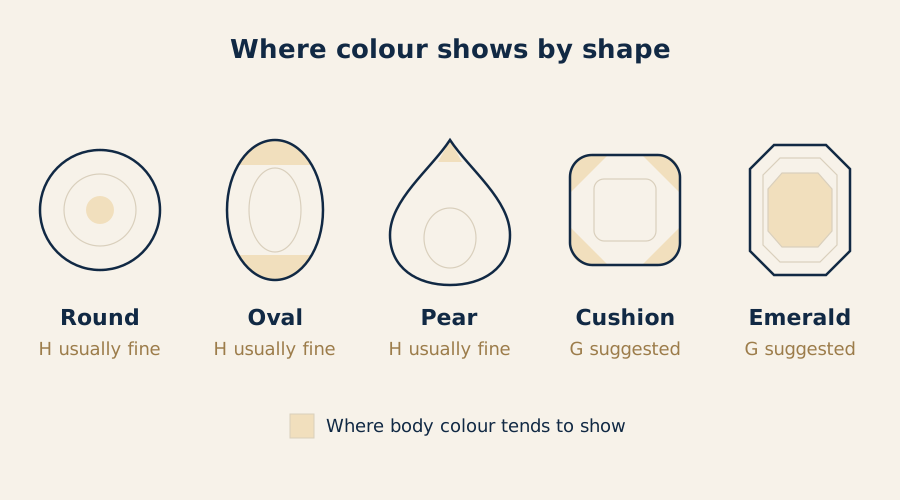
Elongated shapes deserve a closer look, because their ends are thinner and colour tends to pool there. Our guides to choosing an oval diamond and pear cut diamonds and their points explain how cut and ratio change this, and the overview of every diamond shape compares them all.
If you are choosing a round, H colour in a round brilliant is one of the most popular combinations in engagement rings, because the shape does so much of the work for you. For a 2 carat emerald cut in platinum, the case for G (or higher) is much stronger.
Not sure which one is right?
Send us the stones you are looking at and our gemologist will tell you which to choose and why.
Is G or H colour better in white gold, platinum or yellow gold?
The metal sits right against the diamond and reflects into it, so it changes how white the stone looks.
- Platinum: naturally white and stays white. It gives the crispest backdrop, so it is where a G earns its place, especially above 1.5 carats or in a step cut. An H round under about 1.5 carats still looks white in platinum.
- White gold: usually coated with rhodium plating, a thin layer of a very white metal. It looks like platinum when fresh, but the plating wears over roughly 1–3 years and the slightly warmer gold underneath starts to show, which narrows the G vs H gap further.
- Yellow gold: 18 carat yellow gold reflects warm light into the stone, so any difference between G and H disappears. Many people choose H, or even I colour set in yellow gold, and spend the saving elsewhere.
- Rose gold: similar to yellow gold; the pink tone masks a faint tint completely.
- Two-tone: a yellow or rose band with white claws or a white head keeps the diamond framed in white while the band stays warm. It helps a G or H look its whitest.
Does fluorescence affect G and H diamonds?
Fluorescence is a glow, usually blue, that some diamonds give off under ultraviolet (UV) light such as strong sunlight or a black light. GIA reports grade it as None, Faint, Medium, Strong or Very Strong. A sizeable share of natural diamonds show some fluorescence; most of it is faint.
In G and H stones, faint to medium blue fluorescence normally has no visible effect. Strong blue fluorescence can make an H look a touch whiter in daylight, because the blue offsets a little of the yellow body colour. In a small number of stones, very strong fluorescence can make the diamond look slightly hazy or milky, which is why you should judge each stone by its video or in person rather than by the report alone. Diamonds with strong fluorescence are often priced a little lower than otherwise identical stones.
Lab-grown diamonds can fluoresce too, and some show colours other than blue, but it is less common in the stones you will usually see. Fluorescence and other report terms are also defined in our glossary.
G vs H diamond colour price: how much more does G cost in Australia?
For natural diamonds, moving from H up to G usually adds anywhere from a few hundred dollars on a half carat to several thousand on a 2 carat stone, with the gap widening as the stone gets larger. For lab-grown diamonds the step is far smaller in dollars, often only a few hundred, because lab-grown prices are much lower overall. The table below shows broad ranges for round brilliants of VS2 clarity and excellent cut.
| Round, VS2, excellent cut | G colour (AUD) | H colour (AUD) | Typical step |
|---|---|---|---|
| Natural 0.50 ct | about $2,000–$3,500 | about $1,800–$3,100 | a few hundred dollars |
| Natural 1.00 ct | about $8,000–$13,000 | about $7,000–$11,500 | about $800–$1,800 |
| Natural 2.00 ct | about $28,000–$45,000 | about $24,000–$39,000 | several thousand dollars |
| Lab-grown 1.00 ct | about $900–$2,000 | about $800–$1,900 | often under $200 |
| Lab-grown 2.00 ct | about $2,000–$4,500 | about $1,800–$4,200 | a few hundred dollars |
These are approximate ranges only. Prices move with the market, clarity, cut, fluorescence and the lab that issued the report. The real question is what the step buys you. On a natural 1 carat round, the money between G and H could move you from a good cut to an excellent one, or from 0.90 to 1.00 carat, and both of those are easier to see on the hand than one colour grade. Our page on G colour prices and examples shows how the step changes across sizes, and how price varies between diamond shapes explains why a fancy shape can cost less than a round of the same colour.
Browse G and H colour diamonds: natural and lab-grown
G vs H colour in a lab-grown diamond: does it matter?
Lab-grown diamonds are real diamond, with the same hardness (10 on the Mohs scale), refractive index (about 2.42) and sparkle as natural diamond. They are grown in a laboratory by one of two methods: CVD (chemical vapour deposition, building the crystal layer by layer from a carbon-rich gas) or HPHT (high pressure, high temperature, recreating the conditions deep in the earth). Many CVD stones are treated after growth to improve their colour, and the report should say so.
Most lab-grown diamonds sold in Australia carry an IGI report using the same D–Z letters. Because the price step between G and H is so small in lab-grown, many buyers simply choose G or higher and focus on cut. One difference to know: a lab-grown stone's faint tint is sometimes slightly grey or blue rather than yellow, so look at the video in daylight-type lighting. Our guide to how the 4Cs apply to every diamond covers grading for both natural and lab-grown stones.
Natural and lab-grown G and H diamonds look the same to the eye. The choice between them is about rarity, origin and budget. Both are set in exactly the same way, and labs such as IGI grade both on the same D–Z letters.
When is G the smart pick, and when is H?
After grading thousands of stones, the pattern is fairly consistent. G is the smart pick when:
- The stone is 1.5 carats or more, where body colour has more depth to build up in.
- It is an emerald, asscher, cushion or radiant cut, which show colour more than rounds.
- It will sit in platinum or freshly plated white gold with no warm metal nearby.
- It will be worn beside whiter diamonds, such as an E–F halo or an existing eternity band, where colour can be compared.
- You know you are sensitive to warmth and would always wonder.
H is the smart pick when: the stone is a round or princess under about 1.5 carats, the band is yellow or rose gold, or you would rather put the saving into cut quality or a slightly larger stone. If you are weighing whether to go further up the scale, the guide to stepping up to F colour explains what changes and what does not.
Related guideH Colour DiamondsHow do you choose between G and H colour? Step by step
- Decide on shape and size first. A round under 1.5 carats points towards H; a large step cut points towards G.
- Choose the metal. Platinum and white gold make G more worthwhile; yellow and rose gold make H (or I) look just as white.
- Check the report. Confirm the colour grade, fluorescence, the issuing lab and whether the diamond is natural or lab-grown, plus any colour treatment.
- Compare the price step. Note the dollar gap between a G and an otherwise identical H, and ask what that money would buy in cut or carat instead.
- View both face-up. Use 360° videos or see them in person under daylight-type light, not just warm shop light.
- Think about what sits beside it. A halo, side stones or a wedding band of a different grade can make a small colour difference easier to see.
Free consultation
Talk to a gemologist
Compare stones in person or online with Raj Sood, Graduate Gemologist (GIA), AJP (GIA).
Book a consultationShop this shape
FAQ
Common questions
Is H colour good enough for an engagement ring?
Yes. H is a near-colourless grade that looks white face-up in most engagement rings, especially round brilliants under about 1.5 carats. It is one of the most commonly chosen colour grades for engagement rings.
Can you tell the difference between G and H diamonds?
Side by side and face-down, a trained grader usually can. Set in a ring and seen on its own, almost nobody can tell a G from an H, particularly below 1 carat.
Is G colour worth the extra money?
It is worth it for large stones, step cuts such as emerald and asscher, and platinum settings, where a faint tint is easier to see. For a typical round under 1.5 carats, the money often does more for the ring if it goes into cut quality or size.
Does H colour look yellow in white gold?
Not in most cases. An H round in white gold looks white face-up; a faint warmth can sometimes show in large step cuts or cushions, which is where G is the safer choice.
Should I choose G or H for a lab-grown diamond?
Because the price gap between G and H lab-grown stones is usually small, many people choose G or higher. Check the report for any post-growth colour treatment and look at the stone in daylight-type light.
Is G or H better for an emerald cut?
G is usually the safer choice for an emerald cut, especially above 1 carat or in platinum, because the large open table shows body colour more than brilliant cuts. If you notice warmth easily, consider F.

Ask a gemologist
Not sure which diamond to choose?
Raj Sood is a Graduate Gemologist (GIA) and master jeweller. Bring the stones you are considering, or send the reports, and he will tell you honestly which one is better and why.
Keep learning
Related guides
 Diamond 4Cs & GradingG Colour DiamondsDiamond 4Cs & GradingH Colour DiamondsDiamond 4Cs & GradingDiamond Colour Grading
 Diamond 4Cs & GradingI Colour DiamondsDiamond 4Cs & GradingDiamond 4CsDiamond 4Cs & GradingF Colour DiamondsDiamond 4Cs & GradingE Colour Diamonds
 Diamond 4Cs & GradingD Colour Diamonds
Explore more
More guides on this topic
Education